

Can dogs eat avocado? A small taste of plain flesh rarely harms a healthy dog, but the pit can block the gut, the fat can set off pancreatitis, and guacamole brings onion and garlic with it. Here is every part ranked by risk, safe amounts by weight, and what to do now.
If your dog swallowed a whole pit, call your vet or an emergency clinic first and read this afterward.
Can dogs eat avocado? The short answer from vets
Yes, but only a little plain flesh, and only now and then. Pet Poison Helpline rates avocado non-toxic to dogs, yet the pit, skin and leaves are off limits, guacamole is unsafe, and the high fat makes larger portions risky for the pancreas.
The Merck Veterinary Manual says dogs “seem relatively resistant” to persin. Dr. Michael Hyder, an emergency vet quoted by the AKC, says dogs “would typically need to eat large quantities of persin-containing parts to experience poisoning.” So the real problems are physical (the pit) and dietary (the fat), not poison. Sources still split: PetMD and the AKC allow a tiny amount, while Purina suggests skipping it, since avocado adds nothing a complete dog food lacks.
What is persin, and how much does it matter for dogs?
Persin is a natural antifungal compound in the avocado tree, Persea americana. It is highest in the leaves and present in smaller amounts in the flesh. It can kill pet birds and harm horses, but in dogs it usually causes mild stomach upset at most.
In Fallbrook, California, deep in avocado country, Dr. John Abella of Aloha Animal Hospital told the Village News that many local dogs roam the groves and “for the most part it appears not to be clinically significant.” He also admitted, “We really don’t know the toxic dose.”
You may read that avocado damages a dog’s heart. That claim rests on one 1994 report of two dogs in Kenya, titled “Putative avocado toxicity in two dogs.” Putative means suspected, not proven. So the answer to can dogs eat avocado depends far more on the part than on persin.
Can dogs eat avocado skin, pit or flesh? Every part ranked
Ranked from lowest to highest risk: dog food made with avocado, a little plain flesh, a lot of flesh, avocado oil added at home, the skin and leaves, guacamole, and the pit. The pit and guacamole need a call to your vet the same day.
| Rank | Part or form | Risk | Main problem | What to do |
|---|---|---|---|---|
| 1 | Dog food with avocado meal or oil | Very low | Processed, little or no persin | Fine as fed |
| 2 | A lick or teaspoon of flesh | Low | Fat | Watch for a day |
| 3 | A large amount of flesh | Moderate | Vomiting, pancreatitis | Call vet for small or sensitive dogs |
| 4 | Avocado oil added at home | Moderate | Almost pure fat | Do not add it |
| 5 | Skin, leaves and bark | Moderate | Most persin, hard to digest | Call vet or poison line |
| 6 | Guacamole | High | Onion, garlic, salt | Call poison line now |
| 7 | The pit | Very high | Choking, intestinal blockage | Emergency vet now |
Why the pit tops the list
An avocado pit is roughly golf-ball sized, hard, slippery and impossible to digest. It can lodge in the throat, stomach or small intestine, and a blockage there is a surgical emergency. Some dogs vomit a pit back up, but you cannot count on it.
Dr. Abella put it simply: “One thing I have definitely done is taken avocado pits out of dogs.” Big dogs are the ones most likely to swallow a pit whole; the owner questions we found on vet help sites involved Labradors, an 80 pound Dutch Shepherd and a 60 pound pit bull. Hard stones in other fruit carry a similar risk, so see how vets handle date pits in dogs too.
How much avocado can a dog eat? Safe amounts by weight
The common vet ceiling is 1 teaspoon of plain flesh per 10 pounds of body weight, offered only occasionally. PetMD and the AKC both use this rule. Treat it as a maximum, not a daily serving, and skip it entirely for pancreatitis-prone dogs.
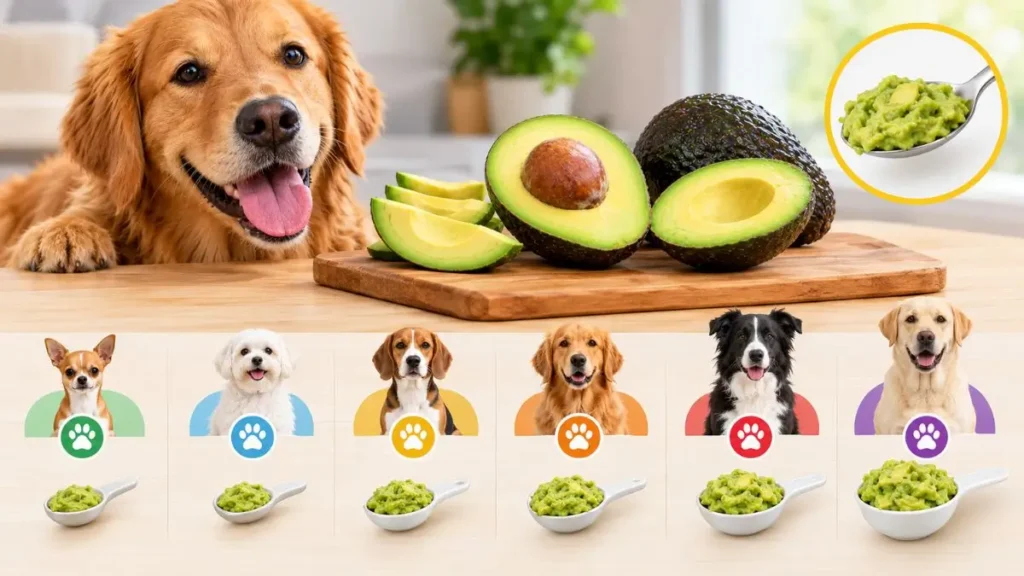
| Dog weight | Maximum flesh | Calories | Fat |
|---|---|---|---|
| 10 lb (4.5 kg) | 1 teaspoon | 8 | 0.7 g |
| 20 lb (9 kg) | 2 teaspoons | 16 | 1.4 g |
| 30 lb (14 kg) | 1 tablespoon | 24 | 2.1 g |
| 50 lb (23 kg) | 5 teaspoons | 40 | 3.5 g |
| 70 lb (32 kg) | 7 teaspoons | 56 | 4.9 g |
| 90 lb (41 kg) | 3 tablespoons | 72 | 6.3 g |
We worked out these figures from USDA FoodData Central, which lists raw avocado at 160 calories and 14.7 grams of fat per 100 grams. It adds up fast: a quarter cup of mash is 12 teaspoons, six times the limit for a 20 pound dog. Treats should stay under 10% of daily food, so check what is left today with our dog treat calculator.
Can dogs eat avocado every day?
No. Even within the teaspoon limit, a daily habit stacks up fat and calories your dog does not need. Frequent exposure can also lead to a food allergy over time, PetMD notes. Keep avocado as a rare taste, if you offer it at all.
Fat from people food adds up across a day. If your dog already had bacon, butter or salami, leave the avocado out. Dr. Sabrina Kong, quoted by Rover, says avocados “don’t offer enough health benefits to dogs” to be worth adding.
What to do if your dog ate avocado
First, figure out which part your dog ate and roughly how much. A swallowed pit means an emergency vet visit. Guacamole means calling a poison line. A little plain flesh usually means watching at home for a day or two.
Your dog ate a little plain flesh
This is the least worrying case. Pick up leftovers, keep meals normal, and skip other fatty foods that day. Watch for vomiting, diarrhea, a sore belly or a drop in appetite over the next 24 to 48 hours, and call your vet if any appear.
Dr. Renee Schmid, a senior veterinary toxicologist at Pet Poison Helpline, told Rover that “a small amount of avocado likely won’t harm most dogs.” Tiny dogs, seniors and dogs with past stomach trouble deserve a quick call to the vet anyway.
Your dog swallowed the pit
Treat it as an emergency, even if your dog seems fine. Call your vet or the nearest emergency clinic now with your dog’s weight and the time it happened. A pit that does not come back up or pass may have to be removed.
Pet Poison Helpline calls the pit a physical injury risk rather than a poisoning, so a vet hospital is the right first call. Do not try to make your dog vomit at home; one owner on a vet help site gave expired hydrogen peroxide to a Goldendoodle that still had not vomited an hour later. A vet on Petco’s vet Q&A warned that blockage signs can appear up to a week later, much like after a dog swallows a chicken bone. For a quick visual recap, watch this short video on dogs and avocado.
Your dog chewed the skin, leaves or plant
Call your vet or a poison line. The skin, leaves and bark hold more persin than the flesh, and tough peel is hard to digest. Bring the peel or plant with you, and estimate how much is missing so the vet can judge the risk.
The ASPCA Animal Poison Control Center answers 24 hours a day at (888) 426-4435, and a consultation fee may apply. Pet Poison Helpline is on (855) 764-7661, with an $89 incident fee listed on its avocado page. Have your dog’s weight and breed ready before you dial.
Your dog ate guacamole or an avocado dish
Call a poison line right away. Guacamole usually contains onion and garlic, which damage a dog’s red blood cells, plus salt and lime. Write down every ingredient you can remember, because the add-ins are often more dangerous than the avocado itself.
Merck says garlic is three to five times more toxic than onion, and the red blood cell damage usually shows 3 to 5 days after eating. PetMD notes onion poisoning is consistently seen above 0.5% of body weight, which for a 20 pound dog is about 45 grams, less than half a medium onion. It is the same problem that makes pizza risky for dogs.
Real cases: what happened when dogs ate avocado pits
Published cases show the pit, not persin, causes the serious trouble. A Labrador cross in England needed a 90 minute operation in 2008, and a 6 kg puppy in Halifax got violently sick in 2017. Both recovered with fast veterinary care.
Dudley, a 7-year-old Labrador and Rhodesian Ridgeback cross, grabbed a peeled avocado that fell on the kitchen floor. The golf-ball-sized stone traveled two thirds of the way through his small intestine, causing internal bleeding, and vets at Haygate Veterinary Centre removed it in a 90 minute operation. “I never realised avocados were dangerous for dogs,” owner David Burton told the Shropshire Star.
Harlow, a 6-month-old Pekingese mix, picked up a pit someone had scattered in Point Pleasant Park in Halifax, Canada. She was violently ill for about three hours, needed fluids and medication, and her owner paid a $200 vet bill, according to the Truro News.
Dr. Rebecca MacMillan told Canine Journal she has never seen persin poisoning in practice, but has seen “a couple of dogs who had eaten avocado pits and ended up having to have them surgically removed.” Stories like these are why any honest answer to can dogs eat avocado comes with a warning about the pit.
Symptoms to watch for, and when they show up
Stomach upset from the flesh can show within hours, so watch for 24 to 48 hours. Blockage signs from a pit can take days, sometimes up to a week. Anemia from the onion and garlic in guacamole typically appears 3 to 5 days later.
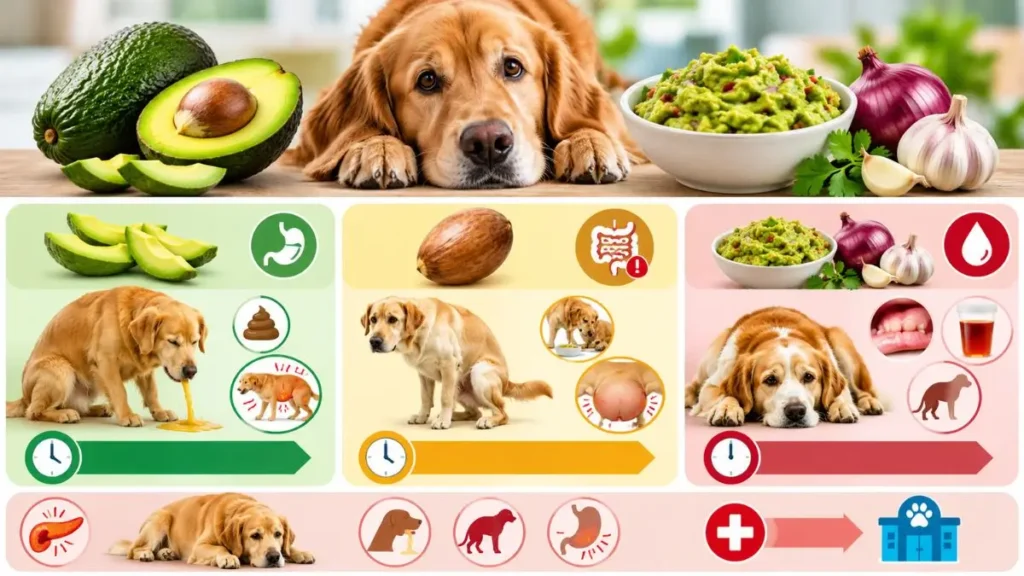
| What your dog ate | Signs | When | Action |
|---|---|---|---|
| Plain flesh | Vomiting, diarrhea, sore belly | Hours to 2 days | Call vet if signs appear |
| The pit | Vomiting, straining, refusing food, swollen belly | Up to about a week | Emergency vet |
| Guacamole | Weakness, pale gums, red or brown urine | 1 to 5 days | Poison line now |
After a big fatty portion, watch for pancreatitis. PetMD says it can start with mild vomiting and turn life-threatening, so repeated vomiting, a hunched back or belly pain means a vet visit the same day.
What not to do after your dog eats avocado
Do not make your dog vomit at home unless a vet tells you to. Do not give bread, milk or oil to cushion it. Do not wait overnight after a pit. Do not guess the amount; save the peel and pit to show your vet.
Pet Poison Helpline says to induce vomiting only under a veterinarian’s guidance, and never in a drowsy or seizing dog.
Can dogs eat avocado oil or dog food with avocado?
Avocado meal and avocado oil inside a complete dog food are considered safe at the levels used. Pouring avocado oil on your dog’s bowl is different. It is almost pure fat, so the AKC and PetMD both warn it can trigger pancreatitis.
A 2022 University of Illinois study fed avocado meal to beagles and found no detectable persin, likely because processing breaks it down. Many pages say avocado oil has no persin at all, but that lab work tested the meal, not the oil. If you are asking can dogs eat avocado oil, the practical answer is yes inside commercial food, and no straight from the bottle.
Which dogs should skip avocado completely?
Skip it for dogs with past pancreatitis, overweight dogs, dogs on prescription diets, and breeds prone to pancreatitis such as miniature schnauzers, Yorkshire terriers, cocker spaniels, dachshunds and poodles. For these dogs, even a teaspoon of extra fat is not worth it.
The Animal Medical Center in New York lists high-fat food, “whether fed in the form of table scraps or stolen,” as a leading pancreatitis trigger, along with obesity, Cushing’s disease, hypothyroidism and diabetes.
Safer fruits to give your dog instead of avocado
Blueberries, strawberries and cantaloupe give your dog a sweet, juicy treat with far less fat and no large pit. Serve them plain, cut to a safe size, and keep to the same 10% treat rule you would use for any snack.
If the real question behind can dogs eat avocado is which fruit you can share, start here. Blueberries make an easy training treat, strawberries should be sliced for small dogs, and cantaloupe needs the rind and seeds removed. Unsure about something else in your kitchen? Type it into our Can my dog eat this? food checker before you share it.
Can dogs eat avocado? Frequently asked questions
These are the questions dog owners ask most after an avocado mix-up, gathered from vet Q&A sites and the FAQ sections of leading pet health pages. Each answer is short enough to read fast if your dog just got into the fruit bowl.
Is avocado toxic to dogs?
Not in the usual sense. Pet Poison Helpline rates avocado non-toxic to dogs, and Merck says dogs seem relatively resistant to persin. The real risks are the pit, which can cause a blockage, and the fat, which can trigger pancreatitis in some dogs.
Can dogs eat avocado skin?
No. The skin holds more persin than the flesh, it is tough and hard to digest, and big pieces can add to a blockage. If your dog chewed a peel, keep it, estimate how much is gone, and call your vet for advice.
Can an avocado pit kill a dog?
It can if a blockage goes untreated. A lodged pit can damage the intestine, as it did in Dudley’s case, and that becomes life-threatening without surgery. With veterinary care, both Dudley and Harlow recovered, which is why a swallowed pit should never wait until morning.
Can puppies eat avocado?
It is best not to. Puppies are curious and quick to swallow things whole, which makes a pit or a chunk of peel even more dangerous. The same portion rules apply if a lick slips through. Harlow, the Halifax case, was only six months old.
Can dogs eat guacamole?
No. Guacamole usually contains onion and garlic, both poisonous to dogs, along with salt and lime. Even a small bowl can be a problem for a little dog. If yours licked some up, call Pet Poison Helpline or your vet and list every ingredient.
Can dogs be allergic to avocado?
Yes, though it is rare. Food allergies build up through repeated exposure, so a dog that eats avocado often is more likely to react. Itching, ear infections or ongoing stomach upset after avocado are worth mentioning to your vet at the next visit.
Is avocado good for dogs at all?
The flesh has vitamins E and C, potassium, fiber and healthy fats, but your dog already gets these from a complete food. PetMD’s vet author concludes the risks outweigh the benefits, so avocado is a treat to skip rather than a superfood.
Final thoughts: can dogs eat avocado safely?
A teaspoon of plain flesh will not hurt most healthy dogs, but avocado has no place in the bowl. Your dog gains nothing from it, and every serious avocado case we found started with a pit or a big helping that nobody meant to share.
So, can dogs eat avocado? In a tiny amount, yes. As a habit, no. If an accident happens, sort it by part: a little flesh means a day or two of watching, while a pit, a big helping, the skin or any guacamole means picking up the phone now. Save both hotline numbers today and drop pits straight into a lidded bin. Dudley’s owner never realised avocados were dangerous for dogs, and most accidents in this guide happened in seconds, in a kitchen or a park.
How we researched and fact-checked this guide
We compared the advice on more than a dozen veterinary and pet health pages, checked each claim against the Merck Veterinary Manual and Pet Poison Helpline, and removed claims we could not verify. The calorie and fat figures come from USDA FoodData Central.
Searching can dogs eat avocado brings up answers from “totally fine” to “toxic,” so where trusted sources disagree, we say so. Last reviewed October 7, 2026. This guide is general information, not a substitute for your own veterinarian.


4 thoughts on “Can dogs eat avocado? 7 parts ranked from safe to dangerous, safe amounts by weight, and what to do if your dog ate the pit”