

Can dogs eat salami? No, and if yours just stole some, the amount matters more than the word “toxic.”
Salami is not an emergency poison like chocolate or grapes. One slice off a countertop taken by a healthy 25 kg dog is almost never a crisis. Half a packet eaten by a 4 kg dog is a phone call to your vet. The difference comes down to three numbers almost no article gives you: sodium per slice, fat per slice, and your dog’s body weight.
What salami actually is
Salami is ground pork, beef, or a mix, packed with salt, fermented, seasoned, then air dried for weeks. Most dry salami is never cooked, since curing salt, low moisture, and fermentation acidity are what make it shelf stable.
That method explains every risk on this page. The salt is a preservative doing structural work, which is why the sodium is so high. The fat is not trimmed out, because it carries flavour and controls drying. Because nothing is cooked, the food safety picture differs from a cooked sausage. Typical seasonings include garlic, black pepper, fennel, and in some Italian varieties, red wine. Each of those matters when you ask whether dogs can eat salami, though not in the order most websites suggest.
What one slice of salami puts into your dog
Using USDA figures for dry or hard pork salami, one thin slice weighs roughly 10 grams and contains about 226 mg of sodium, 3.4 g of fat, and 41 calories. Per 100 grams, salami runs about 1,740 mg of sodium, 26 g of fat, and 336 calories. Brand labels agree: Hormel hard salami lists 520 mg of sodium and 11 g of fat per 32 g serving.
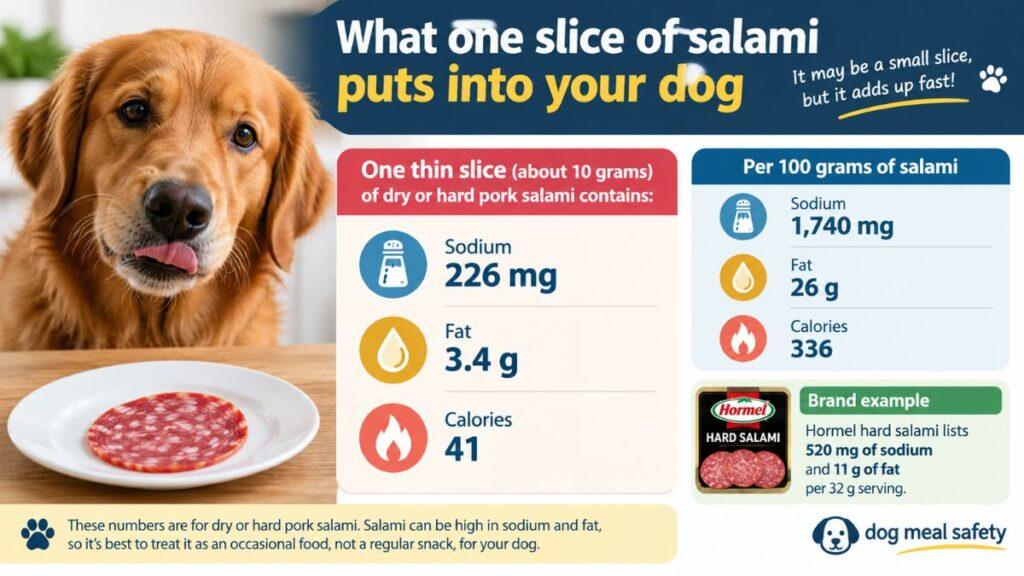
Now compare that to what a dog needs. The National Research Council sets an adult dog’s recommended daily sodium allowance at 26.2 mg multiplied by body weight in kilograms to the power of 0.75. That gives about 88 mg a day for a 5 kg dog, 147 mg for a 10 kg dog, and 248 mg for a 20 kg dog.
So a single 10 g slice carries more sodium than a 20 kg dog’s entire recommended daily intake, and roughly two and a half times what a 5 kg dog needs all day. That single number answers most of the questions on its own.
Can dogs eat salami in any amount without harm?
Not safely, no. But the honest answer depends on your dog’s weight, so here is a risk reference for a dog that has already eaten some. This is not a feeding guide.
| Dog weight | Roughly no concern | Watch closely, call if symptoms | Call your vet now |
| 2 to 4 kg | a bite, under 5 g | 5 to 15 g (about 1 slice) | over 15 g |
| 5 to 9 kg | 1 thin slice | 2 to 4 slices | over 4 slices, or 40 g |
| 10 to 19 kg | 1 to 2 slices | 3 to 7 slices | over 7 slices, or 70 g |
| 20 to 29 kg | 2 to 3 slices | 4 to 10 slices | over 10 slices, or 100 g |
| 30 kg and up | 3 to 4 slices | 5 to 15 slices | over 15 slices, or 150 g |
Two things override this table. If your dog has had pancreatitis, has heart or kidney disease, or is on a prescription low fat or low sodium diet, call your vet at any amount. And if the salami was a whole stick eaten with casing or string, the obstruction risk matters more than the meat.
For context, vets advise treats stay under ten percent of daily calories. A 10 kg dog eating around 550 calories a day gets a treat budget of about 55 calories, which is one and a bit slices of salami, all of it fat.
The garlic warning is real, but it is not the main risk
Almost every article leads with garlic. Garlic and onions are alliums, they contain organosulfur compounds that damage canine red blood cells, and severe cases cause Heinz body haemolytic anemia. All true, and garlic is three to five times more potent than onion by weight. Our guide to whether dogs can eat onions covers the mechanism in detail.
But look at the dose. The Merck Veterinary Manual puts clinical signs in dogs at 15 to 30 g per kg of body weight for raw onion, and published case material puts garlic nearer 5 g per kg. A 2000 study by Lee and colleagues found oxidative red cell damage at 5 g per kg, and none of those dogs developed haemolytic anemia.
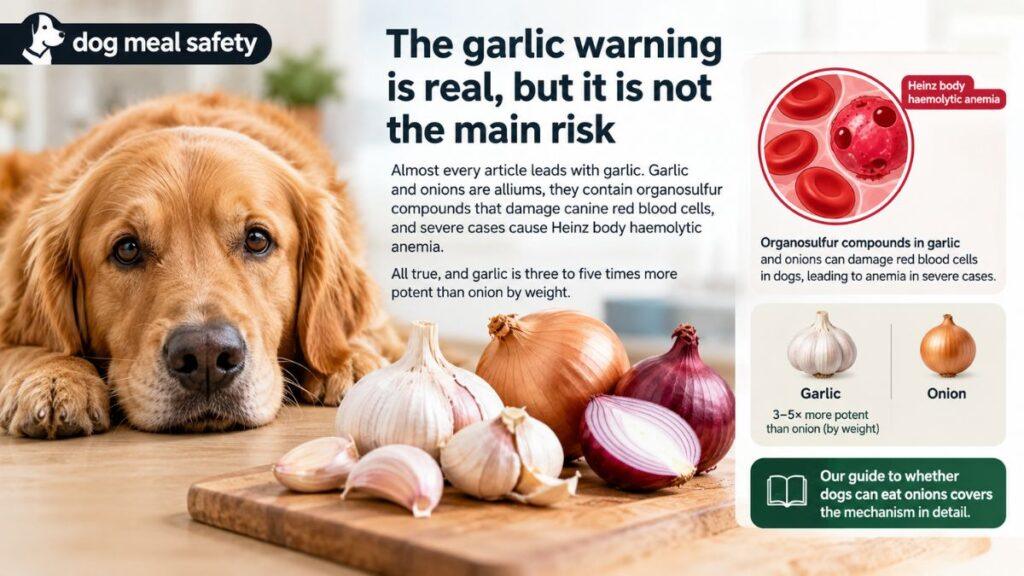
Commercial salami uses garlic at a fraction of one percent by weight. Even allowing for powder being far more concentrated than fresh cloves, 100 g of salami delivers roughly a couple of grams of fresh garlic equivalent. For a 10 kg dog to reach even 5 g per kg you would need close to two kilograms of salami. Sodium and fat cause problems long before garlic does.
Garlic here is worth noting, not panicking over. It matters in three cases: very small dogs, Japanese breeds such as Akitas and Shiba Inus with documented red cell sensitivity, and repeated exposure, since allium damage is cumulative. If seasoning is your worry, read our breakdown of garlic and dogs before you decide how alarmed to be.
Salt poisoning is rarer than the internet suggests
The American College of Veterinary Pharmacists puts salt toxicosis at 2 to 3 g of sodium chloride per kg of body weight, with roughly 4 g per kg potentially fatal. The Merck Veterinary Manual gives the same acute lethal figure for dogs, and the American Kennel Club puts the same thresholds in owner terms.
Convert salami’s sodium to salt and one slice carries about 0.57 g of sodium chloride. A 5 kg dog would need 17 to 26 slices to enter the toxicosis range, and a 10 kg dog 35 to 50.
That is not a reason to relax, but it tells you where to put your attention. Salt toxicosis from a countertop raid is unlikely. What is likely is intense thirst, heavy urination for a day, and a sloppy stool. Keep fresh water freely available and never restrict it, because water deprivation is what turns a salt load into a real problem. Merck notes toxicosis is unlikely while sodium regulation is intact and water is available. Vomiting, diarrhoea, wobbliness, tremors, or disorientation, which can appear within three hours, are vet signs rather than wait and see signs. Our guide to salt poisoning in dogs covers treatment and recovery.
Fat and pancreatitis: what the research actually says now
Here is where most articles run on outdated information.
The claim that fatty food causes pancreatitis in dogs comes largely from a 2008 case control study in JAVMA. Read what it found: getting into the trash raised the odds by 13.2 times, unusual food items by 4.3 to 6.1 times, table scraps by 2.2 times, and being overweight by 1.3 times.
The strongest signal is dietary indiscretion as a category, not fat specifically. A 2022 review in the Journal of Veterinary Internal Medicine by Cridge and colleagues concluded that definitive conclusions about high dietary fat and pancreatitis cannot be drawn from current literature. A narrative review published in early 2026 went further, finding that recent work has generally failed to confirm a consistent association, and noting that the early influential studies used experimental models, tiny samples, and diets unlike modern formulations.
Practically, salami is a textbook unusual food item, and that is the category with real evidence behind it. A large, sudden, fatty meal in a dog that normally eats consistent kibble is the scenario to avoid. A single slice in a healthy adult dog is not the trigger it is made out to be. Dogs with a prior episode, Miniature Schnauzers and other breeds prone to hypertriglyceridaemia, and overweight dogs are the real exceptions, and for them any amount is worth taking seriously. Our full guide to pancreatitis in dogs explains what recovery looks like.
The risk almost nobody writes about
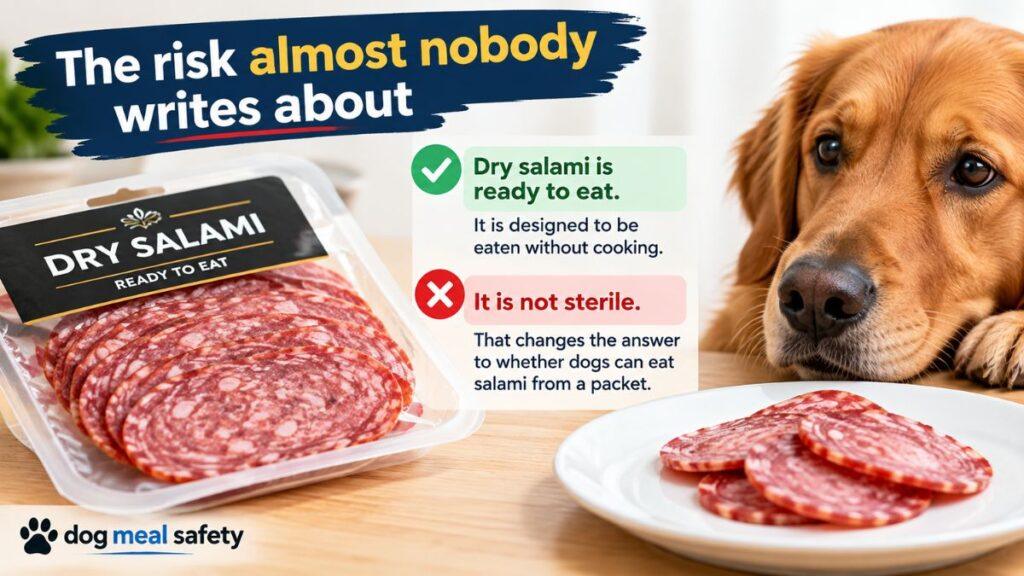
Dry salami is ready to eat, meaning it is designed to be eaten without cooking. It is not sterile, and that changes the answer to whether dogs can eat salami from a packet.
Ready to eat deli meats have been behind some of the most serious food safety events of recent years. The 2024 Boar’s Head listeria outbreak, linked to meats sliced at delis, caused 33 hospitalisations and two deaths and led to a recall of over 200,000 pounds. Recalls have continued: in August 2026 a Chicago establishment recalled around 3,215 pounds of ready to eat pastrami and corned beef over possible Listeria monocytogenes contamination.
Listeria survives refrigeration, which is why ready to eat products are the problem category. Dogs are less susceptible than people but not immune, and an infected dog can shed the organism at home. If you live with small children, an elderly relative, or anyone immunocompromised, this becomes a household issue and not just a canine one. Check anything recalled against the USDA FSIS recall page.
Nitrites, casings, and the parts of the packet that cause trouble
Salami is cured with sodium nitrite or nitrate. At the quantities present, nitrite is not an acute poison for a dog. The World Health Organization does classify processed meat as a Group 1 carcinogen for humans based on colorectal cancer data, and while that evidence involves long term daily human intake, it is not an argument for making cured meat routine.
The bigger practical danger is physical. Casings may be inedible collagen, plastic, or fibrous material, and whole sticks come with string, metal clips, and wrap. A swallowed stick can cause an obstruction, a surgical problem rather than a dietary one. Keep the packaging and tell your vet whether any casing, clip, or wrapper is unaccounted for.
Your dog just ate salami: the first hour
Do not induce vomiting at home. Hydrogen peroxide dosing without veterinary guidance causes its own injuries, and salami does not warrant it.
Work through this instead. Estimate the maximum your dog could have eaten, not the minimum, and note the time. Read the ingredient panel for onion powder, wine, or alcohol. Multiply the sodium per serving by how many servings went missing. Check whether any casing, string, or wrapper is gone. Leave a full water bowl down. Then compare your numbers to the weight table above.
If you land in the “call your vet now” column, or your dog is a puppy, over ten, pregnant, or has any heart, kidney, liver, or pancreatic condition, call rather than waiting for symptoms.
Symptom timeline
Two to twelve hours after eating, expect thirst, heavy urination, and possibly vomiting or loose stool. This is by far the most common outcome and usually resolves on its own.
Twelve to seventy two hours is the pancreatitis window. Watch for repeated vomiting, refusing food, lethargy, abdominal pain, and the hunched or stretched out praying posture dogs adopt when the abdomen hurts. Several of these together after a fatty meal is a same day vet visit.
Three to five days out is when allium related anaemia would appear if at all, showing as pale gums, weakness, rapid breathing, and dark urine. Rare from salami alone, but it is why a dog that ate a large amount deserves a check in later that week. Tremors, disorientation, wobbliness, or seizures at any point are an emergency.
Real cases and what the numbers say
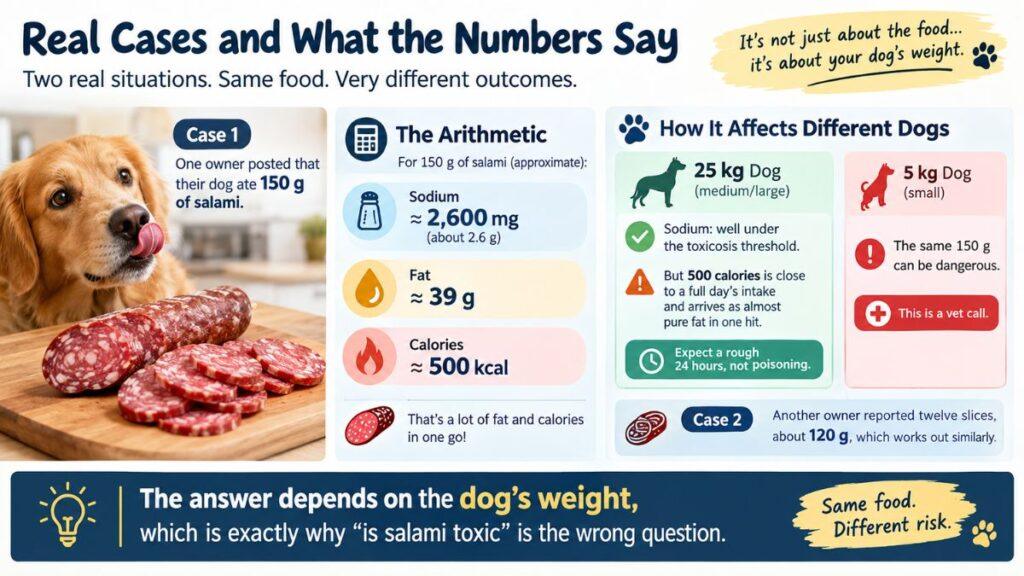
One owner posted that their dog ate 150 g of salami. Run the arithmetic: roughly 2,600 mg of sodium, 39 g of fat, around 500 calories. For a 25 kg dog the sodium sits well under the toxicosis threshold, but 500 calories is close to a full day’s intake arriving as almost pure fat in one hit, so expect a rough twenty four hours rather than a poisoning. For a 5 kg dog the same amount is a vet call. Another owner reported twelve slices, about 120 g, which works out similarly. The answer depends on the dog’s weight, which is exactly why “is salami toxic” is the wrong question.
In a third case a 7 kg Shih Tzu cross ate three slices of garlic seasoned salami and was vomiting bile the next day. The attending veterinarian’s assessment was that the garlic quantity was not the concern, but the fat load in a small dog was, with gastrointestinal upset and pancreatitis the realistic risks. That matches the evidence, and it is the opposite of what most salami articles tell you to worry about.
Which dogs should never have any salami
Puppies under twelve months, whose digestive and sodium handling systems are still developing. Dogs with a history of pancreatitis, where one rich meal can cause a relapse. Dogs with heart or chronic kidney disease, where sodium restriction is part of treatment. Dogs on prescription low fat diets, pregnant or nursing dogs, overweight dogs, and Japanese breeds, for the allium sensitivity above.
Can dogs eat salami that is turkey, low sodium, or uncured?
Less badly, but still no. Genoa and hard salami sit around 1,700 to 1,900 mg of sodium per 100 g. Soppressata and Calabrese versions are often saltier and spicier, with chilli adding gut irritation. Pepperoni is comparable in sodium but usually eaten in larger quantities. Turkey salami cuts fat but not sodium, so it removes half the problem. Reduced sodium products exist, with USDA listing one pork and beef version at about 623 mg per three ounce serving, better but still far above anything a dog needs. The same logic applies to ham and bacon.
Safer alternatives that scratch the same itch
If dogs eat salami because it smells strong and tastes fatty, you can give them that without the salt. Plain cooked chicken, turkey, or pork loin with no seasoning works. Single ingredient freeze dried meat treats usually run under 100 mg of sodium per serving and smell far stronger than salami. Plain cooked liver in small amounts is the highest value training treat most dogs will ever meet. See our list of safe high value dog treats for options you can buy today.
Frequently asked questions
Can dogs eat salami in small amounts?
One slice will not harm a healthy adult dog over 10 kg, but it exceeds the daily sodium a 20 kg dog needs.
Can dogs eat salami every day?
No. Repeated exposure builds cumulative sodium and allium load and adds fat calories your dog does not need.
Is salami toxic to dogs?
Not acutely toxic like chocolate or grapes, but high enough in salt and fat that it is unsuitable as a treat.
My dog ate salami and is drinking a lot of water. Is that bad?
That is the expected sodium response. Leave water freely available and it usually settles within a day.
Can puppies eat salami?
No. Their digestive and sodium regulating systems are not mature.
Is turkey salami safer?
Lower in fat, not lower in sodium, so it fixes only part of the problem.
Does salami cause pancreatitis in dogs?
It is a recognised risk in large or sudden amounts, particularly in predisposed dogs, though recent research has weakened the direct fat to pancreatitis link.
How long should I watch my dog?
Twenty four hours for digestive signs, seventy two hours for pancreatitis signs, and up to five days after a large amount for signs of anemia.
Can I give salami as a training treat?
No. The calorie and sodium cost per piece is far too high for repeated use.
The bottom line
Can dogs eat salami? It fails as a dog treat on arithmetic rather than toxicity. One thin slice carries more sodium than a 20 kg dog needs in a whole day, and about three and a half grams of fat in a food where fat is most of the calories. No version of that works as a regular treat.
But arithmetic cuts both ways. If your dog has eaten a slice or two and is otherwise healthy and average sized, you are looking at a thirsty dog and possibly a loose stool, not a poison. The real warning signs are large amounts in small dogs, whole sticks eaten with casing and string, any amount in a dog with pancreatitis, heart, or kidney history, and repeated exposure over time.
Weigh your dog, read the packet, count what is missing, keep the water bowl full, and call your vet if the numbers land high or symptoms start. That is more useful than deciding whether a food belongs on a toxic list.
2 thoughts on “Can Dogs Eat Salami? 3 Dangerous Risks Every Owner Must Know”