
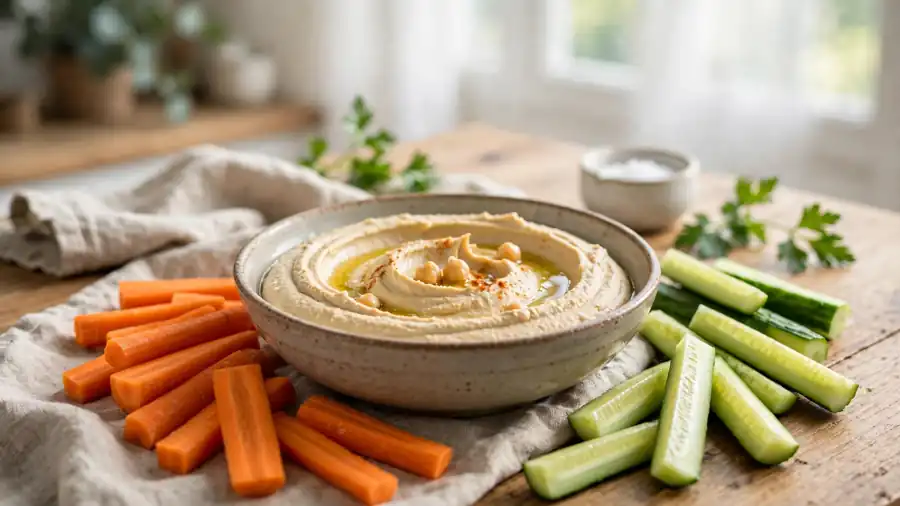
No, dogs should not eat hummus. Garlic and onion in most hummus damage red blood cells and can cause anemia, and the salt, lemon juice, and oil add more risk. Chickpeas alone are safe when cooked and served without seasoning, so offer those instead.
Hummus looks harmless. It sits in the fridge next to foods your dog already eats, it smells mild, and a dog will lick it off a cracker in a second. The dip itself is the problem, not the chickpea at its base.
Most shop-bought hummus contains garlic, listed near the top of the ingredient list or hidden in flavourings. A small lick will not always cause trouble, but the risk is real, and it grows with the amount. PetMD states that hummus is not safe for dogs because of garlic, onion, and spices, while cooked chickpeas on their own are safe.
What Is Hummus Made From?

Hummus is made from cooked chickpeas blended with tahini, lemon juice, garlic, olive oil, and salt, often with cumin or paprika. Shop-bought versions add preservatives and flavours such as roasted red pepper or caramelised onion. Only the chickpeas are safe for dogs.
Traditional hummus has six main parts: cooked chickpeas for body and nutrition, tahini for richness and fat, lemon juice for sharpness, garlic for bite, olive oil for texture, and salt for seasoning.
Shop tubs add preservatives to keep the dip fresh for weeks, plus flavours such as roasted red pepper, sun-dried tomato, olive, caramelised onion, and chilli. A tub of roasted garlic hummus carries more garlic than a classic tub, and a caramelised onion tub adds onion as well.
The chickpea is the only part a dog can eat. Everything around it adds fat, adds salt, irritates the stomach, or damages red blood cells.
| Ingredient | Safe for dogs? | Why |
|---|---|---|
| Chickpeas, cooked | Yes, in small amounts | Fibre, protein, folate, iron, magnesium |
| Tahini | Not toxic, but avoid | Very high in fat and calories |
| Lemon juice | No | Acid irritates the stomach |
| Garlic | No | Damages red blood cells, can cause anemia |
| Onion | No | Damages red blood cells, can cause anemia |
| Olive oil | Not toxic, but avoid | Adds fat, can upset the stomach |
| Salt | No | Dogs need far less salt than people |
| Cumin, paprika, chilli | Avoid | Spices and heat irritate the stomach |
Why Is Garlic in Hummus Dangerous for Dogs?
Garlic is the most dangerous ingredient in hummus. It belongs to the Allium family, and its compounds damage a dog’s red blood cells, which can lead to hemolytic anemia. All forms are toxic, including powder, and signs can take days to appear.
Garlic, onion, leeks, and chives all belong to the Allium family, and their sulfur compounds break down red blood cells. When enough cells break down, the dog develops hemolytic anemia, so the blood can no longer carry enough oxygen.
The Merck Veterinary Manual states that garlic is three to five times more toxic than onion. That ratio matters in hummus because the garlic runs through the whole tub, so every spoonful carries it. A dog that eats a few spoonfuls takes in far more garlic than a dog that eats one clove.
All forms count: fresh, cooked, dried, powdered, and flaked garlic are all toxic, and cooking does not make garlic safe. The VCA notes that one teaspoon of garlic powder equals about eight cloves of fresh garlic, and the AKC adds that powders, flakes, and soup mixes are the most potent forms.
Akitas and Shiba Inus are genetically more sensitive to Allium damage, according to the AKC, and dogs with liver disease or anemia face higher risk too. Small dogs take in more garlic per pound of body weight, so a small dog that eats hummus needs a vet call sooner.
The delay is what makes garlic dangerous in a dip. A dog can eat hummus on Friday, seem fine on Saturday, and show signs on Monday, so watch the dog for days, not hours, and call the vet early.
What About Lemon Juice, Salt, and the Other Ingredients?
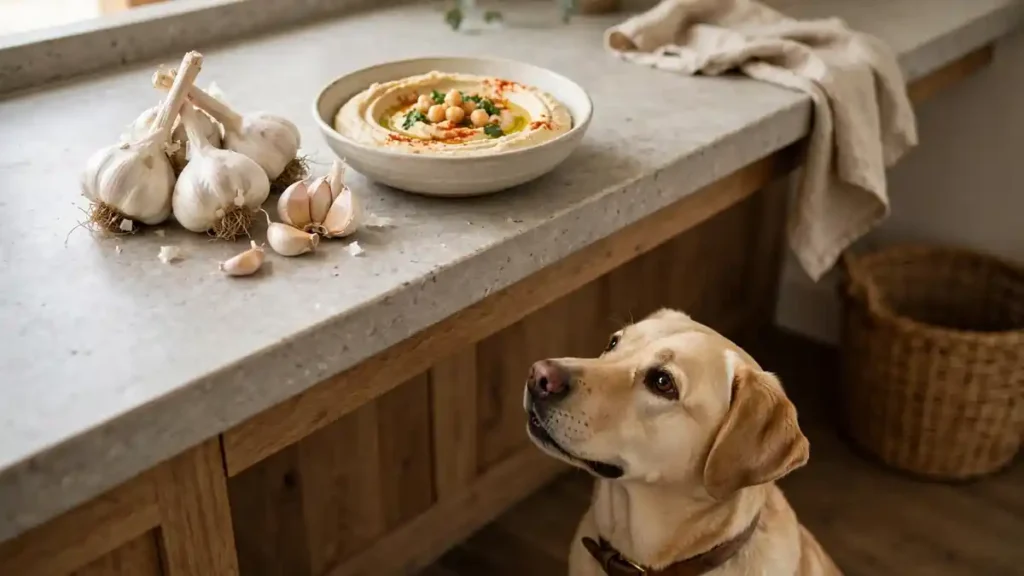
Lemon juice has acid that can upset a dog’s stomach, though it is not toxic. Salt is the bigger worry, and tahini and oil add fat that can upset the stomach or raise pancreatitis risk. Spices such as chilli and caramelised onion add more risk.
Lemon juice needs a clear statement because many guides get it wrong. The ASPCA lists citrus as an irritant, not a toxin. The acid in lemon juice can cause vomiting and diarrhea, and it can irritate the mouth and stomach. It will not poison a dog the way garlic does.
Salt is a different case. Dogs need far less salt than people, and a salty dip adds a lot in a few spoonfuls. The ASPCA lists salt toxicity signs as vomiting, diarrhea, depression, tremors, and seizures. A dog with heart or kidney disease faces more risk from the same amount.
Tahini and olive oil carry no toxin, yet they are very high in fat, and fat can upset a dog’s stomach or trigger pancreatitis in some dogs. A tub can carry several spoonfuls of oil and tahini, so the fat adds up fast.
Flavours decide how bad a tub is. Classic hummus already has garlic. Roasted red pepper adds pepper and often more garlic, caramelised onion adds onion on top of garlic, and spicy or chilli adds heat. Roasted garlic carries the most garlic of all, and chocolate hummus is a separate emergency because cocoa carries theobromine.
| Flavour | Safe? | Why |
|---|---|---|
| Classic | No | Garlic, salt, lemon juice, oil |
| Roasted red pepper | No | Garlic base plus pepper and extra flavourings |
| Caramelised onion | No | Onion plus garlic |
| Spicy or chilli | No | Chilli heat plus garlic base |
| Roasted garlic | No | Highest garlic content |
| Chocolate | No, emergency | Cocoa carries theobromine, plus garlic base |
Can Dogs Eat Plain Chickpeas Instead?
Yes, cooked chickpeas are safe for dogs in small amounts, and mashed chickpeas make a safe homemade hummus. Mash them with a fork and add nothing: no tahini, oil, garlic, lemon, or salt. Serve a little in a Kong or on a lick mat.
This is the short version on purpose. A full guide to chickpeas already lives on this site, and it covers portions, forms, and what to do if your dog eats too many. Read Can Dogs Eat Chickpeas? for those details rather than repeating them here.
The homemade version is simple. Take cooked chickpeas and mash them with a fork. Add a spoonful of water if the mash is too thick. A little plain pumpkin puree can loosen it as well. Serve a small amount in a Kong, spread it on a lick mat, or use it as a food topper. That is the whole recipe. No tahini, no oil, no garlic, no lemon, no salt.
| Alternative | How to serve | Watch out for |
|---|---|---|
| Plain mashed chickpeas | Mash with a fork, serve in a Kong or on a lick mat | Add nothing, no tahini or oil |
| Pumpkin puree | Mix a spoonful into the mash | Use plain puree, not pie filling |
| Sweet potatoes | Cooked and mashed, small amount | Serve plain, no butter or seasoning |
| Greek yogurt | A small dollop as a topper | Plain only, no sweeteners or flavours |
| Carrot, cucumber, apple | Raw or lightly cooked pieces | Cut to size, remove apple seeds |
How to Check a Hummus Label
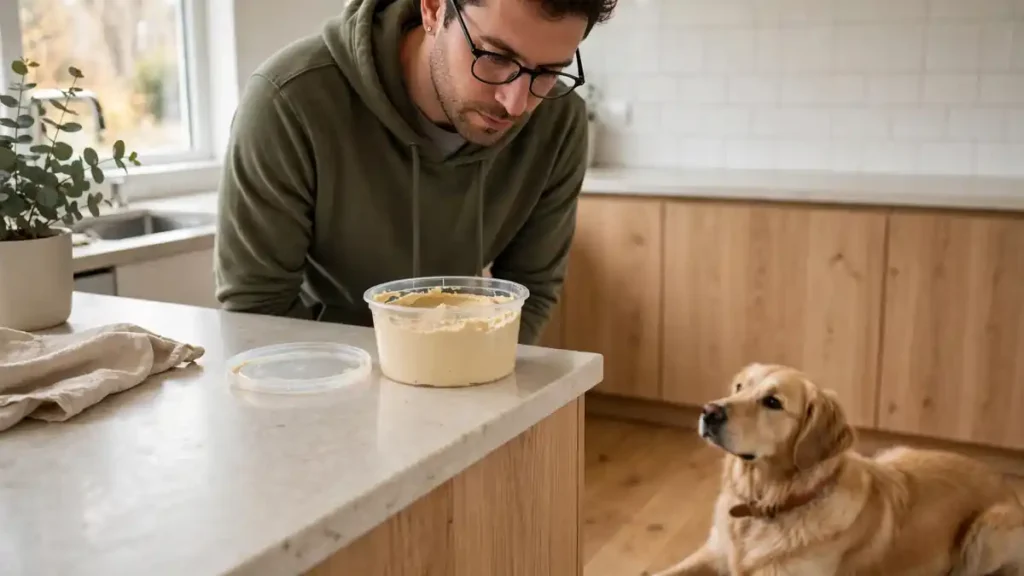
Read the ingredient list before you offer any dip. Garlic and onion can hide as garlic powder, onion powder, or caramelised onion, and some dips add chilli, citric acid, or preservatives. If the label lists any of these, keep the tub away from your dog.
The front of the tub tells you nothing. Words such as natural, classic, and homemade describe a style, not a recipe. The ingredient list on the back is the only part that matters, and it lists ingredients from most to least by weight.
Garlic hides under several names. Look for garlic, garlic powder, garlic flakes, garlic puree, and roasted garlic. Onion hides as onion, onion powder, dried onion, and caramelised onion. A tub can list garlic near the end and still carry enough to matter, because the dip is eaten by the spoonful.
Check the rest of the list too: citric acid and lemon juice add acid, salt shows up as salt, sea salt, and sodium, and chilli and spice blends add heat. Preservatives such as potassium sorbate keep the tub fresh for weeks.
A simple rule covers most cases: if the label lists garlic or onion in any form, do not serve it. If the tub has no label at all, do not serve it either.
| Check for | Concern |
|---|---|
| Garlic in any form | Damages red blood cells, most dangerous ingredient |
| Onion in any form | Damages red blood cells, same family as garlic |
| Lemon juice, citric acid | Acid irritates the stomach |
| Salt, sodium | Dogs need far less salt than people |
| Chilli, spices | Heat and spice irritate the stomach |
| Tahini, extra oil | Very high in fat, can upset the stomach |
| Preservatives | Added chemicals, no benefit for dogs |
What If Your Dog Eats Hummus?
Stay calm and check the label first, noting the flavour, amount, and time. Call your vet or a poison helpline and describe what your dog ate. Do not make your dog vomit unless a vet tells you to, and watch your dog closely.
Start with the tub: note the flavour, how much is missing, and when your dog ate it. That is what the vet will ask for first, and it decides how urgent the case is.
Call your vet and describe what happened. The ASPCA Poison Control line is (888) 426-4435, and the Pet Poison Helpline is 1-855-764-7661. Keep the tub nearby so you can read the ingredients aloud.
Do not try to make your dog vomit at home. Vomiting can cause more harm, and it is a vet decision, not a home remedy. The vet may induce vomiting or give activated charcoal if the dog is seen quickly, but only the vet decides that.
A small lick in a large dog will most often cause mild stomach upset at most, so watch for vomiting or loose stool over the next day and call the vet if signs appear. A small dog, a large amount, a garlic-heavy dip, or chocolate hummus needs a vet call right away, even if the dog looks fine. The chickpeas guide on this site has a full emergency section with the same steps.
What Symptoms Should You Watch For?

Garlic poisoning signs can take two to five days to appear, so watch your dog even if they seem fine at first. Look for vomiting, diarrhea, weakness, pale gums, fast breathing, and dark urine. Call your vet at once if any of these show up.
The delay catches most owners by surprise: garlic damages red blood cells slowly, so the signs build over days. The AKC states that serious signs usually develop two to five days after a dog eats garlic.
Watch for stomach signs first. Vomiting and diarrhea can appear within a day. Then watch for the anemia signs: weakness, tiredness, pale gums, fast breathing or panting, and dark or reddish urine. The VCA notes that kidney damage is also possible after Allium poisoning, which is another reason to call the vet early.
Keep a note of when your dog ate the hummus and how much, because the vet will want that timeline if signs appear on day three. Pale gums, weakness, collapse, or dark urine are emergency signs, and the dog needs a vet at once.
| Sign | What it may mean | What to do |
|---|---|---|
| Vomiting | Stomach upset from garlic, salt, or acid | Offer water, call the vet if it repeats |
| Diarrhea | Stomach upset from fat, salt, or spice | Offer water, call the vet if it repeats |
| Lethargy, weakness | Red blood cell damage, anemia | Call the vet at once |
| Pale gums | Red blood cell damage, anemia | Emergency vet visit |
| Fast breathing, panting | Anemia, body struggling for oxygen | Emergency vet visit |
| Dark or reddish urine | Red blood cells breaking down | Emergency vet visit |
| Loss of appetite | Stomach upset or anemia | Call the vet if it lasts a day |
Frequently Asked Questions
Most questions about hummus, including is hummus safe for dogs, come down to one point: the chickpeas are fine, but the garlic, onion, salt, and oil in hummus are not. The answers below cover garlic, garlic-free hummus, flavours, small licks, and puppies.
Can dogs eat hummus?
No, dogs should not eat hummus. The chickpeas in it are safe, but the garlic and onion in most hummus damage red blood cells, and the salt, lemon juice, and oil add more risk. Offer mashed cooked chickpeas instead, with nothing added.
Is garlic really that dangerous for dogs?
Yes, garlic is three to five times more toxic than onion, according to the Merck Veterinary Manual, and all forms are toxic, including powder, flakes, and cooked garlic. One teaspoon of garlic powder equals about eight cloves of fresh garlic, according to the VCA.
Can dogs eat hummus without garlic?
Shop-bought hummus without garlic is still not a good idea, because it usually contains onion, salt, lemon juice, oil, and preservatives. A homemade version of plain mashed chickpeas is the only safe option, and it has no tahini, oil, garlic, lemon, or salt in it. If a tub lists no garlic but lists onion, keep it away from your dog.
Can dogs eat red pepper or roasted garlic hummus?
No, red pepper hummus still has a garlic base, and roasted garlic hummus carries the most garlic of all the flavours. Roasting does not make garlic safe, and the pepper and extra flavourings add more risk. Chocolate hummus is the worst case of all, because cocoa carries theobromine on top of the garlic base.
What if my dog licked a small amount and seems fine?
Note the flavour, the amount, and the time, then watch your dog for the next few days. Garlic signs can take two to five days to appear, so a dog that seems fine today is not yet in the clear. Call your vet if your dog is small, if the amount was large, or if any sign from the symptoms table shows up.
Can puppies eat hummus?
No, puppies should not eat hummus. Their digestion is still developing, their airways and stomachs are small, and they take in more garlic per pound of body weight from the same spoonful. Use treats made for puppies instead, and offer plain mashed chickpeas only when your vet says your puppy is old enough for them.
The Bottom Line
Hummus is not safe for dogs because garlic and onion can damage red blood cells, and the salt and fat add more risk. Offer mashed cooked chickpeas instead, with nothing added, and call your vet if your dog eats hummus with garlic in it.
Related Guides
Sources
- PetMD, Can Dogs Eat Chickpeas? https://www.petmd.com/dog/nutrition/can-dogs-eat-chickpeas
- VCA Hospitals, Onion, Garlic, Chive, and Leek Toxicity in Dogs https://vcahospitals.com/know-your-pet/onion-garlic-chive-and-leek-toxicity-in-dogs
- American Kennel Club, Can Dogs Eat Garlic? https://www.akc.org/expert-advice/nutrition/can-dogs-eat-garlic/
- ASPCA, People Foods to Avoid Feeding Your Pets https://www.aspca.org/pet-care/animal-poison-control/people-foods-avoid-feeding-your-pets
Disclaimer
This article is for general information only and is not veterinary advice. Every dog is different, so talk with your own veterinarian before changing your dog’s diet, especially if your dog is a puppy, has a health condition, or takes medication.


1 thought on “Can Dogs Eat Hummus? Risks and Safer Snack Options”