

Yes, dogs can eat popcorn when it is air-popped with nothing added, served in small amounts as a treat. Butter, salt, oil, cheese, caramel, and sugar-free sweeteners change the answer, so the topping decides whether a bowl is safe or a vet visit is needed.
A cup of air-popped popcorn has about 31 calories, which is why this snack looks so harmless. It is light and crunchy, and most dogs beg for a piece the moment they hear the popper. The popcorn itself is the safe part.
Everything that usually goes on it is the problem. The American Kennel Club says plain, air-popped popcorn is generally safe for dogs in small amounts, and PetMD agrees that popcorn itself is not toxic to dogs.
Is Popcorn Good for Dogs?

Popcorn gives dogs a little fibre and small amounts of magnesium, manganese, phosphorus, and zinc, but a treat-sized serving holds too little to matter. Its value is crunch and volume for very few calories, not nutrition, so it should never replace part of a meal.
Popcorn is a whole grain, and a cup of the air-popped kind carries about 31 calories with just over a gram of fibre, according to USDA figures cited by Petful. Half a cup holds about 16 calories, according to Petco, which quotes veterinary nutritionist Dr. Jonathan Stockman. A dog eats a few pieces, not a cup, so the nutrients in those pieces are tiny.
Popcorn will not fix a poor diet. If you want a treat with more nutrition per bite, mango is a stronger choice. Popcorn works best as a light, crunchy reward, not as a health food.
| Nutrient | What it does for dogs |
|---|---|
| Fibre | Aids digestion |
| Magnesium | Muscle and nerve function |
| Manganese | Bone and joint health |
| Phosphorus | Bone and teeth health |
| Zinc | Skin and immune health |
| B vitamins | Turn food into energy |
| Polyphenols | Antioxidant plant compounds |
What Kind of Popcorn Is Safe for Dogs?
Air-popped popcorn with nothing added is the only kind that is safe. Buttered, salted, cheese, caramel, kettle, and microwave popcorn add fat, salt, sugar, or chemicals dogs should not eat, so check the label, since a plain-looking bag can hide butter flavouring or xylitol.
The topping decides everything. One tablespoon of butter holds about 102 calories with 7 grams of saturated fat, according to Genghis Collar. Fat is the same reason pecans are risky for dogs: too much fat can upset the stomach and, in some dogs, trigger pancreatitis. A serving of cinema popcorn can carry 400 to 700 milligrams of sodium.
Caramel and kettle corn add sugar, and some sugar-free products hide xylitol, a sweetener that is acutely toxic to dogs. Onion and garlic powder can damage red blood cells, and chocolate brings theobromine, which dogs cannot process well. Microwave bags add PFAS chemicals in the lining and diacetyl in the flavouring. The ASPCA lists xylitol, salt, and onion and garlic among the people foods to avoid feeding pets.
Petful rates the common brands, and its verdict is strict. SkinnyPop Original is mostly plain popcorn with salt, so a dropped piece is fine, but it is not a treat to hand out on purpose. Smartfood White Cheddar is a no because of the cheese powder, fat, and salt, and Pop Secret and Act II microwave bags are a no. Any bag labelled sugar-free or keto needs a full ingredient check first.
| Popcorn type | Safe for dogs? | Why |
|---|---|---|
| Plain air-popped | Yes, occasionally | Nothing added |
| Buttered | No | Fat, stomach upset, pancreatitis |
| Salted | No | Salt poisoning risk |
| Cheese powder | No | Fat and salt |
| Caramel or kettle | No | Sugar, may hide xylitol |
| Microwave bag | No | Lining chemicals, flavourings |
| SkinnyPop Original | One dropped piece | Salted, not a treat |
| Smartfood White Cheddar | No | Cheese powder, fat, salt |
| Sugar-free or keto | No, emergency if xylitol | Xylitol, acutely toxic |
How Much Popcorn Can Dogs Eat?
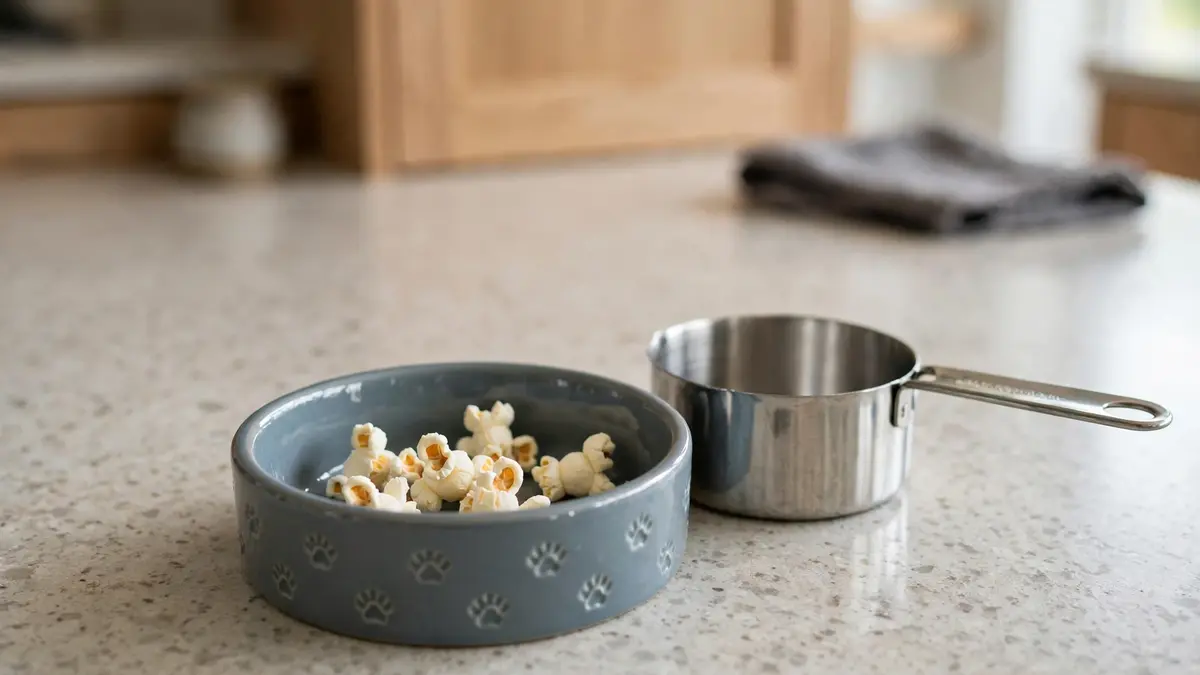
A few pieces are enough for most dogs, kept inside the 10% treat rule. Sources disagree on exact counts and frequency, so start with one or two pieces, watch for stomach upset, and ask your vet for a limit that fits your dog.
The 10% rule is the one point every source agrees on: treats, popcorn included, should add up to no more than a tenth of your dog’s daily calories. PetMD gives ranges by size: extra-small dogs from 2 to 20 pounds get 1 to 2 pieces, small dogs from 21 to 30 pounds get 2 to 3, medium dogs from 31 to 50 pounds get 5 to 6, large dogs from 51 to 90 pounds get a small handful, and extra-large dogs over 91 pounds get a handful. Other sources disagree on frequency: Dial A Vet says once every couple of weeks, Plentum says at most 2 to 3 times a week, and the rest say only “occasionally.” Start with one or two pieces, watch for soft stool or vomiting over the next day, and ask your vet for a limit that fits your dog.
How to Make Plain Popcorn for Your Dog
Pop your dog’s batch first, before you season your own, using an air popper or a dry pan with no oil. Let it cool and pick out every unpopped kernel and hull. A microwave-safe bowl works for plain kernels, but never use a microwave bag.
Pop a small batch for your dog before you season your own bowl, so no butter or salt lands in the dog’s share by mistake. Use an air popper if you have one, or a dry pan on the stove with no oil. A microwave-safe bowl also works for plain kernels, but only with a vented lid and only with plain kernels, never a pre-packaged bag.
Let the popcorn cool completely, since hot pieces can burn a dog’s mouth and warm popcorn hides unpopped kernels. Pick out every kernel and hull, and put a few pieces in a separate bowl. Keep the rest out of reach: leftover popcorn on the floor is the classic way a dog eats flavoured popcorn when nobody is watching.
- Pop the dog’s batch first, before you season your own bowl.
- Use an air popper or a dry pan with no oil.
- A microwave-safe bowl with a vented lid works for plain kernels only.
- Let the popcorn cool completely before serving.
- Pick out every unpopped kernel and hull.
- Serve a few pieces in a separate bowl.
Can Dogs Eat Popcorn Kernels and Hulls?
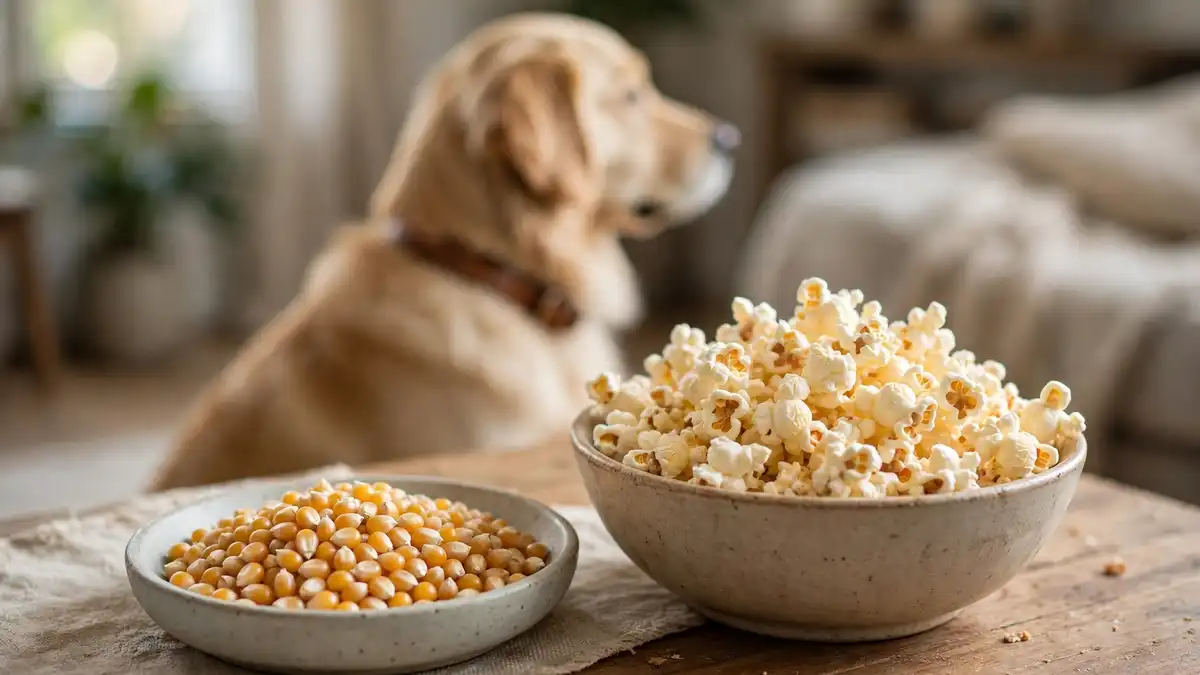
Unpopped kernels can choke a dog, crack a tooth, or block the gut, and hulls can wedge in gums, where they trap bacteria and irritate them. Pick out kernels and hulls, and check your dog’s teeth after eating, since a stuck hull can damage gums.
Kernels cause most of the physical harm in popcorn. PetMD warns that kernels stuck in teeth can lead to dental problems, and that a kernel can choke a dog or block the gut, especially in very small dogs.
Hulls are the thin shells that split off each kernel, and Petful calls the hull the biggest physical hazard in popcorn. A hull can lodge between teeth, wedge into the gum line, or sit in the throat, and hulls trap bacteria along the gum line. One vet warns that a hull stuck for a long time can irritate gums and lead to damage or infection.
“Hulless” popcorn is not hull-free, so the label does not solve the problem. Check your dog’s teeth and gums after eating, and call your vet if your dog coughs, gags, or paws at the mouth.
| Hazard | What it does | How to prevent it |
|---|---|---|
| Unpopped kernels | Choking, cracked teeth, gut blockage | Pick kernels out first |
| Partially popped kernels | Tooth damage and choking | Sort them out too |
| Hulls | Wedge in gums and trap bacteria | Check teeth after eating |
| Fluffy pieces for gulpers | Can be inhaled | Break up, feed one at a time |
Which Dogs Should Skip Popcorn?
Puppies, dogs with pancreatitis or diabetes, dogs with a corn allergy, overweight dogs, gulpers, and flat-faced dogs should skip popcorn unless a vet says otherwise. Sources disagree on puppies, so the safer choice is to wait and use treats made for puppies instead.
Puppies are the one group where the sources openly disagree. Dial A Vet says avoid popcorn for puppies because their digestion is sensitive and the choking risk is higher. Petful says it is not generally recommended for puppies, for the same reasons plus smaller airways.
The AKC says puppies can generally eat a few pieces of plain, air-popped popcorn, but treats made for puppies are the better choice. Canine Bible says yes in moderation, starting with one or two pieces.
When sources split like this, the safer choice is to wait. Dogs prone to pancreatitis should skip popcorn with any fat on it.
Genghis Collar names Miniature Schnauzers and Cocker Spaniels as at-risk breeds, along with dogs that have had pancreatitis before, overweight dogs, and dogs with thyroid or lipid problems. Diabetic dogs need a vet’s word first, since carbs raise blood glucose. A corn allergy means skipping popcorn even when it is plain, since the allergy is to corn itself.
Dogs that gulp food can inhale fluffy pieces, and flat-faced breeds such as French Bulldogs and Pugs, along with Boston Terriers and Bulldogs, have narrow airways and crowded teeth, so Petful advises breaking pieces up, feeding one at a time, and skipping popcorn entirely if the dog gulps or has breathing trouble. Safer treats exist: kiwi is soft and easy to serve in small pieces, and cooked squash is gentle on sensitive stomachs.
| Dog | Why popcorn is risky | Safer choice |
|---|---|---|
| Puppies | Choking risk and sensitive digestion | Puppy treats |
| Pancreatitis-prone dogs | Fat can trigger an attack | No fatty treats |
| Diabetic dogs | Carbs raise blood glucose | Vet approval first |
| Dogs with a corn allergy | Allergy symptoms | Skip it entirely |
| Overweight dogs | Extra calories | Green beans |
| Dogs that gulp | Choking and inhaling pieces | One small piece at a time |
| Flat-faced breeds | Narrow airways and crowded teeth | Break up pieces, skip if troubled breathing |
What to Do If Your Dog Eats Buttered Popcorn

Check the bag for xylitol, then watch your dog for 12 to 48 hours and call your vet if you see vomiting, diarrhea, weakness, or choking. If the popcorn had xylitol, treat it as an emergency and call your vet or a poison helpline.
Start with the bag. Petful advises checking the brand, the flavour, how much is missing, and whether xylitol is listed. That check matters most, since xylitol turns a stomach upset into an emergency. PetMD’s xylitol guide explains that xylitol triggers a rapid insulin release, which drops blood sugar fast, and larger amounts can damage the liver.
Signs can start as early as 20 minutes, with vomiting usually first, followed by lethargy, weakness, unsteadiness, collapse, tremors, or seizures. If the popcorn had xylitol, call your vet, the ASPCA Poison Control line at (888) 426-4435, or the Pet Poison Helpline at 1-855-764-7661 right away. Never try to make your dog vomit at home unless a vet tells you to.
For buttered popcorn without xylitol, watch your dog for 12 to 48 hours. Dial A Vet lists the symptoms to watch for: vomiting, diarrhea, drooling, pacing, panting, lethargy, thirst, and abdominal pain. Offer fresh water, and call your vet if symptoms appear or a small dog ate a lot. Choking needs a faster response: a dog that is choking but still breathing needs a vet immediately, and a dog that cannot breathe needs the Heimlich maneuver followed by a vet visit at once.
| Sign | How urgent | What to do |
|---|---|---|
| One vomit or loose stool | Watch closely | Offer water, monitor |
| Repeated vomiting or diarrhea | Call the vet | Describe what was eaten |
| Choking or gagging | Emergency | Vet at once, Heimlich only if not breathing |
| Pale gums, weakness, collapse | Emergency | Emergency vet right away |
| Seizure or disorientation | Emergency | Vet at once, suspect xylitol |
| Xylitol on the label | Emergency | Call a vet or poison helpline |
Frequently Asked Questions
Most questions about popcorn, including is popcorn safe for dogs, come down to the same split: air-popped is fine in small amounts, while butter, salt, sugar, and flavourings are not. The answers below cover puppies, feeding, caramel popcorn, training rewards, diabetic dogs, and corn allergies.
Can puppies eat popcorn?
Sources disagree, so follow the stricter guidance and wait. Dial A Vet says avoid popcorn for puppies because their digestion is sensitive and the choking risk is higher, and Petful says it is not generally recommended. The AKC says a few pieces are generally fine but treats made for puppies are the better choice, while Canine Bible says yes in moderation. Puppies have small airways and developing digestion, so a puppy treat is the safer pick.
Can dogs eat popcorn every day?
No, popcorn should stay an occasional treat, not a daily habit. The 10% treat rule still applies, and sources disagree on frequency: Dial A Vet says once every couple of weeks, Plentum says at most 2 to 3 times a week, and the rest say only “occasionally.” A few pieces once in a while is the pattern every source can agree on.
Can dogs eat caramel popcorn?
No, caramel popcorn is not safe for dogs. The coating is sugar, and sugar over time can lead to obesity and tooth problems. Some caramel and sugar-free products also hide xylitol, which is acutely toxic. If your dog eats caramel popcorn, check the label for xylitol first, then watch for stomach upset and call your vet if symptoms appear.
Can dogs eat popcorn for training rewards?
Yes, plain air-popped pieces work as a low-value training reward for games that need many small wins. Petful suggests a snuffle mat, a toss game where the dog catches pieces, and a lick mat for movie night, while Canine Bible mentions scattering pieces for foraging and using a puzzle feeder. Break large pieces in half for small dogs and keep the total inside the 10% treat rule.
Can diabetic dogs eat popcorn?
Only with a vet’s approval, because popcorn is mostly carbohydrate and carbs raise blood glucose. Petful advises asking the vet first and counting popcorn inside the vet-set treat plan. No source gives a diabetic-specific portion, so do not guess one. If your dog has diabetes, your vet sets the treat plan.
Can dogs eat popcorn if they have a corn allergy?
No, a dog with a corn allergy should skip popcorn even when it is plain, because the allergy is to corn itself. Reader’s Digest quotes a vet who lists itching and scooting, along with skin or ear issues, as signs, while Dial A Vet adds upset stomach, ear infections, and gassiness. Signs can include itchy skin, hives, and infections, and rarely anaphylaxis, which is an emergency. If your dog shows allergy signs after eating popcorn, call your vet.
The Bottom Line
Popcorn is safe for most dogs when air-popped with nothing added and served as a small treat. Pop a batch for your dog before you season yours, pick out the kernels, and call your vet if the popcorn had xylitol or your dog shows signs.
Related Guides
Sources
- American Kennel Club, Can Dogs Eat Popcorn? https://www.akc.org/expert-advice/nutrition/can-dogs-eat-popcorn/
- PetMD, Can Dogs Eat Popcorn? https://www.petmd.com/dog/nutrition/can-dogs-eat-popcorn
- PetMD, Xylitol Poisoning in Dogs https://www.petmd.com/dog/poisoning/xylitol-poisoning-in-dogs
- ASPCA, People Foods to Avoid Feeding Your Pets https://www.aspca.org/pet-care/animal-poison-control/people-foods-avoid-feeding-your-pets
- Petful, Can Dogs Eat Popcorn? https://www.petful.com/food/can-dogs-eat-popcorn/
Disclaimer
This article is for general information only and is not veterinary advice. Every dog is different, so talk with your own veterinarian before changing your dog’s diet, especially if your dog is a puppy, has diabetes, has had pancreatitis, or takes medication.


