The Short Answer
Yes, dogs can have catnip in moderation — the ASPCA lists the catnip plant as non-toxic to dogs. But do not expect the wild, playful reaction cats get. Most dogs show little to no reaction at all, and the dogs that do react tend to get calmer and sleepier, not more energetic. Large amounts can upset the stomach, so a little goes a long way.

What Catnip Actually Is
Catnip (Nepeta cataria) is a herb in the mint family, native to Europe and parts of Asia and now common across North America. Its active compound is nepetalactone, an essential oil in the leaves and stems. In cats, nepetalactone binds to receptors in the nose and triggers a short burst of rolling, rubbing, and hyperactivity. Dogs do not respond to nepetalactone the way cats do, which is why the same plant that sends a cat bouncing off the walls usually leaves a dog unbothered — or, at most, mildly relaxed.
How Catnip Affects Dogs
Not every dog responds, and that is completely normal. Here is what owners typically see:
- No reaction at all. This is the most common outcome. Your dog sniffs it, maybe sneezes, and walks away.
- Mild calmness or sleepiness. Some dogs relax a little after eating or sniffing catnip, which is why some owners use a pinch before bed or during stressful moments like storms or fireworks.
- Brief curiosity. A few dogs sniff more intently or rub their face on a catnip toy for a minute, then lose interest.
- Upset stomach — only in larger amounts. Eating a lot of catnip can cause vomiting or diarrhea. This is a dose problem, not a poisoning problem.
One honest note: the calming effect is mild and inconsistent. Catnip is not a treatment for anxiety. If your dog has real anxiety, separation distress, or a sleep problem, that deserves a vet visit, not a herb.
Possible Benefits (and Their Limits)
- Relaxation. A small amount may help some dogs settle, which owners sometimes use before car rides or vet visits. For another calming scent guide, see Is Lavender Safe for Dogs?
- Better sleep. A pinch in the evening is a folk remedy some owners swear by for restless dogs — but the effect is gentle and not guaranteed.
- Digestive comfort. Catnip has a long folk history as a stomach-soothing herb, and some owners report it helps mild tummy grumbles. There is no strong veterinary evidence for this in dogs, so treat it as a maybe, not a medicine.
- A shared-household bonus. If you have cats, your dog will inevitably get into the cat’s catnip toys. It is reassuring to know that is not dangerous in itself.
How to Give Catnip to a Dog Safely
- Start with a pinch. About 1/8 teaspoon of dried catnip sprinkled on food or bedding is plenty for a first try.
- Stay in the 1/8 to 1/2 teaspoon range of dried catnip for most dogs, and only occasionally — not every day.
- Fresh leaves work too. A few fresh leaves, washed and offered plain, are fine. Fresh is milder than dried by weight.
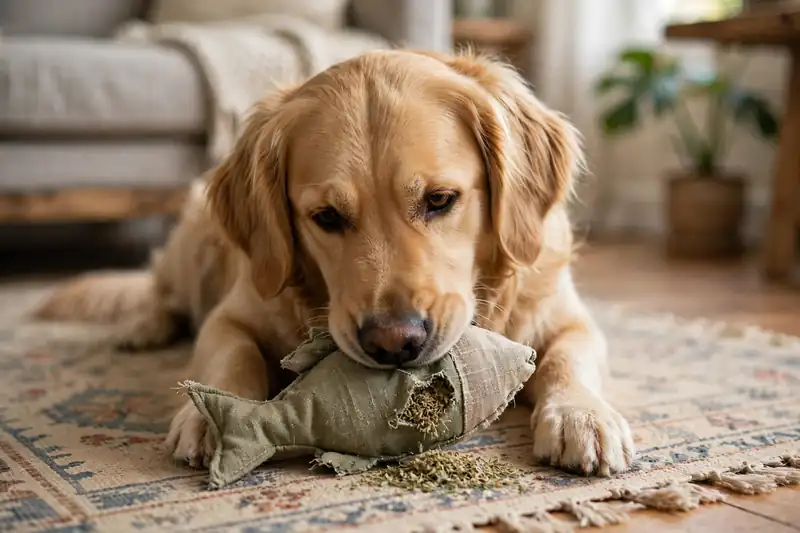
- Toys are fine — with supervision. A catnip-stuffed toy is safe to chew, but check it regularly. The danger is not the catnip, it is a torn toy: swallowed stuffing or fabric can block the gut.
- Sprays and bubbles. Catnip sprays and bubbles sold for cats are usually just water with a little catnip extract, but check the label first — avoid anything with added fragrance, alcohol, or other essential oils, and never spray directly at your dog’s face.
- Watch the first time. Give it when you are home and can watch for stomach upset or unusual drowsiness for a few hours.

What to Avoid
- Catnip essential oil. Concentrated oil is much stronger than dried leaves and can irritate the mouth, stomach, and skin. Do not put undiluted catnip oil on your dog or in their food. For a mint-family caution on oils, see Is Peppermint Oil Safe for Dogs?
- Large amounts. More is not better. A dog that raids a whole bag of dried catnip may vomit or have diarrhea for a day.
- Catnip as a daily anxiety fix. If your dog needs calming every day, something else is going on — talk to your vet instead of increasing the dose.
- Catnip mixed into cat treats. Some cat treats contain extra ingredients meant for cats. Stick to plain catnip.
- Unsupervised toy destruction. Take away any catnip toy that is falling apart before your dog eats the filling. For another scented-plant safety guide, see Is Eucalyptus Safe for Dogs?

Catnip vs. Anise: The “Dog Catnip”
If you want a herb your dog will actually get excited about, many owners reach for anise (aniseed), sometimes nicknamed “dog nip.” Dogs tend to respond to anise with playful energy, much like cats respond to catnip. The same moderation rules apply: a tiny pinch occasionally, plain, and stop if it upsets the stomach. Anise is a fun alternative, but it is not necessary — most dogs are perfectly happy without either herb.
When to Call the Vet
- Vomiting or diarrhea that lasts more than 24 hours after eating catnip
- Your dog swallowed pieces of a torn catnip toy, especially stuffing or fabric
- Unusual drowsiness, wobbliness, or lethargy that does not pass in a few hours
- Signs of an allergic reaction: swelling, hives, or difficulty breathing (rare, but always an emergency)
- Your dog got into concentrated catnip oil — call your vet or animal poison control for advice

FAQ
Q: Is catnip toxic to dogs?
A: No. The ASPCA lists catnip as non-toxic to dogs. Large amounts can cause mild stomach upset, but it is not poisonous.
Q: Why does catnip make my cat crazy but not my dog?
A: Dogs do not respond to nepetalactone the way cats do, which is why most dogs feel little or nothing from catnip; some get mildly sleepy instead.
Q: How much catnip can I give my dog?
A: A pinch is enough — roughly 1/8 to 1/2 teaspoon of dried catnip, occasionally. Start at the low end and see how your dog reacts.
Q: Can catnip help my anxious dog?
A: It may take the edge off for some dogs in the moment, but it is not a treatment for anxiety. If your dog is regularly anxious, talk to your vet about real solutions.
Q: My dog ate the cat’s catnip toy. Should I worry?
A: The catnip itself is fine. Worry only if your dog swallowed toy parts — stuffing, fabric, or squeakers can cause a blockage. Watch for vomiting, loss of appetite, or straining, and call your vet if you see them.
Q: Is catnip oil safe for dogs?
A: No — avoid concentrated catnip essential oil. It is far stronger than dried leaves and can irritate the mouth, stomach, and skin.
Q: Can puppies have catnip?
A: A tiny amount is not toxic, but puppies have sensitive stomachs and are still growing on puppy food, so it is best to wait until they are older — and always check with your vet first.
Q: Is Doggijuana just catnip?
A: Essentially, yes. Doggijuana is a brand that sells catnip-based products made for dogs, so the active ingredient is the same catnip and the same moderation rules apply. Always check the label, though — the safety depends on what else is in the product besides catnip.
Q: Is there a dog version of catnip?
A: There is no true equivalent that works on dogs the way catnip works on cats. Products sold for dogs are usually just catnip packaged for dogs, and anything claiming a special dog-only effect should be checked with your vet first.
Q: Are catnip toys safe for dogs?
A: Yes, as long as the toy is sturdy and your dog is supervised. The dried catnip inside is fine, but if your dog tears the toy open, remove it right away — swallowed stuffing, fabric, or squeakers can cause a blockage.
Vet Disclaimer
This article is for general information only and is not a substitute for veterinary advice. Catnip affects every dog differently, and dogs with health conditions, pregnant or nursing dogs, and puppies should only get new herbs with a vet’s okay. If your dog’s behavior or digestion changes after catnip, stop giving it and talk to your veterinarian.