
No, dogs should not eat chicken bones. Cooked ones are worse, because heat dries the bone out so it breaks into sharp shards rather than clean pieces. Most dogs that swallow one are fine. A minority are not, and nothing tells you in advance which group your dog falls into.
If your dog just ate a bone and is breathing normally, eating, and acting like itself, call your vet and watch closely for 72 hours. If your dog is gagging, drooling heavily, pawing at its mouth, retching without bringing anything up, or struggling to breathe, stop reading and go.
Why cooked chicken bones are the bigger problem
A raw bone still holds moisture and collagen. When a dog cracks it, it breaks into blunt chunks. Cooking drives the water out and denatures the collagen, and what is left fractures along its length into needle-shaped splinters instead. Chicken bones are also thin-walled and partly hollow, the structure that splinters worst, which is why one can cause more trouble than a beef bone twice its size.
The damage happens in a few different ways. A fragment can lodge in the throat or esophagus and block the airway. It can pierce the stomach or intestinal wall, which spills gut contents into the abdomen and causes peritonitis. Or a mass of fragments can pack together and obstruct the intestine, which usually means surgery.
You will read that stomach acid dissolves chicken bone before it can do damage. Dog stomach acid is strong and it does break bone down eventually. Eventually is the problem. It does nothing at all for the throat and the esophagus, which is where a bone does its worst work on the way down.
Are raw chicken bones safer? What both sides actually say
This is where most of the confusion online comes from, because two credible-sounding camps answer it differently.
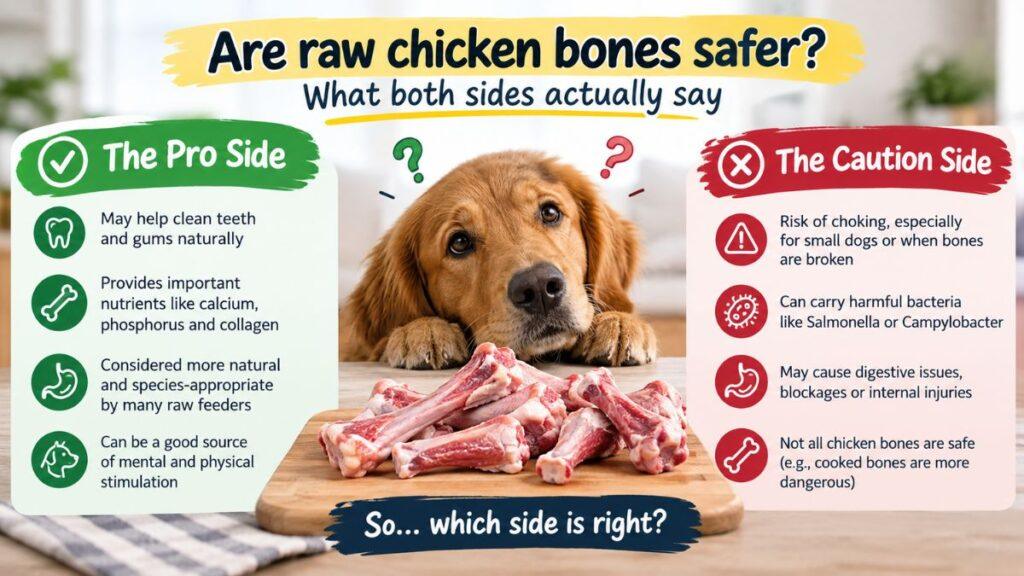
Most veterinarians advise against feeding chicken bones at all. Their reasoning is risk management rather than nutrition. Raw bones still choke dogs, still crack teeth, still cause the occasional obstruction, and they carry Salmonella and Campylobacter, which can infect the dog and the people cleaning up after it.
Raw feeders argue that raw bones belong in a species-appropriate diet, supply calcium and phosphorus in a natural ratio, and scrape tartar off teeth. Their case depends on conditions: the bone raw, sized larger than the dog can swallow whole, cleanly sourced, fed under supervision, introduced slowly to a dog already on raw food.
Both camps are describing something real. Raw bone is meaningfully less likely to splinter, so if your dog stole one, that is better news. Less likely to splinter still is not safe, and the bacterial risk lands on the household as much as on the dog. Feeding raw bones on purpose is a conversation to have with a vet who has examined your dog. If yours swallowed one by accident, monitor it the way you would a cooked bone.
The seasoning problem almost nobody mentions
Dogs rarely steal a plain boiled bone. They steal the rotisserie carcass off the counter, the fried wings out of the bin, the takeaway bucket somebody left on the floor.
All of that comes coated in a rub or a marinade, and standard poultry seasoning contains onion powder and garlic powder. Both are Alliums and both are toxic to dogs. They damage red blood cells, and the resulting anemia can take several days to appear, long after everyone has relaxed. Dried powder is also more concentrated by weight than fresh onion or garlic, so a light dusting matters more than it looks like it should.
Rotisserie and fried chicken skin brings a heavy load of fat and salt as well, and a sudden hit of fatty food is a reliable trigger for pancreatitis.
So a seasoned bone leaves you watching three separate problems on three different clocks. Tell the vet what the chicken was cooked in. It changes what they look for.
What to do in the first ten minutes
Check the airway first. A dog coughing hard is still moving air and is usually coping. A dog that has gone silent, is panicking, or has pale or blue gums is not coping, and that is a get-in-the-car situation.
If there is still bone in your dog’s mouth and it will let you, take it gently or trade it for something better. Do not lunge for it. A dog that thinks it is about to lose its prize will often swallow the whole thing to settle the argument.
Then work out what went down: how many bones, what size, cooked or raw, seasoned or plain, how long ago. Write it down. This is the list the vet will run through with you.
Call your veterinarian, or an emergency clinic out of hours. In the United States you can also reach the ASPCA Animal Poison Control Center on (888) 426-4435 or the Pet Poison Helpline on (855) 764-7661, both staffed around the clock. Each charges a fee, roughly 95 and 89 US dollars at the time of writing, which usually costs less than an emergency visit you did not need.
You will see advice to feed bread or soft food to cushion the fragments. Plenty of vets suggest it. Ask first anyway, because if your dog ends up needing sedation or surgery, a full stomach complicates the anesthesia.
What not to do
Do not make your dog vomit. Of everything on this page, this matters most. Fragments that went down pointing one way come back up pointing the other, and the esophagus tears easily. Hydrogen peroxide and every other kitchen emetic are off the table.
Do not go fishing down the throat for a bone you cannot see. You are more likely to push it further in, and a frightened dog bites. Do not give milk, oil, or a laxative to hurry things along either, since speeding sharp fragments through the gut is the opposite of helpful.
Do not tell your dog off. A dog being scolded swallows the evidence.
And do not decide your dog is in the clear because six uneventful hours have passed. Obstruction and perforation routinely take a day or two to announce themselves.
Emergency now, or watch at home?
Go straight in, without calling first, if your dog is choking or struggling to breathe, retching with nothing coming up, drooling heavily, has pale gums, has collapsed, has a hard or swollen belly, or is crying and standing hunched.
Call the vet the same day if your dog weighs under about ten kilograms, is a puppy or a senior, swallowed several bones or a whole carcass, has had gut surgery before, or ate heavily seasoned bones.
Monitor at home with a vet phone consult, which is what most of these cases come down to, if your dog is a healthy adult of reasonable size, ate one or two bones, and is eating, drinking, toileting, and behaving normally.
Nobody can give you a trustworthy percentage here. There is no register of dogs that swallow a bone and never see a vet, so published complication rates come from cases that walked into a clinic, which skews them upward. Treat any confident number you read, including a reassuring one, with some suspicion.
What to watch for, hour by hour
| Window | What to look for |
| 0 to 2 hours | Choking, gagging, repeated swallowing, drooling, pawing at the mouth, blood in the saliva. Airway and esophagus trouble shows up here. |
| 2 to 12 hours | Vomiting, refusing food, restlessness, whining, unwillingness to lie down. |
| 12 to 24 hours | Repeated vomiting, lethargy, a tender or bloated abdomen, guarding the belly. |
| 24 to 72 hours | Straining to defecate, black tarry stool or fresh blood, appetite loss, fever, collapse. Obstruction and perforation usually declare themselves here. |
| 3 to 7 days | Pale gums, weakness, dark urine, jaundice. Points to Allium toxicity if the bone was seasoned. |
Any of these means stop watching and call.
How your dog’s size changes the risk
Size matters more than most articles let on, because the real variable is the ratio between the fragment and the gut it has to pass through.
| Dog weight | Practical risk |
| Under 5 kg | Highest risk. A single wing bone can obstruct or choke. Treat any bone ingestion as a same-day vet call. |
| 5 to 15 kg | High risk. Thigh and drumstick bones are large relative to the gut. Call the vet. |
| 15 to 30 kg | Moderate. Most pass a small bone, but a carcass or several bones still warrants a call. |
| Over 30 kg | Lowest risk, though not zero. Large dogs tend to gulp rather than chew, so bigger fragments go down whole. |
Chewing style counts alongside size. A dog that inhales its dinner swallows longer shards than one that grinds everything down first, and the fast eater is usually the one in trouble.
Does the type of bone matter?
It does, and the detail is worth having ready when you describe the incident. Wing bones are small and thin, the classic choking item in a small dog, and splinter into fine needles once cooked. Drumstick and thigh bones are thicker, so less of a choking risk in a big dog and more of an obstruction risk in a little one. Neck bones are soft and segmented and cause the least trouble. Rib and back bones are flat and can jam sideways in the esophagus. A whole rotisserie carcass is the worst version of all of it: many fragments at once, with seasoning and fat on top.
How long does it take to pass, and how do you check?
A bone that is going to pass usually clears in 24 to 72 hours. Big dogs and dogs that ate a lot can take longer.
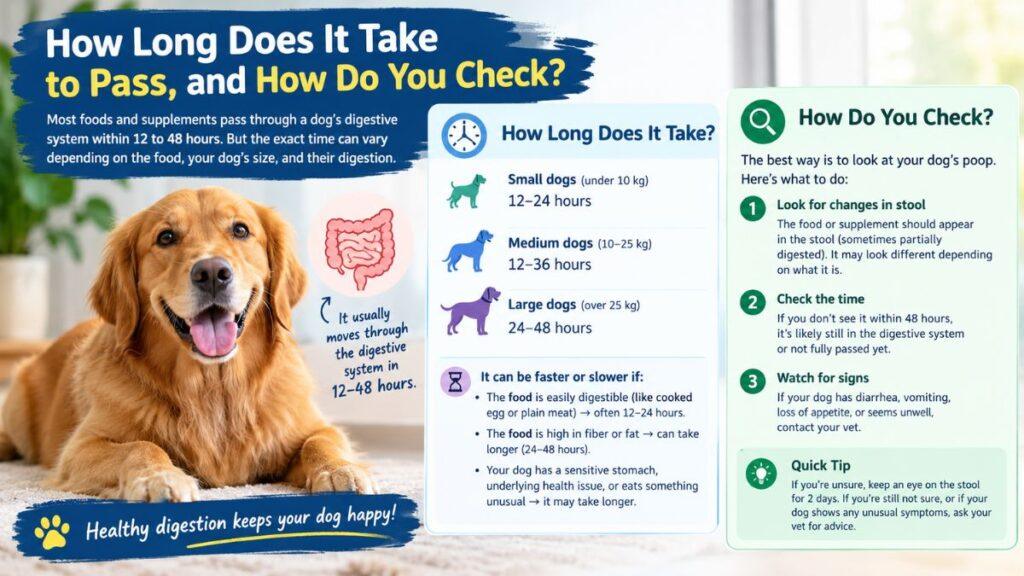
Check every stool in that window. Passed bone turns up as gritty white or chalky material, sometimes as recognizable fragments, and the stool is often harder and paler than usual. That is normal and it is what you want to see. What you do not want is straining with nothing coming out, black tarry stool, which points to bleeding higher up the gut, or fresh red blood, which points to bleeding lower down.
If 72 hours pass with nothing visible, or your dog stops passing stool altogether, call the vet even if it seems perfectly well. A partial obstruction can sit quietly for days before it turns into a full one.
What the vet will do, and what it costs
Expect a physical exam first, including hands on the abdomen feeling for pain or a palpable mass. X-rays come next, since bone shows up clearly on a radiograph. A perforation often does not, which is why ultrasound sometimes follows. Bloodwork checks for infection and for the red cell damage seasoning can cause. If the bone is still in the stomach and reachable, an endoscope can often retrieve it without opening the dog up. If it has moved into the intestine and stuck there, the answer is usually an exploratory laparotomy.
Costs in the United States vary a great deal by region and by clinic. An emergency consultation typically runs 100 to 300 dollars, with X-rays adding roughly 150 to 400. Endoscopic removal is often quoted at 1,500 to 2,500. For obstruction surgery, claims data collected in 2025 for CareCredit put the national average near 4,383 dollars, with a spread of roughly 3,471 to 7,976 depending on where you live. Bowel resection pushes it higher.
That makes a poison control call cheap insurance. And if you carry pet insurance, foreign body removal is usually covered, so check the policy before you turn down treatment on cost.
Puppies, seniors, and flat-faced breeds
Puppies have a narrower gut, so a fragment an adult dog would pass can block a puppy. They also swallow first and think later. Any bone ingestion in a puppy is a vet call, not a wait-and-see.
Senior dogs often have worn teeth and sluggish gut motility, and many carry kidney or heart conditions that make anesthesia riskier if surgery becomes necessary.
Flat-faced breeds such as Pugs, French Bulldogs, and Shih Tzus have crowded airways and a compressed throat. A bone another dog would simply swallow is likelier to lodge, and they cope badly with any airway obstruction. Lower your threshold for going in.
Safer things to give a chewer instead
Dogs chew because it settles them, so taking bones away without putting something in their place rarely works for long. Dental chews carrying the VOHC seal are a sensible start, along with solid rubber toys built for heavy chewers. Whatever you pick, try to dent it with a thumbnail. If you cannot, it is hard enough to fracture a tooth, which rules out antlers, hooves, and the nylon bones sold as indestructible.
How to stop it happening again
Most of these incidents start at the bin rather than the plate. A pedal bin in an open kitchen is not secure. Use a locking lid, keep the bin inside a cupboard, or take bones straight out to an outdoor container, double bagged, since it is the smell that draws the dog in.
Clear plates as soon as people finish instead of leaving them on a low table, and tell guests and children plainly that the dog gets nothing from the table. Barbecues and holidays are when most of these cases walk into clinics.
Frequently asked questions
Will my dog be okay if it ate a chicken bone?
Most dogs are, but a minority develop complications, so monitor for 72 hours and call your vet.
Can dogs eat raw chicken bones?
They splinter less than cooked bones but still carry choking and Salmonella risks, so talk to your vet first.
Should I make my dog throw up the bone?
No. Sharp fragments can tear the esophagus on the way back up.
How long does it take for a dog to pass a chicken bone?
Usually 24 to 72 hours, visible as white or chalky material in the stool.
Should I feed bread after my dog eats a bone?
Ask your vet first, since a full stomach complicates anesthesia if surgery is needed.
Are rotisserie chicken bones worse?
Yes, because of the onion and garlic seasoning and the fat load on top of the bone risk.
Can a chicken bone kill a dog?
Rarely, but perforation and untreated obstruction can be fatal, which is why symptoms are not ignored.
My dog ate a bone a week ago and seems fine. Should I worry?
If it is eating and behaving normally a week later, the bone has almost certainly passed.
The short version
Chicken bones are not something to hand a dog on purpose, and cooked ones do the real damage. If yours has already eaten one, the response is short. Check that it can breathe. Take any remaining bone away without a fight. Note what went down and when, then phone your vet before you do anything else. Do not induce vomiting.
After that it is three full days of paying attention, stool included. Act on vomiting, a lost appetite, a tender belly, or straining rather than waiting to see whether they settle. Size, seasoning, age, and how fast your dog eats all change the picture, so a puppy that ate a rotisserie carcass is not in the same position as a Labrador that swallowed one wing bone.
Most dogs come through this fine. The reason to take it seriously anyway is that you cannot tell in advance which dog you have, and the cases that go wrong go wrong quickly.
This article is general information, not veterinary advice. If you are worried about your dog, contact your veterinarian.