

Can dogs eat turkey? Yes, dogs can eat turkey when it is plain, fully cooked, skinless, and boneless, and when it stays a small extra rather than a full meal. The meat itself is lean and shows up as the main protein in plenty of complete and balanced dog foods. The trouble starts with everything people do to the bird before it reaches the table: butter under the skin, onion in the stuffing, garlic in the gravy, and a carcass full of brittle bones. When owners ask “can dogs eat turkey,” they usually mean that holiday bird, not a plain breast fillet, and the answer changes with every part of it.
Is turkey good for dogs?
Quick answer: Yes, plain turkey breast is one of the leanest meats you can share with a dog. Roasted without skin, it supplies protein plus niacin, vitamin B6, selenium, and zinc for very little fat. Dark meat carries more fat, and the skin causes most turkey problems.
The numbers explain why the cut matters. Based on USDA FoodData Central values, 100 grams of roasted skinless breast has about 147 calories, 30 grams of protein, and 2 grams of fat. Roasted dark meat has about 173 calories and 6 grams of fat. Roasted turkey skin jumps to roughly 442 calories and 40 grams of fat, close to 20 times the fat of the breast meat underneath it.
That lean profile is why vets often suggest plain breast for dogs on a lower-fat diet. Turkey on its own is not a complete diet, though. It is low in calcium and missing other nutrients a balanced food supplies, so use it as a topper or reward. If you want to cook full meals, start from a vet-reviewed homemade dog food recipe rather than plain meat alone.
Which parts of the turkey can dogs eat?
Quick answer: Dogs can eat plain cooked breast, small amounts of skinless dark meat, and extra-lean ground turkey. They should not eat the skin, bones, neck, gravy, stuffing, or drippings. Deli slices, bacon, sausage, jerky, and smoked turkey are too salty for regular feeding.
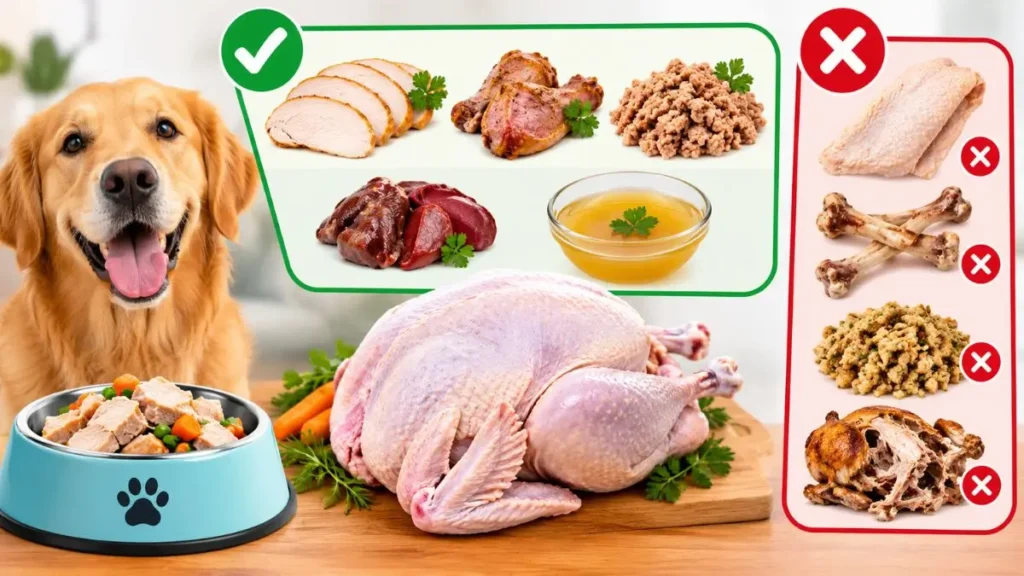
The honest answer to can dogs eat turkey depends on which part lands in the bowl, and the table below breaks it down.
| Turkey part | Safe for dogs? | Reason |
|---|---|---|
| Skinless breast, cooked plain | Yes | Leanest cut, highest protein |
| Thigh or leg meat, skinless, cooked plain | Small amounts | Nearly three times the fat of breast |
| Ground turkey, 93% lean or leaner | Yes | Cook through and drain the fat |
| Skin | No | About 40% fat and usually seasoned |
| Cooked bones, wishbone, drumstick | No | Splinter into sharp shards |
| Neck | No | A chain of small vertebrae |
| Heart and gizzard, cooked plain | Small amounts | Rich organ meat |
| Liver | Tiny amounts only | Extremely high in vitamin A |
| Gravy, drippings, stuffing | No | Fat, salt, onion, and garlic |
| Deli turkey, bacon, sausage, jerky | Avoid | Salt, preservatives, onion or garlic powder |
| Raw turkey | No | Bacteria and bird flu risk |
Deli turkey is the snack most often slipped under the table. One small piece of unseasoned lunch meat is unlikely to cause an emergency, but the salt and preservatives make it a poor habit, the same problem you find with salami and other cured meats.
How much turkey can dogs eat?
Quick answer: Keep turkey and all other treats under 10% of your dog’s daily calories. For a typical neutered adult, that means about 24 grams of skinless breast for a 10 pound dog and about 67 grams for a 40 pound dog. Start with half.
For most owners, the next question after can dogs eat turkey is how much. We worked these figures out ourselves using the resting energy requirement formula that vets use, multiplied by 1.6 for an average neutered adult. We then took 10% of the daily total and converted it to roasted skinless breast at about 1.47 calories per gram.
| Dog weight | Daily treat budget | Max skinless breast per day |
|---|---|---|
| 10 lb (4.5 kg) | About 35 calories | About 24 g (0.8 oz) |
| 20 lb (9 kg) | About 59 calories | About 40 g (1.4 oz) |
| 40 lb (18 kg) | About 99 calories | About 67 g (2.4 oz) |
| 60 lb (27 kg) | About 134 calories | About 91 g (3.2 oz) |
| 80 lb (36 kg) | About 166 calories | About 113 g (4 oz) |
Treat these numbers as a ceiling for a day when turkey is the only extra. Seniors, couch potatoes, and dogs carrying extra weight need less. The skin shows how fast fat adds up: that same 10 pound dog would use its whole treat budget on about 8 grams of roasted skin, a single strip.
How to cook turkey for dogs: 7 safe rules
Quick answer: Cook boneless, skinless turkey with no butter, oil, salt, or seasoning until the thickest part reaches 165°F. Boiling, baking, and dry pan cooking all work. Cool it, cut pieces to suit your dog’s mouth, and add it slowly over the first few days.
- Set aside a slice of breast before anyone rubs, stuffs, or bastes the holiday bird, then roast or poach it on its own.
- On an ordinary day, poach a plain breast fillet in water, or brown 93% lean ground turkey in a dry pan and pour off the fat.
- Check the thickest part with a meat thermometer and cook it to 165°F, the temperature vets recommend to cut Salmonella risk.
- Remove all skin, visible fat, and bone fragments before the meat reaches the bowl.
- Cut small cubes for toy breeds and larger strips for big dogs so nobody gulps a chunk whole.
- Offer only a few pieces the first time, then watch for loose stool or vomiting over the next 24 hours.
- Freeze extra cubes in single portions and use them as a kibble topper, a lick mat spread, or a filling for a rubber chew toy.
If you want to share something else from the holiday table, plain steamed butternut squash or a few cooked Brussels sprouts are safer sides than anything covered in gravy.
Why turkey skin and fat can trigger pancreatitis
Quick answer: A sudden fatty meal can inflame a dog’s pancreas, a painful condition called pancreatitis. Turkey skin, drippings, and gravy are classic triggers. Watch for vomiting, belly pain, diarrhea, fever, and refusal to eat, and take extra care with Miniature Schnauzers and Yorkshire Terriers.
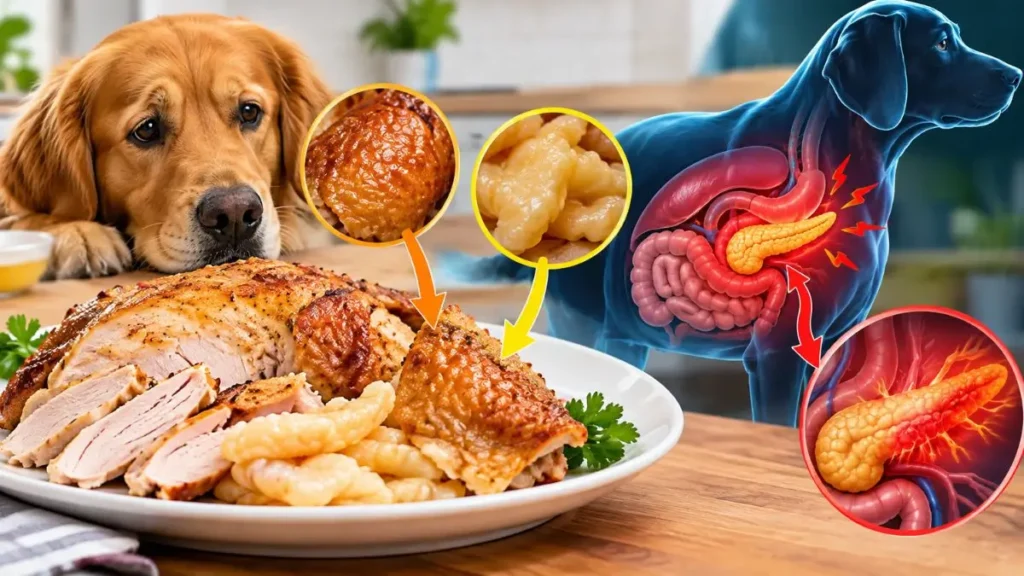
Insurance claims show the holiday pattern clearly. Trupanion reports that vomiting and diarrhea rank among its most claimed conditions over Thanksgiving, and the insurer notes that pancreatitis cases rise after holidays when dogs get fatty leftovers.
Breed plays a part too. Miniature Schnauzers, Cocker Spaniels, Poodles, Dachshunds, and Yorkshire Terriers show higher rates, so owners of these breeds should stick to lean breast or skip turkey altogether. If your dog has had pancreatitis before, ask your vet before offering any.
Onion, garlic, and other seasoning dangers
Quick answer: Onion, garlic, leeks, and chives damage a dog’s red blood cells, and most holiday turkey recipes use at least one of them. Powders in rubs, gravy, and stuffing are the strongest forms. Plain, unseasoned turkey is the only version worth sharing with your dog.
The Merck Veterinary Manual reports clinical signs in dogs after 15 to 30 grams of raw onion per kilogram of body weight, and rates garlic as three to five times more toxic than onion. For a 20 pound dog, the low end of that range is about 136 grams of raw onion. Dried flakes, powders, and soup mixes cause most cases because they pack so much into each spoonful.
Signs of anemia, such as weakness, pale gums, and reddish urine, can take a few days to appear, so call your vet even if your dog seems fine.
Other stuffing ingredients cause trouble too. Nutmeg, sage, raisins, and raw bread dough all appear on vet holiday warning lists. Herbs on the skin are a mixed bag: rosemary is generally considered safe in small amounts, but it rarely comes on a turkey without garlic, salt, and butter alongside it.
Can dogs eat turkey bones or turkey necks?
Quick answer: No. Cooked turkey bones turn brittle and splinter into sharp pieces that can cut the mouth, lodge in the throat, or pierce the gut. Raw bones can still choke or block a dog. Turkey necks are small vertebrae, so the same rule applies.
When we compared the top-ranking pages on this topic, one popular guide called cooked turkey necks fine because the meat is nutritious, while warning against cooked bones in the same article. A cooked neck is still a cooked bone. The same logic covers chicken bones and leftover rib bones.
Store-bought bones carry similar danger. In 2017 the FDA warned owners after receiving reports about roughly 90 dogs that became ill after eating processed bone treats, and about 15 of them died. Problems included choking, blockages, mouth wounds, and rectal bleeding. The agency also advised against handing over leftover chicken or turkey bones.
If your dog loves to chew, ask your vet about chews made for dogs and supervise every session. Even turkey tendon chews can cause choking when a piece is too big to swallow comfortably.
Can dogs eat raw turkey?
Quick answer: Raw turkey is not a safe choice for most homes. It can carry Salmonella, E. coli, and Campylobacter, and raw poultry pet food has carried bird flu. Dogs fed raw meat can shed bacteria in their stool. Cooking turkey to 165°F destroys these pathogens.
Bird flu became a documented raw turkey risk in December 2024. Northwest Naturals recalled a batch of its raw frozen Feline Turkey Recipe after an indoor cat in Oregon died, and genome sequencing matched the virus in the cat to the virus in the food, as the AVMA reported. State officials stressed that thorough cooking destroys H5N1.
That case involved a cat, not a dog, but it shows what raw poultry can carry. Bacteria shed in stool also put children and people with weak immune systems at risk, and the same concerns apply to raw chicken. If you feed a raw diet, work with a vet who knows your dog and handle raw turkey with the same hygiene you use for your own meals.
Can dogs with a chicken allergy eat turkey?
Quick answer: Not without your vet’s input. Many dogs allergic to chicken also react to turkey because the two birds share similar proteins. In one study, 97% of dogs with chicken-specific antibodies also recognized turkey meat. Choose any replacement protein with your veterinarian’s guidance.
Chicken is a common culprit. A review of 297 food-allergic dogs found chicken involved in 15% of cases, behind beef at 34% and dairy at 17%. Turkey did not appear on that list, which is why several sites call it an easy chicken swap.
The antibody research points the other way. A 2017 study tested blood from dogs with raised chicken-specific IgE, and nearly all of them also recognized turkey and duck meat. A positive blood result does not guarantee a dog will itch after eating turkey, but it makes turkey a risky pick during an elimination diet.
Food allergy usually shows on the skin rather than in the stomach. Watch for itching, paw licking, and ear infections that keep coming back.
What to do if your dog ate turkey bones or the carcass
Quick answer: Remove what is left, note what your dog swallowed, and call your vet or a pet poison line. Do not make your dog vomit unless a vet tells you to. For several days, watch for vomiting, belly pain, straining, bloody stool, or refusal to eat.
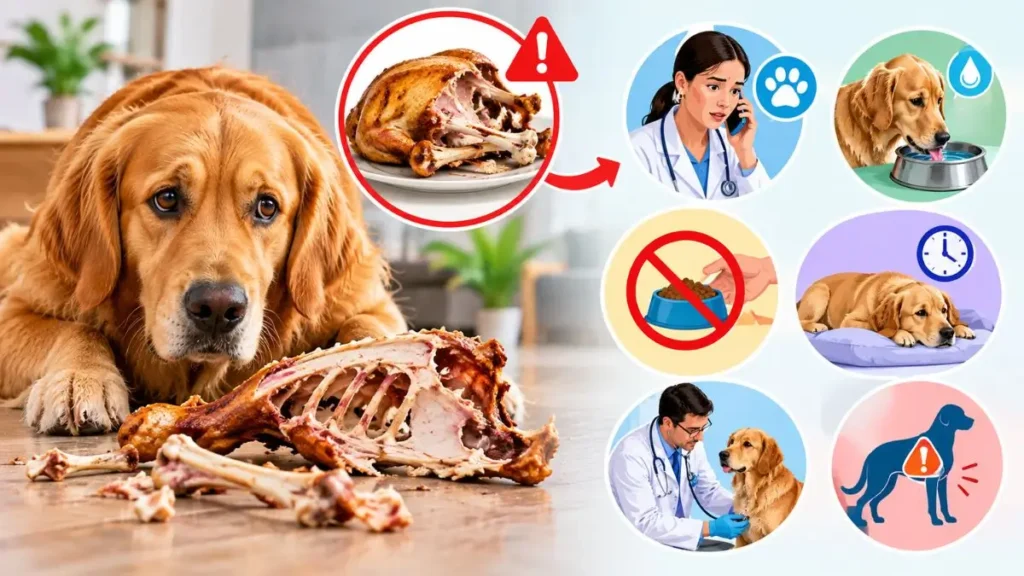
The trash can raid is the classic holiday emergency. One dog owner described coming home to an overturned kitchen bin and realizing her dog Haley had eaten an entire turkey breast carcass, with a single bone left on the floor. Vets see cases like hers every holiday season, and the right response follows the same steps.
First, move the remaining food away calmly and never snatch it from a dog that guards food. Second, note what is missing: bones, skin, gravy, stuffing, cooking twine, foil, plastic wrap, or the pop-up timer. Third, call your vet, an emergency clinic, the ASPCA Animal Poison Control Center at 888-426-4435, or the Pet Poison Helpline at 855-764-7661.
Sharp fragments can do more damage coming back up, which is why home-induced vomiting is off the table. Gasping, gagging, or pawing at the mouth means go to a clinic now.
Cooking twine is the hidden danger. Soaked in juices, it tempts dogs, and once swallowed it can bunch the intestines like a drawstring and cut through the gut wall. Plastic wrap may not even show on an X-ray. Forums often suggest feeding bread or plain pumpkin to cushion bones, but ask your vet before trying either.
How we researched this guide
Quick answer: We reviewed nine top-ranking pages for can dogs eat turkey, then checked each claim against veterinary and government sources, including the Merck Veterinary Manual, USDA nutrient data, peer-reviewed allergy studies, FDA reports, and recall notices. We also ran our calorie math for five dog sizes.
That process turned up two errors worth flagging. One widely read guide treats cooked turkey necks as safe while warning against cooked bones, and another presents turkey as a low-allergy swap for chicken, which the 2017 antibody data does not support. We corrected both here. Portion figures are estimates for healthy adults, so your own vet’s advice for your dog always comes first.
Frequently asked questions about dogs and turkey
Quick answer: These answers cover what dog owners search most about turkey, from skin and lunch meat to giblets and bland diets. The pattern holds throughout: plain, cooked, boneless, skinless turkey in small amounts is fine, while seasoned, processed, fatty, or raw turkey is not.
Can dogs eat turkey every day?
Yes, a small daily portion of plain cooked turkey is fine for most healthy dogs, as long as it stays inside the 10% treat budget. Anything bigger starts replacing balanced food, so ask your vet before turkey becomes a regular part of every meal.
Can dogs eat turkey skin?
No. Roasted turkey skin is about 40% fat, and it usually carries butter, salt, garlic, or onion from the rub. A single strip can trigger vomiting or diarrhea, and in dogs prone to it, a painful bout of pancreatitis. Peel it off before sharing.
Can dogs eat turkey thighs or dark meat?
Yes, in small amounts. Skinless dark meat from the thigh or leg has nearly three times the fat of breast meat, so it suits active, healthy dogs better than overweight dogs or dogs with a history of pancreatitis. Remove every bone before serving it.
Can dogs eat ground turkey?
Yes. Plain ground turkey labeled 93% lean or leaner works well when you brown it fully in a dry pan and drain the fat. It makes a handy alternative to ground beef as a topper. Skip any pack pre-seasoned with salt, garlic, or onion.
Can dogs eat turkey lunch meat or smoked turkey?
Not as a habit. Deli turkey and smoked turkey carry a lot of sodium and preservatives, and many brands add onion or garlic powder. One small unseasoned slice is unlikely to cause an emergency, but repeated slices add up quickly for a small dog.
Can dogs eat turkey bacon or turkey sausage?
No. Turkey bacon and turkey sausage are processed meats packed with salt, fat, preservatives, and seasoning blends that often include garlic or onion. They offer nothing plain turkey breast does not, with far more risk. The same applies to pork products like raw bacon.
Can dogs eat turkey jerky?
Skip human turkey jerky. It is cured with salt and seasonings, often including garlic and onion powder, and the dry, chewy strips can be a choking risk for dogs that gulp. For a jerky-style reward, choose a single-ingredient treat made for dogs and supervise chewing.
Can dogs eat turkey and rice for an upset stomach?
Often, yes. Boiled lean turkey with plain white rice can stand in for the classic chicken and rice bland meal, as long as your dog tolerates poultry. Use it for only a few days, and see a vet if diarrhea lasts beyond 48 hours.
Can dogs eat turkey gravy or stuffing?
No. Gravy is mostly fat and salt, and most recipes use onion, garlic, or a stock made with them. Stuffing adds onion, sage, nutmeg, and sometimes raisins. If you want to moisten kibble, use a little plain, onion-free broth instead of pan juices.
Can dogs eat turkey giblets, hearts, or liver?
Plain cooked heart and gizzard are fine in small amounts. Liver is the exception, because turkey liver is extremely rich in vitamin A, so offer only a tiny piece now and then. Never feed giblets cooked inside a seasoned bird or in gravy.
Can puppies eat turkey?
Yes, a little plain cooked white meat is fine for puppies as an occasional treat. Their stomachs are more sensitive than an adult dog’s, so start with one or two tiny pieces. Turkey should never replace puppy food, which is balanced for healthy growth.
Is turkey better than chicken for dogs?
Turkey breast is slightly leaner than chicken breast, with about a quarter of the fat per 100 grams raw. Both are good lean proteins. Turkey is not hypoallergenic, though, because most chicken-allergic dogs also react to turkey in antibody testing. Choose whichever your dog tolerates.
Does turkey make dogs sleepy?
No. Turkey does contain tryptophan, but the amount is far too small to make a dog drowsy. A dog napping after a holiday meal is more likely worn out by visitors, excitement, and a full stomach than by anything in the meat itself.
Final verdict: can dogs eat turkey?
Quick answer: Dogs can eat turkey safely when it is plain breast meat, skinless, boneless, unseasoned, cooked to 165°F, and small enough to fit the 10% treat budget. For a 20 pound dog, that means about 40 grams on a day with no other treats.
The meat is rarely the problem. Skin, bones, seasoning, and raw handling cause almost every turkey emergency vets see, Take extra care if your dog has had pancreatitis, belongs to a breed prone to it, or has a known chicken allergy, since turkey may not be the easy swap it seems. If your dog raids the carcass, skip home remedies, remember the twine and pop-up timer, and call your vet or a poison line right away. Then bag the leftovers and take them straight to an outdoor bin before dessert. The next time someone at the table asks “can dogs eat turkey,” hand over a plain slice of breast and keep the skin for yourself.