

Can dogs eat bread? Yes, dogs can eat plain baked bread in small amounts. It will not poison them. That is the easy part, and it is where most articles stop.
The harder part is that one slice of white bread carries about 75 calories, and a 10 pound dog only has room for roughly 35 treat calories in an entire day. So when people ask can dogs eat bread, the honest answer is not yes or no. It is yes, but the slice you were about to hand over is probably twice what your dog can afford.
This guide answers can dogs eat bread in real numbers, shows which breads are genuinely dangerous, and tells you what to do in the next hour if your dog already ate something they should not have.
Can dogs eat bread safely?
Can dogs eat bread safely? In small amounts, yes, as long as it is plain and fully baked. Bread is not toxic to dogs the way chocolate or raisins are. It is simply empty.
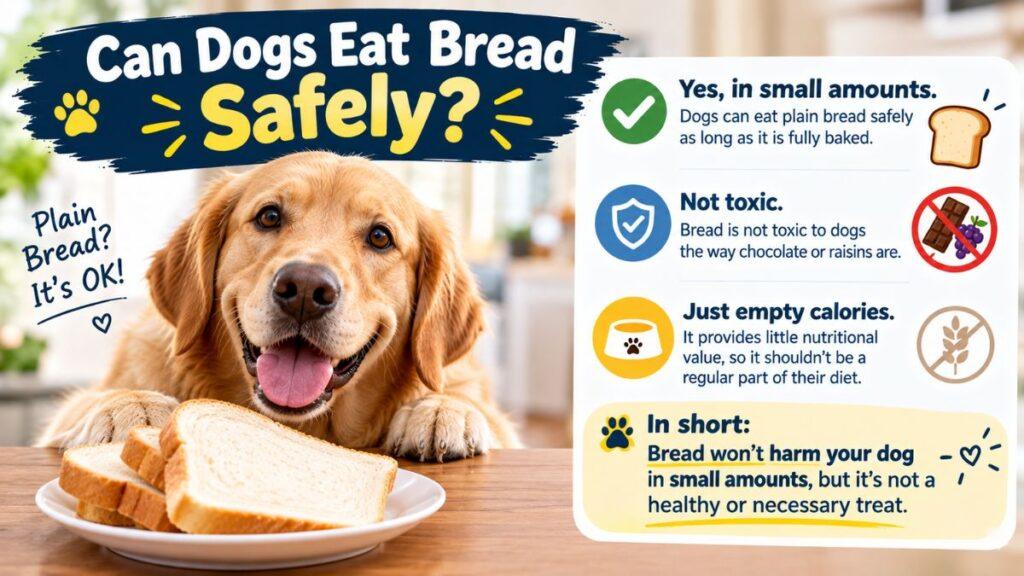
A slice of white bread is flour, water, yeast and salt. That gives your dog carbohydrates and almost nothing else. No meaningful protein, very little fiber, none of the vitamins a complete diet already covers. The question is less about poison and more about what you are spending those calories on.
Bread also behaves differently in a dog’s gut than in yours. Larger portions ferment, which means gas and sometimes a loose stool the next morning. A quarter slice will not do that. Half a baguette will.
How much bread can dogs eat in a day?
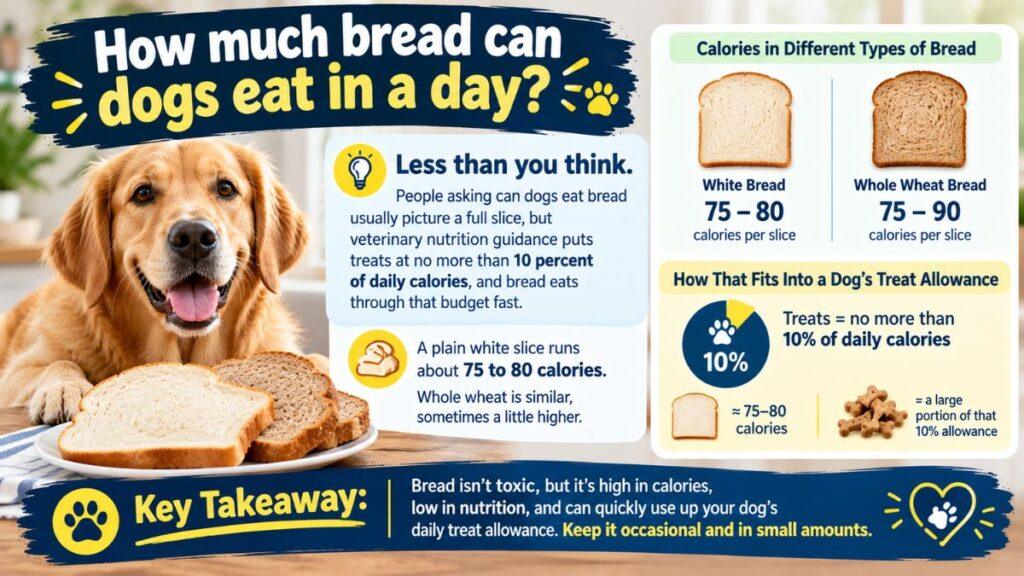
Less than you think. People asking can dogs eat bread usually picture a full slice, but veterinary nutrition guidance puts treats at no more than 10 percent of daily calories, and bread eats through that budget fast.
A plain white slice runs about 75 to 80 calories. Whole wheat is similar, sometimes a little higher. Here is how that lands against a normal adult dog’s treat allowance:
| Dog weight | Daily calories (approx) | Treat budget (10%) | One slice of white bread |
| 10 lb | 345 | 35 cal | 215% of the daily budget |
| 20 lb | 585 | 59 cal | 127% of the budget |
| 30 lb | 790 | 79 cal | 95% of the budget |
| 50 lb | 1,165 | 117 cal | 64% of the budget |
| 70 lb | 1,500 | 150 cal | 50% of the budget |
A single slice is more than a Chihuahua’s entire snack allowance for the day, before the dental chew and the training treats.
A workable rule: dogs under 20 pounds get no more than a quarter slice, once or twice a week. Dogs between 20 and 50 pounds get half a slice. Dogs over 50 pounds can have a full slice. On any day you give bread, take that much out of dinner. These are calories, not extras.
Which types of bread can dogs eat?
Can dogs eat bread of every kind? No. Seven types are safe when plain and fully baked. Five are genuinely dangerous. The rest sit somewhere in between.
| Bread | Verdict |
| Plain white | Safe in small amounts |
| Plain whole wheat | Safe, slightly more fiber |
| Plain toast, no toppings | Safe |
| Bread crusts, plain | Safe, no nutritional value |
| Plain pita, naan, tortilla | Usually safe if unflavored |
| Baked sourdough, plain | Safe once fully baked |
| Gluten-free, plain | Safe, check for xylitol |
| Seeded or multigrain | Risky, some seeds irritate the gut |
| Bagels and dinner rolls | Risky, high calorie and often salted |
| Cornbread | Risky, usually heavy on sugar and butter |
| Banana bread | Avoid, sugar plus possible nuts or chocolate |
| Pumpkin bread | Avoid, often contains nutmeg |
| Garlic bread | Never |
| Raisin or cinnamon raisin bread | Never |
| Chocolate bread or babka | Never |
| Raw dough of any kind | Emergency |
| Moldy bread | Emergency |
The pattern is simple. Once bread stops being flour, water, yeast and salt, it starts being a problem. That is the whole logic behind whether dogs can eat bread of a given type.
Can dogs eat bread dough?
No. Raw bread dough is the one that sends dogs to the emergency room. If your dog swallowed rising dough, stop reading and call your vet.
Two things happen at once. The dough keeps rising in the warm, moist stomach, which can cause painful distension and in some cases gastric dilatation or torsion. At the same time the yeast ferments the sugars into ethanol, which the dog absorbs into the bloodstream. That is alcohol poisoning in an animal that weighs a fraction of what you do. The FDA lists raw dough among the genuinely dangerous household items for pets, and bread dough toxicosis is well documented in the veterinary emergency literature.
Watch for a swollen or hard belly, retching without producing anything, wobbliness, disorientation, and laboured breathing. Do not wait to see if it passes, and do not make your dog vomit at home unless a vet tells you to.
Can dogs eat bread with raisins, garlic or xylitol?
Most pages answering can dogs eat bread wave vaguely at toxic ingredients and move on. The numbers matter, because they tell you whether you are dealing with a wait and watch situation or a drive to the clinic.
Raisins are the worst offender by a wide margin. The Merck Veterinary Manual now advises that more than one grape or raisin per 10 pounds of body weight may carry enough tartaric acid to risk kidney damage. For a 20 pound dog, that is three raisins. A single slice of raisin bread can easily hold fifteen. Dogs lack the transporter humans use to clear tartaric acid, so it builds up in the kidneys. There is no dose anyone is willing to call safe.
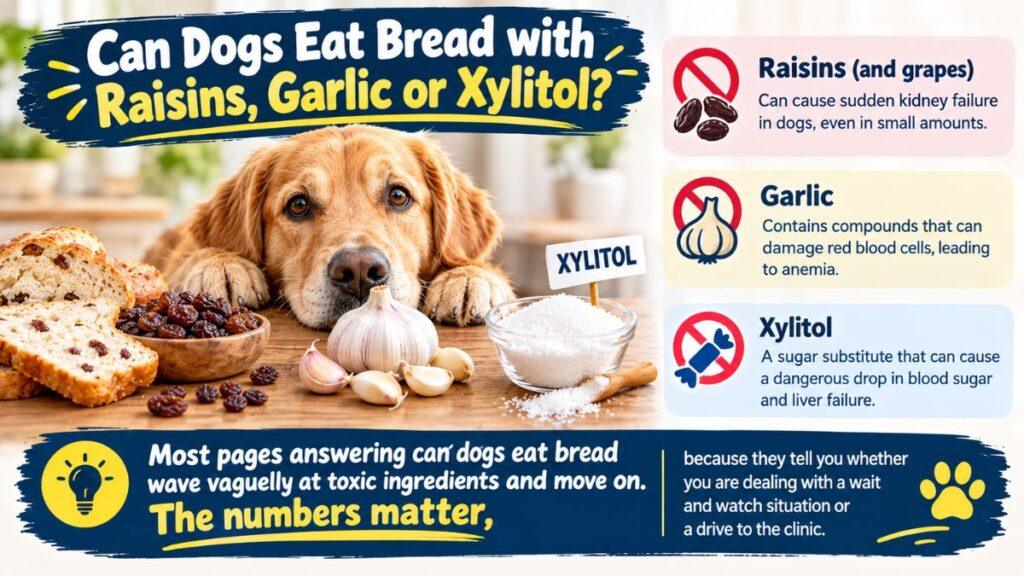
Xylitol is the second. Hypoglycemia has been reported in dogs at roughly 100 mg per kilogram of body weight, and liver injury at around 500 mg per kilogram. Some low sugar and keto breads use it, and on a label it may appear as birch sugar. Blood sugar can crash within 30 to 60 minutes.
Garlic and onion damage red blood cells. Toxic effects in dogs have been reported at about 5 grams of garlic per kilogram, and 15 to 30 grams per kilogram for onion. Garlic is roughly three to five times stronger than onion, and garlic powder is more concentrated again. The cruel part is the delay. Vomiting may show up the same day, but the anemia itself often takes several days to appear, by which point most owners have stopped connecting it to the garlic bread.
Chocolate, macadamia nuts and nutmeg round out the list. All three turn up in sweet breads that look harmless on the counter.
Can dogs eat moldy bread?
Never, and this is the gap almost nobody writes about.
Penicillium molds growing on bread produce tremorgenic mycotoxins, mainly penitrem A. These cross into the brain and interfere with the signals that keep muscles steady. Veterinary toxicology reporting notes poisonings after a dog ate as little as one slice of moldy bread.
Signs come on fast: drooling, whole body tremors, a staggering walk, extreme sensitivity to noise and touch, and seizures. Treatment usually works well when the dog gets there in time, but the window is short because the toxin absorbs quickly.
The practical takeaway is about your bin, not your plate. A dog that raids the kitchen garbage at 2am is the classic case. Use a lidded bin, and throw green bread outside rather than into a bag the dog can reach.
My dog just ate bread. What now?
The answer to can dogs eat bread changes completely depending on what kind. Start by identifying which situation you are in.
If it was plain baked bread and a small amount, you are fine. Skip a treat later, keep water available, and watch for gas or a loose stool over the next day. No vet call needed.
If it was a large amount of plain bread, say half a loaf, expect bloating and possible vomiting. Withhold the next meal, offer water, and call your vet if the belly feels tight or your dog cannot settle.
If it contained raisins, xylitol, chocolate, garlic, onion or macadamia nuts, call now. Early treatment inside the first two hours changes the outcome dramatically for raisins in particular.
If it was raw dough or visibly moldy bread, treat it as an emergency and go in.
Keep these numbers in your phone. ASPCA Animal Poison Control Center: (888) 426-4435. Pet Poison Helpline: (855) 764-7661. Both run 24 hours and charge a consultation fee, which is the cheapest part of the episode. Before you call, weigh your dog, save the packaging, and note the time they ate it. Those three details shape the advice you get.
Can dogs eat bread from the supermarket? Read the label
Thirty seconds with the ingredient list prevents most of the problems above, and it turns can dogs eat bread from a guess into a decision. Scan for xylitol or birch sugar, raisins, sultanas or currants, garlic and onion powder, chocolate or cocoa, macadamia or walnut pieces, and nutmeg.
Two patterns catch people out. Supermarket healthy and low carb breads are the most likely to contain xylitol, so the loaf that looks best for you may be the worst for your dog. Bakery loaves sold loose often carry no label at all. If you cannot read the ingredients, do not share it.
Which dogs should never eat bread?
For some dogs the answer to can dogs eat bread is a flat no. They do not get the small allowance described above.
Diabetic dogs respond badly to refined carbohydrates, and bread interferes with the glucose control you and your vet are working to maintain. Overweight dogs cannot spare the calories. Dogs with a history of pancreatitis should avoid anything buttered or oily, which rules out most bread as it is actually served. Dogs with wheat or gluten sensitivity will show it through itchy skin, recurrent ear infections, loose stools or gas.
Puppies are a separate case. They need every calorie to go toward growth, and a puppy under six months has no reason to eat bread at all. Senior dogs with reduced activity or kidney and heart conditions also do better without the sodium and empty calories.
Two bread myths worth clearing up
Two claims come up every time someone asks can dogs eat bread, and both are wrong.
Bread does not settle an upset stomach. When a vet recommends a bland diet for digestive upset, it is boiled white rice with plain chicken or turkey, not toast. Bread ferments and produces gas, which is the opposite of what an inflamed gut needs. If your dog has had diarrhea for more than a day, that is a vet conversation, not a bread one.
Sourdough is not automatically off limits. Some sources say avoid it, others say it is fine, and both are half right. Fully baked sourdough is dead, because the heat kills the culture. The danger is the starter, that jar of active culture on the counter, which is raw dough that never stops fermenting. Baked loaf, fine. Jar on the counter, keep it shut away.
Better things to give instead of bread
Once you know the real answer to can dogs eat bread, the next step is finding something better. Most of these cost fewer calories and do more good. Baby carrots run about 5 calories each and help scrape teeth. Green beans are filling and nearly free calorically. Blueberries are roughly 1 calorie each and make excellent training rewards. Apple slices with the seeds removed give sweetness without the carb load. Watermelon and cucumber are mostly water.
The best trick costs nothing. Set aside a handful of your dog’s own kibble in the morning and use it as treats through the day. Zero extra calories, and the dog does not know the difference.
Can dogs eat bread? FAQs
Can dogs eat bread every day?
No, the calories add up and bread provides nothing your dog needs.
Can dogs eat bread instead of dog food?
No, bread is not a complete diet and cannot replace a meal.
Can dogs eat bread crusts?
Yes, plain crusts are fine, but they count toward the same calorie budget.
Can dogs eat bread and butter?
No, butter adds fat and salt that can trigger stomach upset or pancreatitis.
Can dogs eat bread dough?
No, raw dough is a genuine emergency and needs a vet the same day.
Can dogs eat bread with seeds?
Not ideally, since mixed seeds and nuts are harder on a dog’s digestion.
Can puppies eat bread?
No, puppies under six months should skip it entirely.
Can dogs eat toast?
Yes, if it is plain, with no butter, jam or spread.
Can dogs eat garlic bread?
No, garlic damages red blood cells and the butter adds pancreatitis risk.
Can dogs eat bread? The bottom line
So, can dogs eat bread? Bread is not poison and it is not food. It sits in an awkward middle where a small piece of plain baked bread does nothing bad and nothing good, while the calories quietly eat a hole in your dog’s daily budget. If you enjoy sharing your toast crust with your dog, keep doing it. Just make it plain, keep it to a quarter slice for a small dog or half for a medium one, and cut dinner slightly to match.
What actually deserves your attention is narrower than the internet suggests. Five things turn a kitchen moment into a vet bill: raw dough, moldy slices, garlic bread, raisin bread and anything sweetened with xylitol. Everything else is a calorie conversation.
Keep the poison control numbers in your phone, read the label before you tear off a piece, and put a lid on your bin. For more on what belongs in your dog’s bowl, see our guides on strawberries and tomatoes.
This article is general information and does not replace advice from your own veterinarian, who knows your dog’s history.
2 thoughts on “Can Dogs Eat Bread? 7 Safe Types and 5 Dangerous Ones”