

Can dogs eat lettuce? Yes. Plain, washed romaine, leaf, butter and iceberg lettuce are safe, non-toxic treats for dogs, and they are almost calorie free. Serve small chopped pieces in moderation, never with dressing or mixed salad, and stop if loose stools show up.
Most owners ask “can dogs eat lettuce?” with a salad in one hand and a pair of begging eyes at their knee. The leaf itself is rarely what makes a dog sick. The trouble comes from what travels with it: Caesar dressing, onion slices, a recalled bagged mix, or slug pellets around a backyard vegetable bed.
For this guide we took nutrient values from USDA FoodData Central, checked poisoning guidance from Pet Poison Helpline and VCA Animal Hospitals, and read CDC data on packaged salad outbreaks, so every number below has a source behind it.
Can dogs eat lettuce safely, or is it toxic?
Lettuce is safe for dogs. It belongs to the daisy and sunflower plant family, contains no compounds known to poison dogs, and the American Kennel Club and Pet Poison Helpline’s veterinary toxicologist both call it safe. Portion size and add-ons decide whether it causes trouble.
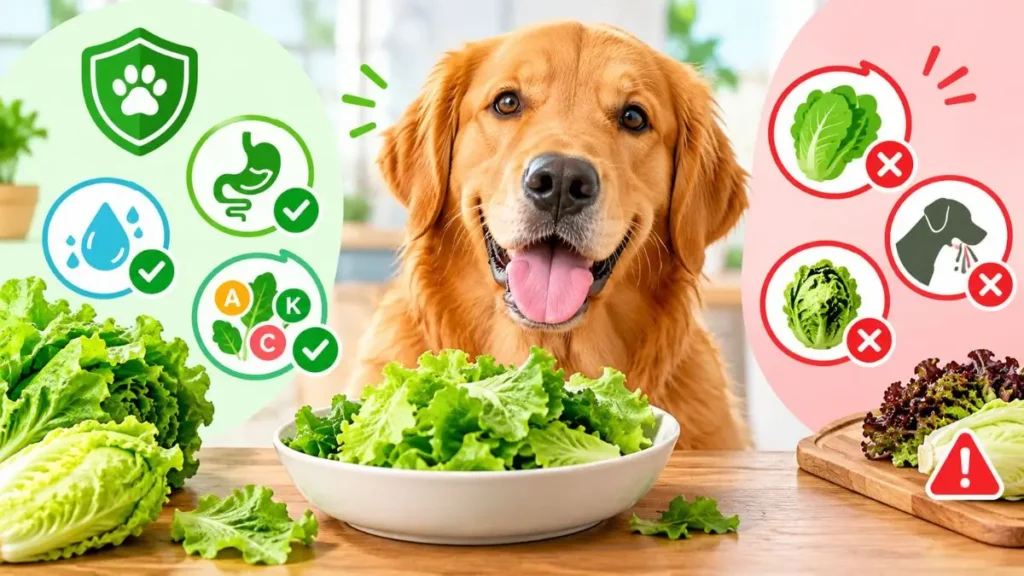
Garden lettuce (Lactuca sativa) has none of the sulfur compounds that make onions and garlic dangerous. Dr. Renee Schmid, a veterinary toxicologist at Pet Poison Helpline, told Rover in 2025 that lettuce is safe for dogs, while pointing out that it adds little to a complete and balanced diet. Dr. Jessica Apted, a regional medical director at Sploot Veterinary Care in Denver, described it to Chewy as low in calories and generally safe in moderation.
That matches what you will find across veterinary sources: a harmless snack, never a meal replacement.
When a dog does get sick after eating lettuce, the cause almost always matches one of the five risks covered further down.
Lettuce nutrition for dogs: what it really provides
Lettuce gives dogs water, a little fiber, vitamin K, folate and beta-carotene, which dogs convert to vitamin A. Romaine is the most useful common type. Iceberg is about 96 percent water. Neither adds much to a complete dog food, so treat lettuce as a snack.
USDA FoodData Central figures show how far apart the two supermarket favorites are:
| Per 100 grams (raw) | Romaine | Iceberg |
|---|---|---|
| Calories | 17 | 14 |
| Water | 94.6 g | 95.6 g |
| Fiber | 2.1 g | 1.2 g |
| Vitamin A (RAE) | 436 mcg | 25 mcg |
| Vitamin K | 102.5 mcg | 24.1 mcg |
| Folate | 136 mcg | 29 mcg |
| Potassium | 247 mg | 141 mg |
By weight, romaine carries roughly 17 times the vitamin A activity of iceberg and about four times the vitamin K. A shredded cup of romaine (about 47 grams) has around 8 calories.
Two benefits get overstated in many guides. Healthy dogs make their own vitamin C, so the small amount in lettuce does little for them. And a full cup of romaine holds only about 1 gram of fiber, most of it insoluble.
That can nudge digestion in a sensitive dog, but it will not fix constipation. If you want more fiber from a vegetable, cooked sweet potatoes and butternut squash carry more of it by weight and are easier to portion.
Which types of lettuce can dogs eat?
Romaine and red or green leaf lettuce are the best choices because they carry more nutrients. Butter lettuce is fine once the root ball is removed. Iceberg is safe but mostly water. Arugula is safe in small amounts, though some dogs dislike the peppery taste.
| Type | Safe for dogs? | How to serve it |
|---|---|---|
| Romaine (cos) | Yes | Chop the leaves. Slice the thick rib and core small, or skip them for small dogs. |
| Green or red leaf | Yes | Tear into bite-size pieces. Darker leaves generally carry more nutrients. |
| Butter (Bibb, Boston) | Yes | Cut off the root ball on hydroponic heads. |
| Iceberg (crisphead) | Yes | Mostly water. Keep portions small to avoid loose stools. |
| Arugula | Yes, in small amounts | Mix a few leaves into food if your dog accepts the taste. |
| Spring mix or bagged salad | Check the label | Many mixes include spinach, kale or add-in packets. |
Can dogs eat lettuce leaves from a bagged spring mix? Usually, but read the bag first. Spinach and kale often share it. The American Kennel Club notes that spinach is high in oxalic acid, which blocks calcium absorption, and that kale contains compounds that can irritate the stomach.
Our guide to kale for dogs explains how much is safe. Cabbage looks similar to lettuce but comes from a different plant family, so check whether dogs can eat cabbage before swapping it in.
How much lettuce can a dog eat?
A small dog under 10 pounds can have about a quarter cup of chopped lettuce, a medium dog about half a cup, and a large dog about one cup. Keep all treats under 10 percent of daily calories, and offer it a few times weekly.
| Dog size | Body weight | Chopped lettuce per serving |
|---|---|---|
| Small | Under 10 lb (4.5 kg) | About 1/4 cup |
| Medium | 10 to 20 lb (4.5 to 9 kg) | About 1/2 cup |
| Large | Over 20 lb (9 kg) | About 1 cup |
These serving sizes follow general guidance from Dr. Schmid. Calories are rarely the limit. A dog that eats 800 calories a day has an 80 calorie treat allowance, and a full cup of romaine uses about 8 of those. The gut sets the real limit.
Lettuce is mostly water and insoluble fiber, so a dog that suddenly eats a lot of it tends to answer with gas or soft stool. That is why a large dog who is fine with a cup of romaine can still get loose stools after demolishing a whole head of iceberg.
Start with two or three bite-size pieces, wait a day, and increase only if stools stay normal. A handful a few times a week is a treat. A heaping bowl every day invites digestive upset.
How to prepare lettuce for your dog
Rinse the leaves under running water, cut away the core and any root ball, and chop or tear the lettuce into bite-size pieces. Serve it plain, either raw for crunch or lightly steamed for seniors and sensitive stomachs, with no oil, salt or seasoning.

Raw lettuce suits most dogs and keeps the crunch. Steaming for a minute or two softens the fibers, which helps older dogs, dogs with dental problems and dogs that get gassy on raw greens. Let it cool first. Skip sauteing, since butter, oil and garlic are exactly what you want out of the bowl. If you cook for your dog, finely chopped romaine can add volume to a homemade dog food recipe for a dog on a weight loss plan, as long as the recipe itself is balanced.
Some trainers use lettuce as enrichment rather than food. Ella Camps-Linney and Alistair Mackenzie of Kirby Dog Training suggested a whole head of iceberg as a shredding toy for dogs that tear up paper and cardboard. In their video, their dog Banjo happily pulled it apart while Byron ignored it completely. If you try it, put a towel down, stay close, and take the head away once your dog starts swallowing big chunks.
5 surprising risks of feeding lettuce to dogs
The five risks are eating too much at once, toxic salad add-ins, fatty dressings and toppings, bacteria from contaminated or recalled greens, and slug bait on garden lettuce. Apart from overeating, every one of them comes from something that travels with the leaf.
1. Too much at once. Lettuce is mostly water and insoluble fiber. A big serving, or a whole stolen head, usually means gas and loose stool for a day. Dogs with sensitive stomachs react to smaller amounts, so start small and let the stool guide you.
2. Toxic salad add-ins. Onions, garlic, chives, grapes, raisins and macadamia nuts are poisonous to dogs, and they turn up in salads all the time. Nuts such as almonds are not in the same danger class, but they are fatty and can choke small dogs. Fresh cilantro is fine in small amounts, and so are fruit toppings like blueberries and strawberries, as long as they were not tossed in dressing.
3. Fatty dressings and toppings. The riskiest lettuce in the house is lettuce that has already been used. Caesar salad brings garlicky dressing, salty cheese and croutons that are often seasoned with garlic or onion powder, so they are a different food from plain bread. A wedge salad adds blue cheese dressing and bacon bits, which is a lot of fat for one dog. Honey mustard dressing adds sugar and spice, and burger lettuce picks up raw onion, sauce and salt. Creamy or oily dressings can contribute to pancreatitis, and some sugar free products use xylitol, which is dangerous to dogs.
4. Bacteria and recalls. Most advice stops at “wash it well,” which undersells the issue. A CDC study in Emerging Infectious Diseases counted 8 US listeriosis outbreaks linked to packaged salads between 2015 and 2024, and roughly 240 packaged salad products recalled over possible Listeria contamination from January 2015 to May 2024. It also cites research showing that romaine and iceberg can take Listeria into the plant itself, so rinsing cannot guarantee a clean leaf. If a recall tells people to throw lettuce away, it is not safe for your dog either.
5. Slug bait on garden lettuce. Metaldehyde, found in many slug and snail baits, causes what vets call shake and bake poisoning: tremors, seizures and a dangerously high body temperature. VCA Animal Hospitals says signs can appear within minutes to three hours after a dog eats it, and Pet Poison Helpline advises treating a baited area as contaminated for at least two weeks. If you bait your vegetable bed, do not feed your dog lettuce from it.
Can puppies, senior dogs and dogs with health issues eat lettuce?
Puppies eating solid food can try a few tiny pieces of plain lettuce. Senior dogs may handle it better lightly steamed. Dogs on prescription diets, and dogs with chronic stomach or bowel problems, should only get lettuce if their veterinarian approves it first.

Puppies need every bite to count toward growth, so keep lettuce a rare taste and chop it very small, because puppies gulp. For overweight adult dogs, swapping a biscuit for a few romaine pieces saves calories without losing the treat ritual. Romaine also has only about 1 gram of sugar per 100 grams, so it can suit diabetic dogs whose vet wants low calorie treats.
Dogs on prescription diets are the clear exception. Chewy’s veterinary guidance says these dogs should get no food or treats outside the diet, because those formulas are balanced for a specific condition. Dogs with inflammatory bowel disease or recurring colitis can react to small changes too, so ask first.
What to do if your dog ate lettuce or salad
If your dog ate plain lettuce, even a whole head, expect gas or loose stool. Offer water and watch for a day. Call a vet if vomiting repeats, stools turn bloody, or the lettuce came with onion, garlic, grapes, dressing or garden bait.
Dogs really do eat whole heads. A Labrador named Morty, whose owner films his kitchen thefts for Instagram, was caught trotting off with an entire head of lettuce in his mouth. For a healthy medium or large dog, that usually means a gassy evening and a soft stool or two. Work through it in this order:
- Find out what was eaten. Check the trash and packaging for dressing, onion, garlic, grapes, raisins, nuts or xylitol.
- Call right away if anything toxic or garden bait is possible. Contact your vet, the ASPCA Animal Poison Control Center at (888) 426-4435 or Pet Poison Helpline at (855) 764-7661. Both may charge a fee. Do not make your dog vomit unless a vet tells you to.
- If it was plain lettuce, keep things simple. Give fresh water, skip other treats and watch your dog for 24 hours. If stools turn soft, ask your vet whether a day of bland food with plain white rice makes sense.
- Call your vet if symptoms build. Repeated vomiting, bloody or black stool, a painful belly, weakness or a full day without eating all need a vet. So does a small dog that swallowed the core whole and then retches or strains.
Healthy alternatives if your dog loves lettuce
If your dog loves lettuce for the crunch, cucumber, celery, green beans and carrots give the same satisfying bite. Cucumber and celery are similarly low in calories, green beans add more fiber, and carrots are sweeter and denser, so portion them more carefully.
For more variety, cooked brussels sprouts and okra work in small amounts, and chilled honeydew is a hydrating summer option with more sugar than lettuce. Rotate two or three foods and keep the same rules: plain, washed, cut small, and introduced one at a time so you know which one caused any upset.
Frequently asked questions about dogs and lettuce
Is lettuce good for dogs?
Lettuce is good for dogs as an occasional low calorie treat, not as a source of nutrition. Romaine and leaf lettuce add small amounts of vitamin K, folate and beta-carotene, plus water and crunch. A complete dog food already covers everything your dog needs.
Can dogs eat lettuce every day?
Most healthy dogs can have a small amount of plain lettuce daily, but a few times a week is a safer habit. Daily heaps of lettuce add bulk without much nutrition and can cause gas or soft stools, especially in sensitive dogs.
Can dogs eat romaine lettuce?
Yes. Romaine is the best common lettuce for dogs because it carries far more vitamin A, vitamin K and folate than iceberg. Wash it, chop the leaves into small pieces, and slice or remove the thick central rib and core for small dogs.
Can dogs eat iceberg lettuce?
Yes, iceberg lettuce is safe for dogs, but it is about 96 percent water and low in vitamins. It works as a hydrating, almost calorie free crunch on hot days. Large amounts are the main problem, since too much can loosen stools.
Can dogs eat lettuce raw or cooked?
Dogs can eat lettuce raw or cooked, as long as it is plain. Raw leaves keep the crunch most dogs enjoy, while lightly steamed lettuce is softer for seniors and sensitive stomachs. Avoid sauteed or grilled lettuce, which usually carries oil, butter or garlic.
Can dogs eat lettuce stems and cores?
Dogs can eat lettuce stems and cores, but they are the parts most likely to cause choking or a blockage if swallowed whole. Chop them into small pieces, or remove them for small dogs, puppies and dogs that gulp food. Cut off hydroponic root balls.
Can puppies eat lettuce?
Puppies can eat a few tiny pieces of plain lettuce once they are fully weaned onto solid food. Keep it rare, because puppies need calorie-dense nutrition for growth, and chop it very small since they tend to gulp. Stop if their stools soften.
Can lettuce give dogs diarrhea?
Yes, too much lettuce can give dogs diarrhea. It is mostly water and insoluble fiber, so a large serving or a sudden change can loosen stools. Mild cases usually settle quickly; call your vet if diarrhea lasts beyond a day or contains blood.
What happens if my dog eats lettuce with ranch or Caesar dressing?
A small lick of ranch or Caesar dressing may only upset your dog’s stomach, but both usually contain garlic or onion, and they are high in fat. Call your vet or a pet poison line if your dog is small or ate a lot.
Can dogs eat spring mix or bagged salad?
Dogs can eat spring mix in small amounts if every green in the bag is dog safe. Check the label first, since mixes often include spinach, kale or herbs, and many kits hide dressing, croutons or cheese packets. Look up recalls before sharing bagged greens.
Does lettuce help a constipated dog?
Lettuce is not a reliable fix for constipation. A full cup of romaine has only about 1 gram of fiber, mostly insoluble. Ask your vet about better options such as plain canned pumpkin, and call if your dog strains without passing stool.
What vegetables should dogs never eat?
Dogs should never eat onions, garlic, leeks, chives or shallots, raw or cooked, because these allium vegetables damage red blood cells. Wild mushrooms are also dangerous. Safe crunchy swaps include lettuce, cucumber, carrots and green beans, served plain and cut into small pieces.
Why does my dog love lettuce?
Most dogs that love lettuce seem to enjoy the crunch and the cool, watery texture. Some also like tearing leaves apart, the same urge behind shredding paper and toys. Liking lettuce is normal, so just keep portions small and plain.
Final verdict: can dogs eat lettuce?
Yes, dogs can eat lettuce, and it earns a spot in the treat rotation for what it lacks: fat, sugar and nearly all calories. Plain romaine or leaf lettuce, washed and chopped, is a safe crunch for most dogs, and iceberg works in modest amounts.
Use the size guide of roughly a quarter cup for small dogs up to a cup for large ones, and let your dog’s stools tell you whether that amount suits them. Keep dressings, mixed salads, sandwich lettuce and anything touched by onion or garlic out of the bowl, and if your dog raids a salad, check what else was in it first.
Check recall notices before sharing bagged greens, and never feed lettuce from a garden bed treated with slug bait. If your dog eats a prescription diet or has a chronic gut problem, get your vet’s approval first. For everyone else, a few crisp pieces of lettuce are one of the easiest healthy yeses in the kitchen.
How we researched this guide
We took nutrient values from USDA FoodData Central, poisoning guidance from Pet Poison Helpline and VCA Animal Hospitals, outbreak data from a December 2025 CDC report, and expert comments veterinarians gave Rover and Chewy. This article is general information, not a substitute for veterinary advice.
Sources: USDA FoodData Central (lettuce, cos or romaine, raw; lettuce, iceberg, raw); CDC, Emerging Infectious Diseases, December 2025; VCA Animal Hospitals; Pet Poison Helpline; American Kennel Club. Last reviewed September 2026.