
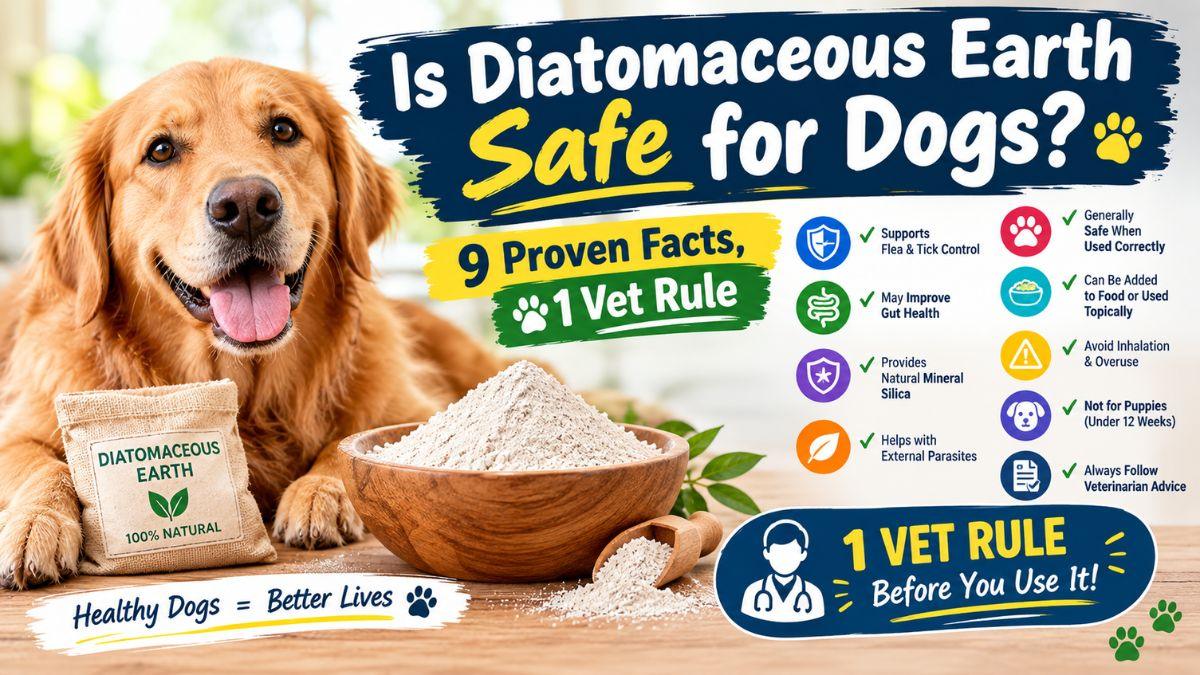
Is diatomaceous earth safe for dogs? Food grade diatomaceous earth is safe for dogs in the sense that it is not toxic, and a dog who licks a small amount off the floor is very unlikely to be poisoned by it. That is the part almost everyone agrees on. The disagreement starts one step later, over whether you should put the powder on your dog’s coat or mix it into his dinner, and there the advice splits cleanly in two. Companies that sell it say yes, with a dosing chart. Veterinarians, including the ones who review articles for PetMD and the American Kennel Club, mostly say no, because the powder is abrasive, the dust irritates airways, and no published study has ever tested it in dogs.
Why it kills fleas but does not shred your dog
This is the question people ask most often, and almost no article answers it properly. If the powder works by cutting insects open, why does it not do the same thing inside a dog?
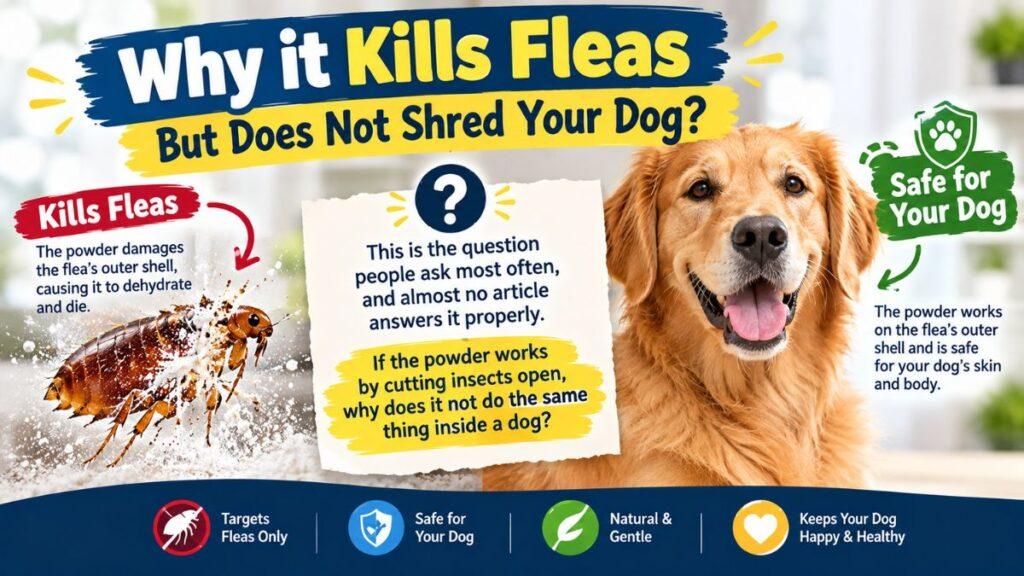
Diatomaceous earth is made from the fossilised silica shells of diatoms, a type of algae. Under magnification the particles look like broken glass, and they do behave like an abrasive. An insect’s outer shell is coated in a thin waxy layer that stops water escaping from its body. The National Pesticide Information Center describes the mechanism in two parts: the sharp particles scratch through that wax layer, and the powder then absorbs the oils and fats underneath, so the insect dries out and dies over roughly one to three days.
A dog has none of that. Mammal skin is thick, layered, constantly renewed, and kept moist from the inside. There is no wax coating to scratch off and no thin body wall to dehydrate through. The scale is wrong too: a particle sized to tear a flea’s cuticle is, against a dog, roughly what fine sand is against a car tyre.
So the answer to whether diatomaceous earth is safe for dogs turns on a different risk than the one people imagine. It is not cutting. It is dryness and irritation, in three places: the eyes, the skin, and the airways.
Food grade and pool grade are not the same product
Every source, friendly or hostile, agrees on this, and it is the most important thing printed on the bag.
Food grade diatomaceous earth is mined, milled, and left in its natural amorphous state. United States feed regulations at 21 CFR 573.340 permit it as an anti caking agent in animal feed at up to two percent of the finished feed by weight, and the FDA treats it as generally recognised as safe. Its crystalline silica content sits under two percent, often under one.
Pool grade, sometimes sold as filter grade, has been calcined, which means heated to high temperature to harden the particles for swimming pool filters. Calcining converts the silica into a crystalline form, usually cristobalite, and pushes crystalline silica content to between sixty and seventy percent. The International Agency for Research on Cancer classifies inhaled crystalline silica as a Group 1 carcinogen. Pool grade is not a dosing question. It has no place in a house with animals in it.
This single distinction decides whether the diatomaceous earth safe for dogs label on the front of a bag means anything at all. You cannot tell the two apart by colour. Both are white to off white powders in similar sacks. The label is the only test.
Why vets and natural pet sites give opposite advice
Search “is diatomaceous earth safe for dogs” and you hit two sets of pages that read like they are describing different substances, so it helps to know who is talking.
Sites that sell the powder present it as a safe natural parasite tool with a dosing chart by body weight. Sites with a veterinarian on the review line take a narrower position. PetMD calls the products non toxic and safe for pets in the environment, then says the powder should not be applied directly to a dog’s fur because it can irritate skin, eyes, and the respiratory tract, and that vets do not widely recommend it. Writing for the American Kennel Club, veterinarian Dr Linda Simon put it more bluntly, saying it is not a parasite prevention method taught in veterinary school and that she has never recommended it to a client.
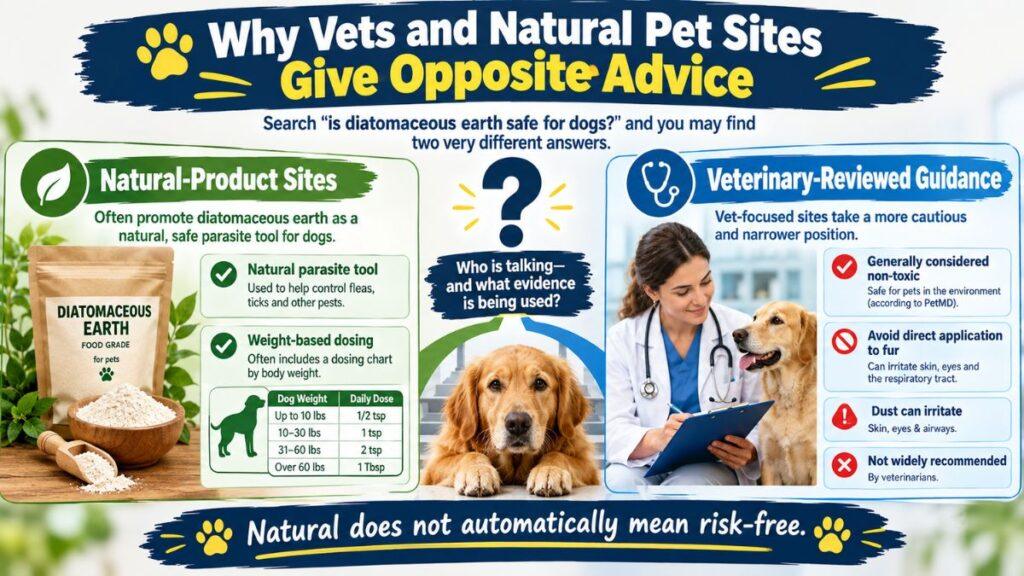
Both camps are describing something true. The powder is non toxic and does kill fleas on contact while dry. It also has no canine safety trial behind it, no established dose, and a dust hazard that worsens the closer an animal’s nose sits to the floor.
Is diatomaceous earth safe for dogs on the skin and coat?
Two of the most visible articles on this topic tell you to work the powder into the fur from the tail base forward and leave it on for anywhere from thirty minutes to forty eight hours. PetMD says the opposite: do not apply it to the fur.
The veterinary position is the more defensible one, for reasons that have nothing to do with toxicity. Coat application puts loose powder within a few centimetres of your dog’s nose and eyes for as long as it stays on, and a dog will shake, roll, scratch, then sleep with his face on the treated area. The powder also absorbs moisture, which is exactly why it works, so repeat applications dry the skin and can leave a flaky, itchy coat on a dog already itchy from flea bites. In an eye it is abrasive against the cornea, and a dog cannot tell you it stings.
If you use it at all, the environment is a better target than the animal. Fleas spend most of their life cycle off the dog anyway.
Is diatomaceous earth safe for dogs to eat, and how much?
Sites that recommend feeding it publish charts by body weight. Put two of the most visible ones side by side and they do not agree.
| Dog weight | Chart A | Chart B |
| Under 10 lbs | half teaspoon | half teaspoon |
| 10 to 19 lbs | 1 teaspoon | 1 teaspoon |
| 20 to 50 lbs | 1 teaspoon | 1 to 1.5 teaspoons |
| Over 55 lbs | 1 tablespoon | 1 tablespoon |
| Over 100 lbs | 2 tablespoons | not listed |
The numbers are close enough to look authoritative, but neither chart traces back to a controlled feeding study in dogs. Follow the citations and they lead to a feed additive regulation, a fact sheet about insecticide mechanism, and in several cases to the homepage of a veterinary association rather than to any document about dosing.
There is no established therapeutic dose of diatomaceous earth for dogs, because nobody has run the study that would produce one. The two percent limit in 21 CFR 573.340 is an anti caking allowance, not a treatment dose, and it is written as a proportion of feed rather than a spoon count. If you intend to feed it anyway, that ceiling is a more sensible reference than any blog chart, and worth raising with your own vet first. The same caution applies to every powdered supplement you stir into a bowl, which is why it helps to read the ingredient panel before adding anything to your dog’s food.
What the research actually shows
The study most often cited as proof is Bennett and colleagues, published in Poultry Science in 2011, which found that adding diatomaceous earth to feed reduced parasite load in free range laying hens. It is a real study with a real result. It is also a study in chickens.

Hens and dogs differ in gut anatomy, transit time, and the parasite species involved. Citing a poultry trial as evidence for a labrador is the weakest link in the case for internal use, and readers deserve to be told that rather than shown a PubMed link and left to assume.
There is a second problem, and it comes from the same fact sheet the sellers cite. The powder only works while dry, since wet diatomaceous earth loses its abrasive and absorbent action. The inside of a dog’s intestine is, by definition, wet. That is the main reason veterinary sources say there is no evidence it kills internal worms, and the dosing charts do not address it.
Is diatomaceous earth safe for dogs with breathing problems?
No, and this is the group that gets left out of most articles. Brachycephalic breeds such as pugs, French bulldogs, boxers, and shih tzus have compressed airways and prominent eyes, the worst combination for a fine airborne dust. Puppies and senior dogs have less respiratory reserve. Dogs with collapsing trachea, chronic bronchitis, kennel cough, or any diagnosed airway disease should not be in a room where powder is being applied, and dogs with surgical sites or open wounds should not have an abrasive near them.
Dehydrated, underweight, or unwell dogs are a separate concern for internal use, because the powder absorbs water in the gut and can firm stools further. Pregnant and nursing dogs have no safety data at all, which is a reason to leave it alone rather than a reason to guess.
My dog ate it or breathed it in
Eating a small amount of food grade powder off the floor is not an emergency. It is not a poison, there is no antidote to give, and most dogs show nothing at all. Do not induce vomiting, because bringing an abrasive powder back up through the oesophagus does more harm than letting it pass. Offer fresh water and watch him. The same rule applies to most non toxic kitchen and household powders, which we cover in more detail in our guide to what to do when your dog eats something he should not.
If powder has gone into an eye, flush gently with saline or clean lukewarm water and call your vet rather than waiting, since corneal scratches get worse quickly and are painful.
Inhaled dust, not swallowed powder, is the part of the diatomaceous earth safe for dogs question that sends animals to the vet. Move the dog into fresh air if he is coughing after an application. Brief sneezing that settles in a few minutes is ordinary irritation. Persistent coughing, wheezing, laboured breathing, or nasal discharge lasting more than a few hours warrants a call, as does a dog who eats a large quantity, turns lethargic, stops eating, or strains without producing stool.
In the United States the ASPCA Animal Poison Control Center is on 888 426 4435 and the Pet Poison Helpline is on 855 764 7661. Both charge a consultation fee and both run around the clock. If you cannot confirm the bag was food grade, say so when you call, because that changes the advice.
Why it will not clear a flea infestation on its own
Adult fleas on your dog are a small fraction of the problem. The rest of the population is eggs, larvae, and pupae sitting in carpet fibres, skirting board gaps, upholstery seams, and bedding.
Diatomaceous earth kills by drying out whatever walks through it. Flea eggs are unaffected, and the pupal stage is sealed inside a sticky cocoon that shrugs off both powder and most sprays. Pupae can wait weeks for the vibration and warmth that signal a host. A treatment that kills only what is currently crawling will always be followed by a fresh hatch, which is why people report that it seemed to work and then the fleas came back.
Clearing a household infestation takes roughly three months of overlapping work whatever you use: hot washing all bedding weekly, vacuuming daily and emptying the canister outside, and treating every animal in the house at once.
Using it around the home without dusting your dog
Keeping diatomaceous earth safe for dogs indoors comes down to placement and quantity. Apply a thin layer, not a visible one. A white film across open floor means you used far too much, and the excess simply becomes airborne.
Target the places insects travel and dogs do not settle: gaps under skirting boards, cracks, the backs of built in units, crevices around door frames. Keep it out of food bowls, water bowls, and bedding. A bulb duster gives far better control than shaking powder from the bag.
Put the dog in another room, open a window, wear a dust mask yourself, and let everything settle for a few hours before he comes back. Leave the application in place for two to three days, then vacuum thoroughly. Reapply after cleaning or after any damp, because wet powder does nothing.
Reading the label before you buy
Look for the words food grade printed on the packaging, not inferred from a product photo or a listing title. A trustworthy bag states its crystalline silica percentage, and you want that figure below two percent. OMRI listing is a useful secondary signal. Anything described as filter aid, pool filter media, or calcined goes back on the shelf.
Marketplace listings are the weak point, since the same generic photograph often appears on both grades. Buy from a seller who publishes the analysis, and store the sack sealed, dry, and away from the dog.
How it compares with what your vet would prescribe
| Food grade diatomaceous earth | Prescription flea products | |
| Speed | 24 to 72 hours, contact only | Hours |
| Kills eggs or larvae | No | Many do, through growth regulators |
| Canine safety data | None published | Licensing trials required |
| Resistance risk | None, mechanical action | Documented in some regions |
| Main risk | Airborne dust, dryness, eye abrasion | Skin reactions, rare neurological effects |
| Works when damp | No | Yes |
Whether diatomaceous earth safe for dogs is the right question depends on what you are comparing it against. Veterinarians typically recommend a licensed monthly preventive plus a fast acting knockdown product for an active infestation. Those exist because they were tested. Diatomaceous earth competes on cost and on the absence of synthetic pesticide, not on evidence.
Other animals in the house
Birds are the main warning, since avian respiratory systems are more efficient than mammal ones and correspondingly more vulnerable to airborne particulate. Cats groom constantly, so anything on the coat gets swallowed and anything on the floor gets licked off the paws. Small mammals in floor level cages sit directly in the settling zone. If you are weighing up other so called natural remedies at the same time, our roundup of natural pet remedies that are worth the hype and the ones that are not covers the rest.
Frequently asked questions
Is diatomaceous earth safe for dogs?
Food grade diatomaceous earth is safe for dogs in the sense that it is not a poison, but it is abrasive and the dust can irritate eyes, skin, and airways.
Can I put it directly on my dog’s fur?
Veterinary sources advise against it, and treating the environment instead achieves more with less risk.
Is diatomaceous earth safe for dogs to eat every day?
There is no established daily dose from any veterinary authority, so this is a question for your own vet rather than a chart.
Does it kill worms in dogs?
There is no evidence that it does, mainly because it stops working once it is wet.
How fast does it kill fleas?
Roughly one to three days on contact, and only while the powder stays dry.
Does it kill flea eggs?
No, which is why infestations return after treatment.
Is pool grade ever acceptable around pets?
No, under any circumstances.
My dog licked some off the floor, should I worry?
Almost certainly not, but offer water and watch for coughing or eye irritation.
Is diatomaceous earth safe for dogs under a year old?
Better not to use it on puppies, since their airways are smaller and there is no safety data for them.
The short version
Is diatomaceous earth safe for dogs? Food grade diatomaceous earth is a low toxicity powder that kills insects mechanically and does not poison dogs. That much is settled. What is not settled, and what the dosing charts quietly skip, is whether it belongs on your dog or in his bowl, and on that the veterinary answer is a reasonable no. There is no canine study, no agreed dose, and a dust hazard that falls hardest on flat faced dogs, puppies, seniors, and any dog with an airway problem. It also stops working the moment it is damp, which undercuts the internal parasite claim.
Used thinly in cracks and along skirting boards, with the dog out of the room and a window open, it is a reasonable part of a household flea plan. Used as a dewormer or rubbed into a coat, it does less than the packaging suggests and more irritation than the dog deserves. If your dog has fleas or worms now, the fastest route through it runs via a product that was actually tested, and a conversation with your vet.