

Yes. A healthy dog can eat plain scrambled eggs that are fully cooked and made without butter, oil, salt, seasoning, onion, garlic, milk, or cheese. Eggs are a treat, not a meal, so they belong inside the 10 percent of daily calories vets set aside for treats. Dogs with pancreatitis, weight problems, egg allergy, or a prescription diet need veterinary clearance first.
Are scrambled eggs safe for dogs?
Plain, fully cooked scrambled eggs are safe for most healthy adult dogs. PetMD and the American Kennel Club treat scrambled, boiled, and poached eggs as equally acceptable, as long as they’re served plain and not cooked in fat.
Most of the risk comes from what goes into the pan, not the egg itself. A restaurant-style scramble made with butter, salt, cheese, and a bit of onion is a different food than the one described here, and two of those additions can genuinely hurt a dog.
Cook the eggs all the way through. The USDA doesn’t recommend feeding raw shell eggs to anyone because of the Salmonella Enteritidis risk, and its guidance is to cook eggs until both the white and yolk are firm, with egg dishes reaching an internal temperature of 160 degrees Fahrenheit (FSIS). Raw egg white also contains avidin, a protein that binds biotin and can interfere with its absorption if fed regularly. Cooking deactivates it, which is one more reason a runny scramble isn’t the version to share.
What scrambled eggs actually give your dog
An egg is a compact source of protein and fat. One large egg supplies about 6 grams of complete protein for roughly 70 calories (Harvard Health), and the yolk carries around 4.5 grams of fat along with the fat-soluble vitamins (American Egg Board).
| Per large egg, cooked plain | Amount |
| Calories | About 70 |
| Protein | About 6 g |
| Fat | About 5 g, nearly all in the yolk |
Eggs are a nice addition, not a necessary one. A complete and balanced commercial diet already meets a dog’s protein, fat, vitamin, and mineral needs, so eggs aren’t filling a gap. What they add is variety, a strong smell that can interest a picky eater, and a high-value reward for training. Claims about a shinier coat, better digestion, or stronger immunity are harder to back up and shouldn’t be the reason you feed them.
Both parts of the egg are fine for dogs. The white is lean protein, the yolk carries the fat and most of the micronutrients, and scrambling them together is simply the easiest way to serve a small portion.
Ingredients to leave out of your dog’s eggs
| Ingredient | Why it stays out |
| Onion, garlic, chives, leeks | Toxic to dogs. Damages red blood cells |
| Butter or cooking oil | Adds fat and calories the dog does not need |
| Salt | No benefit, and large amounts cause sodium problems |
| Pepper, herbs, spice blends | Can irritate the gut, and many blends contain onion or garlic powder |
| Milk or cream | Many adult dogs digest lactose poorly |
| Cheese | Fat, salt, and dairy in one addition |
| Bacon, sausage, bacon grease | Very high in fat and salt |
Onion, garlic, chives, and leeks
These are the ingredients worth being strict about. Sulfur-containing oxidants in Allium species damage red blood cells, producing Heinz body hemolytic anemia and sometimes methemoglobinemia. Garlic is three to five times more toxic than onion, and the concentrated forms cause most poisonings: dehydrated flakes, powders, and dry onion soup mix (Merck Veterinary Manual). Cooking does not remove the risk.
Dose matters, and the numbers are worth knowing before you panic. Clinical signs in dogs have followed ingestion of roughly 15 to 30 grams of raw onion per kilogram of body weight. For a 20 kilogram dog, that’s a substantial amount of onion, not a stray sliver in a scramble. What makes the powders dangerous is that a teaspoon of onion powder represents far more onion than a teaspoon of the fresh vegetable.
The other thing to understand is the delay. Heinz bodies form within 24 hours, but hemolysis usually happens three to five days after the meal, and signs appear only once substantial red cell destruction has occurred. Lethargy, weakness, pale or yellow gums, fast breathing, exercise intolerance, and red or brown urine are the ones to watch for. A dog that seems fine at bedtime isn’t necessarily in the clear, which is why the call to a vet or a poison control line happens on the day of the meal rather than after symptoms show up.
Butter, oil, and added fat
Butter isn’t toxic. It’s just fat your dog has no use for, and it changes the arithmetic of the treat. A plain egg already runs at roughly 65 grams of fat per 1,000 calories, calculated from the figures above. For context, the Merck Veterinary Manual recommends a ration under 20 grams of fat per 1,000 calories for dogs with pancreatitis, and lists dietary indiscretion, meaning fatty table scraps and raided bins, as a common risk factor in dogs. Adding butter to a food that’s already fat-dense is the part worth skipping.
For a healthy dog, a small amount of butter in the pan is an ordinary indulgence rather than an emergency. For an overweight dog, a dog recovering from pancreatitis, or a breed already prone to it, it isn’t.
Milk, cream, and cheese
Many dogs lose most of their lactase after weaning, so dairy commonly produces gas, loose stool, or an unhappy night. Dairy is also the second most frequently reported food allergen in dogs, behind beef, in the BMC Veterinary Research review of confirmed cases. Scrambled eggs cook perfectly well with nothing but heat and a little water.
Salt and seasoning
Dogs get the sodium they need from their food. Beyond the salt itself, seasoning blends are a hidden route to allium exposure, since garlic powder and onion powder turn up in everything from steak rub to seasoned salt. If the shaker has a list of ingredients on it, leave it out.
How to cook scrambled eggs for a dog
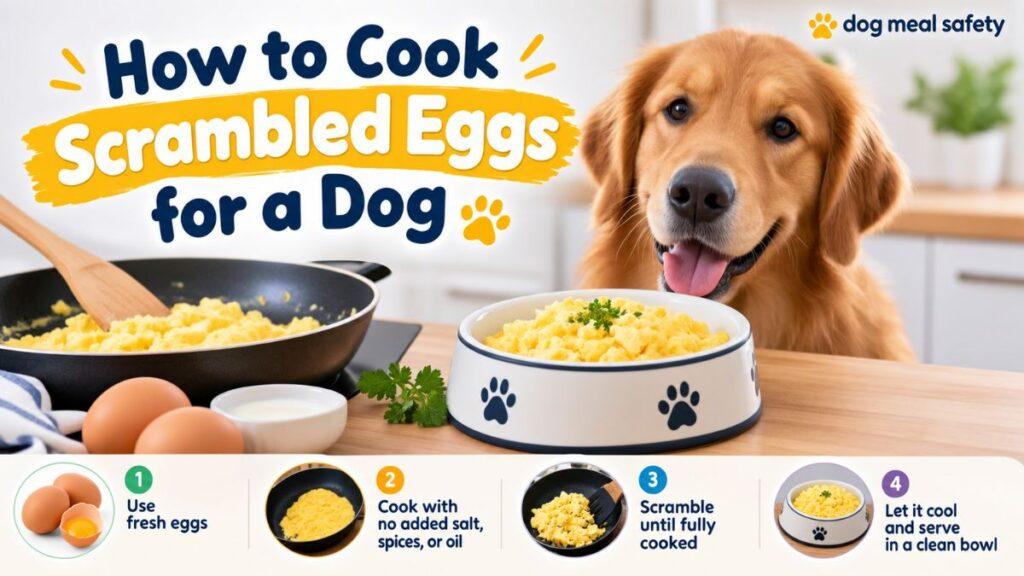
Beat one or more eggs in a bowl with nothing else added. Heat a nonstick pan over medium-low heat, and if the eggs start to stick, add a splash of water rather than butter or oil. Stir gently until the eggs are fully set with no liquid remaining, which is the same firm-white, firm-yolk standard the USDA uses for food safety. Let the eggs cool to room temperature before serving, since dogs tend to bolt their food and will happily burn their mouths on something too hot. Serve the portion that fits your dog’s size, either on its own or mixed into their regular food, and refrigerate any leftovers at 40 degrees Fahrenheit for use within three to four days. Cooked eggs shouldn’t sit out for more than two hours.
How much scrambled egg can a dog eat?
Treats of all kinds should stay under 10 percent of daily calories, with the other 90 percent coming from a complete and balanced diet. PetMD’s veterinary team publishes serving sizes on that basis, paired with a frequency of once or twice a week rather than daily.
| Dog weight | Serving | Frequency |
| 2 to 10 lb | 1/4 egg | 1 to 2 times per week |
| 11 to 20 lb | 1/2 egg | 1 to 2 times per week |
| 21 to 50 lb | 1 egg | 1 to 2 times per week |
| 51 to 90 lb | 1 1/2 eggs | 1 to 2 times per week |
| 91 lb and over | 2 eggs | 1 to 2 times per week |
Source: PetMD, updated September 2025.
Those portions make more sense once you see the calories behind them. The table below takes the daily calorie ranges the World Small Animal Veterinary Association publishes for healthy adult dogs, applies the 10 percent treat limit, and compares the result to a 70 calorie egg. Tufts veterinary nutritionists use the same arithmetic when they point out that a 10 pound dog eating around 300 calories a day has a treat budget of about 30 calories.
| Dog weight | Typical daily calories | 10 percent treat budget | Egg that fills the whole budget |
| 4.4 lb (2 kg) | 140 to 177 | 14 to 18 kcal | About 1/4 egg |
| 11 lb (5 kg) | 280 to 351 | 28 to 35 kcal | About 1/2 egg |
| 22 lb (10 kg) | 470 to 590 | 47 to 59 kcal | About 3/4 egg |
| 44 lb (20 kg) | 790 to 993 | 79 to 99 kcal | 1 to 1.5 eggs |
| 88 lb (40 kg) | 1,340 to 1,670 | 134 to 167 kcal | About 2 eggs |
Calorie ranges are WSAVA figures based on the 2006 NRC maintenance equations. Treat budgets and egg equivalents are calculated from those ranges at 70 calories per large egg. Individual dogs vary by as much as 50 percent from calculated values, so treat these as starting points and adjust with your vet.
Owners often miss this: a serving of egg isn’t a small addition on top of the day’s food, it’s usually the entire treat allowance. A biscuit, a dental chew, and an egg on the same day already adds up to too much.
Start below the serving size if your dog has never had egg. A quarter to a half of what the table suggests, then 24 to 48 hours of watching stool quality and appetite, tells you what you need to know.
Can dogs eat scrambled eggs every day?

Daily eggs are unnecessary for a dog on a complete diet, and for small dogs the calories make it a bad idea. Purina’s nutritionists put it plainly: eggs run about 70 calories each, so the 10 percent rule decides how much your dog gets, and weight gain is the problem you’ll see first if you overdo it.
Once or twice a week suits most dogs. If you want to feed egg more often than that, cut other treats to make room, weigh your dog monthly, and check with your vet, particularly if the diet is a therapeutic one.
Can puppies eat scrambled eggs?
Puppies can have small amounts of plain cooked egg once they’re fully weaned and eating solid puppy food reliably. Portions should be smaller than the adult figures above, and eggs should never displace a growth-formulated diet, since puppies need specific calcium, phosphorus, and energy levels that an egg doesn’t provide.
Introduce one small piece and wait a day. Vomiting, loose stool, or a puppy who then turns down their regular food is a sign to stop and speak to your vet. Large and giant breed puppies are the group to be most careful with, because their skeletal development is sensitive to anything that unbalances a carefully formulated diet.
Can scrambled eggs settle an upset stomach?

Eggs are not a treatment for vomiting or diarrhea, and treating them as one is how owners lose time that matters. Plain cooked foods are sometimes tolerated while a dog transitions back to normal meals after a mild, brief upset, but they do nothing about the cause.
Call your vet if vomiting or diarrhea lasts beyond 24 hours, if there is blood, or if your dog is lethargic, painful in the abdomen, running a fever, or unable to keep water down. Puppies, seniors, and small dogs dehydrate quickly and warrant an earlier call.
There’s also a specific case where eggs are the wrong choice. A dog with pancreatitis needs a low-fat diet, and an egg running around 65 grams of fat per 1,000 calories works against that, so it’s worth checking with your vet before offering eggs rather than after.
Dogs that should not eat scrambled eggs
Check with your veterinarian first if your dog has a diagnosed egg allergy or is in the middle of an elimination diet trial, has a history of pancreatitis or high blood triglycerides, is overweight or on a weight-loss plan, eats a prescription or therapeutic diet where extras can undermine its purpose, is on a protein-restricted or fat-restricted diet for kidney or liver disease, or has a chronic gastrointestinal condition where protein sources are being controlled deliberately.
How to spot an egg allergy or food reaction
Egg allergy is real but uncommon. In the BMC Veterinary Research review of 297 dogs with confirmed cutaneous adverse food reactions, egg was the trigger in 11 dogs, about 4 percent. Beef accounted for 34 percent, dairy 17 percent, chicken 15 percent, and wheat 13 percent.
Skin signs usually dominate rather than digestive ones. Itching around the ears, paws, and face, recurring ear infections, and inflamed patches of skin are typical, and some dogs get vomiting or diarrhea alongside. These reactions build over repeated exposures rather than appearing after one meal, so a single scramble followed by scratching is more likely a coincidence than a diagnosis.
Confirming a food allergy takes an elimination diet followed by a deliberate rechallenge, which the Merck Veterinary Manual describes as the only reliable method. Blood and saliva allergy panels sold for this purpose are not.
Facial swelling, hives, difficulty breathing, or collapse after eating is an emergency, whatever the food. Go to a vet immediately.
Scrambled, boiled, poached, or fried
| Preparation | Verdict | Notes |
| Scrambled, plain | Good | Easiest to portion and to mix into food |
| Hard-boiled | Good | No pan, no fat, keeps well. Chop before serving |
| Poached | Good | No added fat, but check the yolk is firm |
| Fried | Workable | Only in a nonstick pan with no oil or butter |
| Raw | Avoid | Salmonella risk, plus avidin in raw white |
Preparation matters less than the two rules that run through all of it: fully cooked, and nothing added. Hard-boiled has a small practical edge for batch-cooking, since a peeled egg keeps in the fridge with no pan to wash.
What to do if your dog ate buttered or seasoned scrambled eggs
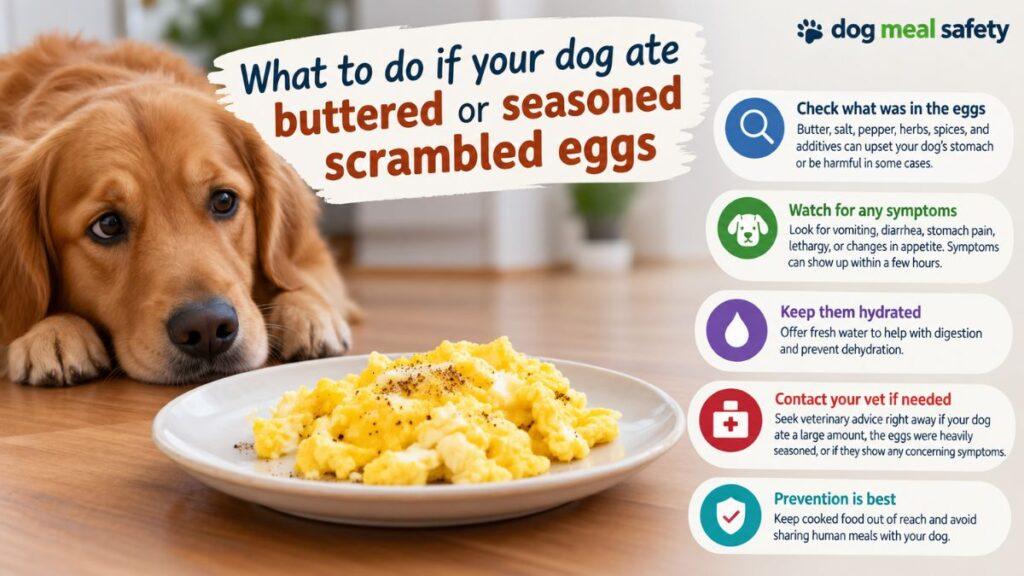
Start by figuring out what was actually in the eggs. Butter, salt, and cheese are a different situation than onion, garlic, chives, or leeks, and the amount matters too: a stolen mouthful from a 40 kilogram dog isn’t the same event as a full plate eaten by a terrier. If any allium was involved, call right away rather than waiting for symptoms. The ASPCA Animal Poison Control Center is available around the clock at (888) 426-4435, and a consultation fee may apply. Pet Poison Helpline at (855) 764-7661 is an alternative. For fat and salt alone, watch for 24 to 48 hours and call if you see vomiting, greasy or loose stool, a hunched posture, restlessness, or a refusal to eat. If your dog has a history of pancreatitis or is on a therapeutic diet, call your vet immediately regardless of the amount eaten.
Most dogs who steal a few bites of buttered egg are fine by morning. The reason to pay attention is that a single fatty meal is a recognized trigger in susceptible dogs, and allium poisoning declares itself days late.
FAQs
Can dogs eat only the egg whites?
Yes. Cooked egg whites are the lower-fat option and can suit dogs on a fat-restricted diet, but they still need to be fully cooked, and most of the vitamins live in the yolk you’re skipping.
Can I cook my dog’s eggs in olive oil or nonstick spray?
A trace of oil isn’t toxic, but it’s unnecessary fat on food that’s already fat-dense, so cook your dog’s portion first in a dry nonstick pan before adding anything to yours.
My dog ate scrambled eggs cooked in bacon grease. What should I do?
Watch for 24 to 48 hours for vomiting, greasy stool, or abdominal pain, and call your vet the same day if your dog has a pancreatitis history, is overweight, or ate a large amount.
Can senior or diabetic dogs eat scrambled eggs?
Eggs rarely affect blood glucose directly, but many senior or diabetic dogs are on fixed-calorie or prescription diets where any extra food changes the plan, so check with your vet first.
Do scrambled eggs improve a dog’s coat?
Not on their own. A dog on a complete diet already gets enough protein and fatty acids for coat health, and persistent coat problems usually point to allergies or an underlying condition that needs a vet, not an egg.
How long do cooked eggs keep for my dog?
Refrigerated at 40 degrees Fahrenheit, cooked eggs keep for three to four days and shouldn’t sit out, including in your dog’s bowl, for more than two hours.
The short version
Plain scrambled eggs, fully cooked, are a good treat for most healthy dogs. Cook them in a dry nonstick pan, skip everything you’d normally add, let them cool, and keep the portion inside your dog’s daily treat allowance. For most dogs that means half an egg to a whole egg, once or twice a week, and less for anything under 10 pounds.
Two things deserve genuine care rather than casual attention. Onion, garlic, chives, and leeks damage red blood cells, and the illness shows up days after the meal, so the phone call happens the same day rather than when symptoms appear. And fat matters more than owners expect: an egg is a fatty food before anyone adds butter to it, which puts it off the menu for dogs with a pancreatitis history unless your vet says otherwise.
If your dog is on a prescription diet, carrying extra weight, or being investigated for a food allergy, ask your vet before the first egg rather than after it.
2 thoughts on “Can Dogs Eat Scrambled Eggs? Benefits, Risks, and Safe Portions”