

Dogs can eat sunflower seeds in one form: plain kernels with the shell removed, unsalted and unseasoned, in small amounts. The kernel is not toxic. The hull, the salt and the flavor coatings are what turn a harmless snack into a problem, and the calories add up faster than most owners expect.
Sunflower seeds are a treat, not a food. Check with your veterinarian before adding any new item to your dog’s bowl, especially if your dog has a health condition or eats a prescription diet.
Which sunflower seeds are safe for dogs
The safest form is a plain, shelled, unsalted kernel, raw or dry roasted, with nothing else on it. PetMD puts it the same way: plain, shelled and unsalted seeds are safe for healthy adult dogs in small amounts, with preparation mattering more than the seed itself.
| Type of sunflower seed | Verdict | Why |
| Plain shelled kernels, unsalted | Best choice | No hull, no added sodium, no seasoning to check |
| Dry roasted, unsalted, unseasoned | Fine occasionally | Roasting is not the issue; whatever is added with it usually is |
| Salted, any roast | Skip | Adds sodium with no nutritional gain over plain kernels |
| Flavored (ranch, barbecue, honey roasted, chilli lime) | Avoid | May contain onion or garlic powder, added sugar and heavy salt |
| In shell, any flavor | Avoid | The fibrous hull is the main blockage risk |
| Bird seed or black oil sunflower seed | Avoid | Almost always in the shell and not cleaned or portioned for pets |
Read the ingredient panel before sharing anything from a bag. A bag labeled “lightly seasoned” tells you nothing useful about what is actually on the seed.
Why the shells are the real problem
Sunflower seed hulls should never be fed on purpose. The shell is fibrous, and a dog cannot break it down the way a person cracks and spits it. PetMD notes that shelled kernels are easier for a dog to digest, and Dr. Nancy Welborn of the LSU School of Veterinary Medicine told Great Pet Care that dogs that cannot digest the hulls run a risk of gastrointestinal blockage.
Scale matters here. A dog that wolfs down one or two stray in-shell seeds off the floor is usually fine. A dog that empties a bowl of hulls is a different situation, and so is a small dog eating the same amount as a Labrador.
Signs of a gastrointestinal obstruction, according to Cornell University’s Riney Canine Health Center, include vomiting, loss of appetite, abdominal pain, diarrhea, dehydration and lethargy. The MSD Veterinary Manual adds that vomiting and refusal to eat are the usual presentation, and that obstructions can deteriorate quickly. That combination is a same-day call to your vet, not a wait-and-see.
Salt, seasoning and flavor coatings
Plain beats salted, though the reason is not what most articles imply. Salt toxicosis is a real condition, but the dose is high. The Merck Veterinary Manual reports that clinical signs in dogs can appear after ingestion of roughly 2 to 3 grams of sodium chloride per kilogram of body weight, with about 4 g/kg described as an acute lethal dose. For a 10 kg (22 lb) dog, the lower end of that range works out to around 20 grams of salt, or roughly three to four teaspoons of pure salt. No realistic handful of snack seeds gets there.
So the argument against salted seeds is not that one kernel will poison your dog. It is that salted seeds deliver the same nutrition as plain ones with sodium your dog has no use for, and the risk sits with the whole bag left on the sofa rather than the single seed that fell on the floor.
Seasoning blends are the genuine hazard. Onion and garlic powder appear in ranch, barbecue and many “everything” style coatings, and both are toxic to dogs. The Merck Veterinary Manual notes that dogs have developed Allium toxicosis after eating raw, cooked, dehydrated or granulated onion and garlic, with garlic three to five times more toxic than onion, and that hemolytic anaemia can show up several days after the meal rather than immediately. Dried forms are concentrated: VCA Animal Hospitals points out that one teaspoon of garlic powder is equivalent to about eight fresh cloves. A seasoning dust that looks trivial on a seed is not trivial once a dog eats a mouthful of them.
What to do if your dog has already eaten sunflower seeds
Work out three things before you decide whether to call anyone: what was eaten, how much, and whether shells or seasoning were involved.
- Identify the product. Plain kernels, in-shell seeds, or a salted or flavored bag.
- Estimate the quantity. A few stray seeds is a different problem from a spilled bag.
- Check for shells. Hulls raise the risk of stomach upset and, less often, a blockage.
- Read the label if a packaged product was involved, looking for salt, onion or garlic powder, and xylitol.
- Watch your dog for the next several hours.
- Call your veterinarian or a pet poison helpline if a large amount was eaten, if the seeds were in shell or heavily seasoned, or if anything looks wrong.
One soft stool a few hours later is usually nothing. Repeated vomiting, refusal to eat or drink, a painful or swollen belly, straining without producing stool, or a dog that is flat and unwilling to move all warrant a call the same day. Small dogs deserve a lower threshold for concern than large ones, because the same quantity represents a much bigger dose.
What sunflower seeds actually provide
Sunflower kernels are genuinely nutrient dense, which is why they get recommended, and genuinely calorie dense, which is why the portion has to stay small. Per 100 grams of dried kernels, USDA FoodData Central lists:
| Nutrient (per 100 g kernels) | Amount |
| Calories | 584 kcal |
| Protein | 20.8 g |
| Fat | 51.5 g |
| Fiber | 8.6 g |
| Vitamin E | 35.2 mg |
| Magnesium | 325 mg |
| Sodium | 9 mg |
That 100 gram figure is a laboratory reference, not a serving. Worked down to something realistic, an ounce (28 g) of kernels is about 164 calories, and a single teaspoon is around 17 calories. Vitamin E is the standout, and PetMD notes that the vitamin E, fats and antioxidants in sunflower seeds can support skin, coat and metabolic health.
None of that makes them necessary. A commercial food carrying an Association of American Feed Control Officials (AAFCO) statement is already formulated to cover a dog’s requirements at its life stage. Treats sit outside that standard, which is why products that do not meet the AAFCO nutrient profiles must be labeled for intermittent or supplemental feeding. Sunflower seeds are an optional extra your dog will enjoy, not a gap in the diet you are filling.
How many sunflower seeds can a dog eat?
There is no official dose. The working limit is the treat rule used by veterinary nutrition services: the UC Davis Veterinary Medical Teaching Hospital advises that treats and extra food items stay under 10% of daily calories, with 90% or more coming from a complete and balanced diet.
Run that against the calorie figures and the ceiling is low. A dog eating 400 calories a day has a treat budget of about 40 calories, which is roughly 7 grams of sunflower kernels, or a bit over two teaspoons for the entire day, before any biscuit, chew or scrap of cheese is counted.
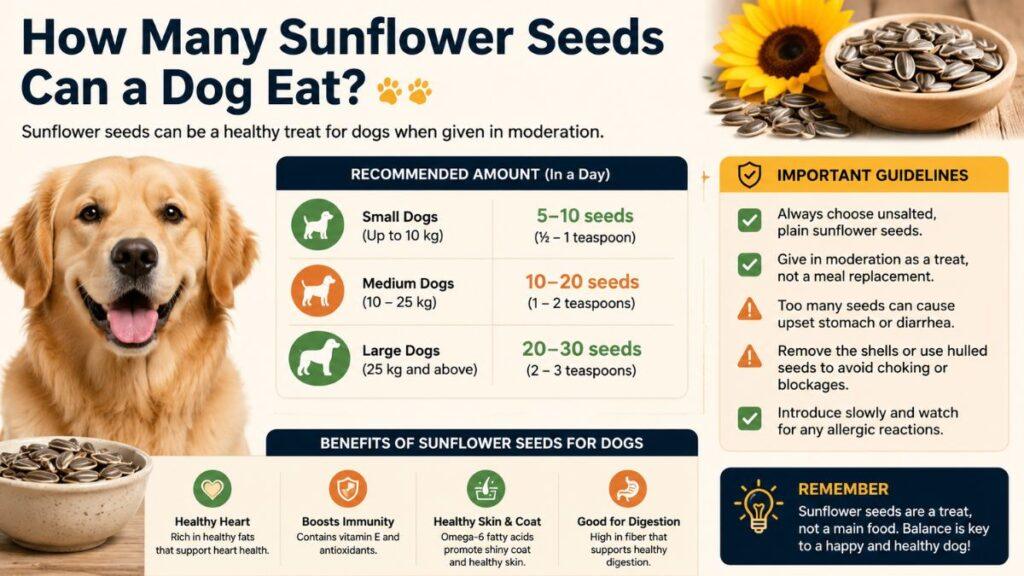
Published portion advice varies more than most articles admit, so here are both ends of it:
| Dog size | Cautious first serving | Upper end of published advice |
| Under 30 lb (14 kg) | 1 to 2 kernels | Dr. Welborn suggests about 10 to 20 kernels a few times a week at most |
| Over 30 lb (14 kg) | 2 to 3 kernels | Dr. Welborn suggests about 30 to 40 kernels a few times a week at most |
PetMD recommends starting with one or two kernels and waiting a few hours before offering more. Dr. Welborn’s figures in Great Pet Care are weekly allowances rather than per-sitting portions, which is where a lot of the confusion online comes from. Treat the low numbers as your default and the higher ones as a ceiling for a healthy, adult, large dog with no weight problem.
Going over that ceiling causes two different problems. In the short term, a dog that eats too much fat at once gets stomach upset or loose stools. Over months, the extra calories show up as weight gain, and an overweight dog carries higher risk for several conditions including pancreatitis.
Which dogs should skip sunflower seeds
Four groups have a reason to avoid them: dogs with a history of pancreatitis, overweight dogs, dogs eating a therapeutic or prescription diet, and dogs with known food sensitivities. PetMD makes the same point about prescription diets, which are formulated to do a specific job that outside treats can undermine.
The pancreatitis link is worth stating precisely, because the popular version overstates the evidence. A 2008 case-control study in JAVMA comparing 198 dogs with pancreatitis to 187 controls found that eating unusual food items raised the odds of pancreatitis (odds ratio 4.3), and a summary of the same work in Today’s Veterinary Practice lists obesity (2.6 times) and getting into the trash (13 times) among the associated factors. Note what that shows: dietary indiscretion, not dietary fat specifically.
A 2026 narrative review went further and concluded that the older studies linking dietary fat to canine pancreatitis were limited by experimental models, small samples and diets that do not reflect current formulations, and that more recent work has not confirmed a consistent association. In plain terms, the evidence for “one fatty treat causes pancreatitis” is weaker than decades of repetition suggest.
That is a reason for accuracy, not complacency. If your dog has had pancreatitis, follow your veterinarian’s guidance rather than a blog, and a low fat treat remains the sensible default until that vet says otherwise.
Can puppies eat sunflower seeds?
A puppy can have a taste of a plain, unsalted, shelled kernel on rare occasion, but the case for caution is stronger than it is with adults. Puppies grow on a tighter nutrient specification: AAFCO’s growth and reproduction profile requires a higher minimum calcium level than adult maintenance (1.2% versus 0.5% of dry matter after the profile revisions) and adds a calcium maximum for foods intended for large-breed puppies, because getting minerals wrong during growth can cause lasting skeletal problems.
Treats that displace a puppy’s complete food are working against that balance. Keep any sunflower seed to a token amount, and ask your vet before making it a habit.
How to offer sunflower seeds safely
- Buy plain, shelled, unsalted kernels and read the ingredient list if they came in a bag.
- Offer one or two kernels the first time, then wait a few hours.
- Crush or grind them for small dogs and enthusiastic gulpers, which lowers the choking risk and helps digestion.
- Count them against the 10% treat budget rather than adding them on top of it.
- Store the bag where your dog cannot reach it, since the real risk is the whole bag rather than the shared kernel.
- Skip them entirely for a dog with pancreatitis history, a weight problem or a prescription diet unless your vet has cleared it.
Lower-risk treats to offer instead
| Alternative | Why it works |
| Raw or cooked carrot sticks | Low calorie, crunchy, no fat or sodium concern |
| Blueberries | Low calorie, small, no shell or seasoning to check |
| Plain green beans | Bulky and low calorie, easy to portion for a big dog |
| Commercial low-calorie training treats | Consistent, labeled calorie count per piece |
One swap to be skeptical about: pumpkin seeds get recommended as the lower fat alternative, but USDA figures for roasted pumpkin seed kernels put them at 574 calories and 49 grams of fat per 100 grams, which is barely below sunflower. If you are moving away from sunflower seeds for calorie reasons, vegetables do the job and other seeds mostly do not.
Frequently asked questions
Can dogs eat sunflower seeds every day? Better not to. Even plain kernels are about half fat and 584 calories per 100 grams, so a daily habit eats through the treat allowance quickly and adds up to weight gain. Occasional use, a few times a week at most, keeps them within the 10% guideline.
Can dogs eat sunflower seed butter? Plain sunflower seed butter with no added salt or sugar is fine in small amounts, but check the label first. Some seed and nut butters are sweetened with xylitol, which the FDA warns is dangerous for dogs and may be listed as birch sugar or wood sugar.
Are sunflower plants toxic to dogs? No. The ASPCA lists sunflowers as non-toxic to dogs, cats and horses, so a dog that chews a leaf or a petal is not poisoned. The concern with garden sunflowers is the seed head, since those seeds are in the shell and unwashed.
Can dogs eat sunflower seeds from a bird feeder? Avoid it. Bird seed sunflower seeds are almost always in the shell, so they carry the blockage and stomach-upset risk, and mixes may contain other ingredients you have not checked. A dog that grabs a small mouthful is usually fine, but watch for vomiting.
Do sunflower seeds help a dog’s coat? They contain more vitamin E than almost any other common food, at 35.2 mg per 100 grams, and PetMD notes this can support skin and coat health. The portion a dog can safely eat is small enough that the effect is modest, and a complete diet already supplies vitamin E.
My dog ate a few seeds in the shell. Is that an emergency? Usually not. One or two hulls typically pass without trouble. A mouthful is worth watching, and repeated vomiting, refusal to eat, abdominal pain or straining without producing stool are reasons to call your vet the same day rather than waiting.
The bottom line
Sunflower seeds are not dangerous to dogs by nature. The risk lives almost entirely in how they are sold to people: in the shell, and salted or coated in seasoning that may include onion and garlic powder. Plain, shelled, unsalted kernels in small amounts are a reasonable occasional treat for a healthy adult dog, with a useful amount of vitamin E and a lot of calories attached.
Keep three things in mind and the rest follows. Buy the plain kernels rather than the snack bag. Count them inside the 10% treat allowance rather than on top of the day’s food. Skip them entirely for a puppy, an overweight dog, a dog with a pancreatitis history, or one on a prescription diet unless your vet has said otherwise.
If your dog has eaten shells or a heavily seasoned batch, call your veterinarian rather than working through a symptom list online. For everything else, a couple of kernels now and then is exactly the size of the treat this is.