
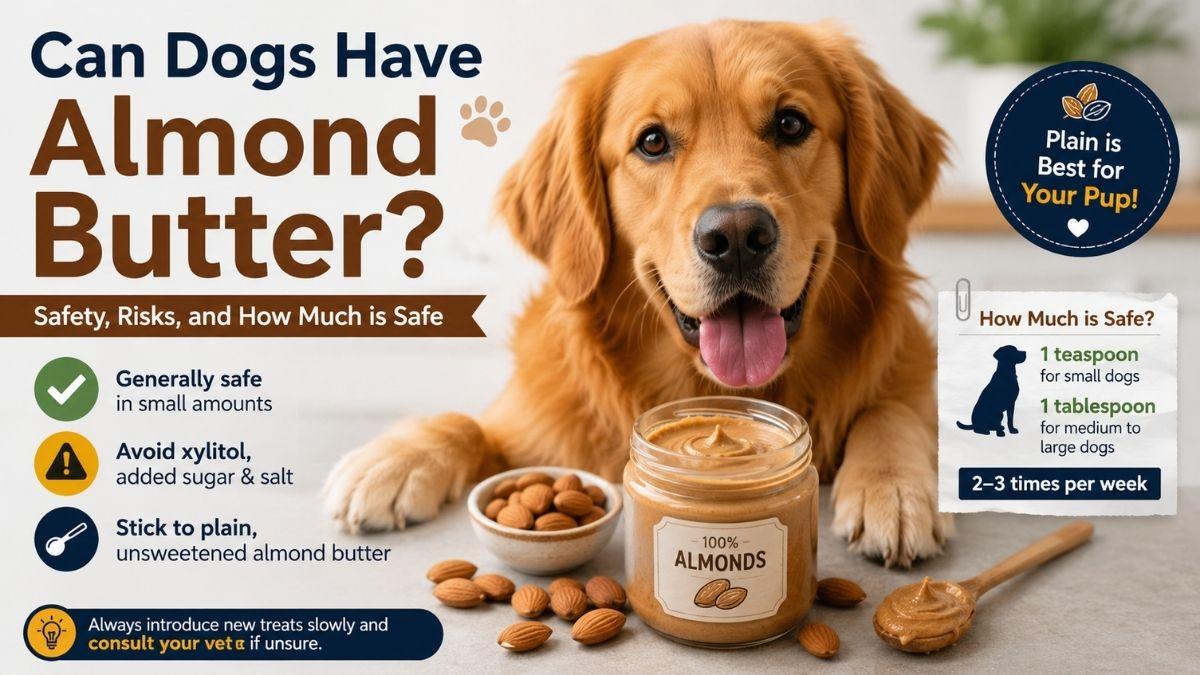
Yes, most dogs can have a small amount of plain almond butter as an occasional treat. Almonds are not toxic to dogs, but the jar has to be free of xylitol and chocolate and low in added sugar and salt. Almond butter is high in fat and calories, so portions stay small and infrequent.
Is almond butter safe for dogs?
Plain almond butter is not toxic to dogs, and veterinarians generally treat a small lick as safe for a healthy adult dog. The risk sits in the additives and the amount, not in the almonds. One ingredient, xylitol, turns a treat into an emergency.
PetMD, reviewed by Sandra C. Mitchell, DVM, DABVP, makes the same split: almond butter is not toxic, but it can carry salt, sugar, or xylitol, and it is high in fat. Dr. Emily Singler, VMD, the staff veterinarian at Fetch Pet Insurance, puts the safe use in terms of a share of the diet: small, occasional amounts that stay under about ten percent of a dog’s daily calories.
That leaves two very different kinds of risk. The slow one is fat and calories adding up over weeks, which shows up as weight gain or a sensitive gut. The fast one is a toxic additive, which can put a dog in a veterinary hospital the same afternoon. Individual tolerance varies too. Dr. Singler is direct that dogs prone to pancreatitis, or with very sensitive stomachs, should skip almond butter entirely.
Whole almonds are a separate question with a different answer. Hill’s Pet Nutrition does not consider almonds a safe food for dogs at all, and PetMD quotes Dr. Richard Goldstein of the Animal Medical Center in New York on why: dogs swallow nuts without chewing them properly, which can obstruct the esophagus, stomach, or intestine, or reach the windpipe in a small breed. Grinding almonds into butter takes that hazard off the table. It does not take away the fat.
One habit is worth building. Manufacturers reformulate, so a brand that was fine last year is not automatically fine today. Read the label on each new jar rather than trusting the brand.
Which ingredients make almond butter unsafe for dogs?
Skip any almond butter containing xylitol, chocolate or cocoa, added sugar, or heavy salt. Xylitol is the dangerous one by a wide margin. The rest mostly add calories, sodium, or stomach trouble. The safest jars list almonds, and at most a pinch of salt, and nothing else.
What to screen for on the label:
- Xylitol, including the alternative names below
- Chocolate or cocoa, which is toxic to dogs on its own
- Added sugar, honey, or corn syrup
- Heavy salt
- Other artificial sweeteners and flavorings
Xylitol does not always appear under that name. The FDA says it may be listed as wood sugar, birch sugar, or birch bark extract, and the agency puts sugar-free nut butters on its list of common xylitol-containing products alongside gum, mints, and sugar-free desserts. Anything marketed as sugar-free deserves a full read of the ingredient panel, and an unfamiliar sweetener name deserves a search before the jar goes anywhere near your dog.
How much almond butter can a dog eat?
There is no single safe dose for every dog. Dr. Singler’s working limit is one teaspoon to one tablespoon in a single serving, scaled to the dog’s size, and only now and then. Hill’s puts the wider boundary around it: treats of any kind should stay under ten percent of a dog’s daily calories.
Calories are what make that ceiling arrive quickly. Great Pet Care puts two tablespoons of almond butter at roughly 200 calories, so a single tablespoon is about 100. For a ten-pound dog on a few hundred calories a day, one tablespoon can eat the entire treat allowance in one lick.
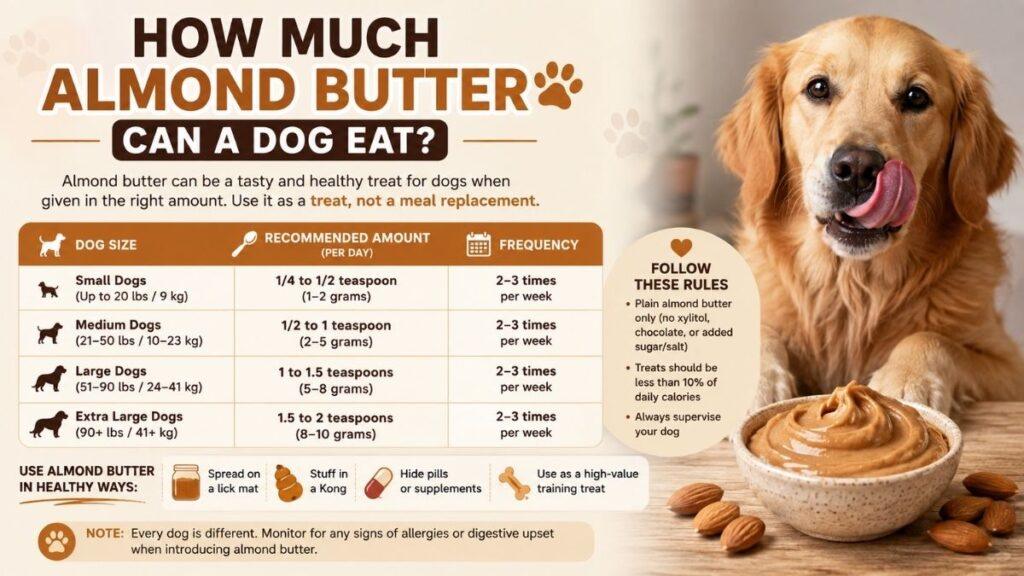
The amounts below sit deliberately below Dr. Singler’s upper limit, because most dogs get other treats during the day. They are a conservative starting point for a healthy adult dog, not a veterinary dose.
| Dog size | Conservative single serving | Notes |
| Under 20 lbs | A lick to 1/4 teaspoon | Treat calories run out fastest here |
| 20 to 50 lbs | Up to 1/2 teaspoon | Watch total treats for the day |
| Over 50 lbs | Up to 1 teaspoon | Dr. Singler’s ceiling is 1 tablespoon |
Size changes the math twice over. The same spoonful delivers far more fat per pound of body weight to a terrier than to a Labrador. It also matters if the product turns out to contain xylitol, because toxic doses are calculated per kilogram of body weight, so a small dog reaches a dangerous amount from a much smaller serving.
Does almond butter have any nutritional benefit for dogs?
Not for a dog already on a complete diet. Almonds do supply vitamin E, magnesium, and some fiber, but a balanced commercial food already covers those. Dr. Jo Myers, a practicing veterinarian with the telehealth service Vetster, told Great Pet Care that almond butter “doesn’t have any nutritional benefit” for a dog eating a well-balanced diet.
What almond butter is good for is getting a dog to cooperate. It hides a pill, it loads a puzzle toy or a lick mat, and it works as a high-value training reward. Those are reasonable uses. Filling a nutritional gap is not one of them, because there is no gap to fill.
What are the risks of giving a dog almond butter?
The everyday risk is fat. Too much of a rich food can mean vomiting, diarrhea, weight gain, and in susceptible dogs a pancreatitis flare. Dr. Maritza Perez, quoted by PetMD, notes that the fat in almonds can set off pancreatitis in some dogs, and Dr. Singler flags both gastroenteritis and pancreatitis as the reason to keep almond butter occasional. Dr. Myers frames it as a dose-response problem: the more a dog eats, the higher the odds of a problem.
Pancreatitis is worth taking seriously because it can look like ordinary indigestion at first. Vomiting, diarrhea, loss of appetite, and lethargy are the early signs, and PetMD’s veterinary sources are clear that it needs a proper diagnosis rather than a wait-and-see at home.
Salt is a smaller but real concern. Dr. Perez points out that heavily salted nuts can increase water retention, which matters most in dogs with heart disease. Tree nut allergies in dogs are uncommon, but they exist, so a first taste should be small and supervised. And a dog that gulps a spoonful too fast can choke on it, especially a small one.
Mild stomach upset after a first taste often settles within a day. Call your veterinarian if you see repeated vomiting, diarrhea lasting more than a day, lethargy, or a hunched, painful posture. Dogs with a history of pancreatitis should not be given high-fat treats at all.
What happens if almond butter contains xylitol?
Treat it as a medical emergency rather than a diet mistake, and call for help before symptoms appear. The Merck Veterinary Manual reports that the most common effect is profound hypoglycemia, which can bring on vomiting, weakness, unsteadiness, lethargy, seizures, and coma.
The numbers are specific. Merck associates doses above roughly 100 mg/kg (45 mg/lb) with hypoglycemia, and doses above about 500 mg/kg (227 mg/lb) with a risk of severe liver injury, though the mechanism behind the liver damage is still not understood. Timing varies more than most owners expect. Signs of low blood sugar can appear within 30 minutes, or be delayed 12 to 18 hours if the product slows absorption. Liver enzyme changes are often detectable within 4 to 12 hours, while visible signs of liver injury may not show up for 24 to 48 hours. The FDA puts the earliest onset at 20 minutes and lists vomiting, decreased activity, weakness or collapse, difficulty walking, tremors or seizures, and liver failure among the signs.
Nut butter labels do not state how much xylitol is in the jar, so calculating a dose at home is usually impossible. That is the argument for reading the label before feeding rather than after.
If your dog has eaten a xylitol product:
- Take the remaining product away and note how much was eaten and when.
- Call your veterinarian, an emergency clinic, or ASPCA Animal Poison Control at (888) 426-4435, or the Pet Poison Helpline at (855) 764-7661. Both run 24 hours a day, and a consultation fee may apply.
- Do not make your dog vomit at home unless a veterinarian tells you to. Merck advises that emesis should be attempted under veterinary supervision, because low blood sugar can come on fast.
- Bring the packaging, or a photo of the ingredient panel, to the clinic.
Waiting for symptoms is the wrong move. Merck cites one study in which most dogs that developed clinical signs of liver injury died or were euthanized despite aggressive treatment. That figure comes from a small 2006 case series, so read it as a measure of how serious liver involvement is rather than as a survival rate, and as one more reason that early treatment matters.
Can puppies have almond butter?
Puppies need more caution than adult dogs. A smaller body weight means a toxic ingredient reaches a dangerous dose faster, and a puppy’s daily calorie budget is small enough that a spoonful of anything makes a real dent. If you offer a taste, keep it smaller than an adult portion and be stricter about choosing a single-ingredient, xylitol-free product.
There is a second reason to go slow. A growing puppy needs a complete, age-appropriate food, and treats should not crowd out those meals or push past the ten percent limit. Check with your veterinarian before introducing almond butter if your puppy is very small or has any known health issue.
Which types of almond butter are safest for dogs?
Plain and unsalted is the safest choice, with almonds as the only ingredient or almonds plus a trace of salt. Sweetened, flavored, and sugar-free varieties carry more risk, and chocolate versions are off the table entirely. Great Pet Care’s guidance is the same: the ingredient list should read almonds, and in some cases a little salt.
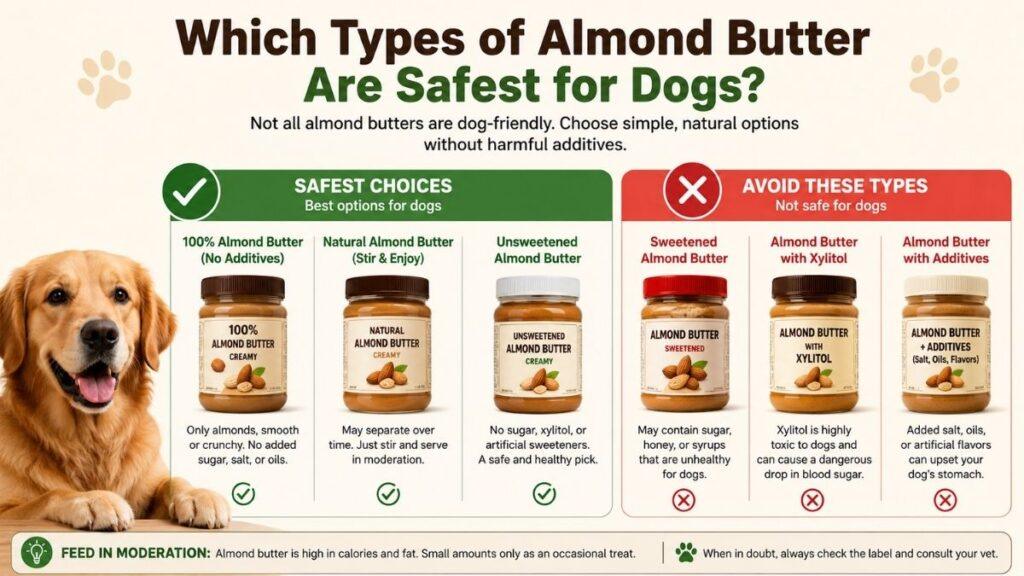
| Almond butter type | Suitability for dogs |
| Plain, unsalted | Best choice |
| Unsweetened, natural | Generally fine in small amounts |
| Lightly salted | Sparingly, and check the sodium |
| Sweetened with sugar or honey | Better avoided |
| Labeled sugar-free | High risk, check the label for xylitol |
| Chocolate or dessert flavored | Avoid, chocolate is toxic to dogs |
| Homemade | Only as safe as what you put in it |
Specialty spreads made for people are the ones to watch. Almond butters blended with chocolate, marshmallow, or cookie flavoring stack a genuinely toxic ingredient on top of the fat load. Homemade follows the same rules: no sweeteners, minimal salt, no cocoa.
Almond butter vs peanut butter for dogs
Neither nut butter is safer by default. Both can contain xylitol, sugar, or salt, and both are calorie-dense. Dr. Myers considers the two nutritionally equivalent for dogs and interchangeable in small amounts, which means the specific product decides the question, not the nut.
| Criteria | Almond butter | Peanut butter |
| Base nut toxic to dogs | No | No |
| Xylitol risk | In some sugar-free versions | In some sugar-free versions |
| Calories per tablespoon | About 100 | About 100 |
| Plain, single-ingredient options | Common | Very common |
| Typical cost | Higher | Lower |
Peanut butter has the longer track record as a dog treat and more minimal-ingredient options on the shelf. That is a convenience advantage, not a safety one, since xylitol shows up in some sugar-free peanut butters too.
What are safer alternatives to almond butter?
If you would rather skip the nut butter question, several options do the same job with less label-reading. Commercial dog treats are calorie-controlled and free of human-food additives. Small pieces of plain cooked lean meat work as a high-value reward. Carrot or apple slices, without seeds or core, cost far fewer calories. Puzzle-toy fillers made for dogs handle enrichment without the fat load, and pet-specific nut butters remove the guesswork about ingredients.
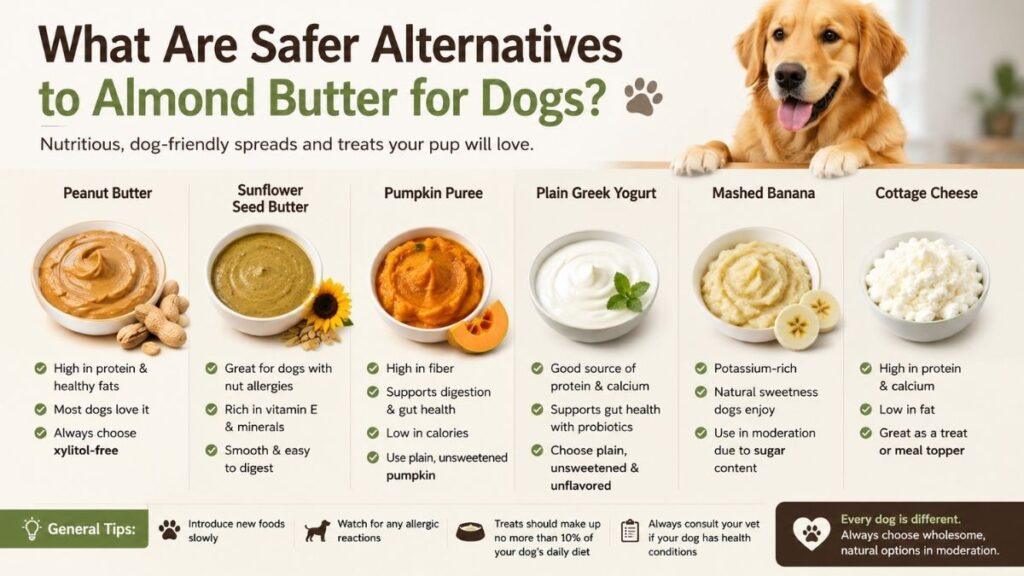
Whatever you pick, the same rules apply: read the label, keep treats to a small share of daily calories, and introduce anything new slowly.
Frequently asked questions
Can dogs have almond butter every day?
Better not. Almond butter is calorie-dense and high in fat, so daily feeding pushes most dogs past the ten percent treat limit and raises the odds of weight gain or stomach upset over time. Keep it for training rewards, pill-hiding, or occasional enrichment instead.
Can dogs eat unsweetened almond butter?
Yes, unsweetened plain almond butter is the safer option, but the word unsweetened does not rule out every problem ingredient. Check the full panel for added salt, oils, and sugar substitutes. A product can be unsweetened in the marketing sense and still contain something you would rather avoid.
Can dogs have salted almond butter?
A small amount of salt is unlikely to trouble a healthy dog, but heavily salted products are worth avoiding. PetMD notes that salted nuts can increase water retention, which is particularly risky for dogs with heart disease. Dogs with kidney disease also do better on lower-sodium treats.
What if my dog ate a lot of plain almond butter?
Watch for vomiting, diarrhea, appetite loss, or signs of belly pain, and call your veterinarian if any of those appear or persist. A large fatty meal can trigger pancreatitis in susceptible dogs. If the product contained xylitol or chocolate, skip the monitoring and call immediately.
Can dogs eat almond flour or almond milk?
Hill’s Pet Nutrition says almond flour carries most of the same risks as whole almonds, and recommends avoiding almond milk since it offers dogs no nutritional benefit and flavored versions may contain artificial sweeteners. A spilled lick of plain almond milk is unlikely to cause harm.
Is homemade almond butter safer for dogs?
It can be, because you control what goes in. Grind plain almonds with no sweetener, no cocoa, and little or no salt, and you have removed the additive risk entirely. The fat and calories stay the same, so portion size still matters as much as it does with a store-bought jar.
What to do before you share almond butter
Almond butter is not something your dog needs, and a small spoonful of the right product is unlikely to cause harm. Most of the work happens before the spoon comes out. Read every ingredient, rule out xylitol and its alternative names, avoid chocolate and heavy salt and sugar, and match the portion to your dog’s size rather than to the spoon in your hand.
Two situations change the answer. If your dog has a history of pancreatitis, carries extra weight, or lives with a chronic condition, ask your veterinarian before adding almond butter or any new treat. And if your dog gets into a product containing xylitol, do not wait for symptoms. Call your veterinarian or a pet poison hotline right away, and take the packaging with you.