

Can dogs eat cream cheese? Yes. Most healthy adult dogs can have a small amount of plain cream cheese as an occasional treat, and it isn’t toxic. The trouble comes from three places: the fat, the lactose some dogs can’t handle, and the add-ins in flavored tubs. This guide covers safe servings by weight, the flavors to avoid, a medication warning most guides skip, and a plan for the day your dog licks out the whole tub.
Can dogs eat cream cheese safely?
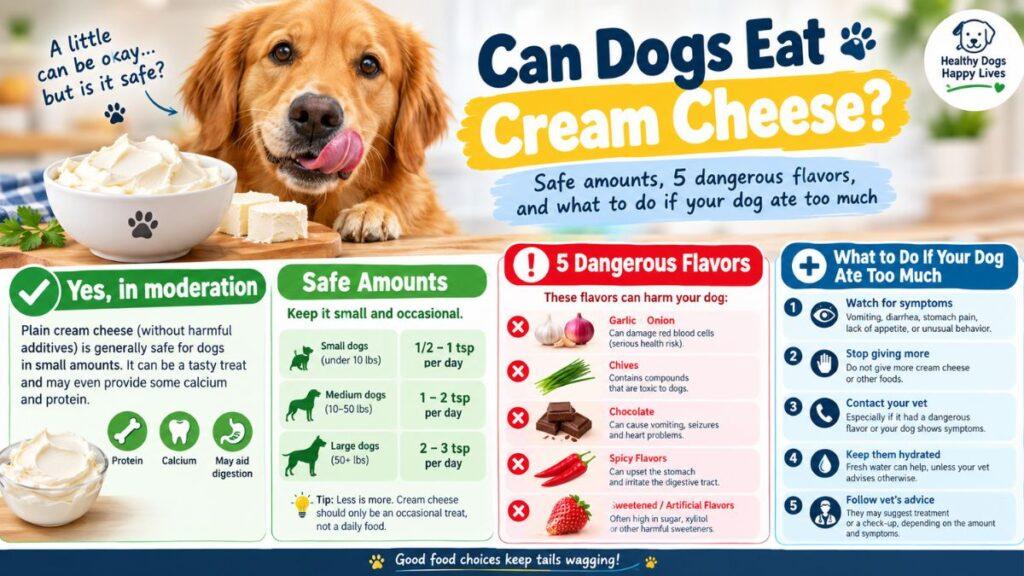
Yes, plain cream cheese is safe for most healthy adult dogs in small amounts. Think a quarter teaspoon to one tablespoon depending on size, a few times a week at most. It is not toxic, but its fat and lactose can upset sensitive stomachs and trigger bigger problems.
Cream cheese sits in the same group as plain cooked chicken or a cube of cheddar: fine in moderation. Nothing in plain cream cheese poisons a dog the way chocolate, grapes, or xylitol can.
It also gives your dog almost nothing it needs. A complete dog food already covers protein, calcium, and vitamins, so cream cheese for dogs is a pleasure food, not a health food. Most vets apply the 10 percent rule: all treats combined should stay under 10 percent of your dog’s daily calories.
Cream cheese nutrition for dogs, per tablespoon
One tablespoon of regular cream cheese has roughly 50 calories, 5 grams of fat, 3 grams of it saturated, under 1 gram of protein, and about 45 milligrams of sodium. It is mostly fat. That is why portion size matters far more than the salt most articles warn about.
Here is how the common types compare per tablespoon, based on USDA FoodData Central figures and product labels:
| Type | Calories | Fat |
| Regular (block or tub) | about 50 | about 5 g |
| Neufchatel (“1/3 less fat”) | about 35 | about 3.5 g |
| Whipped | about 25 | about 2.5 g |
| Fat-free | about 15 | under 0.5 g |
Sodium gets plenty of attention online, but 45 milligrams is modest. Fat is the real concern. A 20-pound dog eating two tablespoons takes in about 10 grams of fat in one go, on top of dinner.
Lactose is lower than people expect, because much of the whey drains off when cream cheese is made. That’s why dogs who get gassy from milk often handle a lick of cream cheese fine.
Can dogs eat cream cheese every day? How much is safe by size
No, a few times a week is plenty. Keep servings tiny: about a quarter teaspoon for toy dogs, half to one teaspoon for small dogs, one to two teaspoons for medium dogs, and up to one tablespoon for large dogs. Count every serving toward your dog’s daily treat allowance.
| Dog size | Weight | Max per serving | Calories |
| Toy | under 10 lb | 1/4 to 1/2 tsp | 4 to 8 |
| Small | 10 to 25 lb | 1/2 to 1 tsp | 8 to 17 |
| Medium | 26 to 50 lb | 1 to 2 tsp | 17 to 34 |
| Large | 51 to 90 lb | 2 tsp to 1 tbsp | 34 to 50 |
| Giant | over 90 lb | 1 tbsp | about 50 |
Here is the math with a real-world example. A neutered, 20-pound adult beagle needs roughly 550 to 600 calories a day by the standard veterinary energy formula. Ten percent of that is 55 to 60 calories for every treat combined. One tablespoon of cream cheese would use nearly all of it. A single teaspoon, about 17 calories, still makes the dog’s day and leaves room for training treats.
If your dog is overweight, halve these amounts or skip cream cheese for now. On a lick mat, measure first and spread thin, because it’s easy to smear on a tablespoon without noticing.
Which types of cream cheese are safe for dogs?
Plain regular, plain whipped, and plain Neufchatel are the safe choices, with whipped and Neufchatel being the lighter picks. Anything flavored needs a label check at best and is a hard no at worst. Plant-based cream cheese is not automatically safer, since savory versions often add garlic or onion.
Whipped is the easy win, because air takes up part of every spoonful. It is not the same as whipped cream, which is mostly sugar. Fat-free sounds ideal, but it leans on gums and stabilizers, and a few light or sugar-free spreads use sweeteners. Scan the label for xylitol, sometimes listed as birch sugar.
Lactose-free cream cheese suits dogs who get gassy from dairy. Plain cashew or almond-based vegan spreads are fine in small amounts too, but they carry just as much fat.
5 dangerous cream cheese flavors and foods for dogs
Keep these five away from your dog: chive and onion or garden vegetable spreads, garlic and herb spreads, everything bagel spreads and bagels, sugar-free spreads or frostings that may contain xylitol, and rich dishes like crab rangoon and cheesecake. Plain cream cheese is fine; these usually are not.
- Chive and onion, and garden vegetable. Chives and onion are alliums. The ASPCA warns that alliums can irritate the gut and damage red blood cells, which can lead to anemia. Dried flakes are more concentrated than fresh.
- Garlic and herb. Garlic is another allium, and in these tubs it’s usually the main flavor, not a trace.
- Everything bagel spreads and bagels. The seasoning is mostly dried garlic and onion. A bite of plain bagel with plain cream cheese is fine; the everything version is not.
- Sugar-free spreads and “keto” frosting. These may contain xylitol, which can drop a dog’s blood sugar fast and injure the liver. Treat any xylitol exposure as an emergency, even before symptoms show.
- Crab rangoon, jalapeno poppers, and cheesecake. Fried party foods pair onion and spice with grease, a rough mix for a dog’s pancreas. Cheesecake adds sugar, a butter-heavy crust, and sometimes chocolate or raisin toppings, both toxic.
Sweet flavors like strawberry or brown sugar cinnamon aren’t toxic. The fruit itself is dog safe; the added sugar is the problem. Honey nut versions may contain walnut pieces, which are best kept away from dogs.
Can dogs eat cream cheese with pills hidden in it?
Yes, cream cheese works well for hiding pills because it is sticky, soft, and easy to mold. Use a pea-sized dab for most tablets. One catch: calcium in dairy can bind some antibiotics, including doxycycline and fluoroquinolones like enrofloxacin, so ask your vet before pairing those with cream cheese.
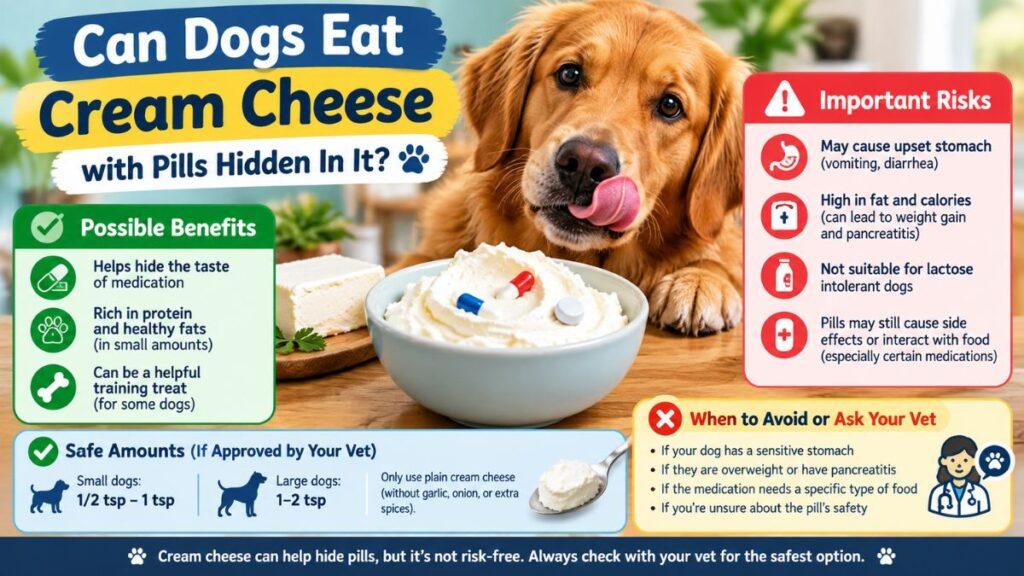
Cold cream cheese straight from the fridge holds its shape better around a tablet. A trick many owners rely on: give one plain dab, then the dab with the pill, then another plain dab right away. Don’t crush pills unless your vet says that medication can be crushed.
Watch the total on a long course. A teaspoon twice a day for a 10-pound dog is roughly 10 percent of its daily calories by itself. Use the smallest dab that covers the pill, and pick something else entirely for a dog being treated for pancreatitis.
Dogs that should skip cream cheese completely
Skip cream cheese for dogs with a history of pancreatitis, obesity, diabetes, inflammatory bowel disease, a known dairy allergy, or confirmed lactose intolerance. Breeds prone to high blood fats, like Miniature Schnauzers, deserve extra caution. If your dog is on a prescription diet, check with your vet first.
Pancreatitis is the big one. A fatty food can trigger a flare in a dog that has had it before, and Miniature Schnauzers, Yorkshire Terriers, and Cocker Spaniels come up often in pancreatitis cases. Dogs with kidney disease usually eat a controlled diet, so extras need a vet’s okay.
Lactose intolerance and dairy allergy are different problems. Intolerance is digestive and shows up as gas or loose stool within hours. An allergy is an immune reaction to milk protein, often seen as itchy skin, ear trouble, or paw licking. Lactose-free cream cheese helps the first and does nothing for the second.
If your dog has never had dairy, offer one lick-sized amount and watch for 24 hours before trying a full serving.
Can puppies eat cream cheese?
Puppies can technically have a tiny lick of plain cream cheese, but there is little reason to offer it. Their stomachs are sensitive, their calorie needs are tightly balanced for growth, and lactase, the enzyme that digests milk sugar, starts dropping after weaning. Wait until your puppy is older.
Puppy food is balanced to the calorie, so treats should stay small and simple. For training, a piece of their own kibble or a bit of plain cooked chicken works without the dairy risk. For a nail trim or first vet visit, a thin smear of plain pumpkin on a lick mat does the job.
My dog ate a lot of cream cheese: what to do
First, check the label. If it contained garlic, onion, chives, xylitol, chocolate, or raisins, call your vet or a pet poison line now. If it was plain, most dogs only get a sore stomach. Watch 48 to 72 hours for repeated vomiting, belly pain, or lethargy.
An 8-ounce block of regular cream cheese holds roughly 800 calories and close to 80 grams of fat. For a 20-pound dog, that’s more than a full day’s calories, nearly all fat, in a few minutes. A 70-pound Labrador copes better, but it’s still a heavy load.
If it was plain, keep water available, feed a smaller normal meal, and skip treats for a day. Some gas, one vomit, or loose stool in the first day is common and usually passes.
Get to a vet the same day if you see repeated vomiting, a hunched posture with the front end down and rear up, a tender belly, refusal to eat, or unusual tiredness. Pancreatitis can take one to four days to show.
Don’t induce vomiting at home with hydrogen peroxide unless a vet tells you to. For toxic ingredients in the US, call the ASPCA Animal Poison Control Center at (888) 426-4435 or the Pet Poison Helpline at (855) 764-7661. Both charge a consultation fee.
Better alternatives to cream cheese for dogs
If you want something spreadable, plain unsweetened pumpkin puree, plain Greek yogurt, low-fat cottage cheese, and xylitol-free peanut butter all work on lick mats and in toys. Pumpkin is the lightest option. Peanut butter is higher in calories than cream cheese, so measure it carefully.
Plain canned pumpkin has about 5 calories per tablespoon and some fiber. Buy pure pumpkin, not pie filling, which has sugar and spices. Plain Greek yogurt is lower in lactose than milk. Low-fat cottage cheese is mild and high in protein but saltier. Peanut butter runs about 95 calories per tablespoon, and a few brands contain xylitol. Plain almond butter works in the same small amounts.
The easiest option is often your dog’s own wet food, smeared on a lick mat and frozen. It’s already balanced, and freezing stretches a small amount from 30 seconds to 15 minutes.
How we researched this article
This guide was written by Raza at DogMealSafety and checked against ASPCA poison control guidance, USDA FoodData Central nutrition data, and the Merck Veterinary Manual. Calorie figures are approximate and rounded. It is general information, not a diagnosis, so your own vet should guide decisions for your dog.
We started with the questions dog owners search for most, then checked every number and safety claim against primary sources. Nutrition figures come from USDA data and product labels. Toxic ingredient guidance follows the ASPCA’s list of people foods to avoid.
Sources:
- ASPCA Animal Poison Control Center, People Foods to Avoid Feeding Your Pets
- USDA FoodData Central, cream cheese entries
- Merck Veterinary Manual, dog nutrition and pancreatitis
- Pet Poison Helpline
Can dogs eat cream cheese? Frequently asked questions
These are the questions dog owners ask most often. The short version holds across all of them: plain cream cheese in small amounts is fine for most dogs, flavored varieties need a label check, and fatty, sugary, or seasoned foods made with cream cheese are best avoided.
Can dogs eat cream cheese frosting?
Only regular frosting in a tiny lick, and never sugar-free frosting that could contain xylitol.
Can dogs eat cream cheese on a bagel?
A small bite of plain bagel with plain cream cheese is fine, but never everything or onion bagels.
Can dogs eat cream cheese if they are lactose intolerant?
Lactose-free cream cheese is the safer choice, in very small amounts.
Can dogs eat strawberry cream cheese?
A lick won’t hurt, but plain is better because of the added sugar.
Can dogs eat Philadelphia cream cheese?
Plain Original is fine in small amounts; check flavored versions for alliums and sweeteners.
Can dogs eat cheesecake?
Avoid it because of sugar, fat, and toppings like chocolate or raisins.
Is cream cheese better than peanut butter for dogs?
It has about half the calories per tablespoon, while peanut butter has more protein.
Can cream cheese give a dog diarrhea?
Yes, too much fat or lactose can cause loose stool within hours.
Can dogs eat vegan cream cheese?
Only plain versions without garlic, onion, or xylitol, and in small amounts.
Is cream cheese safe for dogs with a dairy allergy?
No, even lactose-free cream cheese contains the milk protein behind the allergy.
The bottom line: can dogs eat cream cheese?
Yes, dogs can eat cream cheese in small, plain amounts, and the right serving is smaller than most people guess. A teaspoon covers a small dog, and a tablespoon is the ceiling for a big one. Regular, whipped, and Neufchatel work, with the lighter two easier on the waistline.
The trouble almost always comes from what rides along: garlic and chives in savory tubs, xylitol in sugar-free spreads, and the fat load when a dog gets into a whole block. If your dog has had pancreatitis, carries extra weight, or reacts badly to dairy, skip it and reach for pumpkin or plain yogurt. Hiding pills in cream cheese works well, but ask your vet first if the medication is an antibiotic. And if your dog ever eats a flavored spread or a full tub, read the label, then call your vet. That one check tells you whether you’re dealing with an upset stomach or an emergency.