
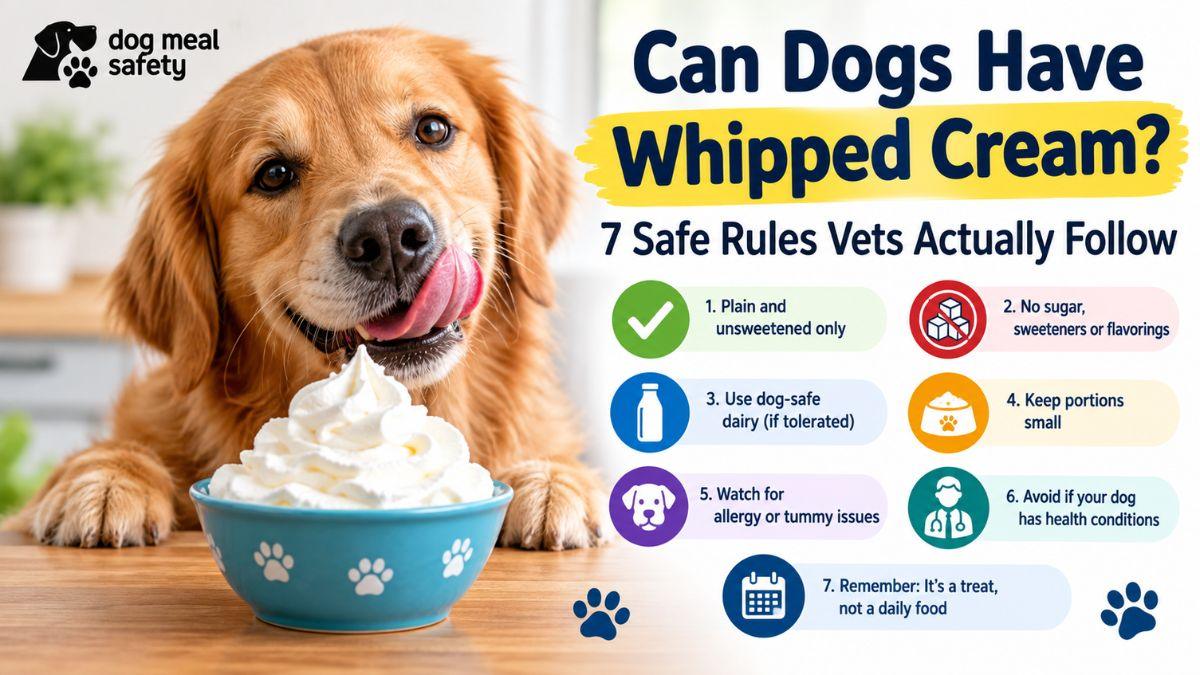
Can dogs have whipped cream? Yes, most of them can, and a lick off your finger is not going to hurt anything. Whipped cream is not toxic and it does not appear on any pet poison list. That part is easy.
What nobody tells you is the amount. A teaspoon and a full Starbucks cup are two very different things for a 20 pound dog, and most articles blur them together under the word “moderation” and leave you no wiser. So here are the numbers, the label problems, and what to do if your dog already ate the whole bowl.
Can dogs have whipped cream safely?
Yes. Plain dairy whipped cream is safe for most healthy dogs in small amounts: about a teaspoon for a small dog, up to two or three tablespoons for a large dog, once or twice a week at most. The risks are fat, calories, and an upset stomach, not poisoning.
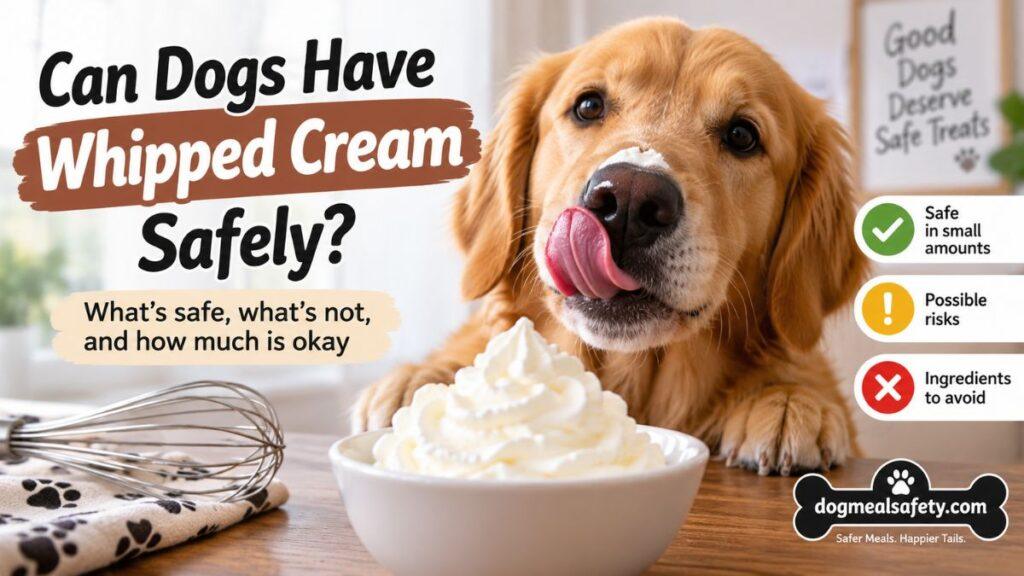
Whipped cream is aerated cream with a little sugar and vanilla in it. None of those ingredients do anything dangerous to a dog, which is why it sits nowhere near chocolate, grapes, or onions on the danger list. Veterinary toxicologist Renee Schmid of the Pet Poison Helpline puts it simply: some dogs handle whipped cream and other dairy fine, and others end up with vomiting, diarrhea, or gas.
Which group your dog falls into is something you only learn by trying a small amount.
Worth saying out loud though: whipped cream does nothing good for a dog nutritionally. It is fat and sugar. If your dog already loves it and tolerates it, fine. If your dog has never had it, there is no reason to introduce it.
How much whipped cream can dogs have? Portions by weight
Treats should stay under 10 percent of your dog’s daily calories. Coffee shop whipped cream runs roughly 25 calories per tablespoon, and canned supermarket whipped cream about 8 calories per tablespoon, so the safe portion is smaller than most owners assume.
These are maximum occasional servings, not daily allowances.
| Dog weight | Rough daily calories | 10% treat budget | Max whipped cream (coffee shop style) |
| Under 10 lb | ~250 kcal | ~25 kcal | 1 teaspoon |
| 10 to 25 lb | ~420 kcal | ~42 kcal | 1 tablespoon |
| 25 to 50 lb | ~700 kcal | ~70 kcal | 2 tablespoons |
| 50 to 80 lb | ~1,000 kcal | ~100 kcal | 3 tablespoons |
| Over 80 lb | ~1,300 kcal | ~130 kcal | A quarter of a standard pup cup |
Run it on a real dog and it gets clearer. A 22 pound beagle mix eats around 420 calories a day, which leaves her about 42 calories for treats. A full Starbucks Puppuccino lands between 80 and 110 calories, since Starbucks whipped cream measures 50 to 70 calories on a hot drink and 80 to 110 on a cold one. One cup swallows two days of her treat budget in about forty seconds, and that is before the dental chew and the biscuits from the walk. For anything under 50 pounds, a full pup cup is closer to a small meal than a snack.
Daily calorie needs shift with age and activity, so treat the table as a starting point and ask your vet for a real number at the next visit.
What is actually inside the can
Aerosol dairy whipped cream is mostly cream, water, and sugar, and it is the best of the three options. Cool Whip style frozen topping contains no cream at all. Coffee shop whipped cream is heavy cream blended with vanilla syrup, which makes it sweeter than people realise.
Turn the can around before you squeeze. Reddi-wip Original and most supermarket own brands list cream, skim milk, corn syrup, cane sugar, mono and diglycerides, carrageenan, and nitrous oxide as the propellant. Nothing there is toxic to a dog. The nitrous oxide is only the gas that pushes the cream out, and it disperses the second it leaves the nozzle, which comes up as a question far more often than you would expect.
Cool Whip is a different animal. Its ingredients open with water, corn syrup, high fructose corn syrup, and hydrogenated vegetable oil from coconut and palm kernel oils. There is no cream in it anywhere. It will not poison your dog, but you would be handing over processed oil and two kinds of corn syrup for nothing, so use the real stuff.
Coffee shop whipped cream sits between the two. Starbucks makes theirs by combining heavy cream with vanilla syrup in a nitrous charged canister, so the Puppuccino your dog gets is not the “plain whipped cream” almost every article calls it. Harmless for a healthy dog, relevant if yours is diabetic or overweight.
Can dogs have whipped cream that is sugar free?
Usually yes, and the standard warning about this is out of date. Reddi-wip Zero Sugar, the main sugar free whipped cream in US stores, is sweetened with sucralose rather than xylitol. Check the label anyway, because xylitol can kill a dog and smaller brands do sometimes use it.
Every article on this topic repeats the same line: avoid sugar free whipped cream because it might contain xylitol. The principle is sound. Xylitol triggers a fast insulin release in dogs, which can crash their blood sugar and, at higher doses, damage the liver. A dog that eats xylitol needs a vet that hour.
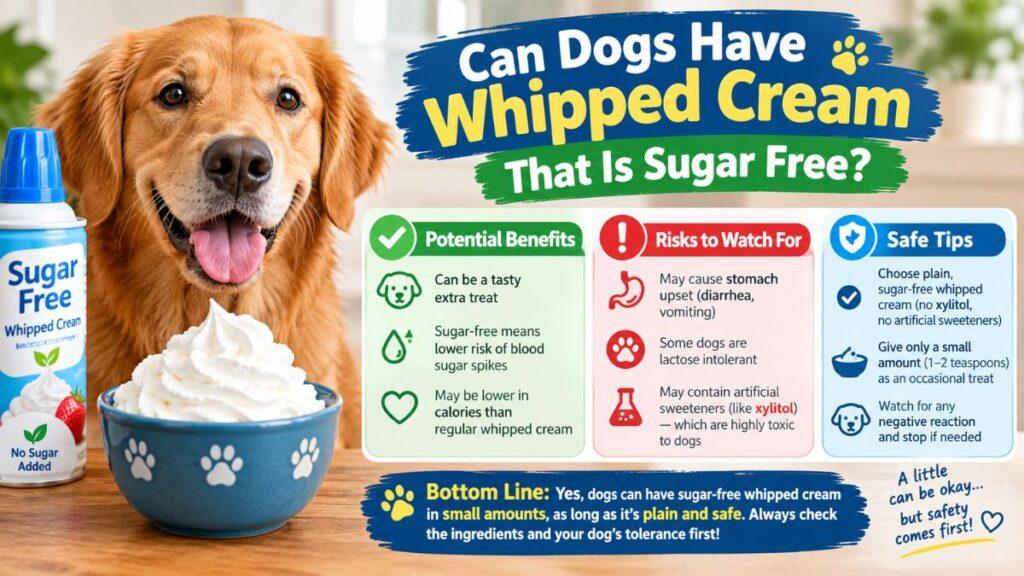
The products on the shelf tell a different story though. Reddi-wip Zero Sugar lists cream, water, nonfat milk, mono and diglycerides, carrageenan, and sucralose. Conagra, which owns the brand, confirms sucralose is the sweetener. Sucralose is not toxic to dogs. Enough of it loosens their stools and that is about the extent of it.
So the useful version goes like this. Dogs can have whipped cream that is sugar free in most cases, but you have to read the container first. Xylitol also appears on labels as birch sugar, and either word means you call your vet or the Pet Poison Helpline straight away. Sucralose, erythritol, or stevia means your dog is not in danger.
Why fat matters more than lactose here
Heavy cream holds only about 0.5 grams of lactose per tablespoon, against roughly 12 grams in a cup of milk. Whipped cream is one of the lowest lactose dairy foods you can buy. The genuine risk is the fat, which can set off pancreatitis.
Adult dogs make far less lactase than puppies, so dairy gets blamed for every soft stool in the house. Whipped cream is a poor example of the problem though. Lactose dissolves in the watery part of milk rather than the fat, so the more fat a dairy food contains, the less lactose is left. Cream is mostly fat, which is exactly why it whips.
What you are left with is close to pure fat, and that is where the caution belongs. High fat meals are a known trigger for pancreatitis in dogs, an inflammation of the pancreas that runs anywhere from a rough 48 hours to a hospital stay. Rachel Hinder, a registered veterinary technician with Embrace Pet Insurance, has made the link directly: whipped cream is high in fat, and fatty diets have been shown to lead to pancreatitis in dogs.
If your dog gets gassy and loose after a pup cup, the fat load is the likelier culprit. It also explains why lactose free whipped cream is not the fix people hope for. Take the lactose out and every gram of fat is still there.
Can dogs have whipped cream from Starbucks?
Yes, for a healthy adult dog, now and then. A Puppuccino is a free espresso cup of whipped cream with no coffee and no caffeine in it. The catch is the serving size, which overshoots any dog under about 50 pounds.
It is an off menu item, so you will not see it on the board. Ask at the counter or the drive thru and most baristas hand one over without charging you. No coffee, no chocolate, no sprinkles unless somebody adds them for fun.
The volume is the issue rather than the ingredients. That espresso cup holds a dessert portion built for a person, and a 15 pound dog gets the whole thing as if it were a biscuit. With a small or medium dog, let them lick the top and bin the rest, or split one cup between two dogs. With a Labrador, the whole cup is defensible once in a while.
One habit worth picking up: glance inside before you pass it back. Some locations add flavoring, and the occasional barista tops it with extra syrup to be nice.
Pup cups at other chains are not the same treat
Starbucks, Dunkin, and Dutch Bros serve whipped cream. Dairy Queen, Culver’s, Rita’s, and Cold Stone serve soft serve, ice cream, or frozen custard, which carry noticeably more sugar and, with custard, more fat. The two are not interchangeable.
People say “pup cup” and “Puppuccino” as though they describe one thing. Dairy Queen’s pup cup is vanilla soft serve with a biscuit on top. Culver’s and Rita’s hand out frozen custard, which contains egg yolks and is richer again. Dunkin’s Cup for Pup and the Dutch Bros version are both whipped cream.
For a dog with a sensitive stomach, whipped cream is the gentler choice, mostly because it is largely air. Soft serve and custard pack real sugar and dairy solids into the same small cup. Chick-fil-A varies by location, so ask what is in it before you accept one.
Which dogs should never have whipped cream
Dogs with a history of pancreatitis, diabetes, obesity, chronic digestive trouble, a confirmed dairy allergy, or any prescribed low fat diet should skip whipped cream entirely. So should puppies under about 12 weeks.
A previous bout of pancreatitis is the strongest reason to say no. Once a dog has had one episode, a single fatty indulgence can start another, and breeds that already sit at higher risk, including miniature schnauzers, Yorkshire terriers, and cocker spaniels, have less room for error.
Diabetic dogs come next. Whipped cream from a can or a coffee shop carries added sugar, and glucose control in a diabetic dog is a daily balancing act that a pup cup quietly undermines.
Overweight dogs make up the largest group and get overlooked the most, because nobody believes one treat counts. For a 12 pound dog already carrying extra weight, a full Puppuccino is the calorie equivalent of a person eating a second dinner. Puppies under 12 weeks are still settling into solid food, and something this rich during that transition usually ends with you awake at 2 a.m.
Your dog ate a whole bowl of whipped cream. Now what?
Watch a healthy adult dog for 24 to 48 hours, skip other treats, keep water available, and offer a small bland meal at the next mealtime. Dogs can have whipped cream in large amounts without lasting harm most of the time, but call your vet the same day if you see repeated vomiting, severe diarrhea, lethargy, a hunched posture, or a swollen painful belly.
The timing tells you a lot. Gas and soft stools usually turn up within a few hours and clear inside a day. One episode of vomiting on its own is common and rarely serious. You are watching for the pattern that keeps going.
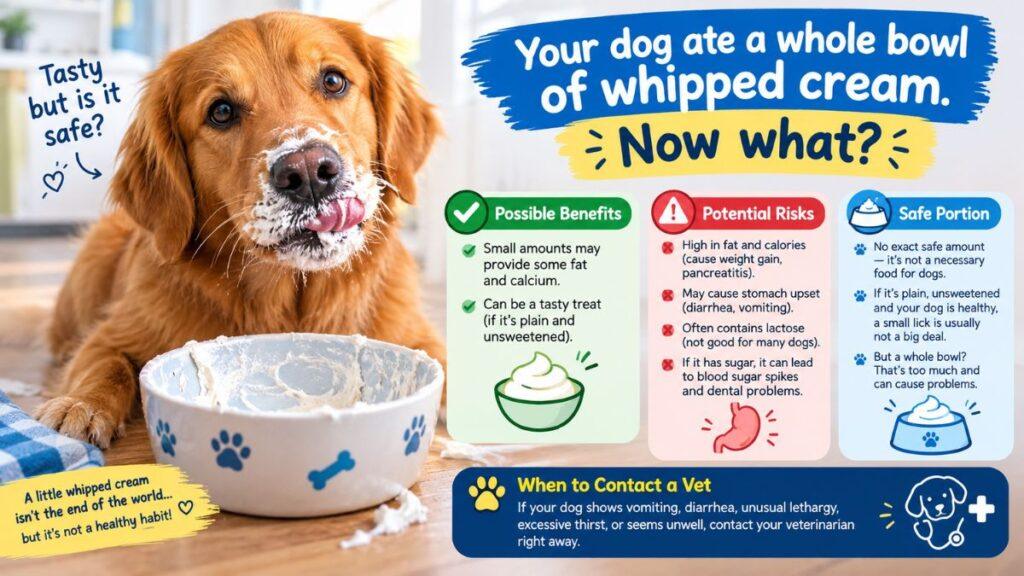
Pancreatitis looks different from simple indigestion and tends to appear 12 to 48 hours later: repeated vomiting, refusing food, clear abdominal pain, restlessness, and the praying position, where the dog drops their chest and front legs to the floor while their back end stays up. That combination is a vet visit today.
For a mild upset, a small portion of plain boiled chicken and white rice at the next meal settles most dogs. Call the clinic sooner if diarrhea runs past two days, or if your dog is a small breed, a puppy, or a senior. And if the whipped cream came alongside chocolate, grapes, raisins, or a sugar free label you have not read yet, treat it as urgent rather than waiting.
How to give whipped cream to a dog safely
Use plain aerosol dairy whipped cream, start with a teaspoon, serve it away from mealtimes, and wait 24 hours the first time to see how your dog reacts. Do not make it a daily thing.
Squeeze it onto a spoon or a lick mat instead of letting your dog eat straight from the can, which keeps you in control of the portion. Keep it out of the food bowl too, since piling something this fatty on top of a full meal is the quickest route to a bad night.
First time, give a small taste and stop there for the day. Dogs that react usually do so within a few hours. Keep a rough tally of everything else they ate as well, because the 10 percent rule covers every treat combined, not whipped cream on its own.
Better alternatives to whipped cream
Plain unsweetened Greek yogurt, a frozen banana blend, or unsweetened whipped coconut cream deliver a similar texture with less fat and something closer to actual nutrition.
Plain Greek yogurt is the nearest swap. Thicker, lower in fat, and it brings live cultures with it. Read the label for sweeteners and put back anything marked sugar free until you have checked what is in it.
For a homemade version, blend half a ripe banana with two tablespoons of plain yogurt and freeze it in an ice cube tray. It scoops like soft serve and you know every ingredient. Unsweetened whipped coconut cream suits dairy sensitive dogs, though it is still high in fat, so the same portions apply.
One thing I notice with my own dog: the ritual matters more than the cream. Carrot sticks or a handful of their own kibble served in a paper cup gets a near identical reaction for a fraction of the calories.
Frequently asked questions
Can puppies have whipped cream?
Not under 12 weeks, and only a lick or two after that.
Is Cool Whip safe for dogs?
Not toxic, but it contains no cream and two forms of corn syrup, so use real whipped cream instead.
Can dogs have whipped cream every day?
No. Once or twice a week at most, inside the 10 percent treat rule.
Is the nitrous oxide in whipped cream cans harmful to dogs?
No. It disperses as soon as the cream leaves the can.
Can diabetic dogs have a Puppuccino?
No. Ask your vet for an approved low sugar treat.
Does whipped cream cause pancreatitis in dogs?
A large amount can trigger it, especially in dogs that have had it before.
Is lactose free whipped cream better for dogs?
Slightly, for dairy sensitive dogs, though the fat content does not change.
Can dogs have whipped cream after surgery or while on medication?
Ask your vet first, since fatty foods interfere with some recovery diets.
The bottom line
So, can dogs have whipped cream? Yes, and the question stops being interesting the moment you look at portions instead. A teaspoon for a small dog, a couple of tablespoons for a big one, once or twice a week, and never for a dog with pancreatitis, diabetes, or a weight problem.
Two things are worth carrying away. The fat matters more than the lactose, whatever the usual advice says. And a full pup cup is a serious portion for any dog smaller than a Labrador, which covers most dogs sitting in most drive thru queues.
Read the label on anything marked sugar free, leave the frozen toppings made from oil and corn syrup on the shelf, and pour a few licks onto a spoon instead of handing over the cup. If your dog does get into a large amount and starts vomiting repeatedly, goes off their food, or stands in that hunched praying position, call your vet that day. Anything milder usually sorts itself out overnight.
1 thought on “Can Dogs Have Whipped Cream? 7 Safe Rules Vets Actually Follow”