

Can dogs have cottage cheese? Yes. Plain, low-fat cottage cheese is safe for most healthy dogs in small amounts. A 20 lb dog can have about 4 tablespoons a day at most, a 50 lb dog about half a cup. Skip it entirely if your dog has kidney disease, heart disease, a history of pancreatitis, or a dairy allergy.
That covers what most people came for. The rest of this page is the part almost nobody publishes: the actual numbers, the sodium problem, and the one medication you should never hide inside it.
What Is Actually in Cottage Cheese
Quick answer: A 100 g serving of 2% cottage cheese has 81 calories, 10.4 g protein, 308 mg sodium, 111 mg calcium, and 150 mg phosphorus.
Most articles call it “high in protein and calcium” and stop. Here is what USDA data says about lowfat 2% milkfat cottage cheese, the type most people buy.
| Per 100 g (about 7 tbsp) | Amount |
| Calories | 81 kcal |
| Protein | 10.4 g |
| Sodium | 308 mg |
| Calcium | 111 mg |
| Phosphorus | 150 mg |
In serving sizes you can actually measure:
| Serving | Weight | Calories | Protein | Sodium |
| 1 tablespoon | 15 g | 12 kcal | 1.6 g | 46 mg |
| 1/4 cup | 57 g | 46 kcal | 6.0 g | 176 mg |
| 1/2 cup | 113 g | 92 kcal | 11.8 g | 348 mg |
The protein is good and highly digestible, which is why vets reach for it during recovery feeding. The sodium is the number nobody quotes, and it is the reason this food is not a free-for-all.
Can Dogs Have Cottage Cheese Every Day? Portions by Weight
Quick answer: A healthy dog can have cottage cheese daily as long as it stays under 10% of daily calories. That is roughly 2.5 tbsp for a 10 lb dog, 4 tbsp for a 20 lb dog, and 8 tbsp for a 50 lb dog.
Treats and toppers should stay under 10% of daily calories so the balanced food in the bowl keeps doing its job. Here is that rule converted into tablespoons, using estimated daily energy needs for a neutered adult dog with average activity.
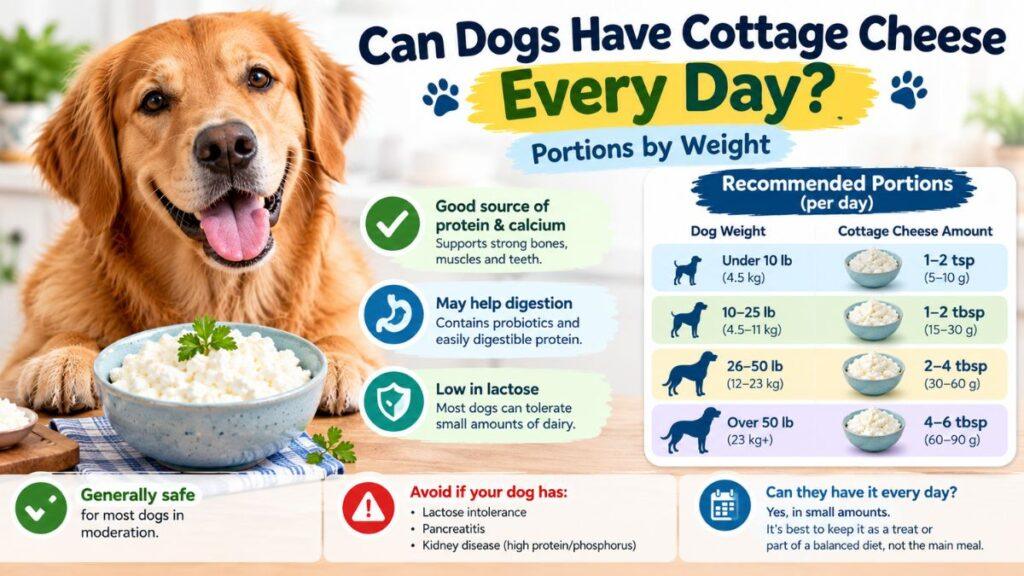
| Dog weight | Est. daily calories | 10% ceiling | Max cottage cheese per day |
| 5 lb | ~180 kcal | 18 kcal | 1.5 tbsp |
| 10 lb | ~300 kcal | 30 kcal | 2.5 tbsp |
| 20 lb | ~510 kcal | 51 kcal | 4 tbsp (1/4 cup) |
| 30 lb | ~695 kcal | 70 kcal | 6 tbsp |
| 50 lb | ~1,020 kcal | 102 kcal | 8 tbsp (1/2 cup) |
| 70 lb | ~1,315 kcal | 132 kcal | 10 tbsp |
| 90 lb | ~1,580 kcal | 158 kcal | 13 tbsp (3/4 cup) |
Read that last column as a ceiling, not a target. Dental chews, training treats, and peanut butter all come out of the same 10%. In practice I feed about half the number shown and spend the rest of the allowance elsewhere.
Here is how that works on a real dog. A 25 lb beagle needs roughly 600 kcal a day, so her treat budget is 60 kcal. That buys 5 tablespoons of cottage cheese. It also buys five small training treats, or two dental sticks. Not all three.
One widely shared article recommends 3 oz per 25 lb of body weight per day. For that beagle, 85 g works out to 69 kcal, which uses her entire allowance with nothing left. Reasonable for a dog recovering from illness under vet supervision. Too much as a routine habit for a healthy dog.
Read more on how many treats a dog can have per day for the full calorie breakdown.
The Sodium Problem Nobody Mentions
Quick answer: A quarter cup of cottage cheese carries 176 mg of sodium, which can more than double the daily sodium of a small dog on a low-sodium diet.
For context, the AAFCO minimum for adult dog food is 0.08% on a dry matter basis, roughly 200 mg of sodium per 1,000 kcal.
So a 20 lb dog eating 500 kcal of a lean, minimum-sodium food takes in around 100 mg of sodium from her bowl. A quarter cup of cottage cheese more than doubles that.
Most commercial foods sit well above the AAFCO floor, so the real-world jump is smaller. But if your dog is on a prescription cardiac or renal diet where sodium has been deliberately restricted, a daily spoon quietly works against that diet. Worth a conversation with your vet rather than a guess.
Low-sodium and no-salt-added versions exist and cut the figure sharply. Check the Nutrition Facts panel, not the front of the tub. “Light” and “low-fat” say nothing about salt.
Which Tub to Buy
Quick answer: Buy plain 1% or 2% milkfat cottage cheese with no added flavours, no fruit, and no sugar-free sweeteners.
1% or 2% milkfat. Whole-milk cottage cheese runs around 4% fat. For a dog with any pancreatitis history or a sensitive stomach, that extra fat causes the trouble, not the lactose.
Plain only. Flavoured tubs are where the real hazards live. Onion, garlic, and chive seasonings damage red blood cells in dogs. Fruit-on-the-bottom versions add sugar. Anything sold as sugar-free may contain xylitol, which is life-threatening to dogs in small amounts. See our guide to xylitol poisoning in dogs if you think your dog got into one.
Scan for gums and starches. Some brands add carrageenan, modified food starch, or guar gum for texture. Not toxic, but if your dog gets loose stools on cottage cheese, rule these out before blaming the lactose.
The Probiotic Claim Is Mostly Wrong
Quick answer: Most supermarket cottage cheese contains no live probiotics. Only tubs labelled “cultured” or “live and active cultures” do.
You will read everywhere that cottage cheese supports gut health through probiotics. For most tubs on a shelf, that is not true.
Traditional cottage cheese is made with a bacterial culture. Most large-scale production now uses direct acidification, where acid sets the curd and no live culture is involved. Even where cultures are used, live counts are often negligible by the time the tub reaches you.
If probiotics are what you want, the label has to say so. Otherwise you are feeding a protein source, which is still useful, just not the supplement the internet promised. Plain kefir or a yoghurt with live cultures does that job better. Our can dogs eat yogurt guide compares the two.
Can Dogs Have Cottage Cheese for an Upset Stomach?
Quick answer: Yes. Mix 1 part plain low-fat cottage cheese with 2 parts boiled white rice, feed small portions every 6 hours, and return to normal food over 2 days once stools firm up.

This is where cottage cheese earns its reputation, and where vague advice helps nobody. Veterinary bland-diet handouts usually specify one part low-fat cottage cheese to one part boiled white rice, or one to three for a gentler mix.
A practical version:
- Withhold food for 6 to 12 hours if your vet agrees, keeping water available.
- Mix 1 part plain low-fat cottage cheese with 2 parts plain boiled white rice.
- Start with about 2 tablespoons of the mixture for a small dog, up to a quarter cup for a large one.
- If it stays down, feed small portions every 6 hours rather than two big meals.
- Once stools are normal, usually after 2 to 4 days, fold increasing amounts of the regular food into the bland diet across about 2 days.
A bland diet is a short-term tool. It is not complete nutrition and should not run for more than a few days without veterinary input. Full instructions are in our bland diet for dogs guide.
Use boiled chicken instead if your dog has reacted badly to dairy before. Adding lactose to an already inflamed gut makes diarrhoea worse, which is the opposite of what you want.
Call your vet rather than managing at home if there is blood in the stool, repeated vomiting, lethargy, a distended or painful abdomen, or if the diarrhoea passes 24 hours without improving.
Hiding Pills in Cottage Cheese: One Warning
Quick answer: Cottage cheese is an excellent pill-hiding food, except for doxycycline and other tetracycline antibiotics. Calcium binds to those drugs and reduces absorption.
Soft, strongly flavoured, and it coats a tablet completely. For most medications it works well.
The exception matters. Calcium binds to tetracycline-class antibiotics, doxycycline included, and cuts how much of the drug your dog absorbs. Doxycycline gets prescribed constantly for tick-borne disease and respiratory infections, so this comes up more often than you would think.
If your dog is on doxycycline, minocycline, or tetracycline, use a non-dairy pill pocket, plain cooked chicken, or a dab of plain pumpkin instead. Ask your vet about any other specific drug.
Watch for portion drift too. A teaspoon twice a day is nothing. A heaped tablespoon twice a day for a 12 lb dog is roughly 8% of her daily calories before anything else goes in the bowl.
Which Dogs Cannot Have Cottage Cheese
Quick answer: Avoid cottage cheese in dogs with kidney disease, heart disease, pancreatitis history, a confirmed dairy allergy, or any dog on a prescription elimination diet.
Kidney disease. Cottage cheese carries 150 mg of phosphorus per 100 g. Renal diets restrict phosphorus on purpose, and this works against that. Do not add it without your vet’s approval.
Heart disease. The sodium figures above are the reason. Dogs on sodium-restricted cardiac diets should not get salted dairy as a daily topper.
Pancreatitis history. Even low-fat cottage cheese adds fat. Dogs who have had one episode are prone to more. See pancreatitis in dogs for the warning signs.
Confirmed dairy allergy. Allergy is not the same as lactose intolerance. An allergic dog reacts to the milk protein, so low-lactose changes nothing. Itching, ear infections, and chronic soft stool are the usual signs.
Overweight dogs. Not a hard no, but the calories have to come out of the meal, not sit on top of it.
Dogs on elimination diets. The whole point of a novel-protein trial is that nothing else goes in. One spoon of dairy invalidates weeks of work.
Can Puppies Have Cottage Cheese?
Quick answer: Yes, in very small amounts. Keep toppers under 5% of daily calories for large-breed puppies, because unbalanced extras dilute a carefully formulated growth diet.
It makes a decent soft training reward. Two caveats.
First, keep it small. A puppy’s whole calorie budget is tiny, so one tablespoon eats into it fast.
Second, the large-breed concern is not what people assume. Cottage cheese contains about 137 mg of calcium per 100 kcal, which is lower than a properly formulated growth food, so it will not spike calcium. Dilution is the real issue. Large-breed puppy foods are built around a tight calcium and phosphorus balance, and every calorie of unbalanced food pulls the overall diet away from those targets. During the rapid growth window that matters more than it does for an adult.
My Dog Ate a Whole Tub of Cottage Cheese
Quick answer: Plain cottage cheese is not toxic. Expect gas and loose stool for 12 to 24 hours. Call your vet if the tub was flavoured, sugar-free, or seasoned with onion or garlic.
A whole tub is unlikely to be an emergency for a medium or large dog. Expect a bloated belly and soft stools as the lactose load hits.
What to do: keep water available, skip the next meal if your dog seems uncomfortable, then return to normal food in small portions. Most dogs are fine within a day.
Call your vet or the ASPCA Animal Poison Control Center on 888-426-4435 if the product was flavoured or sugar-free and may contain xylitol, the tub contained onion or garlic seasoning, your dog is a small or toy breed, or you see repeated vomiting, bloody diarrhoea, a hard swollen abdomen, or unproductive retching.
Cottage Cheese Compared With Other Dairy
Quick answer: Cottage cheese is the best routine dairy option for dogs. Kefir wins on probiotics, cheddar works as an occasional training treat, and blue cheese should never be fed.
| Food | Lactose | Fat | Best use |
| Cottage cheese, 1-2% | Low | Low | Bland diets, pill hiding, protein topper |
| Plain yoghurt, live cultures | Moderate | Low to moderate | Genuine probiotic benefit |
| Plain kefir | Low | Low | Probiotics, better tolerated than yoghurt |
| Cheddar | Very low | High | Occasional high-value training treat |
| Cream cheese | Low | Very high | Best avoided, common additives |
| Blue cheese | Low | High | Never. Contains roquefortine C |
| Milk | High | Varies | Avoid, worst lactose load of the group |
Our can dogs eat cheese guide covers the harder cheeses in more detail.
Frequently Asked Questions
Can dogs have cottage cheese every day?
Yes, if the portion stays inside the 10% treat allowance and the rest of the diet is complete and balanced. Most dogs do better with it two or three times a week.
Is cottage cheese good for dogs with diarrhoea?
It helps as part of a bland diet, but only if your dog tolerates dairy. In a dairy-sensitive dog it makes diarrhoea worse. Boiled chicken is the safer default.
Is full-fat or low-fat better for dogs?
Low-fat for routine feeding and for any dog with pancreatitis risk. Full-fat is reasonable for underweight dogs who need calories, under vet guidance.
Can lactose-intolerant dogs have cottage cheese?
Usually yes, in small amounts. Cottage cheese carries roughly half the lactose of milk per serving. Start with half a teaspoon and watch for 24 hours.
Can dogs have cottage cheese with pineapple or fruit?
Plain is better. Fruit versions add sugar, and the syrup is the problem rather than the fruit itself.
Does cottage cheese help a dog gain weight?
It helps, but it is inefficient. At 81 kcal per 100 g it is mostly water. A vet-recommended calorie-dense food does the job faster without unbalancing the diet.
The Bottom Line
So, can dogs have cottage cheese? Yes, and it is a good food that gets recommended for the wrong reasons. The protein is real and useful. The probiotic story is mostly marketing, and the sodium and phosphorus numbers are what actually decide whether your dog should have it.
For a healthy dog: plain, low-fat, inside the portion table above, and it makes a decent thing to spoon over dinner. For a dog with kidney, heart, or pancreas issues: ask the vet first, and bring the sodium number with you.
1 thought on “Can Dogs Have Cottage Cheese? 7 Proven Safe Daily Portions”