
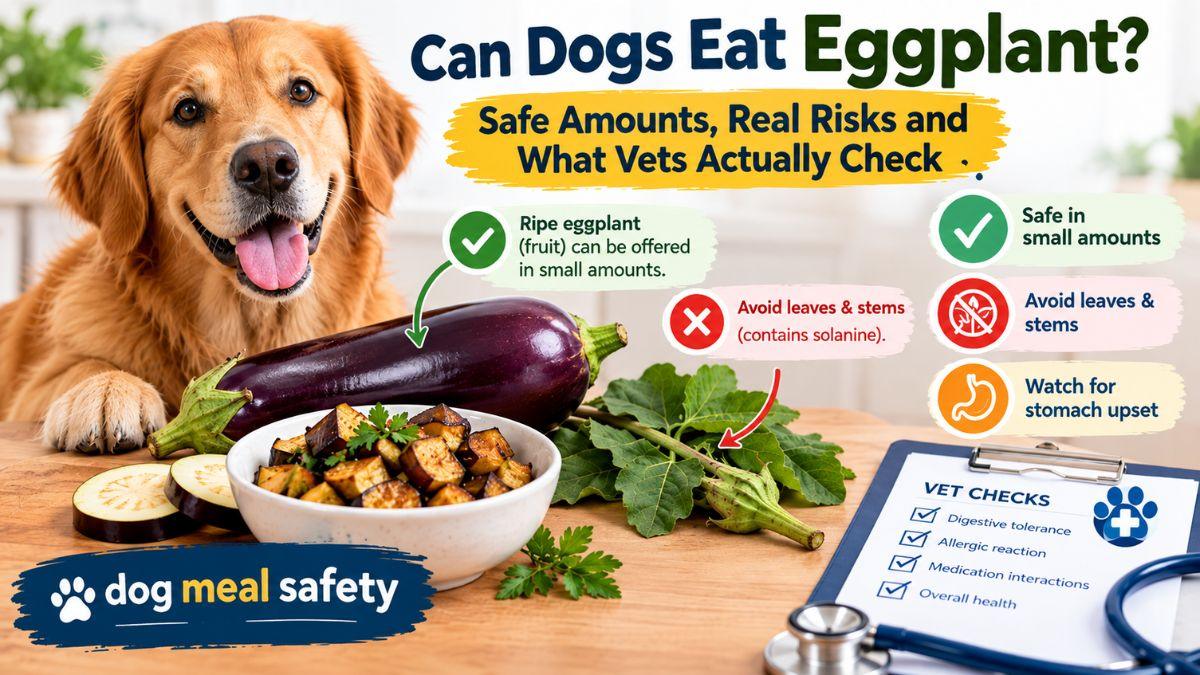
Can dogs eat eggplant? Yes, in small amounts. Plain, ripe, cooked eggplant flesh is not toxic to dogs, and a few diced pieces are fine for most healthy adult dogs. What poisons dogs is the rest of the plant: the leaves, the stems and the green cap at the top. Not the purple flesh sitting in your fridge.
A dog that steals a slice of roasted aubergine off the counter is almost always fine. The dogs that end up at the vet ate something else. They got into the plant in the garden, or they were handed a dish built on garlic, onion, oil and cheese.
Most of what gets published on this question repeats two warnings that fall apart the moment you look at the numbers. Both are covered below.
Can dogs eat eggplant safely, or is it only tolerated?
There is a difference between a food being safe and a food being worth feeding, and eggplant sits on the line.
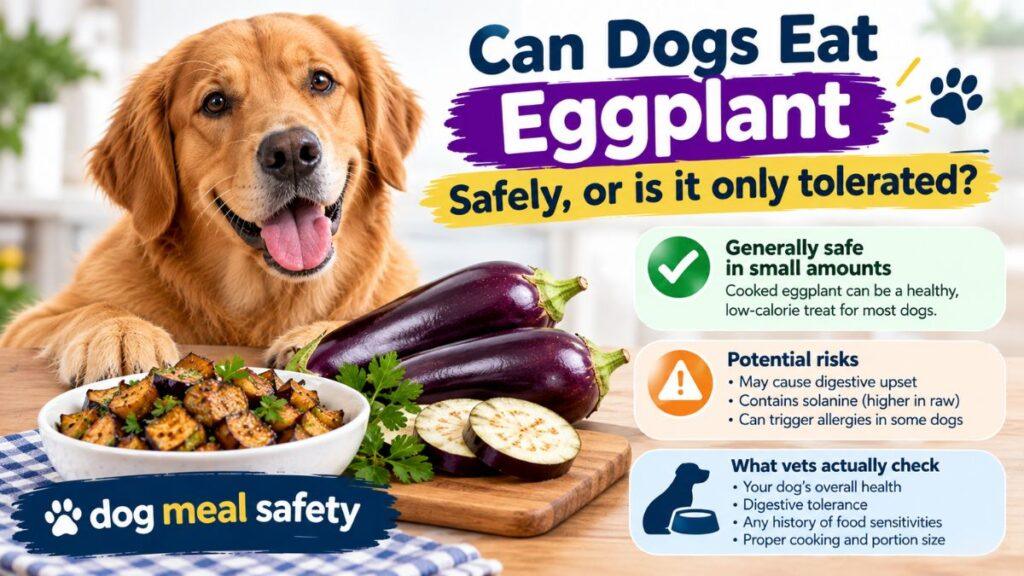
Safe means it will not hurt a healthy adult dog at a normal treat portion. Eggplant clears that bar. Worth feeding means the dog gains something. Eggplant does not really clear that one. A 100 gram portion gives about 25 calories, 2.5 grams of fibre, a little potassium, some vitamin B6 and thiamine, plus the antioxidants nasunin and chlorogenic acid. A dog on a complete commercial food already has all of it.
So when people ask can dogs eat eggplant, the useful answer is yes, but treat it as a snack your dog enjoys rather than a nutritional upgrade.
What usually happens when a dog eats eggplant
Nothing at all, most of the time. Ripe eggplant flesh is roughly 92 percent water and chemically dull once cooked.
The next most likely outcome is soft stool. That 2.5 grams of fibre per 100 grams is not much for a human, but a gut used to one fixed kibble does not appreciate a sudden change. You get loose stool for a day, a bit of gas, maybe a skipped meal, and then it passes.
The rarest outcome is worth knowing about. Some dogs react badly to nightshade foods with itching, paw licking, repeated ear trouble or digestive upset that does not settle. That is not poisoning. It is an individual intolerance, and it builds over repeated exposure rather than showing up after one cube.
The solanine question, with actual numbers
Every article on this topic mentions solanine. Almost none of them say how much is in an eggplant or how much a dog would have to eat, which is the only part that helps you make a decision.
Ripe eggplant fruit usually holds under 10 mg of solanine per 100 grams of fresh flesh. Food safety literature starts calling a nightshade fruit poisonous somewhere above 60 mg per 100 grams. In animals, toxic effects from solanine are generally reported around 2 to 5 mg per kilogram of body weight.
Run the arithmetic. A 10 kg dog needs roughly 20 mg of solanine to reach the bottom of that band. At the worst case figure of 10 mg per 100 grams, that is about 200 grams of raw eggplant flesh, near enough half a medium eggplant, eaten in one sitting. Most supermarket eggplant tests lower than that, so the real amount is higher again.
For a 4 kg terrier the sum is 8 mg, which lands around 80 grams, or a thick slice. Still far more than anybody hands over as a treat, but the margin is tighter. That is the reason portion size follows body weight instead of being one number for every dog.
Two cubes of roasted eggplant is not a poisoning risk for any dog. The risk sits elsewhere.
Where the real danger is: leaves, stems and the green cap
The leaves, stems, flowers, green calyx cap and unripe green fruit carry glycoalkaloid loads many times higher than the ripe fruit.
This is documented, not theoretical. The Canadian Veterinary Journal published a case in 2015 describing the successful treatment of a Labrador retriever puppy poisoned by Solanum dulcamara, a nightshade in the same genus as eggplant. Dogs chewing plant material from this family is a recognised clinical event.
If you grow eggplant, tomatoes or potatoes, fence the bed. Do not leave prunings or pulled plants in a compost heap the dog can reach. In the kitchen, the stem and green cap go in the bin rather than on the floor.
The kidney and oxalate warning is mostly copied wrong
Here is the claim that has spread across dozens of pet sites: eggplant is high in oxalates, so dogs with kidney problems must avoid it.
Eggplant is not a high oxalate food. Published values put raw eggplant around 16 to 18 mg per 100 grams, with broader analytical ranges reaching about 55 mg depending on cultivar and method. For scale, raw spinach runs from roughly 600 mg to over 1,000 mg per 100 grams. Okra sits near 146 mg. Peanut butter is around 96 mg. Sweet potato is about 56 mg.
That last figure is the awkward one. Several of the same articles warning you off eggplant on oxalate grounds recommend sweet potato as the safer swap, and sweet potato carries roughly three times the oxalate. Boiling cuts the level further, which makes plain boiled eggplant one of the lower oxalate vegetables you could put in a bowl.
None of this means stone prone dogs can ignore diet. Calcium oxalate stones are a real problem in Miniature Schnauzers, Bichon Frises, Shih Tzus, Lhasa Apsos and Yorkshire Terriers, and those dogs are usually on a prescription diet for a reason. Run any new food past your vet if that describes your dog. But singling out eggplant while handing over sweet potato is not something the oxalate data supports.
The arthritis claim and what the evidence actually says

The second repeated warning is that nightshades worsen joint inflammation, so arthritic dogs should avoid eggplant.
No controlled canine studies show this. The idea comes from human anecdotal reports about nightshade elimination diets, which have not held up well in human research either. Some vets still suggest avoiding nightshades in arthritic dogs as a precaution. A precaution is not a finding.
The practical answer is simple. Eggplant gives an arthritic dog nothing it cannot get from a vegetable with no question mark on it, so there is no argument worth having. Skip it and move on.
How much eggplant is safe, by weight
Treats should stay under 10 percent of daily calories. With eggplant the limiting factor is fibre and novelty rather than energy.
- Under 5 kg: one small cube, roughly a teaspoon, once a week
- 5 to 10 kg: one to two small cubes
- 10 to 25 kg: about two tablespoons, diced
- Over 25 kg: up to a quarter cup
Once or twice a week is plenty. First time out, give a single piece and wait a full 24 hours before offering more. That one habit catches almost every sensitivity reaction before it turns into a problem.
How to prepare eggplant for a dog
Pick a firm, fully ripe eggplant with glossy deep purple skin, no green patches and no soft spots. Green means underripe, and underripe means more glycoalkaloid.
Wash it. Cut off the stem and the green cap and throw both away. Peel it if your dog is small or has a delicate stomach, since the skin is not toxic but it is chewy and adds choking risk in bigger pieces. Dice the flesh small.
Steam, bake or boil it plain. No oil, butter, salt, garlic, onion, stock or spice. Cool it completely before serving. Boiling suits dogs best because it softens the flesh and lowers oxalate at the same time. Deep frying breaks down solanine more effectively than any other method, which is true and useless here, since the fat load in fried food carries a pancreatitis risk you have no reason to take.
Raw ripe eggplant in a small quantity is unlikely to hurt a dog, but it is dense, bitter and harder on the gut. Cooked is the better default.
Eggplant dishes that are never safe
The eggplant is rarely the problem. What we cook it with usually is.
Eggplant parmesan is out on cheese, breadcrumbs and garlic. Baba ghanoush is built on garlic, tahini, lemon and salt. Moussaka brings onion, dairy and cinnamon. Baingan bharta and most curries carry onion, garlic and chilli. Tempura and anything fried adds enough fat to set off pancreatitis in a susceptible dog. Grilled eggplant only passes if it went on the grill dry, with nothing brushed over it.
Garlic and onion are the serious ones. Both damage canine red blood cells, the effect is dose dependent, and signs can take one to three days to appear. If your dog ate a seasoned eggplant dish, the garlic and onion is what you ring the vet about, not the aubergine.
Dogs that should skip eggplant entirely
Puppies under six months, whose digestion is still settling. Dogs with a confirmed nightshade sensitivity. Dogs on a veterinary elimination or prescription diet, where any new plant compromises the whole exercise. Dogs with a calcium oxalate stone history, pending a word with your vet. Dogs with inflammatory bowel disease or a reliably touchy stomach.
Cats are a separate answer. Their liver detoxification pathways are more limited than a dog’s, which leaves them more exposed to plant alkaloids across the board. Do not offer eggplant to a cat.
Can dogs eat eggplant leaves? What to do after an accident
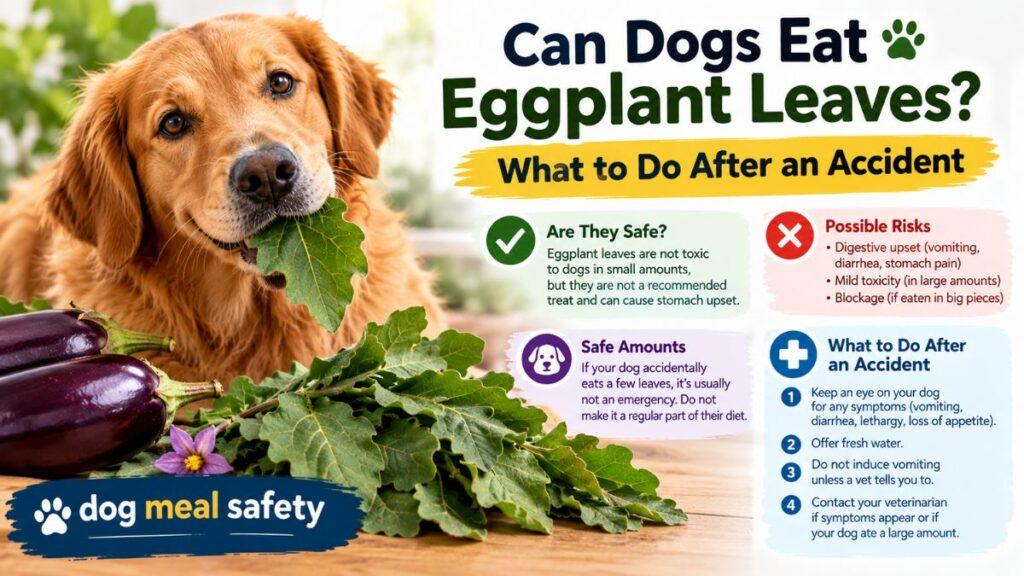
No, and this is the scenario that actually needs a plan. Work out what was eaten first, because the response changes with each one.
Plain ripe flesh, small amount: do nothing but watch. Keep water available, feed normally, monitor for 24 hours.
A large amount of plain eggplant: expect possible vomiting or diarrhoea. Ring your vet if it runs past 12 hours, if your dog refuses water, or if you see blood.
Cooked with garlic or onion: ring your vet the same day rather than waiting for symptoms.
Leaves, stems, green cap or a garden plant: ring your vet or a poison line straight away. In the United States that is the ASPCA Animal Poison Control Center on 888-426-4435 or the Pet Poison Helpline on 855-764-7661. Both charge a consultation fee.
Have three things ready before you call: your dog’s weight, how much was eaten, and whether any green plant parts were involved. Those are the first questions you will be asked.
Signs worth acting on
Digestive signs turn up within 2 to 12 hours. Vomiting, diarrhoea, drooling, a refused meal.
Allergic signs build over days and look like itching, paw licking, ear inflammation, hives or facial swelling.
Tremors, weakness, an unsteady walk or laboured breathing belong in a different category. Those point at genuine glycoalkaloid toxicity and mean an emergency vet now, not a wait and see.
Vegetables that do the job better
If the goal is a vegetable topper your dog gets regularly, there are easier choices. Plain pumpkin is gentler on digestion. Green beans give bulk without the fibre shock. Carrots, zucchini and cucumber all sit outside the nightshade argument entirely.
Eggplant is best kept as an occasional novelty. Tomatoes raise the same nightshade question, so the garden advice above applies to both, and the 10 percent treat rule covers all of them. For anything seasoned, check the garlic and onion safety guide first.
Frequently asked questions
Can dogs eat raw eggplant?
Small amounts of ripe raw flesh are unlikely to harm, but cooked is easier to digest and less of a choking risk.
Can dogs eat eggplant skin?
The skin is not toxic, though it is tough and better peeled off for small dogs.
Is eggplant poisonous to dogs?
The ripe fruit is not, but the leaves, stems and green cap are.
Can dogs eat eggplant parmesan?
No, the cheese, breading and garlic make it unsafe.
Can dogs eat eggplant every day?
No, once or twice a week is the sensible ceiling for a treat food.
Can dogs eat grilled eggplant?
Only if it went on the grill plain, with no oil, salt or seasoning.
Does eggplant cause kidney stones in dogs?
Eggplant is a low to moderate oxalate food, so it is not a leading cause, but stone prone dogs should follow their vet’s diet plan.
Can puppies eat eggplant?
Wait until six months.
Can dogs eat Japanese or baby eggplant?
Yes, the same rules apply to every ripe cultivar.
Can cats eat eggplant?
No, cats process plant alkaloids less efficiently and should not be offered it.
The bottom line
Can dogs eat eggplant? Yes, and the solanine numbers show why. A dog would need to put away a serious quantity of raw flesh in one go before the dose became interesting, which is not what happens when you hand over two cubes. The oxalate warning circulating online does not survive contact with the data either, since eggplant carries less oxalate than the sweet potato many of those same articles recommend instead.
What genuinely matters is narrower than most write ups admit. Keep the dog away from the plant in the garden. Bin the stem and the green cap. Never share a dish cooked with garlic, onion or oil. Start with one piece and wait a day before offering a second.
If your dog loves it, a couple of cubes once a week is a fine treat. If your dog is indifferent, there is no nutritional reason to push it. Green beans and pumpkin do the same job with fewer footnotes attached.
1 thought on “Can dogs eat eggplant? Safe amounts, real risks and what vets actually check”