

Can dogs eat raisins? No. Dogs should never eat raisins, not even one. Raisins can cause sudden kidney failure in dogs, and vets have never found an amount they consider safe. Some dogs eat a handful and never get sick, while others go into kidney failure after a few. There is no way to know ahead of time which kind of dog you have, so every raisin a dog eats is treated as an emergency.
If your dog ate raisins in the last few hours, call your vet or an emergency clinic now. You can also call the ASPCA Animal Poison Control Center at (888) 426-4435 or Pet Poison Helpline at (855) 764-7661. Both lines are open around the clock. The ASPCA line charges a consultation fee, and Pet Poison Helpline usually does too.
This is one of the most common poisonings in dogs. Pet Poison Helpline’s list of the top dog poisons of 2025 put grapes and raisins in second place, right after chocolate.
My dog just ate raisins: what to do right now
Speed matters more than anything else. A vet can often make a dog bring raisins back up if you get there early, and raisins that leave the stomach never reach the kidneys.
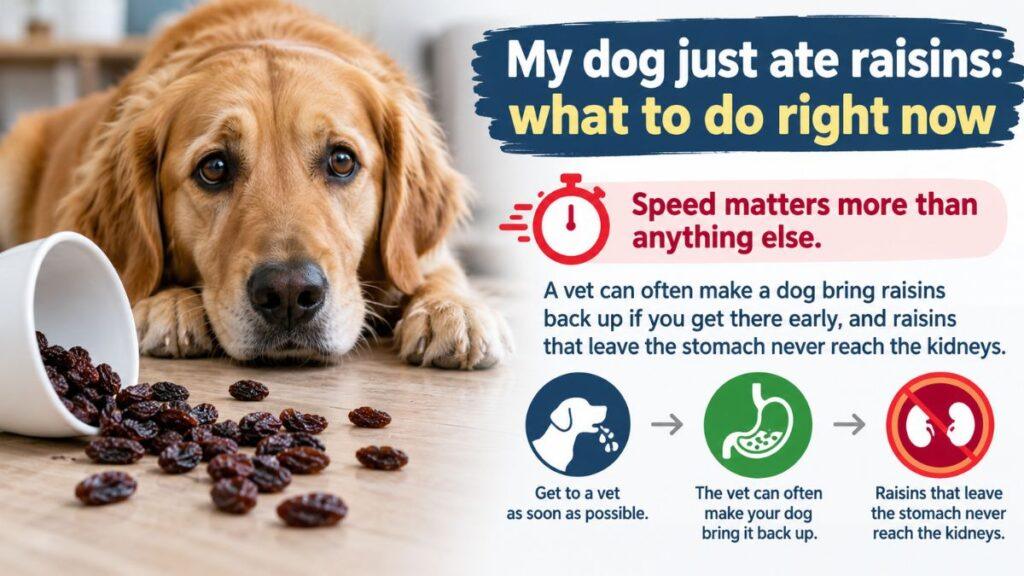
- Move your dog away from any leftover raisins and keep the packet or food wrapper.
- Call your vet or one of the hotlines above. Have ready your dog’s weight, a rough count of how much was eaten, the product name, the time it happened, and any symptoms you have seen.
- If they tell you to come in, go straight away and bring the packaging so the vet can read the ingredients.
Do not make your dog vomit at home unless a vet or poison control expert tells you to. Many websites and forum posts suggest hydrogen peroxide, but Pet Poison Helpline warns that this can be dangerous. Inducing vomiting at the wrong time, or in a dog that is already weak, can do more harm than good.
How many raisins are toxic to a dog?
Nobody knows an exact number, and anyone who gives you a “safe” count is guessing. The level of tartaric acid (the likely toxin) in grapes ranges from 0.35% to 2%, which is why toxicity is so hard to predict. One raisin can carry several times more of it than the next.
Two reference points do exist. ASPCA Poison Control considers more than one grape or raisin per ten pounds of body weight potentially dangerous. And in a published study of dogs with kidney failure, the smallest raisin dose that caused it was 2.8 grams per kilogram of body weight. The table turns both numbers into everyday amounts.
| Dog’s weight | ASPCA warning level | Lowest amount linked to kidney failure in a study |
| 10 lb (Shih Tzu size) | More than 1 raisin | About 13 g, under half an ounce |
| 25 lb (Beagle size) | More than 2 or 3 raisins | About 32 g, just over 1 ounce |
| 50 lb (Border Collie size) | More than 5 raisins | About 64 g, roughly 2.2 ounces |
| 80 lb (Labrador size) | More than 8 raisins | About 100 g, roughly 3.5 ounces |
Treat this table as a sign of how worried poison control will be, not as permission. A 50-pound dog that ate three raisins still needs a phone call today. Size does not protect a dog: small and large dogs can both develop kidney failure, and the reaction seems to depend on the individual dog more than its weight or breed.
Gram for gram, raisins are also worse than grapes. Drying takes out the water but leaves the acid behind, so a small handful of raisins holds much more of it than the same amount of fresh grapes.
Raisin poisoning symptoms: a timeline
Raisin poisoning comes in two waves, and the quiet stretch between them fools a lot of owners.
| Time after eating | What you may see | What is going on |
| 0 to 2 hours | Usually nothing | Raisins are still in the stomach, which is the best window for a vet to remove them |
| 6 to 24 hours | Vomiting (sometimes with raisin pieces), diarrhea, not eating, drooling, low energy, belly pain | Stomach upset and early stress on the kidneys |
| 24 to 72 hours | More thirst, then less urine or none at all, chemical-smelling breath, weakness, tremors, seizures in severe cases | Kidney injury becoming visible |
Peeing less, or not at all, is an especially serious warning that the kidneys may be failing.
My dog ate a raisin 24 hours ago and seems fine
This question comes up all the time on Reddit and dog forums. The dog ate a raisin yesterday, looks perfectly normal today, and the owner wants to know if the danger has passed.
It hasn’t, not yet. Call your vet today even if your dog seems completely normal. A dog can appear to recover after the early stomach upset while kidney damage develops underneath, and blood tests can still look normal during this window. For that reason vets usually start treatment before lab values change and repeat the tests over two to three days.
At 24 hours, making the dog vomit is usually too late to help. The vet can still do a lot. They can run baseline kidney bloodwork, recheck it the next day, and start IV fluids as soon as values begin to rise. Finding a rising kidney value on day two is far better than finding a dog that has stopped making urine on day three.
Why raisins are toxic to dogs
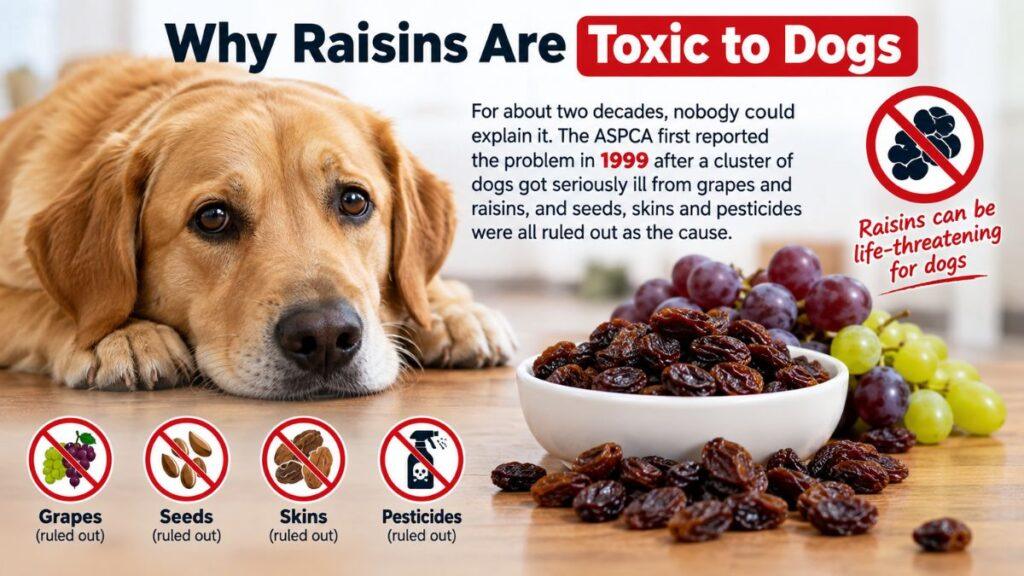
For about two decades, nobody could explain it. The ASPCA first reported the problem in 1999 after a cluster of dogs got seriously ill from grapes and raisins, and seeds, skins and pesticides were all ruled out as the cause.
The answer came from homemade playdough. ASPCA toxicologist Dr. Colette Wegenast was working on a dog that had eaten playdough, noticed the illness did not look like typical salt poisoning, asked for the recipe, and found it contained cream of tartar, a form of tartaric acid. The dog later died, and the microscopic kidney damage matched what vets had seen in grape and raisin cases.
Later research backed this up. A 2022 case series found that dogs eating cream of tartar or tamarind developed the same kidney injury seen with grapes and raisins. A 2023 lab study then showed that tartaric acid damaged dog kidney cells but not human ones, probably because dogs have very little of a transporter called OAT-4 that normally clears the acid from the kidney. That explains why raisins are a healthy snack for you and a poison for your dog.
It also explains why some dogs eat raisins and walk away fine. Tartaric acid levels change with how ripe the fruit is, and dogs differ in how sensitive they are. Tartaric acid is still called the leading suspect, since veterinary medicine has not fully confirmed it as the toxin. The practical advice stays the same either way.
Real cases that show how this plays out
Hattie and the hot cross bun. Hattie was a five-month-old puppy in the UK. Her owner, Paul, left a hot cross bun on the kitchen counter while he got the butter, and she ate it in two bites. He acted fast because his niece’s dog had nearly died from raisins a couple of years earlier, partly because nobody noticed in time. Hattie reached the vet within half an hour, got an injection that made her vomit the bun back up, and her risk was kept to a minimum. Thirty minutes made the treatment simple.
Nova and the forum advice. An owner on a golden retriever forum posted that her dog Nova had jumped up and eaten a hot cross bun with several raisins. One reply said it probably was not an emergency, and another suggested keeping hydrogen peroxide at home because it is cheaper than the vet. She went to the emergency vet anyway. The vet made Nova vomit the bun, and by the next morning she was eating breakfast and acting like herself. Making the call was the right move.
How vets treat raisin poisoning and what it can cost
There is no antidote, so treatment focuses on getting the fruit out, protecting the kidneys, and watching for complications. If the raisins were eaten recently, the vet may induce vomiting and then give activated charcoal. Most dogs also get IV fluids, usually for at least 48 hours in the hospital, with repeated checks of creatinine, blood urea nitrogen and electrolytes. Anti-nausea drugs and pain relief are added as needed, and some specialty hospitals offer dialysis if the kidneys stop producing urine.
That hospital stay is where the cost climbs. In one widely shared case involving grapes, which carry the same toxin, a dog ate 65 grapes. The family rushed all four of their dogs to the vet, the one that ate the grapes spent two days on fluids and monitoring, and the final bill reached $7,000. A visit in the first hour, where the vet only needs to empty the stomach, is usually far less involved than days on a drip. If you are comparing pet insurance plans, a poisoning emergency like this is a good test of what a policy actually covers.
Can dogs eat raisins and survive?
Yes. Most dogs survive, especially when care starts early. In a study of 139 dogs that ate grapes or raisins, fewer than 7% developed kidney injury, and all but one of those dogs survived.
The picture changes once the kidneys are failing. In an earlier study of dogs that already had grape-related kidney failure, only about half survived. Dogs that pull through can carry lasting effects, because kidneys have very little ability to repair themselves and often work less well after this kind of injury. Your vet may want follow-up blood tests for months afterward.
Everyday foods that hide raisins
Most raisin poisonings don’t start with a box of raisins. They start with a food the owner never thought about. The toxin stays in the fruit whether it is raw, cooked or baked.
In American kitchens, the usual culprits are raisin bran and other cereals, oatmeal raisin cookies, cinnamon raisin bagels and bread, trail mix, granola and snack bars, fruitcake, and hot cross buns at Easter. Chocolate-covered raisins are twice as bad, because chocolate is also toxic to dogs. Raisins also turn up in carrot cake, rice pilaf, curried chicken salad and kids’ lunchbox snack boxes.
To prevent accidents, keep these foods in closed cupboards instead of on the counter, use a trash can with a locking lid, and tell children, guests and dog sitters that raisins are off limits. A solid “leave it” command gives you a few extra seconds when something falls on the floor.
Golden raisins, sultanas, currants, grape juice and cream of tartar
Golden raisins and sultanas: every kind of raisin is dangerous, whether golden, dark, organic or conventional.
Currants: the dried “currants” sold in most US stores are Zante currants, which are small dried grapes and just as toxic as raisins. True currants from Ribes bushes are a different fruit and are not considered toxic to dogs.
Grape juice, jelly and wine: Cornell notes that grape juice, jelly, grape seed oil and wine have not been linked to poisoning, probably because processing removes or lowers the tartaric acid. Keep them away from your dog anyway. Homemade juice skips that processing, jelly is loaded with sugar, and wine contains alcohol.
Cream of tartar and tamarind: these are the foods almost nobody warns you about. Eating cream of tartar or tamarind can cause vomiting and acute kidney injury in dogs. Tamarind contains about 8% to 18% tartaric acid, far more than grapes. Watch out for tamarind candy, tamarind paste, and homemade playdough made with cream of tartar.
Can cats eat raisins?
No. Cats rarely eat raisins, but there are anecdotal reports of cats and ferrets developing kidney injury after eating grapes or raisins, so vets recommend keeping these foods away from them as a precaution. Grapes were added to Pet Poison Helpline’s top 10 cat poisons list for 2025.
Safe fruits to give your dog instead
If your dog loves a sweet snack, plenty of fruits are safe in small amounts. Blueberries, strawberries, seedless watermelon without the rind, and apple slices with the core and seeds removed all work well, and so do small pieces of banana. Treats and extras should stay under about 10% of your dog’s daily calories.
Can dogs eat raisins? Quick answers to common questions
Can dogs eat raisins in small amounts?
No, there is no amount vets consider safe, and a few raisins have been enough to cause kidney failure in some dogs.
My dog ate one raisin. Is that an emergency?
Yes, call your vet or poison control now, because a single raisin has been enough to harm some dogs.
Can dogs eat raisins if they are cooked or baked?
No, baking does not remove the toxin.
Can dogs eat raisin bread or cinnamon raisin bagels?
No, any bread with raisins in it is off limits.
Are golden raisins safer than dark raisins?
No, all raisin varieties carry the same risk.
How soon do symptoms of raisin poisoning start?
Vomiting usually starts within 6 to 24 hours, and kidney signs within 24 to 72 hours.
I found raisin pieces in my dog’s vomit. What now?
Call your vet, because vomiting rarely brings up every raisin.
Should I give my dog hydrogen peroxide?
Only if a vet or poison control expert tells you to.
Can puppies eat raisins?
No, and a puppy’s small body weight means fewer raisins reach a dangerous level.
Is cream of tartar toxic to dogs?
Yes, it contains tartaric acid, the likely toxin in raisins.
The bottom line
So, can dogs eat raisins? No, and they are one of the few human foods where even a tiny amount can put a dog in the hospital. There is no breed or size that is immune, and baking, cooking or buying golden or organic raisins does not change that. The toxin is most likely tartaric acid, which dogs cannot clear from their kidneys the way people can. The amount varies from raisin to raisin, so no two cases are the same.
The good news is that most dogs recover when they get help early. Hattie was treated within half an hour and the bun came straight back up. The dogs that do badly are usually the ones nobody caught in time. If your dog eats a raisin, call your vet or a poison control line right away. Do not try home remedies, and do not wait to see what happens. Keep raisin foods out of reach, and give your dog blueberries or apple slices instead. Oranges are another safer choice in small amounts.
Sources
- ASPCApro: Toxic component in grapes and raisins identified
- ASPCApro: Common human snack toxicities in pets
- Cornell Riney Canine Health Center: Grape and raisin toxicity
- Pet Poison Helpline: What happens if a dog eats raisins
- Pet Poison Helpline: Top 10 pet poisons of 2025
- VCA Animal Hospitals: Grape, raisin, and currant poisoning in dogs
- Journal of Veterinary Emergency and Critical Care (2022): Cream of tartar, tamarinds and tartaric acid
- Journal of Veterinary Emergency and Critical Care (2023): Tartaric acid and canine kidney cells
- Journal of Veterinary Emergency and Critical Care: Outcomes in 139 dogs after grape or raisin ingestion
- Journal of Veterinary Internal Medicine: Acute renal failure in 43 dogs after grapes or raisins
- Canada West Veterinary Specialists: Toxic tartar
- Hattie case (Vets Now, via JOE)
- Nova case (Golden Retriever Forum)
- $7,000 grape case (AOL)
3 thoughts on “Can Dogs Eat Raisins?”