
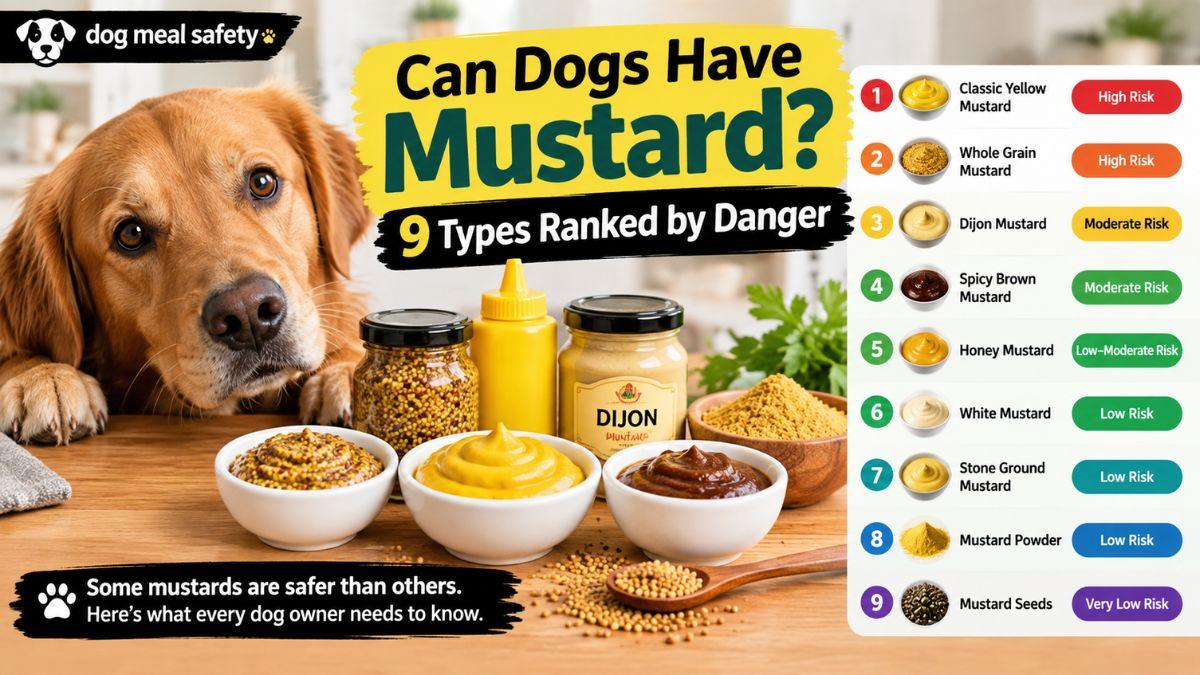
Can dogs have mustard? No, they should not. Mustard gives dogs nothing nutritionally, and the seeds it is made from contain compounds that irritate the stomach and gut. That said, a lick off a plate or one bite of a mustard-covered hot dog rarely turns into an emergency. Most healthy adult dogs get mild stomach upset at worst, and many show nothing at all.
The risk climbs with the amount eaten, how small your dog is, how hot the mustard is, and what else is in the jar. Dry mustard powder, whole seeds, and mustards made with onion or garlic powder are the ones that deserve a phone call. If your dog just stole a bite, start with the next section.
What to do if your dog just ate mustard
Start by moving your dog away from the source so it can’t finish the spill or the rest of the sandwich. Then gather three facts: roughly how much was eaten, what kind of mustard it was, and when it happened. Read the ingredient label while you have the bottle in hand. If it lists onion powder, garlic powder, or xylitol (sometimes called birch sugar), call your vet now instead of waiting for symptoms.
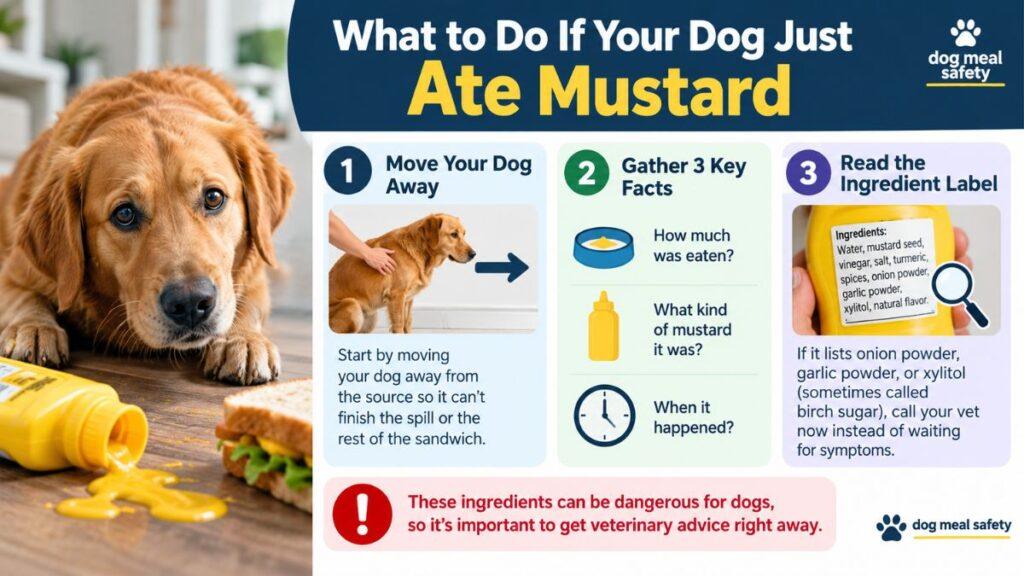
Do not try to make your dog throw up. Mustard does not work as an emetic, and salt or hydrogen peroxide given without instructions can cause more harm than the mustard did. Leave fresh water out, let your dog rest, and keep the next meal normal or a little smaller unless your vet tells you otherwise.
For a small lick of plain yellow mustard, watching your dog at home for the next 24 hours is usually enough. For anything bigger, or if you are unsure, a quick call beats guessing. In the US, the ASPCA Animal Poison Control Center is at (888) 426-4435 and the Pet Poison Helpline is at (855) 764-7661. Both answer around the clock and charge a consultation fee.
Is mustard toxic to dogs or just irritating?
Many pet food brands call mustard “toxic,” while some veterinarians answering owners online call it an irritant. Both describe the same thing from different angles.
Mustard does not attack organs the way grapes can damage kidneys or xylitol can crash blood sugar. What it does is inflame the lining of the stomach and intestines, which leads to vomiting, diarrhea, and belly pain. With a large enough dose, or in a very small dog, that inflammation (gastroenteritis) can become serious through dehydration. So “irritant” is the more accurate word for a smear on a burger, and “avoid it completely” is still the right advice. That is the real answer to can dogs have mustard: a smear rarely hurts them, but it should never be on the menu.
Why mustard upsets a dog’s stomach
Mustard seeds hold natural compounds called glucosinolates. When the seed is crushed and mixed with water or vinegar, an enzyme in the seed converts them into isothiocyanates, the chemicals that give mustard its bite. Those same chemicals irritate the mouth, stomach, and intestines.
The type of seed changes the strength. Brown and black mustard seeds contain sinigrin, which breaks down into allyl isothiocyanate, the sharp, sinus-clearing compound. Yellow mustard seed (also sold as white mustard) contains sinalbin, which produces a much milder heat. That is why classic American yellow mustard tastes gentle while Dijon, spicy brown, English, and Chinese hot mustard bite back. Expect the hotter styles to be rougher on a dog’s gut.
Mustard plants also contain goitrogens, substances that can interfere with thyroid function when eaten in large amounts over a long period. One mustard accident will not cause thyroid disease, but it is another reason mustard has no place in a dog’s regular diet.
Can dogs have mustard of any kind? Types ranked by risk
The table below is a practical guide for a small, accidental amount in a healthy adult dog. Any mustard eaten in a large quantity, or by a puppy or a dog with health problems, calls for a vet’s advice.
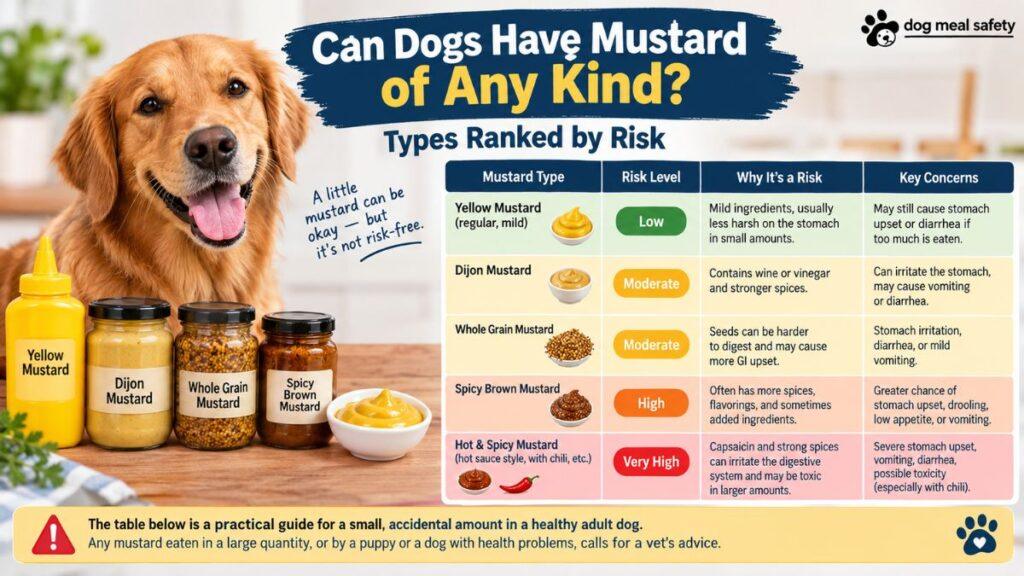
| Mustard type | Main concern for dogs | Risk from a small amount |
| Yellow (ballpark) mustard | Mild seed, vinegar, salt, sometimes garlic or onion powder | Low, watch at home |
| Dijon mustard | Brown seed with stronger heat | Low to moderate |
| Spicy brown or deli mustard | Brown seed, often extra spices | Moderate |
| Whole grain mustard | Cracked and whole seeds | Moderate |
| Honey mustard | Added sugar, possible xylitol in sugar-free versions | Low unless xylitol is listed |
| English or Chinese hot mustard | Very high pungency | Moderate to high for small dogs |
| Beer or flavored mustard | Varies by recipe, may include garlic, onion, or chili | Read the label |
| Dry mustard powder | Concentrated, nothing to dilute it | High, call your vet |
| Whole mustard seeds | Most concentrated source of the irritating compounds | High, call your vet |
Check the label for these hidden ingredients
Mustard seed is often not the worst thing in the bottle. Onion powder and garlic powder turn up in plenty of yellow, deli, and flavored mustards, and both come from the allium family, which damages a dog’s red blood cells. The catch with alliums is timing. Signs of anemia such as weakness, pale gums, or fast breathing can appear a few days after the meal, long after any stomach upset has passed.
Xylitol is the other ingredient to scan for. It is rare in regular mustard but can appear in “sugar-free” or “keto” sauces and dressings, including some honey mustard styles. Even a small amount of xylitol can drop a dog’s blood sugar dangerously, so treat any xylitol exposure as an emergency. Salt and vinegar add to thirst and stomach irritation, especially in small dogs.
The food under the mustard often matters more
Dogs rarely want the mustard itself. They want the hot dog or sandwich under it, and that food can be the bigger problem. Hot dogs, sausages, bacon, and deli meats are salty and fatty, and a sudden fatty meal is a known trigger for pancreatitis in some dogs, particularly Miniature Schnauzers and dogs that have had pancreatitis before.
Potato salad and deviled eggs often include onion too, so count the whole plate, not only the condiment.
Can dogs have mustard in small amounts?
Can dogs have mustard in small amounts without trouble? Most can handle a lick, but there is no published toxic dose of prepared mustard for dogs, so be wary of any article that names an exact teaspoon limit. What vets weigh instead is the amount compared with the dog’s body size, the type of mustard, and the dog’s health history.
A lick or a smear from a plate is unlikely to do more than cause a gurgling stomach in most dogs. A full condiment packet or a heaped spoonful is a very different dose for a 10 pound Chihuahua than for a 70 pound Labrador, so smaller dogs should get a call to the vet at a lower amount. A dog that has chewed open a mustard bottle, eaten dry mustard powder or seeds, or eaten any mustard containing onion, garlic, or xylitol should be assessed no matter its size. The same goes for puppies, senior dogs, and dogs with a history of pancreatitis, inflammatory bowel disease, kidney problems, or thyroid disease.
Symptoms of mustard ingestion in dogs
When mustard causes a reaction, it usually shows up within a few hours. Look for drooling or constant lip licking, vomiting, diarrhea or soft stool, a gurgling or tender belly, reluctance to eat, and lower energy than usual. Some dogs pace or stretch into a “praying” position because their stomach hurts.
Mild cases typically settle within a day. The signs that mean you should stop watching and start calling are repeated vomiting, blood in vomit or stool, a swollen or painful belly, refusal to drink, weakness or collapse, pale gums, or diarrhea still going after 24 hours. Dry, tacky gums and sunken eyes point to dehydration.
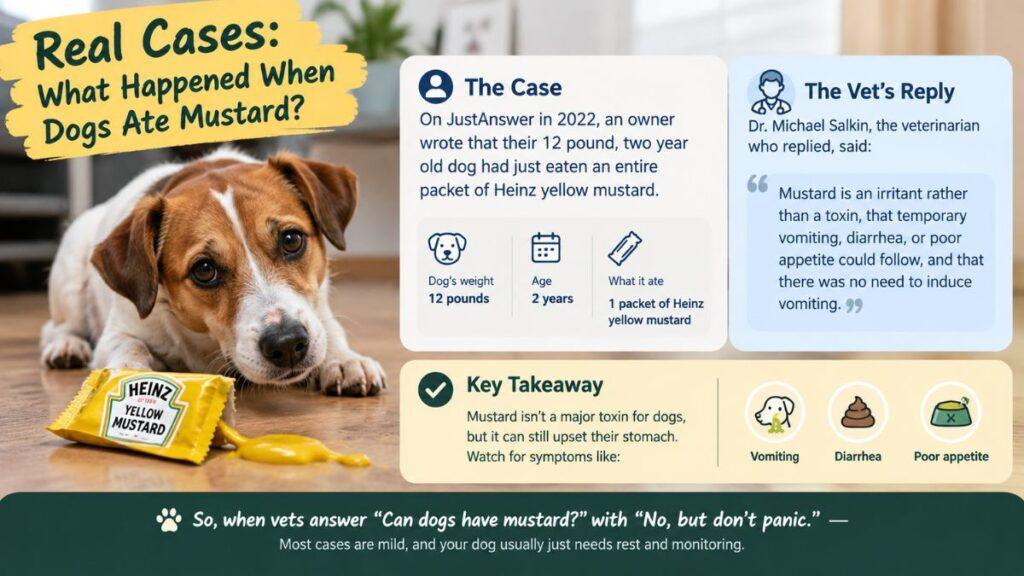
Real cases: what happened when dogs ate mustard
These cases show why vets answer “can dogs have mustard” with “no, but don’t panic.” On JustAnswer in 2022, an owner wrote that their 12 pound, two year old dog had just eaten an entire packet of Heinz yellow mustard. Dr. Michael Salkin, the veterinarian who replied, said mustard is an irritant rather than a toxin, that temporary vomiting, diarrhea, or poor appetite could follow, and that there was no need to induce vomiting.
In a JustAnswer exchange from 2020, a 25 pound rescue dog ate half a turkey and prosciutto sandwich with yellow mustard. The vet expected some loose stool at most and no significant side effects.
A Reddit r/dogs thread describes a 35 to 40 pound Blue Heeler and Border Collie mix that ate a few sandwich pieces with beer mustard. Other owners in the replies expected a short bout of stomach upset at worst.
All three involved plain mustard, a modest amount for the dog’s weight, and a healthy dog. If your situation differs on any of those, call.
Don’t use mustard to make your dog vomit
Older home remedy lists sometimes suggest feeding mustard, or mustard stirred into water, to make a dog throw up after eating something dangerous. The ASPCA says mustard does not work for this, and Pet Poison Helpline lists giving mustard among the methods that can hurt your dog. Salt is worse still, since a large dose can push sodium levels high enough to cause tremors and seizures.
If your dog ate something that truly needs to come back up, call your vet or a poison control line first. They will tell you whether vomiting is safe for that substance and, if home treatment fits, exactly how to do it.
Can dogs have mustard greens?
Mustard greens are a different story from the condiment. The leaves are a vegetable in the cabbage family, and plain cooked greens in small amounts are generally fine for healthy dogs. Boiling or steaming makes them easier to digest, and boiling with the water poured off lowers some of the compounds that cause trouble.
A few limits apply. Mustard greens contain goitrogenic compounds, so dogs with thyroid disease should skip them. They also contain oxalates, so dogs with a history of calcium oxalate bladder stones should avoid them too. Serve them chopped, unseasoned, and as a small topper, never as a meal.
The version to keep away from your dog is the one on your dinner table. Southern-style greens are usually cooked with ham hock, bacon fat, salt, and often onion. Sarson ka saag, the Punjabi mustard greens dish, is built on garlic, onion, ginger, green chili, and ghee. Both are great for people and a poor choice for dogs.
Mustard seeds, mustard powder, and mustard oil
Whole and ground mustard seeds are the most concentrated form of the irritating compounds, and dry mustard powder has no vinegar or water to dilute it. If your dog gets into a spice drawer, a pickling spice blend, or a dry rub for ribs, call your vet even if the amount looks small.
Can dogs have mustard oil? Not as food. Mustard oil is really two different products. Pressed mustard oil, common in South Asian kitchens, is a fatty cooking oil that can contain 20 to 40 percent erucic acid. That is why the US FDA does not allow it to be sold as a vegetable oil, and why bottles in American grocery stores say “for external use only.” A dog drinking a spill of any oil risks vomiting, diarrhea, and pancreatitis, and the same caution applies to kitchen oils in general, as our guide to olive oil for dogs explains. Essential mustard oil is the distilled flavoring made mostly of allyl isothiocyanate. It is far more concentrated than the condiment and can burn the mouth and stomach, so store it well out of reach.
Safe alternatives when your dog wants a taste
Since the answer to can dogs have mustard is no, offer something from your dog’s own menu when it stares at your hot dog. A few pieces of plain cooked chicken or turkey with no seasoning, a spoonful of plain canned pumpkin (not pie filling), a small lick of plain unsweetened yogurt, or a thin smear of xylitol-free peanut butter on a lick mat will satisfy the begging without upsetting the stomach. Fruit works too, such as a few blueberries or seedless apple slices.
Keep extras to about 10 percent of daily calories. At cookouts, keep condiment bottles off low tables and practice a solid “leave it” before guests arrive.
Frequently asked questions
Can dogs have mustard if it is just a lick?
A single lick is unlikely to cause more than mild stomach upset in a healthy dog, but don’t offer it.
Can dogs have mustard on a hot dog?
No, and the salty, fatty hot dog is often a bigger risk than the mustard on it.
Is honey mustard safe for dogs?
No, and check any sugar-free version for xylitol, which is an emergency.
Is Dijon mustard worse than yellow mustard?
Usually yes, because Dijon is made with brown seed that has a much stronger bite.
How long after eating mustard will a dog get sick?
Stomach signs usually appear within a few hours, and mild cases fade within about a day.
Can puppies have mustard?
No, and because puppies dehydrate quickly, call your vet if a puppy eats more than a lick.
Can dogs have mustard seeds or mustard powder?
No, seeds and dry powder are the most concentrated forms and warrant a call to your vet.
Can dogs eat cooked mustard greens?
Yes, plain and in small amounts, unless your dog has thyroid disease or a history of oxalate stones.
Should I induce vomiting if my dog ate mustard?
No, a mustard accident rarely needs it, and vomiting should only be induced on a vet’s instruction.
Is mustard good for dogs in any way?
No, it offers nothing that a complete and balanced dog food doesn’t already provide.
The bottom line on dogs and mustard
So, can dogs have mustard? The right advice comes in two halves. Don’t feed it on purpose, because it irritates a dog’s stomach and gives nothing back. And don’t panic over a lick, because a small amount of plain yellow mustard almost always ends with a normal dog or a day of soft stool.
The details are what change the picture. Hot brown mustards, dry powder, and whole seeds are stronger. Onion, garlic, or xylitol on the label turns a stomach problem into a possible poisoning. A greasy hot dog can set off pancreatitis on its own, and tiny dogs, puppies, and dogs with health conditions have less margin for error. So when you find your dog next to an empty mustard packet, read the label, estimate how much is gone, and think about your dog’s size. If any of those worry you, call your vet or a pet poison line and let a professional decide what happens next.
1 thought on “Can Dogs Have Mustard? 9 Types Ranked by Danger ”