
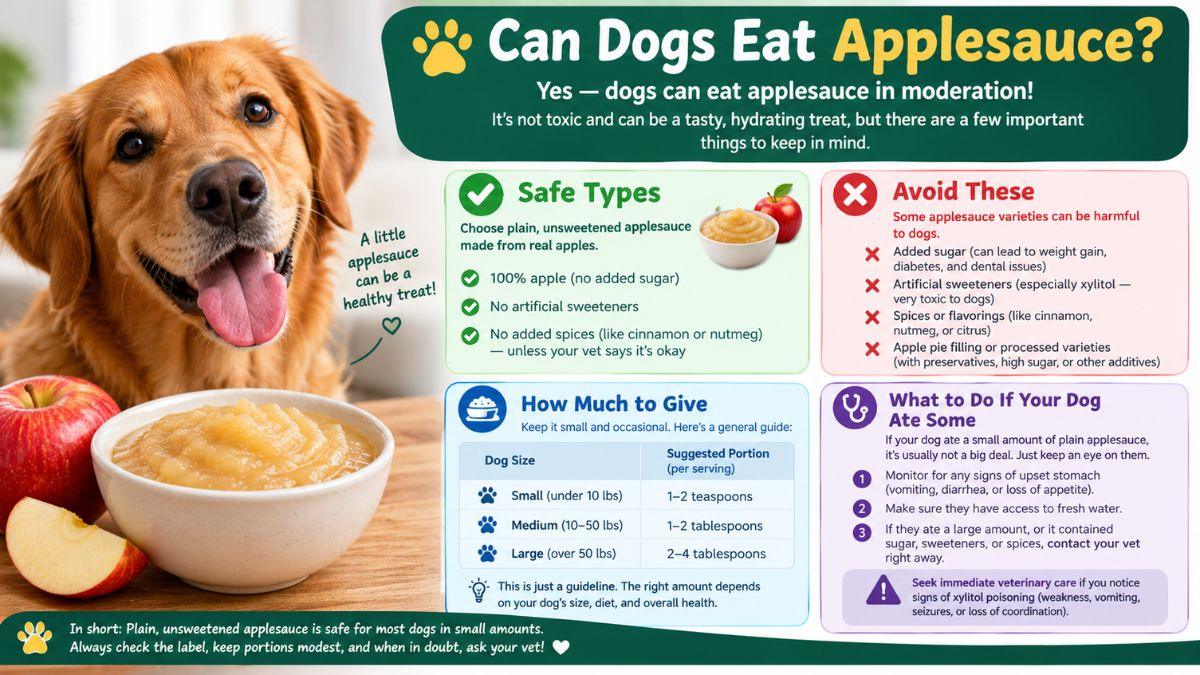
Yes, dogs can eat applesauce if it is plain and unsweetened, with apples as the main ingredient and nothing more than water or vitamin C added. A teaspoon for a small dog or a tablespoon for a medium dog is enough, a few times a week at most. Be careful with anything labeled sugar free or light until you have checked it for xylitol, skip spiced and flavored versions, and never let your dog finish a spoonful that had someone’s medicine stirred into it. That last risk gets almost no attention in most guides, and it is one of the more serious ones.
Is applesauce good for dogs, or just safe?
Plain applesauce is safe for most healthy dogs. Calling it a healthy food is a stretch, though, and the numbers show why.
According to USDA FoodData Central, unsweetened canned applesauce has about 42 calories, 9.4 grams of sugar, and 1.1 grams of fiber per 100 grams. The sweetened kind jumps to about 68 calories, with roughly 10 of its 15 grams of sugar coming from added sugar. Here is what that looks like at the size you would actually serve.
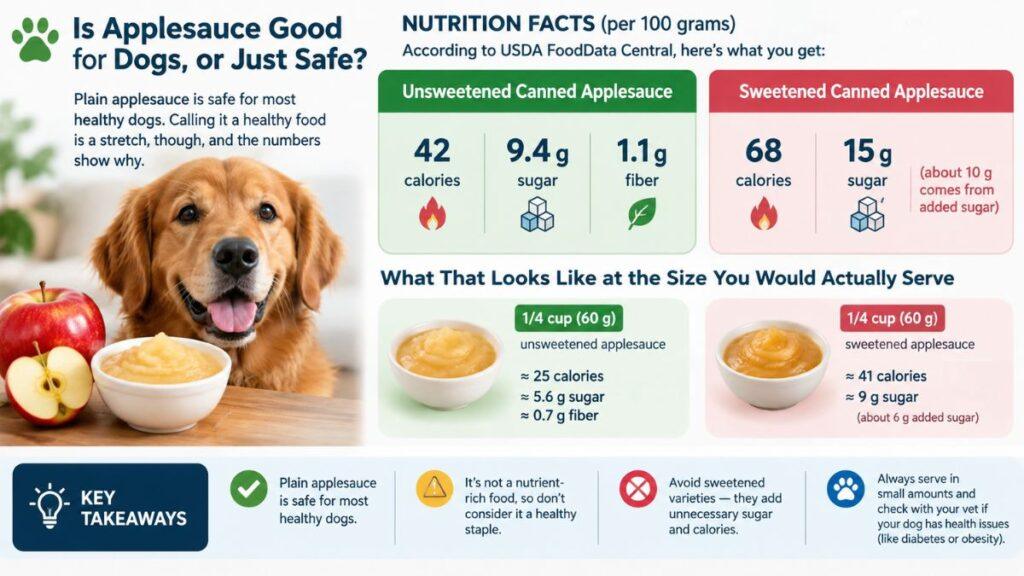
| Per 1 tablespoon (about 15 g) | Unsweetened | Sweetened |
| Calories | about 6 | about 10 |
| Total sugar | about 1.4 g | about 2.2 g |
| Added sugar | 0 g | about 1.5 g |
| Fiber | about 0.2 g | about 0.2 g |
| Fat | trace | trace |
Many articles say applesauce is rich in vitamins A and C. USDA data lists almost no vitamin A in applesauce, and the vitamin C content is low unless the maker adds ascorbic acid to keep the color. Dogs also make their own vitamin C, unlike people. So a spoonful will not boost your dog’s immune system in any way you could measure.
What applesauce does offer is a low-fat flavor most dogs love, a soft texture older dogs with sore teeth can manage, and a sticky base for pills or lick mats. Think of it as a treat, not a supplement.
How to read an applesauce label before you share
The front of the jar can mislead you, so read the ingredient list on the back.
“Unsweetened” is the version you want. A good ingredient list reads apples, water, and sometimes ascorbic acid. Ascorbic acid is simply vitamin C and is fine for dogs. Organic is a nice extra but not a safety requirement.
“No sugar added” usually means no sweetener at all, though some products add fruit juice concentrate. That is not dangerous in a small serving, just sweeter than you expect.
“Sugar free,” “light,” “reduced sugar,” and “keto” are the labels to slow down on, because these products replace sugar with something else. The one that matters for dogs is xylitol, which also appears as birch sugar. If the label just says sweetener without naming it, leave that jar for the humans.
Xylitol is not a mild problem. The Merck Veterinary Manual reports that doses above about 100 mg per kilogram can cause dangerously low blood sugar in dogs, and doses above about 500 mg per kilogram can lead to liver failure. For a 10 pound dog, the low blood sugar threshold is under half a gram. Signs can start within 30 minutes and include vomiting, weakness, wobbling, and seizures.
Cinnamon applesauce worries people more than it should. The ASPCA lists cinnamon as non-toxic to dogs. The real issue with flavored sauces is extra sugar, and some spice blends include nutmeg. Pet Poison Helpline notes that nutmeg contains a compound called myristicin, and while small recipe amounts rarely cause serious harm, there is no reason to feed it.
Fruit blends need their own check. Some pouches mix apples with other fruits, and grapes and raisins are toxic to dogs. Squeeze pouches also come with a small plastic cap and spout that a dog can chew off and swallow.
How much applesauce can a dog have?
Use these amounts as a starting point for a healthy adult dog, a few times a week.
| Dog’s weight | Serving of plain unsweetened applesauce |
| Under 10 lb | 1 teaspoon |
| 10 to 25 lb | 2 teaspoons |
| 25 to 50 lb | 1 tablespoon |
| 50 to 90 lb | 2 tablespoons |
| Over 90 lb | up to 3 tablespoons |
Vets commonly recommend keeping all treats under 10 percent of a dog’s daily calories. Here is how that works in practice. Using the standard energy formula vets rely on, a typical neutered 10 pound adult dog needs roughly 350 calories a day, so its treat budget is about 35 calories. A teaspoon of unsweetened applesauce has about 2 calories.
So calories are rarely the reason to limit applesauce. The stomach is. A big dose of fruit sugar and fiber at once causes loose stools and gas long before the calories add up. Keep in mind that the 10 percent budget covers every treat your dog gets that day, including chews and training rewards.
If you use applesauce as a daily food topper for a picky eater, stay at the low end of the chart and watch the scale and the stool.
Introducing applesauce the first time
Offer about half the serving from the chart and then wait a full day. Watch for vomiting, diarrhea, extra gas, itching, or red skin. Apple allergies are uncommon in dogs, but any new food can disagree with a sensitive stomach. If everything looks normal after 24 hours, you can move up to the full serving next time.
Applesauce or fresh apple slices: which is better?
For most dogs, fresh apple slices are the better everyday choice. They are crunchy and carry more fiber if you leave some skin on. You do need to remove the core and seeds first. The ASPCA notes that apple seeds, stems, and leaves contain cyanogenic compounds, so preparation matters. Our guide to [can dogs eat apples](NEED URL) covers slicing and serving in detail.
Applesauce wins for senior dogs with missing or painful teeth, for lick mats, and for hiding pills. Store-bought applesauce also has no seeds.
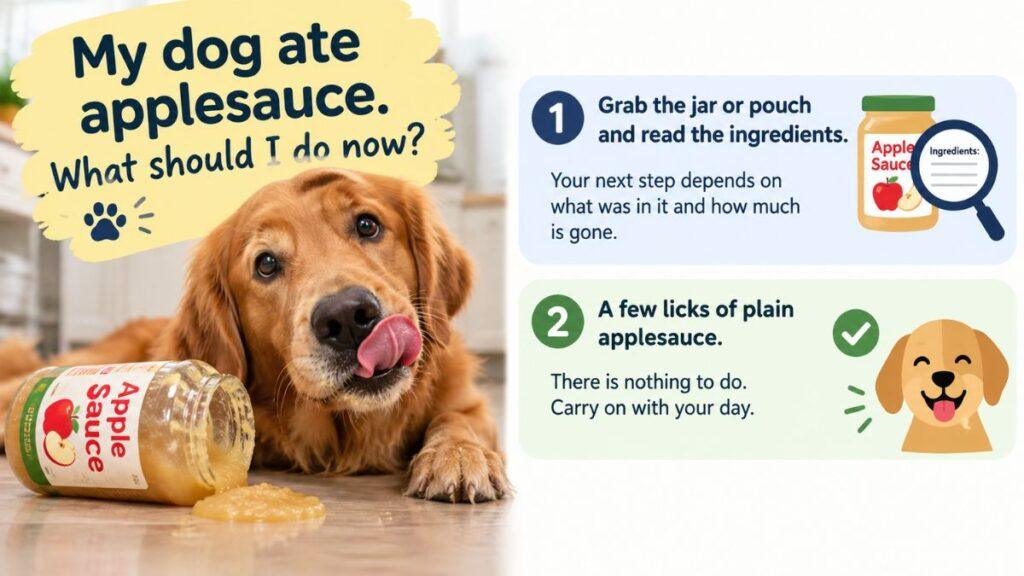
My dog ate applesauce. What should I do now?
Grab the jar or pouch and read the ingredients. Your next step depends on what was in it and how much is gone.
A few licks of plain applesauce. There is nothing to do. Carry on with your day.
A large amount of plain, unsweetened applesauce. This one comes up often. On JustAnswer, the owner of a 6 year old pug reported that the dog ate half a cup of unsweetened applesauce, and the veterinarian answering said it should not pose any issues. Half a cup is only about 50 calories. The likely result is soft stool or a gassy evening. Keep fresh water available and call your vet if you see repeated vomiting, diarrhea lasting more than a day, or unusual tiredness.
Sweetened or cinnamon applesauce. Expect the same mild stomach upset at most. The bigger worry is packaging. Another JustAnswer case involved a dog that ate an apple cinnamon pouch and chewed off part of the plastic top. If your dog swallowed a cap or spout, watch for gagging, vomiting, loss of appetite, or straining to poop, and call your vet if any of those appear.
Anything with xylitol or birch sugar. Treat this as an emergency even if your dog seems fine. Call your vet, an emergency clinic, the ASPCA Animal Poison Control Center at (888) 426-4435, or Pet Poison Helpline at (855) 764-7661. A consultation fee may apply. Do not try to make your dog vomit unless a veterinarian tells you to.
Applesauce that had medicine in it. Read the next section, then call right away.
The applesauce risk most guides skip: medicine mixed in
Applesauce is a common way to take medicine that can’t be swallowed whole. The prescribing information for Adderall XR, a widely used ADHD medication, allows patients to open the capsule and sprinkle the beads on applesauce, and other extended-release capsules are given the same way. In a busy house, that can mean a medicated spoonful left on the table within reach of the dog.
This happens. One JustAnswer question came from the owner of a 47 pound, 18 month old poodle that licked up applesauce containing 5 mg of Adderall set out for an 8 year old child.
Dose relative to body size is what matters. According to guidance from Pet Poison Helpline veterinarians reported by dvm360, amphetamines are generally toxic to dogs at around 1 mg per kilogram, or 0.8 mg per kilogram for extended-release forms, and methylphenidate at 0.5 mg per kilogram. A 5 mg dose works out to roughly 0.23 mg per kilogram for that 47 pound poodle. The same 5 mg eaten by a 10 pound dog comes to about 1.1 mg per kilogram, which is over the line.
Pet Poison Helpline lists the signs as agitation, dilated pupils, tremors, a racing heart, high blood pressure, drooling, vomiting, panting, and seizures. Call a poison line or your vet even if you think the amount was small, because you rarely know how much of the dose was left on the spoon.
Prevention is simple: mix medication at the counter, give it right away, and rinse the spoon before walking off.
Applesauce recalls worth knowing about
A product recalled for people should not go to your dog either.
In September 2026, Wakefern Food Corp. recalled Wholesome Pantry Organic Unsweetened Apple Sauce after FDA testing found patulin above safe limits. Patulin is a toxin produced by mold on bruised or damaged apples. The recall covers 23 ounce plastic jars with UPC 04119005677 and a best-by date of June 16, 2027, sold at ShopRite, Price Rite Marketplace, The Fresh Grocer, Gourmet Garage, and Fairway Market. Stores are offering refunds.
In late 2023, WanaBana, Schnucks, and Weis recalled cinnamon applesauce pouches after the FDA traced lead and chromium to the cinnamon in them. Some recalled pouches stayed on shelves after the recall began, so check older pouches in your cupboard, and search any brand on the FDA recalls page before sharing.
Dogs that should skip applesauce
Diabetic dogs should not get applesauce unless your vet approves it, because the natural sugar can make blood glucose harder to control. Dogs on a weight-loss plan have a tight treat budget, and a green bean or a piece of their own kibble usually fits better. Dogs on a prescription or elimination diet should not get any extra ingredient, since even one spoonful can spoil a food trial. If your dog already has diarrhea, do not use applesauce as a home remedy. Call your vet, who may suggest a bland diet or plain canned pumpkin instead.
Pancreatitis often appears on these lists, but applesauce is nearly fat free, and high-fat food is the classic trigger. Even so, dogs with a history of pancreatitis often eat strictly managed diets, so ask your vet before adding anything new.
Smart ways to use applesauce
Pill hiding. A small dollop hides a tablet well. Check with your vet or pharmacist first, because some medications need an empty stomach, and never open or crush a capsule that was designed to be swallowed whole.
Frozen lick mats. Spread a thin layer on a silicone lick mat and freeze it for a slow, cooling treat on hot days.
Baking. Unsweetened applesauce is a common binder in homemade dog biscuits. In one JustAnswer thread, an owner found that a store-bought dog birthday cake mix called for unsweetened applesauce, and the vet confirmed the brand they had was fine once they checked it contained no xylitol.
How to make dog-safe applesauce at home
Homemade applesauce lets you control every ingredient.
Wash 4 apples. Peeling is optional.
Cut out the core and remove every seed.
Chop the apples and simmer them in about half a cup of water for 15 to 20 minutes, until soft.
Mash with a fork or blend smooth. Add nothing else: no sugar, honey, cinnamon, or lemon juice.
Cool completely before serving.
Keep it in a sealed container in the fridge for up to 5 days, or freeze it in an ice cube tray. A standard cube holds about 2 tablespoons, which is too much for a small dog, so fill small dog portions halfway.
Can puppies eat applesauce?
A weaned puppy can have a tiny taste of plain unsweetened applesauce, but it doesn’t need it. Puppy food covers everything a growing dog requires, and young stomachs react to new foods easily, so start with a lick and ask your vet.
Frequently asked questions
Can dogs eat cinnamon applesauce?
A small amount will not poison them, but plain unsweetened is better because flavored versions carry more sugar.
Can dogs eat sugar free applesauce?
Only after you confirm the label has no xylitol or birch sugar.
Can dogs eat applesauce every day?
A few times a week is the safer habit, and daily toppers should stay at the low end of the portion chart.
Is applesauce with ascorbic acid safe for dogs?
Yes, ascorbic acid is just vitamin C added to keep the sauce from browning.
Is applesauce good for a dog with diarrhea?
It is not a reliable remedy, so call your vet if diarrhea lasts more than a day.
Can dogs eat applesauce pouches?
The sauce may be fine, but take away the cap and check the ingredients for other fruits and sweeteners.
What if my dog ate applesauce with medicine in it?
Call your vet or a pet poison line right away, even if your dog seems normal.
The bottom line
Dogs can eat applesauce safely when it is plain, unsweetened, and served in small amounts as an occasional extra. It is not a healthy food. Start with half a serving the first time and watch your dog for a day. A tablespoon has about 6 calories and very little vitamin A or C, so its real value is taste and texture for senior dogs, lick mats, and pill hiding.
The dangers come from what gets added or mixed in, not from the apples. Read the label for xylitol and birch sugar, take pouch caps away, and keep medicated spoonfuls out of reach. If your dog ate plain applesauce, even a lot, expect nothing worse than soft stool. If it contains xylitol or medication, call your vet or a pet poison line straight away. Check recall notices before opening an older jar, and when in doubt, a slice of fresh, seedless apple does the same job.
Sources
USDA FoodData Central: applesauce, canned, unsweetened (FDC 171695) and sweetened (FDC 171696)
Merck Veterinary Manual: Xylitol toxicosis in dogs
Pet Poison Helpline: Amphetamines; Nutmeg and cinnamon toxicity
dvm360: Psychotropic substances are poisoning pets
ASPCA Animal Poison Control: Cinnamon; Apple
Adderall XR prescribing information (Takeda), section 2.2
FDA: Elevated lead and chromium levels in cinnamon applesauce pouches