
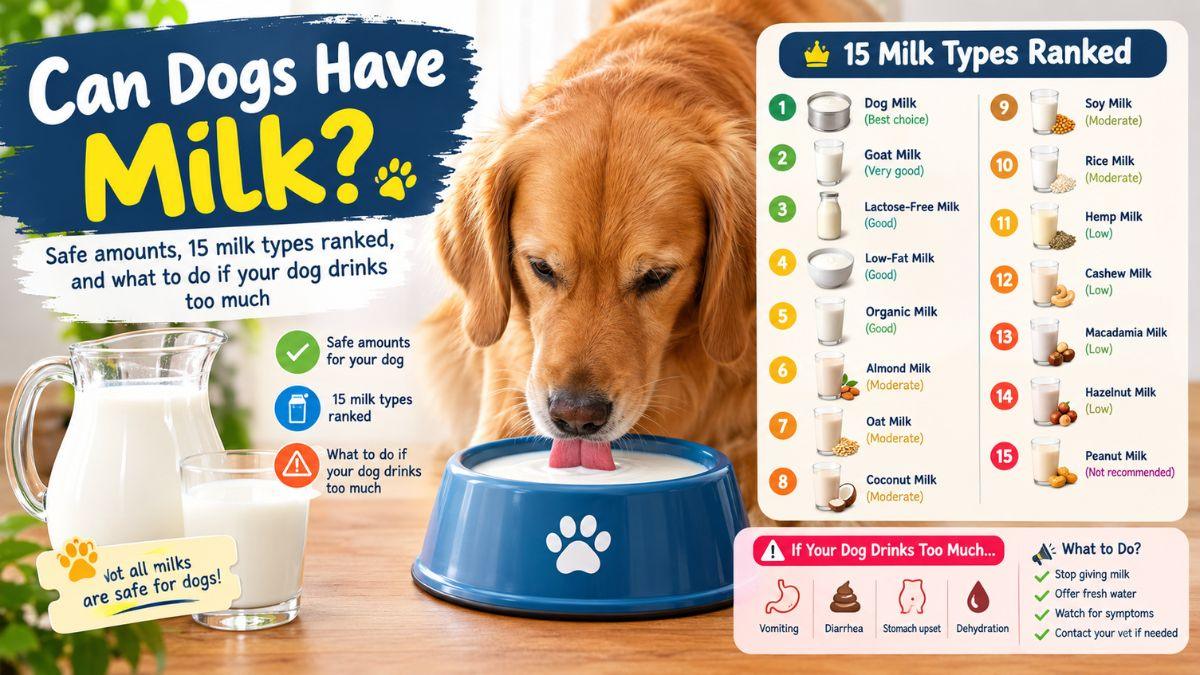
Can dogs have milk? Yes, most dogs can have a small amount of plain, pasteurized milk, but milk is not good for them and many adult dogs get gas or diarrhea from it. Milk is not toxic to dogs. The trouble is lactose, the natural sugar in milk, which most grown dogs struggle to digest. For a dog that has already handled dairy without problems, a teaspoon to a few tablespoons now and then, depending on size, is a realistic limit. Puppies, overweight dogs, and dogs with a history of pancreatitis should skip it. Raw milk, chocolate milk, sweetened condensed milk, macadamia milk, and anything sweetened with xylitol should never go in your dog’s bowl.
Why milk upsets so many dogs
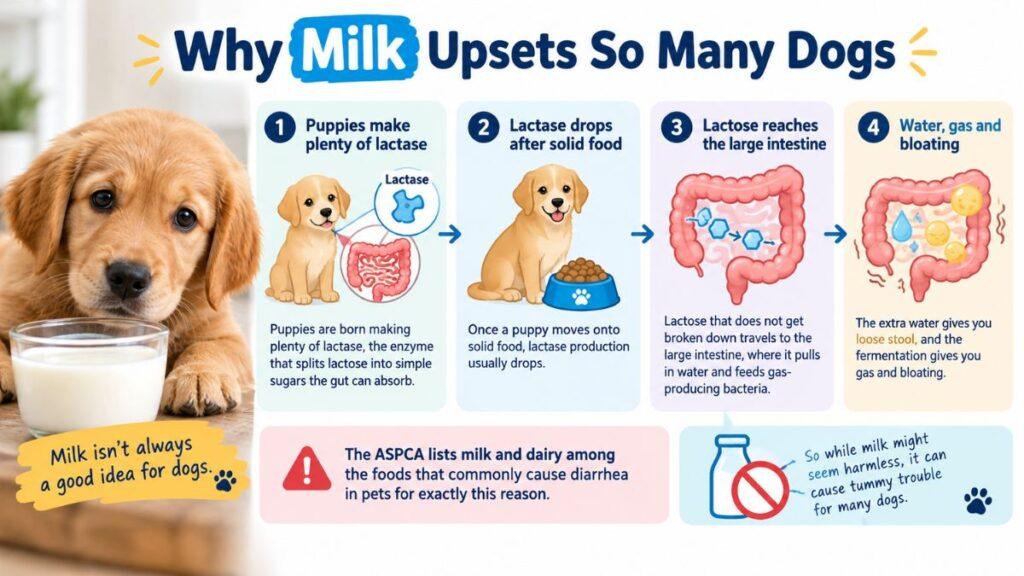
Puppies are born making plenty of lactase, the enzyme that splits lactose into simple sugars the gut can absorb. Once a puppy moves onto solid food, lactase production usually drops. Lactose that does not get broken down travels to the large intestine, where it pulls in water and feeds gas-producing bacteria. The extra water gives you loose stool, and the fermentation gives you gas and bloating. The ASPCA lists milk and dairy among the foods that commonly cause diarrhea in pets for exactly this reason.
How much lactase an adult dog keeps varies a lot, and genetics plays a part. A 2021 whole-genome study in Molecular Biology and Evolution found a lactase persistence variant in most European dogs sampled and in very few wolves. A 2018 feeding trial in the Italian Journal of Animal Science found that 8 of 14 healthy adult dogs showed no digestive signs even at the highest lactose dose, while others reacted to much smaller amounts.
Lactose intolerance and milk allergy are different problems. Intolerance means the dog lacks enough enzymes, and the signs stay in the gut. A milk allergy is an immune reaction to milk proteins such as casein and whey, and it tends to show up as itchy skin, ear infections, paw licking, or ongoing soft stool. Lactose-free milk can help an intolerant dog but does nothing for an allergic one, because the proteins are still there.
Signs your dog does not handle milk well
Digestive signs usually appear within a few hours, though some dogs react the next day. Look for loose stool or diarrhea, gas, a gurgling stomach, bloating, vomiting, restlessness, or a dog that keeps asking to go outside. Some dogs drink more water afterward because diarrhea costs them fluid.
Allergy signs build slowly. If your dog gets dairy regularly and has itchy skin, red ears, or mild stomach trouble no one can explain, ask your vet whether dairy could be involved.
One bout of soft stool after a splash of milk is not an emergency, but it tells you this dog should not get milk again.
How much milk can a dog have
Veterinary guidelines from AAHA and WSAVA say treats and extras should stay under 10 percent of a dog’s daily calories, a rule the American Kennel Club and UC Davis veterinary school also use. Milk counts as an extra. Whole cow’s milk has about 150 calories per cup, or roughly 9 calories per tablespoon. Skim milk has a little over half that.
For most dogs, lactose becomes a problem long before calories do, so the amounts below sit well under each group’s treat budget. They are for dogs that have already had milk with no reaction, and they are occasional amounts, not daily servings.
| Dog size | Approximate daily treat budget | Occasional milk limit |
| Toy, under 10 lb (4.5 kg) | about 20 to 25 calories | 1 to 2 teaspoons |
| Small, 10 to 25 lb (4.5 to 11 kg) | about 25 to 55 calories | up to 1 tablespoon |
| Medium, 25 to 50 lb (11 to 23 kg) | about 55 to 100 calories | up to 2 tablespoons |
| Large, 50 to 90 lb (23 to 41 kg) | about 100 to 150 calories | 3 to 4 tablespoons (about 1/4 cup) |
| Giant, over 90 lb (41 kg) | 150 calories or more | up to 1/4 cup |
Can dogs have milk in bigger amounts if they seem fine? Not safely. Be careful with advice that scales milk by body weight without a ceiling. Some published figures work out to more than two cups a day for a 60 pound dog, which breaks the 10 percent rule on calories alone and would give most intolerant dogs diarrhea. A full bowl of milk is too much for almost any dog.
How to test whether your dog tolerates milk
Choose a day when your dog is healthy and you will be home for the next 24 hours.
- Offer 1 teaspoon of plain, pasteurized milk, or half a teaspoon for a toy breed. Lactose-free milk is the gentlest start.
- Give no other new foods that day, so you know what caused any reaction.
- Watch stool, gas, appetite, and energy for 24 hours.
- If everything stays normal, you can offer the chart amount on a later day. If you see any stomach upset, stop and keep dairy out of the diet.
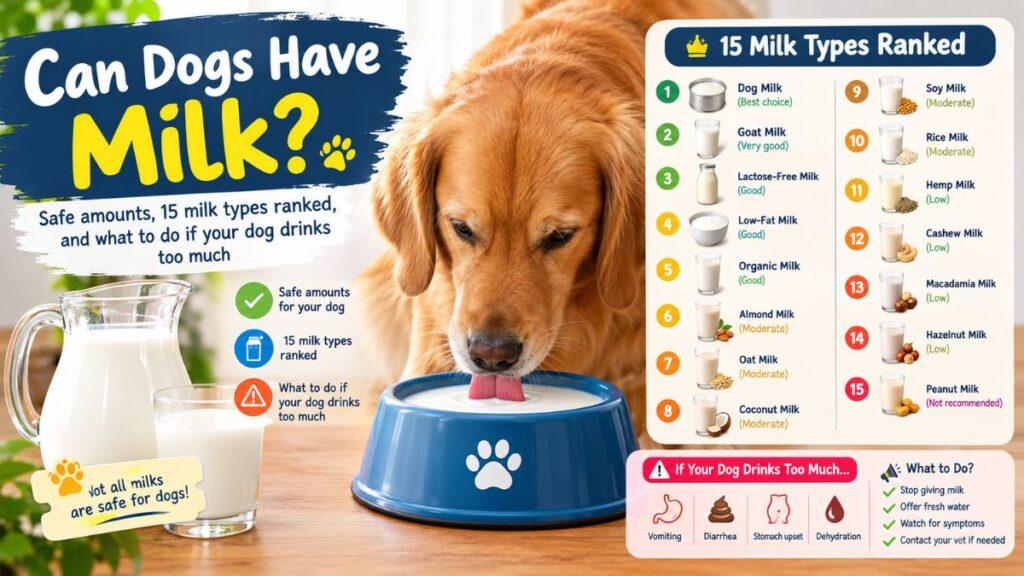
Can dogs have milk of every kind? 15 types ranked
No. Fat, sugar, lactose, and added ingredients all change the answer.
| Milk type | Verdict | Why |
| Whole cow’s milk | Small amounts only | About 5 percent lactose and the most fat of common grocery milks |
| 2 percent or skim milk | Small amounts only | Less fat, same lactose |
| Lactose-free milk | Best choice if you give milk | Lactose already broken down; still has fat and milk proteins |
| Pasteurized goat’s milk | Small amounts only | Slightly less lactose than cow’s milk, but not hypoallergenic |
| Pet goat’s milk powders and dog milks | Fine as directed | Made for pets; count them as treats |
| Raw cow’s or goat’s milk | Avoid | Can carry Salmonella, Listeria, E. coli, and H5N1 bird flu |
| Evaporated or condensed milk | Avoid | Concentrated lactose, and condensed milk is loaded with sugar |
| Chocolate or flavored milk | Avoid | Cocoa is toxic to dogs; flavored milks add sugar or sweeteners |
| Unsweetened almond, cashew, oat, or rice milk | Rarely, tiny amounts | Not toxic, but nut fats or added sugar can upset the stomach |
| Macadamia milk | Avoid | Macadamia nuts are toxic to dogs |
| Unsweetened soy milk | Rarely, tiny amounts | Soy is a known allergen for some dogs |
| Coconut milk | Rarely, tiny amounts | Coconut oils can cause loose stools |
| Buffalo milk | Avoid | Much richer in fat than cow’s milk |
| Human breast milk | Avoid | Higher in lactose than dog milk |
| Plain kefir or plain yogurt | Small amounts | Fermentation lowers lactose; check for xylitol |
Read the ingredient list before you pour. The ASPCA says xylitol is uncommon in dairy alternatives but still worth checking, because it can cause dangerously low blood sugar and liver injury in dogs.
Why raw milk is a bad idea for dogs
Some raw feeding brands promote raw milk as easier to digest because it keeps natural enzymes. The picture changed after H5N1 bird flu reached U.S. dairy herds in 2024. Cats have died after drinking raw milk, and the FDA has told pet food makers that scientific data show cats and dogs have become ill from consuming the virus. The AVMA advises keeping pets away from raw milk and colostrum.
Pasteurization inactivates H5N1, and FDA testing of 464 pasteurized dairy products found no live virus. Raw milk can also carry Salmonella, Listeria, and E. coli, which puts the people handling the bowl at risk too. Stick to pasteurized products.
Can puppies drink milk?
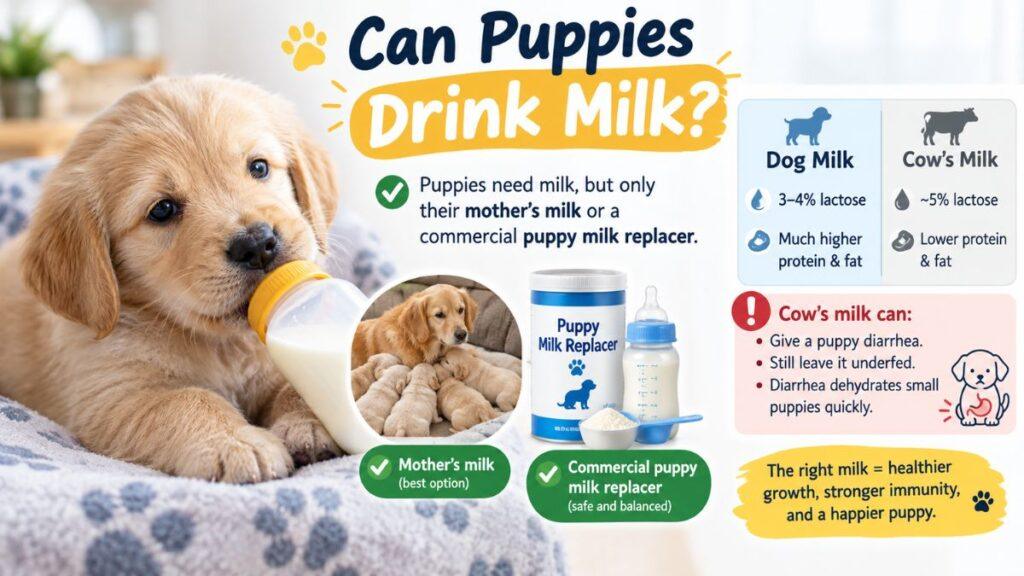
Puppies need milk, but only their mother’s milk or a commercial puppy milk replacer. Dog milk has roughly 3 to 4 percent lactose and far more protein and fat than cow’s milk, which sits around 5 percent lactose. Cow’s milk can give a puppy diarrhea and still leave it underfed, and diarrhea dehydrates small puppies quickly.
Goat’s milk is not a safe swap either. A Tufts University study comparing dog milk with commercial replacers found plain goat’s milk had too much lactose to recommend when better-matched products exist.
Most puppies start weaning at around 3 to 4 weeks and eat puppy food only by about 7 to 8 weeks, after which they do not need milk at all. Soften kibble with warm water, not milk. If you are caring for an orphaned litter, call your vet before feeding anything, since newborns can inhale formula when fed the wrong way.
Pregnant, nursing, and senior dogs
A pregnant or nursing dog does not need milk. A complete puppy or all life stages food, which vets commonly recommend for late pregnancy and nursing, covers her extra energy and calcium needs. Dairy can cause diarrhea just when she needs every calorie, and vets generally advise against extra calcium in pregnancy unless they prescribe it.
Senior dogs often move less, gain weight easily, and have more sensitive stomachs. If an older dog has always handled milk, a teaspoon or tablespoon now and then is usually fine, unless it has one of the conditions below.
Dogs that should not have milk at all
Dogs with a history of pancreatitis top the list, because fatty foods are a common trigger and a flare can turn serious. Overweight dogs and dogs with diabetes do not need the extra sugar and calories. Dogs with a food allergy, chronic itchy skin, inflammatory bowel disease, or frequent diarrhea should stay off dairy unless their vet says otherwise.
Any dog on a prescription diet, such as a kidney, liver, digestive, or weight loss food, should not get milk without the vet’s approval. For these dogs, and for any dog that has reacted to dairy even once, the answer to “can dogs have milk” is a firm no.
My dog drank milk: what to do now
First work out what kind of milk it was and how much. A few licks of plain milk from a cereal bowl usually cause nothing worse than gas. Put down fresh water, skip other extras for the day, and watch your dog for 24 hours.
If your dog drank a full glass or a whole bowl, expect loose stool and maybe vomiting over the next several hours. Keep water available, offer frequent trips outside, and avoid rich or fatty food that day. Most healthy adult dogs are back to normal within a day.
Call your vet for vomiting more than once or twice, diarrhea past 24 hours, blood in the stool or vomit, a painful or swollen belly, weakness, refusal to eat, or a hunched “prayer position” with the front end down. Those last signs can point to pancreatitis, especially after full fat dairy. Call sooner for puppies, toy breeds, seniors, and dogs with a pancreatitis history.
The type of milk can matter more than the amount. If it was chocolate milk, a cocoa or coffee drink, a sugar-free product that may contain xylitol, or macadamia milk, call your vet or the ASPCA Animal Poison Control Center at (888) 426-4435 right away instead of waiting for symptoms.
Common milk myths
Many owners give milk after a dog swallows something toxic, believing it neutralizes poison. Pet Poison Helpline says it hears this every day, and milk rarely helps while it can add stomach upset to the problem. Call a vet or poison line before giving anything by mouth.
Milk will not settle a sick stomach either, and for many dogs it makes diarrhea worse. Using it for constipation is no better, since the loose stool it causes is a sign of intolerance, not a treatment.
Dogs also do not need milk for calcium or hydration. A complete and balanced dog food already supplies the calcium they need, too much calcium can harm growing large breed puppies, and a dog with milk-induced diarrhea loses fluid instead of gaining it.
Better options than milk
Fresh water is the one drink every dog needs, all day. If you want to share something creamy, lactose-free milk in the chart amounts is the gentlest choice. A spoonful of plain, unsweetened yogurt or kefir suits many dogs, and a little cottage cheese or mild cheese is easier on most stomachs than a drink of milk, though cheese is high in fat.
For dogs that do not drink enough, a splash of low sodium bone broth made without onion or garlic works better than milk, and a few seedless cubes of watermelon add water with very few calories. On hot days, freeze plain yogurt mixed with mashed blueberries or strawberries in an ice cube tray.
Frequently asked questions
Can dogs have milk every day?
No, milk should stay an occasional treat and not become part of a daily routine.
Can dogs have milk if they are lactose intolerant?
Skip regular milk; a tiny amount of lactose-free milk may be tolerated, but water is the better choice.
Can dogs have milk with their food?
A small splash over adult kibble is fine if it counts toward the treat budget, but never soak a puppy’s food in milk.
Can dogs have milk chocolate?
No, milk chocolate is less concentrated than dark chocolate but still contains theobromine, which is toxic to dogs.
Can dogs have Milk-Bone treats?
Yes, Milk-Bone biscuits are baked dog treats, not a drink of milk, so just count them toward the daily treat limit.
Can dogs have milk when they have an upset stomach?
No, milk often makes diarrhea worse, so stick to water and call your vet if the upset lasts.
Can dogs have milk and cookies?
Skip it, since cookies often contain chocolate, raisins, macadamia nuts, xylitol, or lots of sugar.
Can dogs drink milk mixed with water?
Diluting milk lowers the lactose in each sip but not the total, so it only helps if the amount of milk stays small.
Does a dog need water after drinking milk?
Your dog should always have fresh water, and it matters most if milk causes loose stool, but you do not need to push water after a small splash.
Can dogs have ice cream?
A tiny lick of plain vanilla is unlikely to hurt, but chocolate, coffee, rum raisin, macadamia, and sugar-free flavors are dangerous.
So, can dogs have milk?
Can dogs have milk safely? Most can, in small amounts, but it is not a healthy food for them. Most adult dogs make less lactase than they did as puppies, so even a modest pour can mean gas and diarrhea. If your dog has handled milk before, a small splash of plain, pasteurized, ideally lactose-free milk now and then is fine, sized to the chart above. Keep puppies on their mother’s milk or a proper replacer, and keep dogs with pancreatitis, weight problems, diabetes, or food allergies away from dairy altogether. Never offer raw milk, chocolate milk, condensed milk, macadamia milk, or anything sweetened with xylitol. If your dog gets into a large amount, watch closely for 24 hours and call your vet at the first sign of repeated vomiting, blood, or belly pain. Your dog’s regular food already covers every nutrient milk contains, which is why a little milk goes a long way and water is always the better drink.
Sources
- ASPCA Animal Poison Control Center, People Foods to Avoid Feeding Your Pets
- ASPCA, Are Dairy Substitutes Safe for My Pet?
- Pet Poison Helpline, Pet Poison First Aid Misconceptions
- U.S. Food and Drug Administration, Investigation of Avian Influenza A (H5N1) Virus in Dairy Cattle
- American Veterinary Medical Association, Avian influenza virus type A (H5N1) in U.S. dairy cattle
- American Kennel Club, How Many Treats Can a Dog Have Per Day?
- UC Davis School of Veterinary Medicine, Treats Guidelines for Dogs
- Heinze CR et al., Comparison of the nutrient composition of commercial dog milk replacers with that of dog milk, JAVMA
- Analysis and Comparison of Nutrition Profiles of Canine Milk with Bovine and Caprine Milk
- Liu YH et al., Whole-genome sequencing reveals lactase persistence adaptation in European dogs, Molecular Biology and Evolution, 2021
- Grandi M et al., Effects of dietary supplementation with increasing doses of lactose in adult dogs, Italian Journal of Animal Science, 2018
1 thought on “Can Dogs Have Milk? 15 Milk Types Ranked Safe to Dangerous”