

How long can dogs hold their pee? A healthy adult dog can usually wait 6 to 8 hours during the day and 8 to 10 hours overnight, but being able to wait and being comfortable are two different things.
If you left at 8, got stuck in a late meeting, and walked in after 6, your dog has been waiting more than ten hours. This guide covers bladder limits by age, why nights are easier than days, the point where not peeing becomes an emergency, and a potty schedule you can start tomorrow.
How long can dogs hold their pee?
Most healthy adult dogs can hold their pee for 6 to 8 hours during the day and 8 to 10 hours overnight. Those are upper limits. Vets and trainers recommend a bathroom break every 4 to 6 hours, and puppies and seniors need breaks sooner.

A healthy adult dog pees three to five times a day, says Dr. Jerry Klein of the American Kennel Club. Certified trainer Alexandra Bassett told Rover that most dogs can manage up to 11 hours overnight, while 12 is pushing it. Here is how long dogs can hold their pee at each life stage.
| Age | Daytime break (awake) | Overnight (asleep) | What to know |
| 8 to 12 weeks | Every 1 to 2 hours | About 3 to 4 hours | Go out after every meal, nap, and play session |
| 3 to 6 months | Every 2 to 4 hours | Age in months plus one, in hours | Accidents are still normal |
| 6 to 12 months | Every 4 to 6 hours | 7 to 8 hours | Bladder control is improving |
| Adult (1 to 7 years) | Every 4 to 6 hours, 8 at most | 8 to 10 hours | 11 hours is fine once in a while |
| Senior (about 7 years and up, sooner in giant breeds) | Every 3 to 6 hours | Often 6 to 8 hours | New accidents deserve a vet check |
How long can dogs hold their pee at night?
At night, most healthy adult dogs hold their pee for 8 to 10 hours, and some manage 11. During sleep they stop drinking, eating, and moving around, so the kidneys make less urine and the bladder fills slowly. That’s why nights feel easier than afternoons.
A question that keeps coming up on r/dogs: my adult dog sleeps from 10 pm to 8 am without a break, is that okay? For a healthy adult who gets a proper walk right before bed, it usually is. Daytime is less forgiving, because activity, meals, and water all fill the bladder faster.
Push the last walk as late as you can and let your dog sniff around, since many dogs pee twice on a slow walk.
Puppy bladder control by age
Puppies can hold their pee for about one hour per month of age while resting. A 3-month-old puppy manages about 3 to 4 hours asleep, but often only 30 to 90 minutes when awake, playing, and drinking water during the day.

The “one hour per month” rule is a standard house-training guideline, but it describes quiet time. An awake puppy chewing a toy and lapping water fills up fast, which is why PawChamp’s trainers suggest a break every 30 to 90 minutes during active hours.
Here is how the math works in real life. A 10-week-old puppy is about 2.5 months old. If she goes into her crate at 10 pm, her comfortable limit is roughly 3 to 3.5 hours, so an alarm around 1 am saves you a wet crate. Keep that night trip boring: out, pee, praise, back to bed.
Adult dogs and a full workday
A healthy adult dog can usually get through an 8-hour workday, but doing it five days a week is hard on them. If you are gone longer than 8 hours, including your commute, plan a midday walk, a dog walker, or daycare.
For working owners, the real question is not only how long can dogs hold their pee, but how long they should. Leave at 7:30, work 9 to 5, get home at 6:15, and your dog has waited nearly 11 hours. That is past every daytime guideline here.
Sweden offers a useful benchmark. The Swedish Board of Agriculture’s official guidance, attached to the country’s dog welfare regulations, says dogs should be walked at least every six hours during the day, and more often for puppies and older dogs. It is official advice rather than a strict legal limit.
Senior dogs need shorter gaps
Senior dogs often need a break every 4 to 6 hours, and some need one every 3 or 4. Weaker bladder muscles, kidney changes, arthritis, and conditions like diabetes all shorten the time an older dog can comfortably wait without an accident.
Age changes the answer to how long can dogs hold their pee more than anything else. Veterinarian Brian Evans told Daily Paws that an older dog who used to go every six hours may need to shift to every three or four. That shift is normal. A sudden rise in thirst and peeing is a different story, because it can point to chronic kidney disease, diabetes mellitus, or Cushing’s disease, so book a checkup instead of blaming old age.
Watch for look-alikes too. Some spayed females leak urine while sleeping because the muscle that closes the bladder weakens. That is incontinence, not a dog who can’t wait.
What changes how long a dog can hold it
Age matters most, but it is not the only factor. Water intake, diet, heat, exercise, stress, marking behavior, medications like steroids or diuretics, and illnesses such as urinary tract infections, diabetes, and kidney disease all change how fast the bladder fills.
Size is more complicated than most articles admit. Small dogs have smaller bladders, but two veterinarians interviewed by Care.com said size and breed do not change how many times a day a dog pees.

Output adds up quickly. A healthy dog makes roughly 10 to 20 ml of urine per pound of body weight each day, so a 60-pound Labrador produces somewhere between 600 and 1,200 ml. Diet pushes that number around. Salty people food like ham, bacon, or pretzels makes a dog thirsty, and more water in means more trips out.
Moist meals such as a homemade dog food recipe or water-rich fruit like honeydew also raise urine output. Intact males often pee in small amounts to mark territory, which is behavior, not a weak bladder.
What happens if a dog holds its pee too long
Holding urine too long, too often, lets bacteria sit in the bladder longer and lets minerals concentrate. Over time that raises the risk of urinary tract infections, crystals, and bladder stones, and it can stretch the bladder and lead to indoor accidents.
One long day won’t harm a healthy adult dog. The risk comes from the habit. Urine that sits for hours gives bacteria time to multiply, and concentrated urine helps struvite or calcium oxalate crystals form, some of which grow into stones.
There is a training cost as well. A dog who has to go indoors because nobody came home learns that indoors is an option. Punishing the accident only teaches them to hide the next one.
When not peeing becomes an emergency
Straining with little or no urine coming out is an emergency, especially in male dogs. Go to a vet now. If your dog simply has not peed in 12 hours and seems lethargic or uncomfortable, call your vet right away.
Straining with nothing coming out can mean a urethral blockage, most often a bladder stone stuck in the tube that carries urine out. Male dogs are at higher risk because their urethra is longer and narrower and passes through a small bone in the penis.
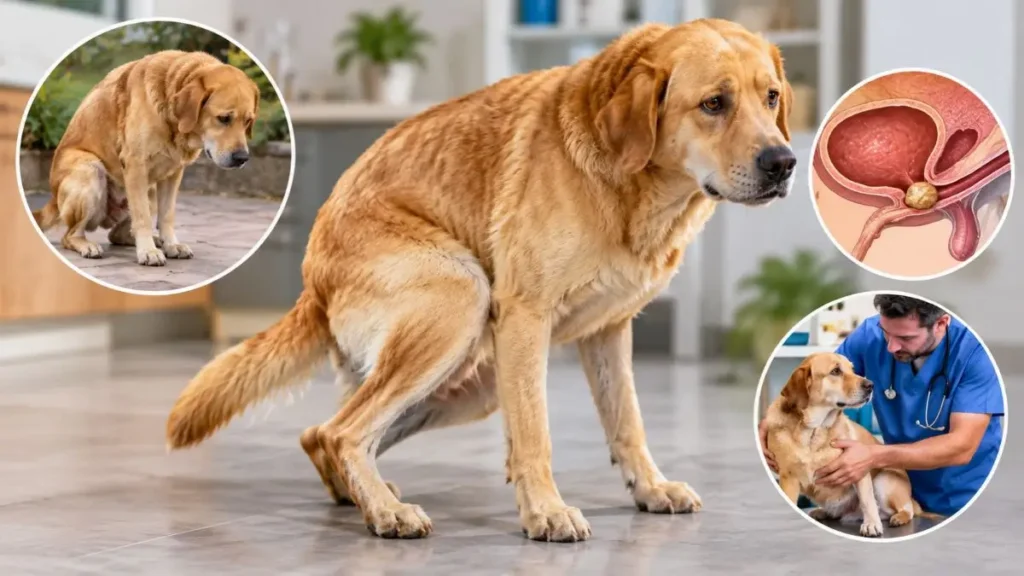
According to the American College of Veterinary Surgeons, a dog with a complete blockage will be in pain, may vomit and stop eating, and will die within days if it is not relieved. The Merck Veterinary Manual notes that a complete obstruction leads to uremia within 36 to 48 hours.
Kidney damage can also stop urine production.
A dog that pees much less, or not at all, in the days after eating grapes or raisins needs urgent care. A blockage can look like constipation, so a short phone video of your dog squatting helps the vet. Blood in the urine, crying while peeing, or a swollen belly also mean going the same hour.
Signs your dog has been holding it too long
One of the clearest signs is a very long pee. Most dogs empty a full bladder in about 20 seconds, so a stream that goes much longer suggests they waited too long. Pacing, whining, circling, and sudden indoor accidents are other clues.
That 20-second figure comes from a 2014 Georgia Tech study in the journal PNAS, which found that mammals heavier than about 3 kg, from dogs to elephants, empty their bladders in roughly 21 seconds. If your Labrador routinely pees for 40 seconds when you get home, the gap was too long. PawChamp’s fix: add breaks until the long pees stop, then stretch the gap back out by 5 to 15 minutes at a time.
The opposite pattern matters too. A dog who squats every few minutes and produces only drips more likely has a urinary infection than a training problem.
Road trips, flights, and new places
On road trips, stop every 2 to 4 hours, and more often with a puppy. Many dogs won’t ask to go in a moving car, and plenty refuse to pee in unfamiliar spots like a new apartment, a boarding kennel, or an airport relief area.
For flights, line the carrier with a pee pad and find the pet relief area as soon as you land. In a new home or kennel, walk your dog on a leash to one spot, use your usual cue word, and give them time.
A potty schedule you can copy
Build the day around predictable breaks: first thing in the morning, after breakfast, midday, late afternoon, after dinner, and right before bed. That gives a healthy adult dog five or six chances to go and keeps daytime gaps under six hours.
For someone working 9 to 5 outside the home, a realistic version looks like this: a proper walk at 6:30, a quick yard break after breakfast at 7:30, a dog walker or lunch visit around 12:30, a walk when you get home at about 5:45, a short trip after dinner, and a last call around 10:30. No daytime gap runs past five hours.
If your dog is a poor drinker, a splash of plain, low-sodium chicken broth in the bowl can help. Reward the moment your dog pees outside, treat a pee pad as a backup rather than a replacement for walks, and change the routine gradually.
Video: how long can dogs hold their pee, explained by a vet
If you prefer video, a veterinarian walks through safe holding times by age and health in this explainer on YouTube. It pairs well with the table above, especially if you are planning a puppy schedule or a workday routine for your dog.
Watch: How Long Can Your Dog Safely Hold Their Pee, Veterinarian Explains
Frequently asked questions
Can a dog hold its pee for 10 or 12 hours?
A healthy adult dog can hold its pee for 10 hours overnight, and sometimes 12, but trainers treat 12 as the outer edge. During the day, 10 to 12 hours is too long. If it happens once, offer a long walk and watch for straining.
Can a dog go 24 hours without peeing?
No, not safely. A dog that has not peed in 24 hours needs a vet visit today, and one straining without producing urine needs emergency care much sooner. A complete blockage can cause life-threatening uremia within 36 to 48 hours.
How long can a puppy hold its pee at night?
A sleeping puppy can usually hold its pee for its age in months plus one, in hours. An 8-week-old puppy may last about 3 hours, and a 4-month-old about 5. Most puppies sleep through the night by around 6 months.
Is it okay to leave a dog alone for 8 hours?
An occasional 8-hour stretch is fine for most healthy adult dogs. As a daily routine it is not ideal, and with a commute it usually becomes 9 or 10 hours. A midday walk, dog walker, or daycare closes that gap.
How long can a dog go without peeing after surgery?
Anesthesia, pain, and a cone can make a dog slow to pee after surgery. Call the clinic if your dog has not peed by the next morning, and call right away if they strain without producing any urine at any point.
How many times a day should a dog pee?
Healthy adult dogs usually pee three to five times a day. Puppies go far more often, sometimes 8 to 12 times. A sudden jump in frequency, tiny drips, or needing to go out at night can point to infection, diabetes, or kidney trouble.
Do small dogs need to pee more often than big dogs?
Often, yes, but less than people assume. Small dogs have smaller bladders, and toy breeds tend to need more trips. Some vets say breed and size barely change the daily count, so your own dog’s pattern matters more than its size.
Should I limit water so my dog can hold it longer?
No. Restricting water to cut down on bathroom trips can dehydrate your dog and concentrate the urine, which raises the risk of crystals and stones. The only common exception is lifting a puppy’s bowl an hour or two before bed during house training.
The bottom line on your dog’s bladder
So, how long can dogs hold their pee? For a healthy adult, 6 to 8 hours in the day and 8 to 10 overnight is the realistic range, and a break every 4 to 6 hours is the kinder target. Puppies run on roughly one hour per month of age while resting, and seniors need more trips than they used to. Your dog’s own habits tell you more than any chart: how long each pee lasts, whether accidents creep back in, whether they sprint for the door when you get home. When those change, the schedule should change too.
Fresh water, a predictable routine, and a midday plan for long workdays prevent most of the trouble covered here, from urinary infections to the frustration of cleaning up yet another accident. And if your dog ever strains with nothing coming out, don’t wait. That is a same-hour vet visit, every time.
How we checked this guide
To answer how long can dogs hold their pee accurately, we compared limits from the American Kennel Club, the American College of Veterinary Surgeons, the Merck Veterinary Manual, and professional trainers, removed figures vets did not support, and rechecked every number on September 29, 2026.
Other sources: Swedish Board of Agriculture guidance, Rover (interview with trainer Alexandra Bassett), Daily Paws (Dr. Brian Evans), Care.com, PawChamp, and Yang et al., “Duration of urination does not change with body size,” PNAS, 2014.