
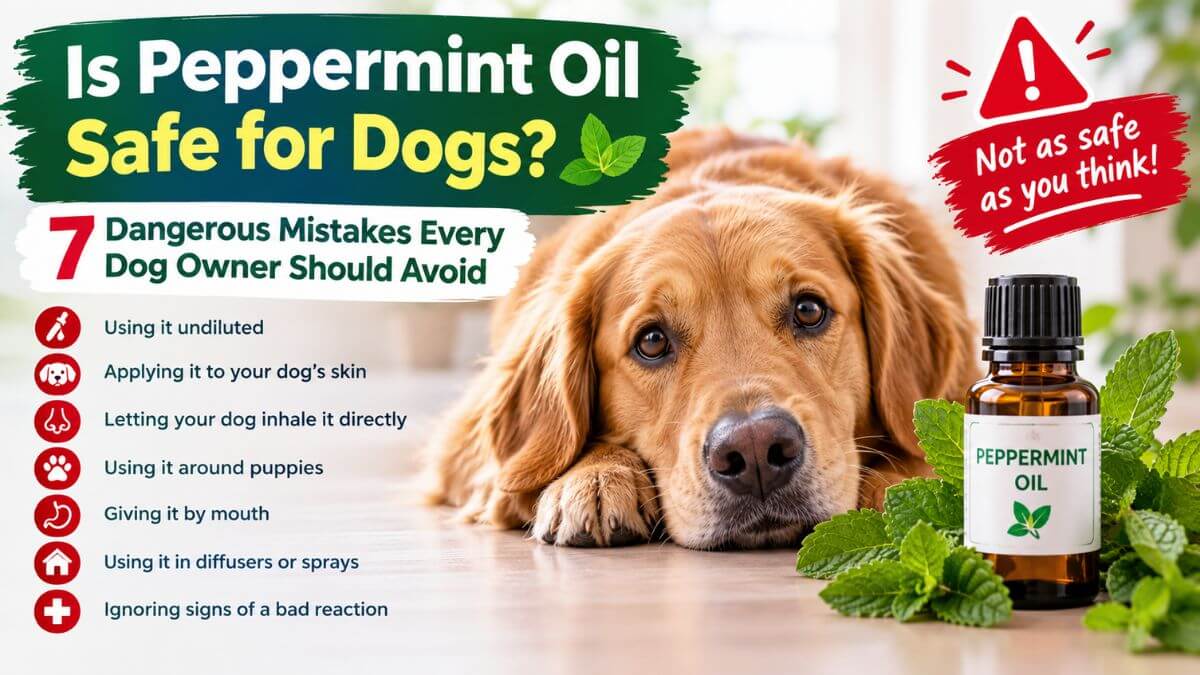
Is peppermint oil safe for dogs? No, not in concentrated form. Pure peppermint oil can poison dogs through licking and skin contact, and heavy diffusing can irritate their airways. A faint scent drifting from another room is low risk for most healthy dogs.
People usually search “is peppermint oil safe for dogs” after something has already happened: a diffuser is running, a homemade spider spray went down along the baseboards, or a candy cane vanished from the coffee table. This guide covers each case, with every safety claim checked against VCA, the ASPCA, Pet Poison Helpline, the Merck Veterinary Manual, the FDA, the EPA, and the European Food Safety Authority.
Is peppermint oil safe for dogs in every form?
Not in every form. The risk ranges from mild to serious. Concentrated essential oil, baking extract, liquid potpourri, and DIY sprays carry the most risk. Plain leaves, weak tea, and flavored dog chews are low risk. Candy depends on whether it contains xylitol.
| Form of peppermint | Strength | Main concern for dogs | Verdict |
|---|---|---|---|
| Peppermint essential oil (100%) | Very concentrated | Poisoning through the skin or mouth | Keep it off and away from your dog |
| Peppermint extract for baking | Oil in alcohol | Concentrated oil plus alcohol | Store it out of reach |
| Liquid potpourri or oil warmers | Often concentrated | Mouth and skin burns if licked or spilled | Never leave it simmering unattended |
| Homemade peppermint spray | Unknown | Residue on floors, bedding, and fur | Pet-free areas only, and let it dry |
| Diffuser mist | Low per breath, builds in closed rooms | Airway irritation and mist on the coat | Short sessions in a room your dog cannot enter |
| Fresh or dried mint leaves | Low | Vomiting or diarrhea after large amounts | A nibble is usually fine |
| Plain peppermint tea | Low | Little research in dogs | Ask your vet before offering it |
| Candy canes, mints, and gum | Low mint, possible xylitol | Xylitol, chocolate, and wrappers | Check the label and call your vet if xylitol is listed |
| Dog dental chews with peppermint flavor | Flavor level | Minimal at labeled amounts | Follow the label |
Why peppermint oil is risky for dogs
Peppermint oil packs far more menthol into a few drops than a dog would get from leaves. Dogs absorb essential oils quickly through the gut, skin, and lungs, and the liver has to clear them. Licking and skin contact cause the most serious trouble.
Peppermint essential oil is steam distilled from Mentha x piperita, a natural hybrid of watermint and spearmint. Most of its cooling bite comes from menthol and menthone, which are dilute in a leaf and packed tight in a 15 ml bottle.
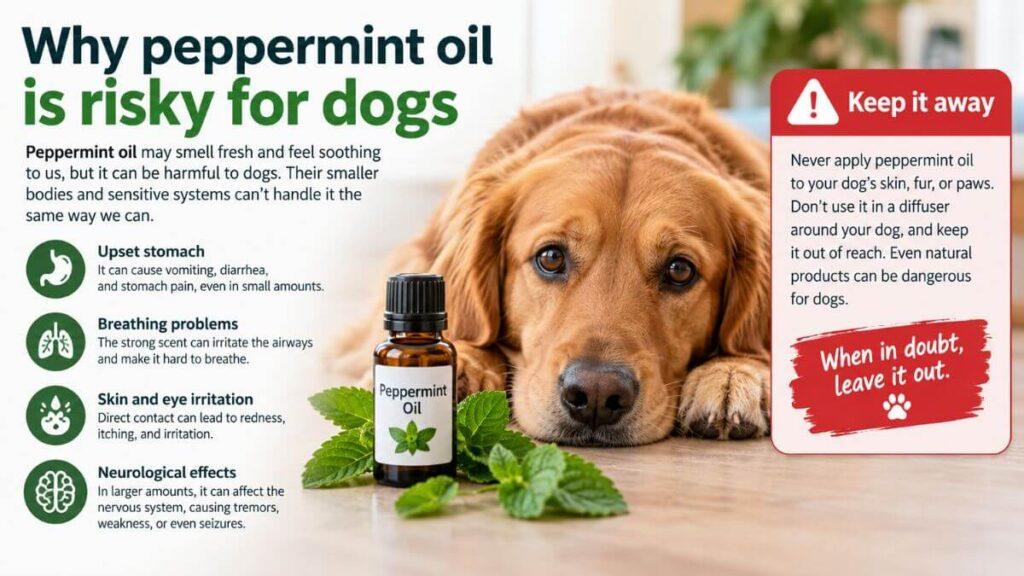
VCA Animal Hospitals, in an article written with Pet Poison Helpline veterinarians, lists peppermint with tea tree, pennyroyal, wintergreen, pine, and cinnamon oil as essential oils that are poisonous to dogs, and notes that both swallowing and skin exposure can be toxic. The Merck Veterinary Manual explains that essential oils are absorbed quickly through the gut, skin, lungs, and mucous membranes, so a dog does not have to drink the oil for it to reach the bloodstream.
The liver breaks these compounds down, which is why VCA singles out puppies and dogs with liver disease as more sensitive. Low exposures usually mean an upset stomach. Concentrated oil can also irritate or burn the mouth and skin, and VCA warns that only a few licks of some products can cause harm.
To keep this in proportion, peppermint is not the worst oil on those lists. Tea tree oil is the one poison centers see most often, and the ASPCA says concentrated tea tree can cause problems at seven or eight drops. Nobody has published a safe or toxic dose of peppermint oil for dogs, though, so the bottle belongs in a closed cabinet.
Is peppermint oil safe for dogs to smell?
A short burst from a diffuser in a room your dog cannot enter is unlikely to hurt a healthy dog, the ASPCA says. Hours of diffusing in a closed room with your dog, or any diffusing near a dog with breathing problems, is riskier.
This is the question behind most Reddit and Quora threads on the topic. The ASPCA guidance on essential oils is more measured than the flat “never” found on many sites. Its poison control team says a diffuser used for a short time in a secured area, one the pet cannot get into, is not likely to cause a problem.
The type of diffuser matters. Ultrasonic and nebulizing diffusers push tiny droplets into the air, and that mist settles on floors, dog beds, and fur that your dog later licks. Passive reed diffusers release scent more slowly but can spill if they get knocked over. A shut bedroom concentrates any scent quickly, and a level that smells faint to you can be a lot for a dog’s nose.
Simple diffuser rules for a dog home:
- Run it in a room your dog cannot enter, and keep sessions short.
- Air the room out before your dog comes back in.
- Place the unit high and stable so it cannot be knocked over, and wipe up any spill right away.
- Skip diffusers entirely for dogs with a history of breathing problems, and in any home with birds.
- Switch it off if your dog sneezes, drools, paws at its face, or leaves the room.
7 dangerous peppermint oil mistakes dog owners make
The riskiest mistakes are diffusing in closed rooms, spraying homemade bug repellent where dogs lie, oiling collars, treating fleas with peppermint, trusting home dilution, leaving sugar-free mints within reach, and making a dog vomit after exposure. Each one makes a harmful reaction more likely.
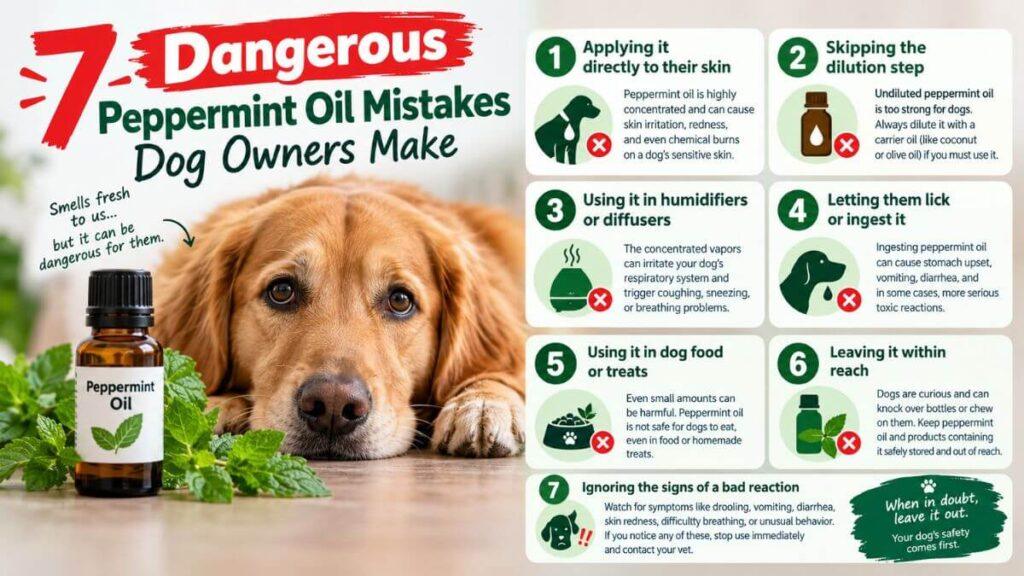
- Running a diffuser for hours in a closed room with your dog. Scent builds up fast, and the mist settles on the bedding and fur your dog later licks.
- Spraying homemade peppermint bug repellent on floors, rugs, or dog beds. The residue ends up on paws and tongues.
- Putting a few drops on a collar or bandana. That holds concentrated oil next to your dog’s nose and mouth all day.
- Using peppermint oil as a flea treatment. There is no good evidence it works on dogs, and essential oil flea products have made pets sick.
- Assuming home dilution makes it safe. Nobody at a kitchen counter knows the menthol content of their bottle, and dogs lick their coats anyway.
- Leaving sugar-free mints or gum within reach. The xylitol in many of them is far more dangerous than the peppermint.
- Making your dog vomit after it licks peppermint oil. Oil brought back up can be inhaled into the lungs, so call a vet or poison hotline instead.
Peppermint oil bug and mouse sprays in a dog home
Homemade peppermint sprays for ants, spiders, and mice are a common way dogs get exposed. The mist dries onto floors, baseboards, and bedding that dogs walk on and lick. If you use one, spray only where your dog never goes and let it dry.
Here is a real case from a veterinary Q&A site. An owner mixed peppermint oil with water, sprayed it around the bedroom, over the linens, and across the floor as a pest deterrent, and only then read that it might harm dogs. The owner’s beagle and American foxhound sleep on that bed. The fix at that point is to wash the linens, wipe every surface, and watch both dogs for coughing, drooling, or lethargy.
Product reviews show the same habit. One buyer of bulk peppermint oil set containers of a 50/50 oil and water mix under the return air grate so the air conditioning would carry the scent through a house shared with two older dogs. Another mixed a spray for wolf spiders and planned to use some on their dogs too.
Store-bought “natural” pest sprays need the same care. Peppermint oil is on the EPA list of active ingredients allowed in minimum risk pesticides, so products built on it can be sold without federal pesticide registration. That means the EPA does not review their safety data the way it does for registered flea and pest products.
There is data on what happens when these products meet pets. A 2012 study in the Journal of Veterinary Emergency and Critical Care reviewed ASPCA Animal Poison Control Center records from 2006 to 2008 and found 39 cats and 9 dogs with reactions to EPA-exempt flea products made from essential oil blends, some containing 0.25 to 3 percent peppermint oil. Signs included lethargy and vomiting, and the authors concluded that pets can react badly even when owners follow the label.
If you still want a peppermint spray indoors, keep it inside cabinets or behind appliances, let it dry fully, and never spray dog beds, crates, bowls, or toys.
Peppermint oil for fleas, itching, or an upset stomach
Do not use peppermint oil as a flea treatment, itch remedy, or stomach aid for your dog. No clinical trials in dogs show it treats any of these problems, and home dilutions are guesswork. Your dog will lick off whatever you apply.
One reader of Dr. Julie Buzby’s veterinary blog wrote that they had used peppermint oil on their dog as a flea killer for years. Dr. Buzby, an integrative veterinarian, pointed them toward a safer option. In the article itself she notes that no studies show peppermint provides health benefits for dogs, and says she prefers vet-prescribed flea products that have passed safety and efficacy trials.
Grooming is the real problem. Dogs lick their coats and paws, so a topical oil becomes an oral dose. Home dilution does not fix that, because nobody at a kitchen counter knows the menthol content of their bottle or how much their dog will lick off.
Check the recipes, too. While researching this guide we found a widely shared one that lists tea tree oil as a “carrier oil” for peppermint. Tea tree is the essential oil most often reported in pet poisonings, according to the Merck Veterinary Manual, so that recipe adds a second hazard to the first.
For fleas, ask your vet for a tested preventive. Itching needs a diagnosis, and a stomach upset that repeats or comes with lethargy needs a vet visit.
Signs of peppermint oil poisoning in dogs
Watch for drooling, pawing at the mouth, vomiting, a wobbly walk, weakness, tremors, and trouble breathing. Exposed dogs often smell of peppermint on the coat or breath. Red or burned patches on the lips, gums, or tongue point to contact with concentrated oil.
VCA lists these signs of essential oil poisoning in dogs:
- Drooling and pawing at the mouth or face
- Vomiting, sometimes with the smell of the oil
- A wobbly or uncoordinated walk
- Lethargy, weakness, or muscle tremors
- Difficulty breathing
- Redness or burns on the lips, gums, tongue, or skin
- A strong peppermint smell on the coat, skin, or breath
The ASPCA adds that dogs who walk through oil or get it on their coat can become unsteady and depressed, and in severe cases develop a low body temperature. A dog that swallowed concentrated oil may also have diarrhea.
Breathing heavy vapor alone usually causes sneezing, coughing, or watery eyes that fade in fresh air. If they do not, or your dog seems weak or wobbly, treat it as a poisoning. Your vet may run bloodwork to check the liver and kidneys.
What to do if your dog licked or swallowed peppermint oil
Move your dog away from the source, wash any oil off the coat with hand dishwashing liquid, and call your vet or an animal poison hotline right away. Do not make your dog vomit, because oily liquid brought back up can be inhaled.
- Turn off the diffuser or remove the product, open the windows, and move your dog into fresh air.
- Wash oil off the fur, skin, or paws with hand dishwashing liquid and lukewarm water. Water alone will not lift oil. Dry your dog well so nothing is left to lick.
- Call your vet, the ASPCA Animal Poison Control Center at (888) 426-4435, or Pet Poison Helpline at (855) 764-7661. Both hotlines run around the clock and charge a consultation fee.
- Do not make your dog vomit and do not give activated charcoal at home. VCA advises against both, and Dr. Buzby explains that a dog vomiting peppermint oil can breathe some in and develop aspiration pneumonia, which can be deadly.
- Put the bottle or packaging in a sealed bag and bring it to the clinic.
Have these details ready when you call:
- The product name and its ingredient label
- Roughly how much oil was involved and how your dog was exposed
- When it happened
- Your dog’s weight, age, and any health conditions
- Any signs you have seen so far
There is no antidote, but VCA notes that with early supportive care most dogs survive. Pet Poison Helpline also lists 800-213-6680 on its contact page.
Peppermint candy, gum, mint leaves, and dog dental chews
With peppermint candy and gum, the bigger danger is usually xylitol, not the mint. Check the label for xylitol, birch sugar, or wood sugar, and call your vet at once if you find it. A few mint leaves rarely cause more than stomach upset.
The FDA warns that xylitol shows up in sugar-free gum, breath mints, sugar-free candy, toothpaste, and mouthwash, and says poisoning signs can start within 20 minutes, including vomiting, weakness, seizures, and liver failure. Chocolate mints add chocolate to the problem, and swallowed wrappers can block the gut.

A plain sugar candy cane is a much smaller issue. One commenter on Dr. Buzby’s blog says an 80-pound Lab ate several peppermints with no harm, which is plausible for ordinary sugar mints. A handful of sugar-free mints would be an emergency.
The ASPCA plant database lists garden mint (Mentha species) as toxic to dogs, with vomiting and diarrhea after large amounts, and names the plant’s essential oils as the toxic part. A nibble from the herb pot is rarely a crisis. Pennyroyal (Mentha pulegium) is a different matter. It is a mint relative sometimes sold as a natural flea repellent, and Pet Poison Helpline says every form of it should be kept away from dogs because it can damage the liver.
Dog dental chews and breath products often use peppermint as a flavor, and dose explains why they are not the same as the oil. In a 2025 scientific opinion, the European Food Safety Authority’s animal feed panel judged peppermint oil safe for all animal species at up to 12 mg per kg of complete feed. Here is that ceiling next to a single drop of essential oil, which is commonly estimated at 30 to 50 mg:
| Dog size | Food per day (rough) | Most peppermint oil at the EFSA ceiling | One drop compared with that amount |
|---|---|---|---|
| 5 kg (11 lb) | about 100 g | 1.2 mg | about 25 to 40 times more |
| 20 kg (44 lb) | about 300 g | 3.6 mg | about 8 to 14 times more |
| 40 kg (88 lb) | about 500 g | 6 mg | about 5 to 8 times more |
Food amounts are rough estimates for dry food. A flavor-level amount spread across a day of meals is nothing like a lick of pure oil, so follow the label and never add essential oil to food or water.
Which dogs face the highest risk
Puppies, small dogs, and dogs with liver disease or breathing problems tend to react to smaller amounts. Flat-faced breeds should skip peppermint diffusers entirely. Cats and birds in the same home are even more sensitive, so the most fragile pet sets the rules.
- Puppies, which VCA lists as more sensitive, and which spend much of the day on the floor where residue collects.
- Small and toy breeds, because one drop is a far bigger dose for a 3 kg Chihuahua than for a 40 kg German shepherd.
- Dogs with liver disease, since the liver does the work of clearing these compounds.
- Dogs with a history of breathing problems, which the ASPCA says should not be around diffusers, and by extension pugs, French bulldogs, and other flat-faced breeds with narrow airways.
- Cats in the same home. The Merck Veterinary Manual explains that cats are deficient in glucuronyl transferase, a liver enzyme that helps clear essential oils.
- Birds, rabbits, guinea pigs, and hamsters. The ASPCA advises against diffusers in homes with birds and extends its caution to small mammals.
Safer ways to keep a dog home fresh and pest free
Fix the source instead of covering it with scent. Wash dog bedding often, clean accidents with an enzyme cleaner, and air the house out. Use a vet-recommended flea preventive, and handle mice and insects with sealed gaps and enclosed traps your dog cannot open.
- For dog odor, look for the cause first. Ear infections, dental disease, and skin problems all cause smells that fragrance only hides.
- For fleas, use a vet-recommended preventive that has been tested for safety and effectiveness in dogs.
- For mice, seal gaps around pipes and doors, keep food in sealed containers, and use enclosed traps. Skip rodent poison baits, which are far more dangerous to dogs than peppermint oil.
- For ants and spiders, clean up crumbs, seal cracks, and ask a pest control company to plan treatment around your pets.
- For your own enjoyment, diffuse peppermint only in a pet-free room, air it out before your dog comes back, and store the bottle in a closed cabinet.
How we researched this guide
We compared the top-ranking pages for “is peppermint oil safe for dogs,” then checked each safety claim against veterinary and regulatory sources. We dropped claims we could not trace to a reliable source, and confirmed hotline numbers on each organization’s own website in September 2026.
This guide is written for dog owners and does not replace a veterinary exam. The main sources behind it:
- VCA Animal Hospitals and Pet Poison Helpline on essential oil poisoning (updated July 2026)
- ASPCA Animal Poison Control Center guidance and toxic plant database
- Merck Veterinary Manual, essential oil toxicoses
- Genovese, McLean, and Khan, Journal of Veterinary Emergency and Critical Care, 2012
- EPA minimum risk pesticide ingredient list
- EFSA opinion on peppermint oil in animal feed, 2025
- FDA consumer update on xylitol and dogs
We left out two claims that other guides repeat, a precise count of scent receptors in a dog’s nose and a peppermint-specific timeline for delayed liver damage, because we could not trace either to a primary source. We also left out dilution ratios on purpose, since no safe dilution for use on dogs has been established.
Frequently asked questions
These are the questions dog owners ask most about peppermint oil, written the way people type or say them. Each answer is kept short. If your dog already shows symptoms, skip ahead and call your vet or an animal poison hotline now.
Is it safe to diffuse peppermint oil around dogs?
Only briefly, and only in a room your dog cannot enter. The ASPCA says short diffuser use in a secured area is unlikely to cause problems. Skip diffusers completely if your dog has breathing problems or you keep birds, and air the room out afterward.
What happens if my dog licks peppermint oil?
A lick of pure oil can cause drooling, pawing at the mouth, vomiting, and redness or burns on the lips and tongue. Larger amounts can cause wobbliness, weakness, and tremors. Wipe oil off the face, wash the coat, and call your vet right away.
Is peppermint oil safe for dogs if you dilute it?
Not for putting on your dog. Home dilution does not fix the main problem, which is that dogs lick their coats and absorb oils through the skin. Nobody at home knows the menthol content of their bottle, so the real dose is guesswork.
Does peppermint oil repel fleas on dogs?
There is no good evidence that peppermint oil works as flea control on dogs. A 2012 review of ASPCA poison center records found dogs and cats sickened by essential oil flea products, some containing peppermint oil. Ask your vet for a tested preventive.
How much peppermint oil is toxic to dogs?
No safe or toxic dose of peppermint oil has been published for dogs. Risk depends on your dog’s size, health, the oil’s strength, and how exposure happened. Treat any lick of pure oil or any skin contact as a reason to call your vet.
Can peppermint oil kill a dog?
Death is uncommon, but serious poisoning is possible with concentrated oil, especially in small dogs, puppies, and dogs with liver disease. There is no antidote. VCA notes that most dogs survive with early veterinary care, so call as soon as exposure happens.
Do dogs hate the smell of peppermint?
Many dogs seem to dislike strong peppermint scent. Veterinarian Dr. Julie Buzby notes that dogs do not appear to enjoy it as much as people do. Sneezing, pawing at the face, or leaving the room are signs the scent is too strong.
Is peppermint oil safe for dogs and cats in the same house?
Not in concentrated form, and cats are more sensitive than dogs. The Merck Veterinary Manual explains that cats lack enough of a liver enzyme called glucuronyl transferase to clear essential oils well. Keep concentrated oil and running diffusers away from both pets.
Is peppermint oil safe for puppies?
No. VCA notes that puppies are more sensitive to essential oils than adult dogs, and their small size means one drop is a large dose. Puppies also spend much of their day on the floor, where spray residue and diffuser mist settle.
Can dogs eat peppermint candy or candy canes?
It is best not to share them. Some peppermint candy, mints, and gum contain xylitol, which can make dogs sick within 20 minutes, according to the FDA. Plain sugar candy usually causes mild stomach upset at most, but wrappers can block the gut.
How long does peppermint oil poisoning last in dogs?
Mild reactions from a whiff or a small lick often settle within a day once the source is gone. Dogs that swallowed or wore concentrated oil may need bloodwork and longer monitoring. Your vet will judge recovery based on the signs and dose.
The bottom line: is peppermint oil safe for dogs?
Peppermint oil is not safe to put on, in, or near your dog in concentrated form. Keep bottles closed and out of reach, use diffusers and sprays only in pet-free rooms, and never use it as a flea or home remedy.
Most of the conflicting advice online comes from mixing up forms. The mint in a dental chew, a leaf from the garden, and a bottle of pure oil are not the same thing, and neither are a whiff from the hallway and a sprayed dog bed. If your dog has licked the oil, had it on the coat, or starts drooling, wobbling, or breathing hard after exposure, call your vet, the ASPCA Animal Poison Control Center at (888) 426-4435, or Pet Poison Helpline at (855) 764-7661. Bring the bottle with you. For fleas, odors, and pests, a vet-tested product or a cleaning fix works better and carries far less risk than peppermint oil.