

Can dogs eat kale? Yes. Most healthy adult dogs can eat a small amount of plain, washed kale without any problem. No, it should not be a daily vegetable in your dog’s bowl. Kale is not toxic the way onions, grapes, or xylitol are. There is no emergency if your dog swipes a leaf off your cutting board. But kale carries three complications that lettuce and cucumber do not, and for a small group of dogs it is genuinely a bad idea.
If your dog has a history of bladder stones, kidney stones, thyroid disease, or a stomach that reacts to everything, skip kale entirely. For everyone else, the safe window is roughly half a teaspoon to two tablespoons of chopped kale per week depending on body weight, served plain with stems removed.
Can dogs eat kale safely? The 7 rules at a glance
Before the detail, here are the seven rules that answer can dogs eat kale for almost every situation:
- Plain only. No salt, oil, butter, garlic, onion, or dressing.
- Stems off. Leaves only, chopped small.
- Wash it. Kale is third on the pesticide residue list.
- Weekly, not daily. Once or twice a week is the ceiling.
- Size the portion. Half a teaspoon for a Chihuahua, two tablespoons for a Great Dane.
- Screen your dog first. Kidney stones, thyroid disease, or a reactive gut means no kale.
- Introduce it alone. One or two pieces, then wait 48 hours.
Here is the full picture, including the part where the experts openly disagree.
Why experts disagree: can dogs eat kale or not?
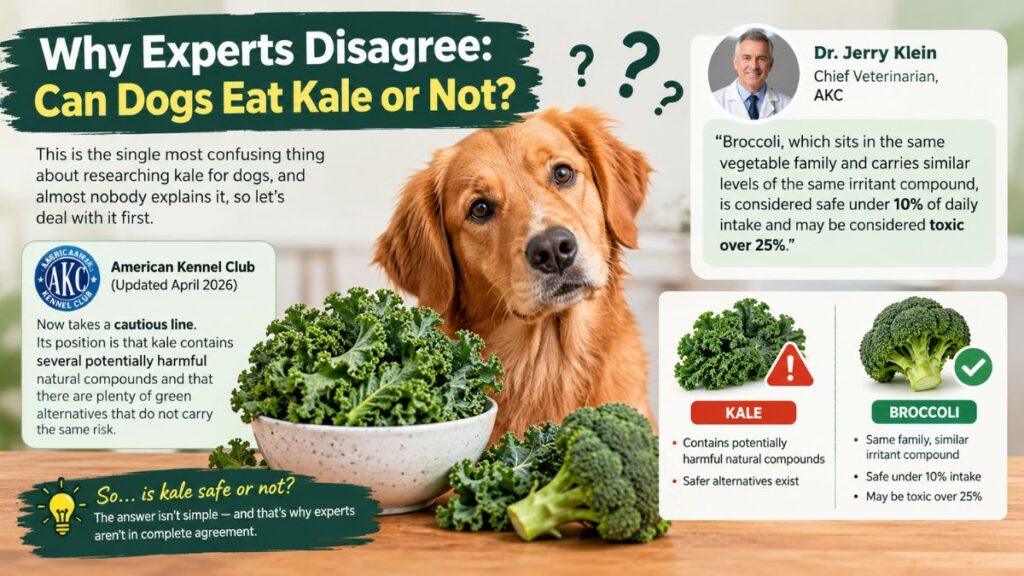
This is the single most confusing thing about researching kale for dogs, and almost nobody explains it, so let’s deal with it first.
The American Kennel Club updated its kale article in April 2026 and now takes a cautious line. Its position is that kale contains several potentially harmful natural compounds and that there are plenty of green alternatives that do not carry the same risk. AKC Chief Veterinarian Dr. Jerry Klein has said that broccoli, which sits in the same vegetable family and carries similar levels of the same irritant compound, is considered safe under 10% of daily intake and may be considered toxic over 25%.
At the same time, Laura Gaylord, DVM, DACVIM (Nutrition), a board certified veterinary nutritionist, told Daily Paws that kale can be a safe and healthy addition to almost any dog’s diet, and that it qualifies as a functional food with compounds that may reduce disease risk with regular consumption. PetMD’s veterinary reviewers land in the middle: fine as an occasional treat for healthy adult dogs, off limits for dogs with kidney or bladder issues.
So who is right? All of them, because they are answering different questions. Nobody disputes the chemistry: kale contains calcium oxalate, isothiocyanates, and goitrogens. What they disagree on is the default advice for a general audience. AKC writes for millions of owners who will read “yes” and then dump a handful of raw kale into a Yorkie’s dinner. A veterinary nutritionist writes for a controlled scenario where the portion is calculated and the dog’s medical history is known.
Control the dose and screen the dog, and the two positions become the same advice. That is what the rest of this guide does.
What kale actually does inside your dog’s body
Kale has four mechanisms worth understanding, because they explain every rule that follows.
Calcium oxalate. The same compound that forms calcium oxalate uroliths, the most common bladder stone in dogs. Kale is high in it, along with spinach, Swiss chard, beet greens, collards, parsley, leeks, quinoa, and okra. A healthy dog handles small amounts fine. For a dog that has already formed stones, or a prone breed such as a Miniature Schnauzer, Shih Tzu, Lhasa Apso, Bichon Frise, or Yorkshire Terrier, regular kale is a genuine risk.
Isothiocyanates. These come from glucosinolates, which give cruciferous vegetables their bitter bite. Studied for cancer prevention in humans; in dogs they cause gastric irritation ranging from mild gas to serious vomiting and diarrhea. This is the compound behind the 10% and 25% thresholds above.
Goitrogens. Cruciferous vegetables can interfere with thyroid iodine uptake. For a healthy dog eating kale twice a month this is a non-issue. For a dog on levothyroxine for hypothyroidism, regular kale can complicate medication management.
Fiber and contaminants. Kale is mostly water and fiber. Too much fiber too fast causes loose stool, flatulence, or constipation, and can interfere with nutrient absorption. Kale also sits third on the Environmental Working Group’s Dirty Dozen list for pesticide residue and readily absorbs heavy metals such as thallium from soil. Both are arguments for washing thoroughly and buying organic where the budget allows.
How much kale can a dog eat by weight?
Two rules apply at the same time.
Rule one, the 10% rule. Every treat, topper, chew, and scrap your dog eats in a day, combined, should stay under 10% of daily calories. Gaylord is explicit that this means taking a complete inventory, not just counting the kale.
Rule two, the weekly cap. Because of the oxalate and isothiocyanate load, kale gets a tighter ceiling than plain vegetables like cucumber. PetMD’s veterinary reviewers give these weekly limits for washed, chopped kale:
| Dog size | Weight | Kale per week |
| Extra small (Chihuahua, Yorkie, Pomeranian, Pug) | 2 to 20 lb | About 1/2 teaspoon |
| Small (Beagle, Basenji, Scottish Terrier) | 21 to 30 lb | About 1 teaspoon |
| Medium (Border Collie, Basset Hound, Cattle Dog) | 31 to 50 lb | About 2 teaspoons |
| Large (Labrador, German Shepherd, Pit Bull) | 51 to 90 lb | About 1 tablespoon |
| Extra large (Newfoundland, Saint Bernard, Great Pyrenees) | Over 90 lb | About 2 tablespoons |
Read those numbers again, because they surprise most people. That is a weekly allowance, not a daily one. A Yorkie’s entire week of kale fits on a fingertip; a Labrador’s fits in a tablespoon.
Frequency matters as much as volume. Once or twice a week is a treat. Every day is a pattern, and patterns are where oxalate accumulation and thyroid interference start to matter.
My dog just ate kale off my plate. What now?
This is probably why half of you are here, so here is the triage.
Plain kale, small amount, healthy adult dog. No action needed. Give fresh water and watch for 24 to 48 hours. Some gas or one soft stool is normal.
A large amount, such as a dog that got into a bag of kale or ate a whole bunch of raw leaves. Call your vet or the ASPCA Animal Poison Control Center at 888-426-4435, especially for a small dog. The risk is gastric irritation and, rarely, obstruction from stems.
Kale with anything on it. This is the scenario that actually sends dogs to the clinic. If your dog ate kale from a Caesar salad or one with vinaigrette, the kale is the least of your problems: most dressings contain garlic or onion, both toxic to dogs and damaging to red blood cells. Garlic powder is especially concentrated. Call your vet with the ingredient list in front of you.
Red flags that mean call the vet now: repeated vomiting, diarrhea lasting more than 48 hours, straining to urinate, frequent trips outside with very little urine produced, blood in the urine, visible abdominal pain, or lethargy. Urinary signs are the ones people ignore, and a fully blocked urethra is a life-threatening emergency.
Can dogs eat raw kale, or is cooked kale better?
Both are safe, and the trade-off is small. Raw kale keeps slightly more vitamin content and fiber. Cooked kale is easier on the digestive system, and light cooking can actually increase the availability of certain nutrients. Gaylord recommends steaming or blanching, and warns against overcooking, which destroys nutrients.
If your dog has a sensitive stomach, cook it. If your dog handles raw vegetables well, raw chopped kale is fine.

What is never fine: kale fried in oil, sauteed in butter, or salted. Fat-heavy foods are a known pancreatitis trigger, and dogs on a complete commercial diet already get all the sodium they need. Use the smallest possible amount of oil if you roast it, and no oil at all for a dog with a pancreatitis history. Let it cool completely before serving.
Can dogs eat kale stems?
Most guides skip this, and it matters. Stems and thick ribs carry more calcium oxalate than the leaves, and they are tough enough to be a choking hazard for small breeds or an obstruction risk if swallowed in pieces.
Some sources suggest pulverizing and sauteing the stems to make them usable. That works for a large dog with no urinary history, but for most owners the effort is not worth it. Strip the leaves off, discard the stem, chop the leaves small.
Can dogs eat kale chips, smoothies, or pesto?
No to all three. Real kitchens produce kale in forms that are nothing like a plain leaf.
Kale chips are fried or oil-roasted and almost always salted, often with garlic powder or chili. A dog eating a handful is getting a fat and sodium load, not a vegetable.
Kale smoothies are worse than they look. Smoothies frequently contain grapes or grape juice (capable of causing acute kidney failure in dogs), heavy fruit sugar, and increasingly xylitol, which is severely toxic even in small doses. For a frozen kale treat, blend plain kale with water and freeze it in a silicone mold instead.
Kale pesto is mostly garlic, oil, and cheese. Skip it.
Kale from your salad is covered above. The dressing is the problem, not the leaf.
Dogs that should never eat kale
Screen your dog against this list before you start:
- Dogs with a history of calcium oxalate bladder or kidney stones, or breeds predisposed to them
- Dogs with chronic kidney disease or any diagnosed urinary condition
- Dogs with hypothyroidism, particularly those on thyroid medication
- Dogs with inflammatory bowel disease, chronic diarrhea, or any diagnosed GI condition
- Underweight dogs, or any dog that needs calorie-dense food rather than filler
- Dogs prone to pancreatitis, if the kale would be cooked in any oil
- Dogs currently being transitioned onto a new food, since one variable at a time is the rule
Gaylord specifically flags underweight pets and dogs with gastrointestinal disease as poor candidates for extra fiber, and notes that dogs needing oxalate limits to prevent urinary stones may need to avoid kale altogether.
Can puppies eat kale? What about seniors and pregnant dogs?
Puppies. Skip it. Puppies have precise requirements for growth, especially around calcium and phosphorus, plus a developing gut that reacts badly to fiber loads. Anything that displaces properly formulated puppy food works against you.
Senior dogs. Caution. Kidney function declines with age, and early kidney disease is common in older dogs and often undiagnosed until bloodwork catches it. Get recent bloodwork before adding an oxalate-heavy vegetable to the routine.
Pregnant or nursing dogs. Their calorie demands are elevated and low-calorie filler works against that. Ask your vet first.
My dog food lists kale as an ingredient. Should I worry?
No, and this is a question almost no article answers.
Several commercial dog foods include kale. In a formulated complete-and-balanced diet, it is present in a calculated quantity the manufacturer has accounted for in the overall nutrient profile, including total oxalate load. That is very different from an owner adding an uncontrolled handful on top.
The takeaway: if your dog’s food already contains kale, do not add more as a topper. The weight chart above assumes the kale is coming from you, not from the bag. If your dog has a stone history, show the ingredient list to your vet.
How to introduce kale safely the first time
- Check your dog against the exclusion list above. If anything applies, stop and call your vet.
- Buy organic if possible, and wash thoroughly under running water either way. Washing removes some pesticide residue and reduces the risk of E. coli and Salmonella, which leafy greens are a known source of.
- Strip the leaves from the stems and discard the stems.
- Chop the leaves smaller than you think necessary.
- Steam or blanch for two to three minutes, then cool completely. Skip this only if your dog handles raw vegetables well.
- Serve one or two pieces on their own, not mixed into the meal, so you can tell what caused any reaction.
- Wait 48 hours. Watch stool quality, gas, appetite, and urination.
- If all normal, move to the weekly amount for your dog’s size. If anything is off, stop.
Is kale good for dogs nutritionally?
Honest answer first: if your dog eats a complete and balanced commercial diet, they are already getting every nutrient they need. Kale adds nutrients above the minimum requirement, which is a bonus rather than a fix.
That said, kale is genuinely nutrient dense. Gaylord notes it supplies antioxidants and phytonutrients including glucosinolates, polyphenols, carotenoids, and terpenoids, plus vitamins A, B family, C, and K, and minerals including calcium, potassium, magnesium, iron, zinc, and manganese. Beta-carotene converts to vitamin A for vision and immune function, and vitamin K supports blood clotting.

One practical use case is worth naming. For a dog on a vet-supervised weight loss plan, steamed low-calorie vegetables can improve stool quality and curb appetite without adding meaningful calories. Kale can fill that role, but cucumber, green beans, and plain pumpkin do the same job with none of the oxalate baggage, which is why most vets suggest those first.
Safer green vegetables if you want to skip kale
If you want a crunchy, low-calorie, dog-safe vegetable treat, these come with fewer conditions attached:
- Green beans. Plain, fresh or frozen, raw or steamed. Most vets’ default recommendation.
- Cucumber. High water, very low calorie, good for hot days.
- Carrots. Crunchy and good for chewing, but higher in sugar, so keep portions modest.
- Plain pumpkin puree. Not pie filling. Excellent for stool quality.
- Zucchini and romaine lettuce. Mild, soft, easy to digest.
Spinach, Swiss chard, collards, and beet greens carry the same oxalate issue as kale, and broccoli carries the same isothiocyanate issue, so none of those are substitutes. If you want the full picture, our guide to vegetables dogs can eat covers the complete safe and unsafe list.
Can dogs eat kale? Your questions answered
Can dogs eat kale?
Yes, healthy adult dogs can eat small amounts of plain washed kale once or twice a week.
Is kale toxic to dogs?
No, kale is not toxic to dogs, but it contains compounds that cause problems in large or regular amounts.
Can dogs eat raw kale?
Yes, raw kale is safe for most dogs, though cooked kale is easier to digest.
Can dogs eat kale every day?
No, once or twice a week is the safe ceiling for healthy dogs.
Can puppies eat kale?
No, wait until your dog is a healthy adult.
Can dogs eat kale stems?
Best avoided, since stems are higher in oxalate and pose a choking risk.
Will kale give my dog kidney stones?
Only with regular consumption, or in dogs already prone to calcium oxalate stones.
Can dogs eat kale chips?
No, kale chips are fried and salted, often with garlic.
My dog ate a whole bag of kale. Is that an emergency?
Call your vet, especially for a small dog, and watch for vomiting or urinary changes.
The bottom line: can dogs eat kale?
Kale sits in an awkward middle zone, which is why you found contradictory answers before landing here. It is not dangerous enough to panic over and not beneficial enough to bother with for most dogs. A healthy adult dog can have a small amount of plain, washed, stem-free kale once or twice a week, sized to body weight, and get a modest nutrient bonus. That is the honest ceiling of what kale does.
If your dog has kidney or bladder stones, thyroid disease, or a reactive gut, the answer is no, and your vet will say the same.
For everyone else, ask what you actually want from the vegetable. If the goal is a healthy crunchy treat, green beans and cucumber deliver it with none of the oxalate, goitrogen, or pesticide questions attached. Feed kale if your dog likes it and you enjoy giving it. Do not feed it because you think your dog is missing something without it. They are not.
This article is for general information and is not a substitute for veterinary advice. Talk to your veterinarian before adding any new food to your dog’s diet, especially if your dog has an existing health condition.
1 thought on “Can Dogs Eat Kale? 7 Proven Rules & the Best Safe Amounts”