

Can dogs eat raw chicken? Physically yes, and plenty of dogs eat it daily without getting sick. That is not the same thing as safe. Raw poultry is one of the biggest sources of salmonella and campylobacter in an ordinary kitchen, and since late 2024 it has also become the main route for bird flu into pet homes. Here is what to do if your dog just ate some, what the research shows, and which dogs should never touch it.
Can dogs eat raw chicken? The short answer
Dogs can eat raw chicken, but the FDA and the AVMA both advise against it, because of salmonella, campylobacter and, more recently, avian influenza. A healthy adult dog that swallows a piece of raw chicken breast will usually be fine. A puppy, a senior dog, a dog on immune-suppressing medication, or any dog living with a toddler or an immunocompromised person is a completely different situation.
The useful question is how much risk you are taking on, and who in your house carries it. The risk to most dogs is low. The risk to the people cleaning up after that dog is what most articles skip.
My dog ate raw chicken by accident. What now?
Do not induce vomiting, and watch your dog for three days. If the chicken was boneless and your dog is a healthy adult, no immediate vet visit is needed. Call your vet straight away if bones were involved, if your dog is very young, very old or already unwell, or if the chicken had been sitting out warm for hours.
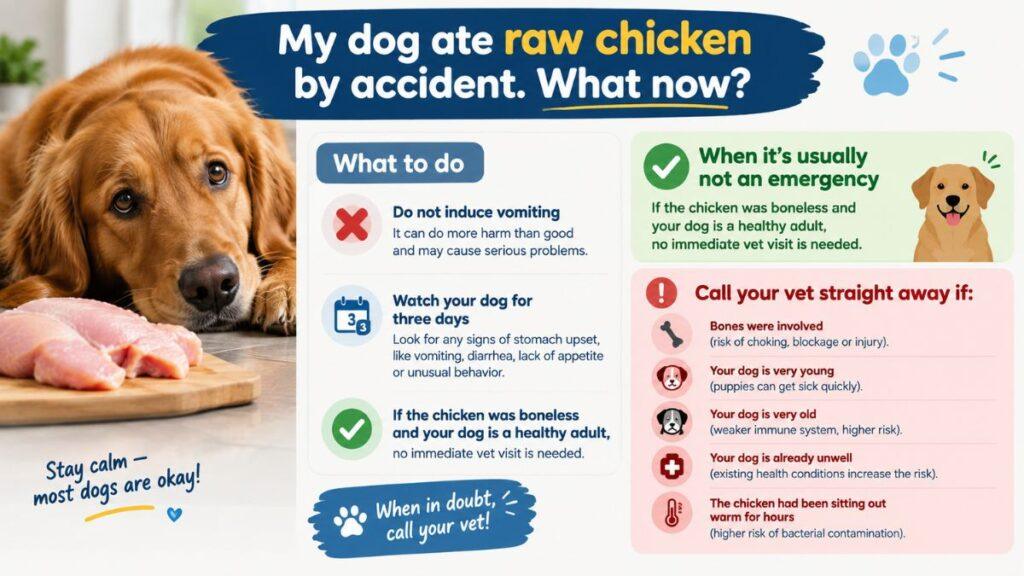
What to do in the next few hours:
- Check the mouth and throat quickly for a stuck bone fragment.
- Remove the packaging, absorbent pad and string. Plastic and foam send more dogs to emergency surgery than the meat does.
- Offer fresh water. Do not force a meal.
- If your dog vomits once then acts normal, rest the stomach a few hours and go back to the usual food in small portions.
- Wash your hands, the floor, the bowl and every surface the chicken touched with hot soapy water, then disinfect.
That last step is not filler. Your dog is more likely to make you sick than the chicken is to make your dog sick.
Symptom timeline: what to watch and for how long
Most signs show up inside the first three days, so the practical watch window is 72 hours. Some dogs never show anything at all.
- 2 to 6 hours: vomiting from the sudden rich meal, usually once or twice.
- 12 to 48 hours: loose stool or mild diarrhoea, normally self-limiting.
- Day 1 to day 3: the real salmonella and campylobacter window. Watch for fever, repeated vomiting, bloody diarrhoea, refusing food or lethargy.
- Day 3 to day 7: most dogs are back to normal. Diarrhoea past this point needs a faecal test, not more waiting.
Call the vet without waiting if you see blood, a swollen or painful belly, repeated retching with nothing coming up, pale or grey gums, or a dog that will not stand up. Those are not upset stomach signs.
Risk 1: salmonella, and what the research actually shows
Raw chicken carries salmonella, dogs can carry it without looking ill, and they shed it into your home. In a Canadian study, sixteen dogs were fed one meal of commercial raw food naturally contaminated with salmonella. Seven shed salmonella in their stool afterwards. None of the twelve dogs fed uncontaminated food shed anything, and none of the shedding dogs looked sick.
That last detail is the one raw feeding pages leave out. Anyone asking can dogs eat raw chicken is usually thinking about the dog. The bigger question is whether the dog quietly turns your kitchen floor into a contaminated surface for a week.
There is a fair counterpoint. A large University of Helsinki survey of raw feeding households found confirmed cross-contamination was rare. That is self-reported data from experienced feeders with settled routines, so it does not cancel the lab work, but it shows handling changes the outcome.
Risk 2: campylobacter and the paralysis link most articles skip
Raw chicken has been tied to a rare paralysing nerve condition in dogs called acute polyradiculoneuritis, or APN.
A University of Melbourne study published in the Journal of Veterinary Internal Medicine compared 27 dogs with APN against 47 healthy controls. Eating raw chicken raised the risk of developing APN by more than 70 times. Campylobacter turned up in 48% of the APN dogs and 23% of the controls. Chicken necks came up again and again, and they happen to be a popular dental treat for small breeds.
APN is the canine version of Guillain-Barre syndrome. The dog’s immune system attacks its own nerve roots, and weakness starts in the hind legs then climbs towards the front legs, neck and face over several days. Most dogs recover with supportive care, though it can take six months, and a dog can die if the chest muscles become paralysed.
Worth keeping in perspective: it was a small study in one country, and association is not proof of cause. APN is rare, so a 70 times increase on a tiny base is still a small absolute risk. But if you feed chicken necks for dental health, other chews carry none of this.
Risk 3: bird flu, the newest reason vets say no
Since late 2024, raw poultry pet food has been confirmed as a route for H5N1 avian influenza into household pets.
- December 2024, Northwest Naturals. A raw frozen turkey recipe was recalled after testing positive for H5N1. An indoor cat in Washington County, Oregon died after eating it. Genome sequencing showed the virus in the food and in the cat were exact matches, and the cat had no outdoor exposure.
- March 2025, Wild Coast Raw. Frozen Boneless Free Range Chicken Formula was recalled after the same H5N1 strain turned up in the product and in infected cats in Washington and Oregon.
- September 2025, RAWR Raw Cat Food Chicken Eats. A San Francisco cat fell ill and was euthanised. FDA testing identified genotype B3.13, already found in other raw poultry pet foods linked to cat illness and death.
On 30 September 2025 the FDA reminded pet food manufacturers that H5N1 counts as a known or reasonably foreseeable hazard when they use uncooked poultry ingredients.
Dogs are in a better position than cats. They can catch H5N1 but usually show mild signs with low mortality, and at the time of those FDA notices no cases had been detected in dogs in the United States, though fatal cases have happened abroad. If a cat shares the house with a raw fed dog, the cat is the one genuinely at risk.
Risk 4: contaminated products, with real 2025 and 2026 recalls
Raw chicken pet food gets recalled regularly, which is why none of this is theoretical.
- Albright’s Raw Pet Food, Chicken Recipe for Dogs Complete and Balanced. The FDA posted this recall on 7 May 2026 after routine sampling tested positive for salmonella. One lot, code C001730, sold nationwide and through retailers in six states.
- Oma’s Pride, Woof Complete Canine Chicken Recipe frozen raw. Recalled in August 2026 after an FDA sample tested positive for salmonella. Three dog illnesses were reported and the lot had reached 11 states. It started with a consumer complaint, not routine testing.
- Rhondda Raw, UK. In October 2025 the Food Standards Agency recalled a raw frozen dog food, a beef product rather than chicken, after salmonella was found. The warning covered handling, bowls, utensils and contact with the dog’s faeces, the same exposure route raw chicken creates.
What that means if you are buying: “complete and balanced” says nothing about microbiology, and brand reputation does not replace checking recall notices. Bookmark the FDA animal food recall page and the AVMA recall search.
Risk 5: the freezing myth. Does freezing raw chicken kill bacteria?
No. Freezing pauses bacterial growth, it does not kill salmonella, campylobacter or listeria. This is the most repeated piece of bad advice in raw feeding content, and several brand pages word it carefully enough to imply more protection than it gives.
The FDA’s position is that freezing and refrigeration do not kill pathogens in raw pet food. Freezing does handle some parasites, a real benefit for certain meats, but it is not a bacterial control step. Once the meat thaws, whatever was in it starts multiplying again.
Risk 6: no kill step. What HPP is and why it matters
High pressure processing, or HPP, is the only widely used kill step in commercial raw pet food, and the one thing worth hunting for on a label. It puts sealed packages under extreme pressure instead of heat. At roughly 87,000 psi for three minutes it can achieve a 5-log reduction of salmonella in chicken, beef and lamb pet food formulas, meaning a 99.999% reduction under validated conditions.
Two things to be clear about. HPP does not kill bacterial spores, so it is a large risk reduction rather than sterilisation. And freeze drying on its own is not a kill step, however it is marketed, because lower moisture slows microbial growth without reliably killing what was already there. If a brand cannot tell you its kill step, treat the product as untreated raw meat.
Risk 7: bones. Can dogs eat raw chicken bones?
Raw chicken bones splinter less than cooked ones, but they still cause choking, mouth injuries, obstructions and perforations. Cooked chicken bones are genuinely dangerous and should never be given.
The realistic problems are a gulping dog swallowing a wing whole, and an older dog with dental disease cracking a tooth. If your dog has already swallowed a bone, do not induce vomiting, because bones coming back up the oesophagus can tear it. Call your vet, describe the bone size and the dog size, and follow what they tell you.
Dogs and households that should never do raw chicken
Can dogs eat raw chicken if they are healthy adults? Usually without incident. The dogs and homes below are the exception, and this is where a general safety answer stops being useful.
Skip it if your dog is a puppy under one year, a senior with reduced immune function, pregnant or nursing, on steroids or chemotherapy, recovering from surgery, or has a history of pancreatitis, IBD or kidney disease. Dogs with a diagnosed chicken allergy are out too, since chicken is one of the more common protein allergens in dogs.
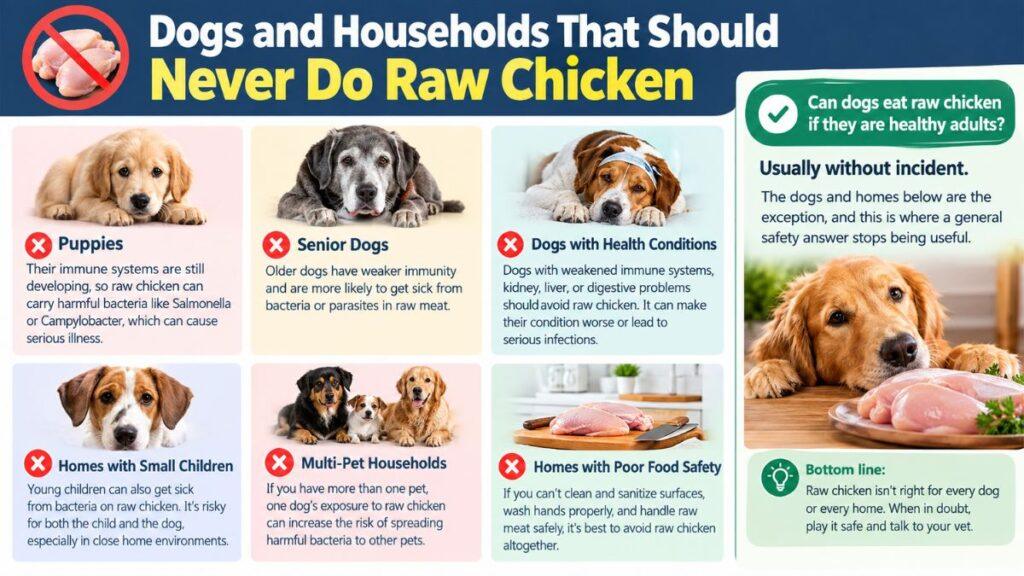
Skip it as well if anyone at home is under five, over seventy, pregnant or immunocompromised. There the risk sits with the people, and a symptom-free shedding dog is exactly the problem. The same goes if you live with cats, given the bird flu findings above.
Can dogs eat raw chicken safely? How to lower the risk
If you have weighed all that and still want to feed it, buy commercially prepared raw with a validated kill step rather than building meals from supermarket chicken. DIY raw carries the highest cross-contamination risk of anything here.
- Choose a brand that states its kill step and publishes testing results.
- Keep raw pet food sealed and separate from human food in the freezer.
- Thaw in the fridge on the bottom shelf in a sealed container, never on the counter.
- Feed in a stainless steel bowl, lift it after 20 minutes, and wash it in hot soapy water or the dishwasher every time.
- Wash hands for 20 seconds and disinfect surfaces. One tablespoon of bleach in one quart of water works.
- Never feed raw chicken as the entire diet. Plain chicken is not nutritionally complete and causes deficiencies over months.
- Do not let a raw fed dog lick faces, especially children’s faces.
Cooked chicken is the simpler option
Plain cooked chicken gives your dog the same protein with none of the bacterial risk. Cook it to an internal temperature of 165 F (74 C), with no salt, garlic, onion, oil or seasoning, and take out every bone.
Boneless skinless breast, poached and shredded, is the standard bland diet recommendation and works as a treat or food topper. Keep it to roughly 10% of daily calories as an add-on. If dental health was the goal, veterinary approved dental chews and toothbrushing do the job chicken necks were supposed to do.
FAQs
Can dogs eat raw chicken every day?
Not safely, because daily exposure multiplies both the contamination risk and the chance of an unbalanced diet.
Can puppies eat raw chicken?
No. Their immune systems and digestive tracts are not developed enough, and the risk is meaningfully higher.
Can dogs eat raw chicken breast?
Physically yes, and it is the leanest cut, but it carries the same bacterial load as any other raw piece.
Can dogs eat raw chicken from the supermarket?
They can, but supermarket chicken is not tested or treated for pet food use, so it carries the highest contamination risk.
How much raw chicken can a dog eat?
There is no safe standard amount, and raw chicken alone is not a complete diet at any quantity.
Can dogs eat raw chicken necks?
Necks are the specific item linked to the paralysis risk in the Melbourne research, so most vets now advise against them.
Will my dog get salmonella from one piece?
Probably not, but they may shed bacteria for several days without ever looking unwell.
Can dogs eat raw chicken thighs?
Yes, though thighs are fattier than breast, so they are a poor choice for dogs prone to weight gain or pancreatitis.
Can dogs eat raw chicken skin?
It is very high in fat and can trigger pancreatitis, so remove it whether the chicken is raw or cooked.
Can I mix raw chicken with kibble?
Mixing itself is not the main issue, but it adds the bacterial risk of raw food with no nutritional gain.
The bottom line
So, can dogs eat raw chicken? Physically yes, and one accidental mouthful is rarely an emergency. If your dog grabbed some off the counter, bin the packaging, watch for three days and clean properly. Call your vet if bones were involved, or if your dog is very young, very old or already unwell.
Feeding it on purpose is a different decision. Salmonella and campylobacter are real, dogs shed them without symptoms, raw chicken is linked to a rare paralysing nerve condition, and since 2024 raw poultry has become a confirmed route for bird flu into pet homes. Freezing does not fix that, and a kill step like HPP lowers the risk without erasing it.
If you just want to give your dog chicken, cook it. If you want a full raw diet, work with a vet who knows raw feeding and buy from a brand that will tell you how it controls pathogens. Talk to your own vet before changing your dog’s diet, because age and health history change this answer.
Sources
- FDA, Get the Facts: Raw Pet Food Diets Can Be Dangerous to You and Your Pet
- FDA, H5N1 notices for RAWR Raw Cat Food Chicken Eats and Wild Coast Raw
- AVMA, cat deaths linked to bird flu contaminated raw pet food
- Martinez-Anton et al., Journal of Veterinary Internal Medicine, 2018
- Joffe and Schlesinger, Canadian Veterinary Journal
- FDA recalls, Albright’s Raw Pet Food (May 2026) and Oma’s Pride (August 2026)
- UK Food Standards Agency, Rhondda Raw recall, October 2025
2 thoughts on “Can Dogs Eat Raw Chicken? 7 Risks Every Dog Owner Should Know”