

Can dogs eat french fries? No. A fry that hits the kitchen floor will not poison a healthy dog, so there is no need to panic over one. But fries are a bad treat: heavy on calories, cooked in oil, salted after frying, and often dusted with onion or garlic seasoning that is toxic to dogs. The potato is fine. What happens to the potato in the fryer is not.
What matters more than the yes or no is how much your dog ate, what was on it, and how much your dog weighs. Those three things decide whether you watch and wait or pick up the phone. This page has the numbers.
Why french fries are bad for dogs
The short answer to can dogs eat french fries is no, and a fry carries four separate reasons why. They are not equally serious.

The one that applies to every dog, every time, is calories. A medium order of McDonald’s fries in the US runs about 320 calories and 15 grams of fat. Divide that out and a single fry is roughly 7 to 8 calories. Sounds like nothing. Put it next to what a small dog actually needs in a day and it stops sounding like nothing, which is what the table below is for.
Then there is the oil. Deep frying loads a potato with fat that dogs handle badly, and a sudden greasy meal often produces vomiting, loose stool and a lot of gas within a few hours. Vets do weigh a high-fat dietary indiscretion when they assess a dog for pancreatitis, but eating fries neither causes nor confirms the condition on its own. The fry count tells your vet almost nothing.
Seasoning is the part that can turn a snack into an emergency. Onion and garlic are Alliums, and they damage canine red blood cells badly enough to cause hemolytic anemia. Plain fast food fries are usually just salt. Curly, cajun, garlic and most restaurant specialty fries are not, and dried onion or garlic powder is far more concentrated by weight than the fresh bulb.
Acrylamide comes last and is the least urgent of the four. It forms when starchy food cooks above about 120 degrees Celsius, and fried potato is the biggest dietary source of it, according to the FDA. Nobody has established a canine safety threshold. File it under reasons not to make fries a habit rather than a reason to worry about one stolen fry.
Can dogs eat french fries that are plain or unsalted?
This is the version most owners hope is the safe one, and it is the least bad of the options without being good. Take away the salt and the seasoning and you have removed the two hazards that send dogs to the clinic. What remains is still a strip of potato that spent several minutes in hot oil.
So can dogs eat french fries with no salt on them? A healthy adult dog will not be harmed by one or two. They just have no reason to be eating them, because a piece of plain boiled potato delivers the same flavour your dog is actually after with none of the frying fat. Unsalted does not mean healthy. It only means less risky.
How many french fries can a dog eat
None, if you want the recommendation. Most people want a number anyway, so here it is with a warning attached. The figures below are not serving sizes. They are the point at which fries have swallowed your dog’s entire daily treat allowance. Veterinary nutrition guidance caps treats at 10 percent of daily calories, because the other 90 percent has to come from complete food or the diet stops adding up.
| Dog weight | Approx. daily calories | 10% treat budget | Fries that use it all |
| 5 lb (2.3 kg) | ~210 kcal | ~21 kcal | 3 fries |
| 10 lb (4.5 kg) | ~350 kcal | ~35 kcal | 4 to 5 fries |
| 25 lb (11 kg) | ~690 kcal | ~69 kcal | 9 fries |
| 50 lb (23 kg) | ~1,150 kcal | ~115 kcal | 15 fries |
| 80 lb (36 kg) | ~1,650 kcal | ~165 kcal | 21 fries |
Those calorie figures assume a healthy, neutered adult dog at rest. Puppies, working dogs and any dog on a weight plan fall outside them, so use your vet’s number if you have one.
That last column is easy to misread. Nine fries are not fine for a 25 pound dog. What the column shows is that a 10 pound dog eating five fries has spent its whole day’s treat budget on something with no protein, almost no fiber and no vitamins to speak of. For most dogs, that is the real cost of fries.
The salt question, with actual numbers
Most articles asking can dogs eat french fries lead with salt poisoning. The arithmetic does not really back that up.
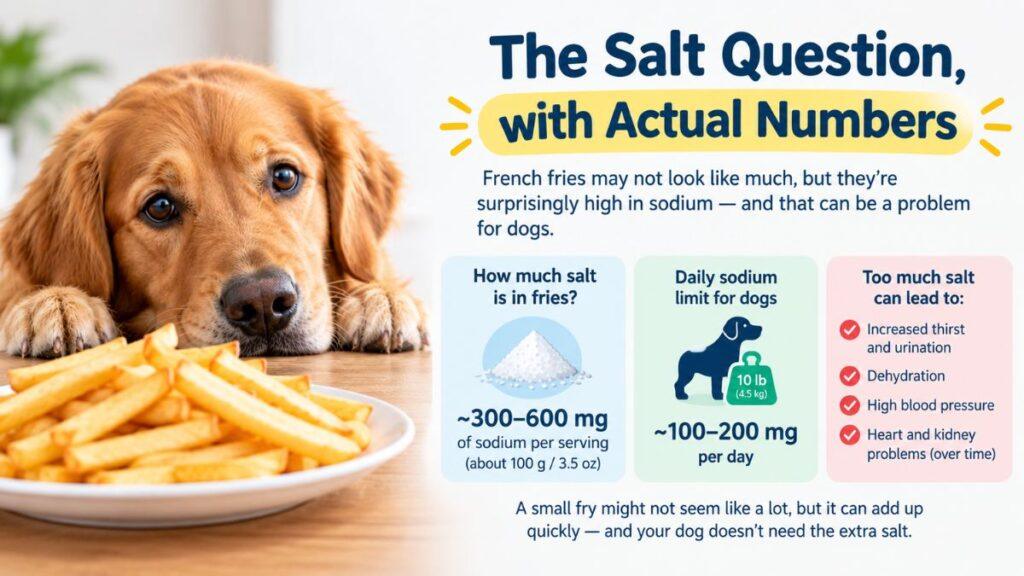
Signs of salt toxicosis in dogs have been reported at roughly 2 to 3 grams of sodium chloride per kilogram of body weight, with about 4 g/kg reported as lethal, according to the Merck Veterinary Manual. A medium McDonald’s order carries around 260 mg of sodium, which works out to about 0.66 grams of salt. For a 10 kg dog, the bottom of the toxic range is roughly 20 grams of salt. That is something like 30 medium orders in one sitting.
So if your dog ate plain salted fries, salt is not the thing to watch. Fat, calories and an upset stomach are. Salt becomes the headline with far more concentrated sources: a bag of table salt, salt dough, or ice melt off the driveway.
Fast food fries compared
Not all fries carry the same risk. The figures below are approximate US medium servings, and chains update their menus, so check the current nutrition page if the amount matters clinically.
| Chain | Calories (medium) | Sodium | Worth knowing |
| McDonald’s | ~320 | ~260 mg | Oil blend contains natural beef flavor made with hydrolyzed wheat and milk |
| Burger King | ~370 | ~270 mg | Thicker cut, similar beef flavor ingredient listing |
| Wendy’s | ~350 | ~500 to 600 mg | Skin on and sea salt seasoned, noticeably saltier |
| Chick-fil-A | ~420 | ~240 mg | Waffle cut, cooked in canola oil, high fat for the salt level |
| Five Guys | 500+ for the smallest size | 1,000 mg+ at large | Cooked in peanut oil, portions far bigger than a standard medium |
The McDonald’s row is the one owners tend to miss when they ask can dogs eat french fries from a drive-through. US McDonald’s fries are not potato and salt. The oil blend includes a natural beef flavor made from hydrolyzed wheat and hydrolyzed milk, and McDonald’s lists the fries as containing wheat, milk and gluten. If your dog has a diagnosed wheat or dairy sensitivity, that changes things.
Seasoned, curly, cheese and loaded fries
Once seasoning enters the picture, this stops being a calorie question.
Seasoned, curly and cajun fries nearly always contain onion powder, garlic powder or both. Clinical signs of Allium toxicosis in dogs have been reported at 15 to 30 grams of raw onion per kilogram of body weight, per the Merck Veterinary Manual, though plenty of vets work to a more cautious threshold of around 0.5 percent of body weight before they want a phone call. Garlic runs roughly three to five times more potent than onion by weight, and the dried powders beat the fresh vegetable for concentration.
A Labrador that steals two curly fries is nowhere near a dose that matters. A 4 kg terrier that gets through a shared basket of garlic fries is worth calling about.
Cheese fries add lactose and more sodium. Chili fries usually have onion in the chili. Loaded fries put bacon fat, sour cream and scallions on one plate, which is about as bad as this food gets for a dog.
If the fries tasted of anything besides salt, find out what was in the seasoning before you decide it was fine.
Can dogs eat sweet potato fries
Sweet potato fries start from a better ingredient and end up with the same problem. Sweet potato itself suits dogs well, with fiber, beta carotene and vitamins they can use. Deep frying and salting it strips most of that back out, and restaurant versions usually arrive in a seasoned batter that contains garlic or onion powder plus sugar. The name suggests a health food. The plate does not deliver one. Sweet potato sticks baked or air fried at home, served plain, are a good treat, and that version is at the end of this page.
Can dogs eat french fries with ketchup and other dips
Most dogs do not eat fries dry. They eat whatever the fries were dipped in, and the dip is often the bigger problem.

| Dip | Main issue | Verdict |
| Ketchup | Sugar and sodium; some brands contain onion or garlic powder; sugar-free versions may contain xylitol | Avoid, and check the label if a sugar-free bottle was involved |
| Mayonnaise | Almost entirely fat | Avoid |
| Ranch | Garlic and onion powder plus dairy | Avoid |
| Cheese sauce | Lactose, sodium, fat | Avoid |
| BBQ sauce | Sugar plus onion and garlic powder | Avoid |
Xylitol is the one worth spelling out. It turns up in some sugar-free condiments and is dangerous to dogs in very small amounts because it causes a sharp drop in blood sugar. If a sugar-free bottle was involved, read the ingredient panel and call your vet without waiting for symptoms. Ordinary full-sugar ketchup licked off the floor is not an emergency.
My dog ate french fries, what happens now
Write down four things: your dog’s weight, roughly how many fries, what seasoning or dip was involved, and what time it happened. Every vet and poison line asks for exactly these, and guessing at them later is worse than noting them now. Then put fresh water down and watch the clock.
For the first couple of hours, most dogs show nothing except thirst and a strong interest in more fries. That is normal, and it does not tell you much either way.
Between two and twelve hours is when a fatty meal shows itself, if it is going to. Vomiting, greasy or loose stool, gurgling, gas. One vomit from a dog that is otherwise bright and eating usually settles on its own.
Twelve to forty eight hours is the window where it can go past a bad stomach. Repeated vomiting, a hunched back, a belly that hurts when touched, refusing food, unusual flatness. Any of those in this window is a call rather than another night of waiting.
Twenty four to seventy two hours is the Allium window, and it catches people out. Red blood cell damage from onion or garlic starts within about a day and peaks around the three day mark. A dog that ate heavily seasoned fries can look completely normal on Monday and show pale gums, weakness or dark urine by Wednesday. If you know the seasoning was there and the dog is small, do not stop watching after one quiet day.
When to call the vet
Call straight away, without waiting for symptoms, if your dog is small and ate a large volume, if the fries were seasoned with garlic or onion, if any sugar-free sauce was involved, or if your dog has a history of pancreatitis.
Call urgently if you see repeated vomiting, a painful or bloated abdomen, weakness, tremors, seizures, pale or white gums, or dark red or brown urine.
In the United States, the ASPCA Animal Poison Control Center is 888-426-4435 and the Pet Poison Helpline is 855-764-7661. Both charge a consultation fee. Do not induce vomiting unless a veterinarian tells you to.
Dogs that should never have fries at all
For most healthy adult dogs, one stolen fry is a non-event. Some dogs are not in that group, and for them the answer to can dogs eat french fries is a firm no rather than a shrug.
Puppies have small bodies and developing guts, so the same fry lands as a much larger dose. Older dogs often have reduced kidney or liver function. A dog that has had pancreatitis once is at higher risk of a second episode, and a fatty snack is a known trigger. Miniature Schnauzers and Yorkshire Terriers are predisposed to high blood fat levels, which is linked with pancreatitis risk. Dogs on sodium restricted diets for heart or kidney disease should not be getting salted human food at all, and diabetic or overweight dogs have no calories to spare. If your dog is on any prescription diet, nothing comes off the table without asking your vet first.
Better alternatives, including fries your dog can actually have
Plain cooked potato with no butter, oil or salt is safe in small amounts. Baked or steamed sweet potato is better, and most dogs prefer it anyway. If you want the actual fry shape, this takes about half an hour.
Scrub one medium sweet potato and leave the skin on. Cut it into sticks about a centimetre thick. Soak the sticks in cold water for ten minutes and pat them completely dry, which also cuts down acrylamide formation. Air fry at 190 degrees Celsius for 12 to 15 minutes, shaking the basket halfway, or bake at 200 degrees Celsius for 25 minutes on a lined tray. No oil, no salt, no seasoning of any kind. Let them cool fully before serving, and cut them small for small dogs.
They keep in the fridge for about three days. Count them inside the 10 percent treat budget above, start with a small amount, and stop if your dog gets loose stool. Owners who came here asking can dogs eat french fries usually leave with this recipe instead, and the dogs do not complain.
Frequently asked questions
Can dogs eat french fries from McDonald’s?
No, and worth knowing that the US recipe includes a natural beef flavor made with wheat and milk derivatives, so they are not plain potato and salt.
Are french fries toxic to dogs?
Plain fries are not toxic the way chocolate or grapes are, but garlic or onion seasoned fries contain ingredients that are.
My dog ate one french fry, should I worry?
No. Offer water, watch for stomach upset, and do not let it become a habit.
Can puppies eat french fries?
No. The same amount is a much bigger dose for a puppy, and their diet has no room for empty calories.
Can dogs eat french fries without salt or seasoning?
That removes the two biggest hazards, but the fat and calories stay, so plain baked potato is still the better option.
Can dogs eat sweet potato fries?
Not the fried restaurant version, which is usually battered and seasoned. Plain sweet potato sticks baked at home are fine.
Can dogs eat french fries with ketchup?
A small lick of regular ketchup is not an emergency, but check for onion powder, and treat any sugar-free sauce as a possible xylitol exposure.
How long after eating fries would a dog get sick?
Stomach upset usually shows within two to twelve hours, while Allium related red cell damage peaks closer to 72 hours.
Can dogs eat french fries every day?
No. As a daily habit it is a calorie and diet balance problem rather than a poisoning one, so swap it for a plain sweet potato cube.
Can dogs eat frozen fries cooked at home?
Only if you cook them plain with no oil or salt, and read the bag first, since many frozen fries come pre-seasoned.
The bottom line
So, can dogs eat french fries? Not as a treat, and not as a habit. Fries are not poison, and treating one stolen fry as an emergency does nobody any good. They still fail every test a dog treat ought to pass. A handful wipes out a small dog’s daily treat allowance and gives back nothing useful. The frying oil sets off exactly the sort of stomach upset that fills vet waiting rooms on a Sunday. Seasoned versions carry a real toxicity risk that can take three days to surface.
Two numbers are worth remembering. Ten percent is the share of your dog’s calories that can come from treats. Seventy two hours is how long to stay alert after your dog eats anything dusted with garlic or onion powder. Most of the rest follows from those.
If your dog loves the ritual of getting a bit of whatever you are eating, do not fight it. Bake a sweet potato, cut it into sticks and hand those over. Your dog gets the same routine and you skip the fryer.