
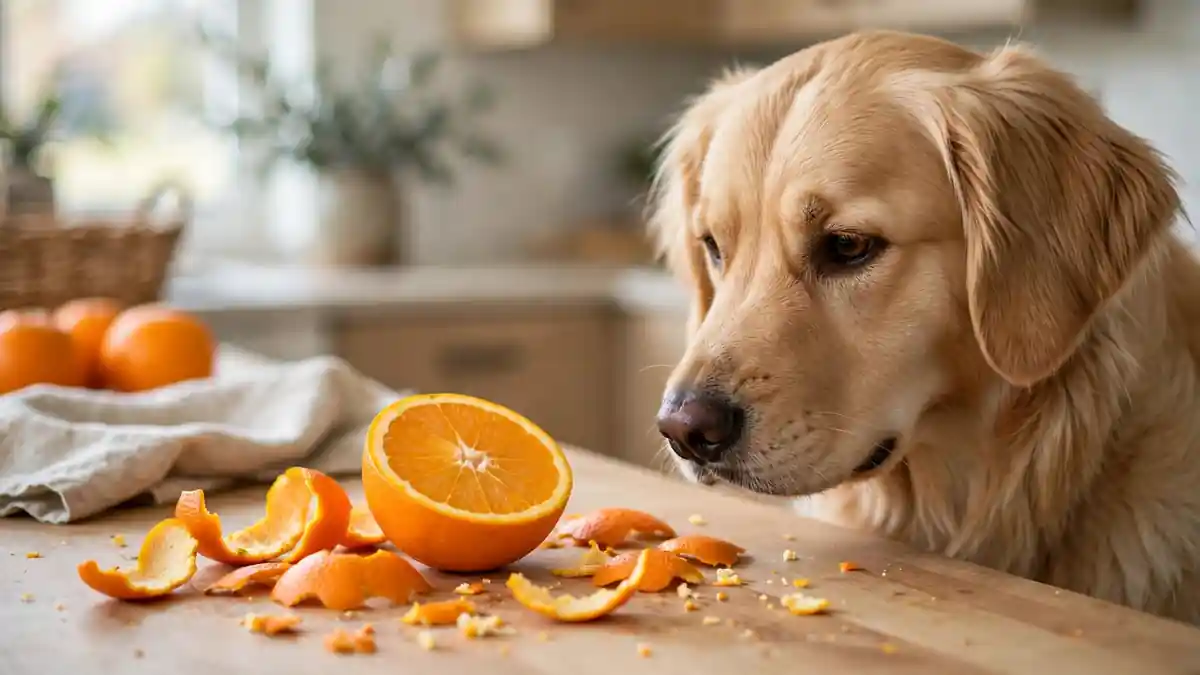
An orange peel smells like a treat to a dog. The smell comes from oils packed into a tough skin, and both the oils and the skin work against a dog that swallows a piece. The flesh inside is a different story.
This guide keeps the two apart, so you can share the fruit and bin the peel. Skip the peel.
Can Dogs Eat Orange Peels?
No, dogs should not eat orange peels, because the peel is tough and hard to digest, and its scent oils can upset the stomach. A scrap may pass with mild upset, while a large piece can block the gut. Serve the flesh instead.

Search data from Semrush in November 2026 puts US searches for “can dogs eat orange peels” at 2,400 a month, with a global figure of 3,600. The wider question, “can dogs eat oranges”, draws far more, with 60,500 US searches a month.
PetMD states that dogs should not eat orange peels or seeds. The peel is difficult to digest and could lead to intestinal obstruction. It also holds oils that can upset the stomach, leading to vomiting, diarrhea, and possibly dehydration. The peel fails on two counts at once.
The split runs through the whole fruit. The flesh is food, and the peel is the wrapper that kept it safe on the tree and on the shop shelf.
| Part of the orange | Safe for dogs? | Why |
|---|---|---|
| Flesh | Yes, in a small amount | Soft, juicy, breaks down with ease |
| White pith | No | Tough fibre, hard to digest |
| Outer peel (zest) | No | Tough skin plus concentrated scent oils |
| Seeds | No | Choking hazard, hard to digest |
What Is in an Orange Peel?
An orange peel has three parts, the zest outside, the white pith under it, and a waxy coat. The zest holds the scent oils, the pith holds tough fibre, and the coat can carry residue. None of the three belongs in a dog’s bowl.

The zest is the thin coloured skin on the outside. It holds the scent oils that give an orange its smell. The two oils that matter here are limonene and linalool, and limonene gives oranges their signature scent while sitting in the peel in a far higher concentration than in the flesh.
The pith is the white spongy layer under the zest. It holds almost no scent oil, and it holds a lot of fibre. ChefsResource notes that the white pith is less acidic than the outer zest and carries fewer essential oils, so it irritates the gut less. It still has no place in a dog’s diet.
The waxy coat is the third part. Supermarket oranges carry a food grade wax that keeps them shiny, and the peel under it can carry pesticide residue from the orchard. ChefsResource calls this the most overlooked risk of the peel, and notes that a quick rinse under the tap does not remove the residue. Wash the fruit before you peel it, so the knife does not drag the coat onto the flesh.
| Layer of the peel | What it holds | Risk for dogs |
|---|---|---|
| Coloured zest | Scent oils (limonene, linalool) | Irritates the stomach |
| White pith | Tough fibre | Hard to digest, can block the gut |
| Waxy coat | Wax and spray residue | Adds residue a rinse will not remove |
Are Orange Peels Toxic to Dogs?
Orange peels are not classed as toxic, yet they can still make a dog sick. The peel holds scent oils that irritate the stomach, and tough fibre can block the gut. The danger sits in the oils and the texture, not in a poison.

The AKC says orange peels are not considered toxic to dogs. PetMD gives the same reading in plainer words: the peel is difficult to digest and could lead to intestinal obstruction.
The ASPCA takes the other view and lists citrus plants as toxic to dogs, naming essential oils and psoralens as the toxic principles. Its entry adds that the flesh is the edible part, while skins and plant material can cause side effects.
Both readings end in the same place, so keep the peel out of the bowl. Grapes poison a dog in a different way. Peel harms a dog through the oils in the zest and the fibre in the skin.
A small scrap may bring a bout of vomiting or loose stools. A large piece may lodge in the gut.
Concentrated citrus products raise the stakes. Dogster notes that limonene in large amounts can upset the stomach, while concentrated forms may harm the nervous system and liver. That covers essential oil bottles and citrus cleaners, not a slice of fruit.
What Happens If a Dog Eats Orange Peel?
Take the rest of the peel away first, then watch the dog for vomiting, loose stools, or belly pain. Offer fresh water and keep the dog calm. Do not make the dog vomit at home. Call the vet if a large piece went down.

Start with the rest of the peel. Pick up every scrap from the floor and the plate, and put it in the bin before the dog goes back for more. Then look at the dog. A dog that paws at its mouth, gags, or struggles to breathe needs help right now.
Offer fresh water and keep the dog calm, and do not try to make the dog vomit at home, since ChefsResource warns that forcing it can send a hard piece back up into the throat and injure the esophagus. Only a vet should decide that step, and most vets will not ask for it with a tough piece like peel.
Watch the dog for the next day. ChefsResource puts the watch window at 12 to 24 hours for a peel grab. A large piece deserves a longer watch and a faster call.
| What to track | Looks fine | Call the vet |
|---|---|---|
| Vomiting | None | Vomiting that repeats |
| Stools | Normal and on time | Loose stools that persist, or none at all |
| Appetite | Eager at meals | Refuses food |
| Energy | Normal play and walks | Weak or lethargic |
| Belly | Soft and calm | Hard, swollen, or sore |
The signs above match the signs of a gut blockage from any tough, indigestible piece. Our guide to watermelon rind covers the same watch in full, because rind and peel fail a dog’s gut in the same way. Two or more signs together call for a vet visit the same day. Do not wait for the signs to pass on their own.
Can Dogs Eat Oranges?
Yes, dogs can eat oranges, as long as you serve peeled, seedless flesh in a small amount as an occasional treat. Remove the peel, the white pith, and every seed first. Skip oranges for dogs with diabetes, weight trouble, or a sensitive stomach.

AKC says dogs can eat oranges in small amounts as an occasional treat. Oranges carry vitamin C and fibre, and they also carry potassium. The AKC adds that most dogs get what they need from a complete and balanced diet, so oranges stay a treat rather than a staple.
Wash the orange. Peel it fully, and pull off the white pith strings that cling to the flesh. Take out every seed.
Cut the flesh into small pieces. That is the safe form, and it is the only form to serve. PetMD adds one more rule: choose plain fresh slices, not processed citrus products.
Sugar and acid set the limit. Oranges carry natural sugar, and too much can upset the stomach or add weight over time. The acid can do the same, and dogs with sensitive stomachs feel it first.
PetMD says plainly not to feed oranges to dogs who are overweight or diagnosed with diabetes. Treats of every kind should stay a small part of a dog’s daily food. A small amount of flesh fits that rule.
| Dog | Oranges? | Notes |
|---|---|---|
| Healthy adult | Yes, a small amount | Peeled, seedless, occasional treat |
| Puppy trying oranges first | A tiny piece first | More sensitive to acid, watch for upset |
| Sensitive stomach | Best skipped | Sugar and acid can bring vomiting or loose stools |
| Diabetes or weight trouble | Skip | Sugar can affect blood sugar and add weight |
Other citrus follows the same split. Mandarins are safe in small amounts like oranges, and our guide to mandarin oranges covers them in full, so this article does not repeat that ground. Lemons, limes, and grapefruit stay off the menu, because they are far more acidic and far more likely to irritate a dog’s stomach.
A mango pit stays out of the bowl, and our guide to melon covers melon flesh with the rind off.
How to Keep Peels Away From Your Dog
Peel over the bin and bag the peel at once, so the dog never gets a chance at it. Use a bin with a lid, and clear plates before the dog checks them. Give the dog its own treat at the table.

Peel the orange over the bin, not over a plate. The peel falls where the dog cannot reach it, and the habit takes no extra time. A dog that has stolen peel from the counter once will check the same counter every time after.
Use a bin with a lid. An open bin is an invitation, and a tall dog can nose the lid off a light one.
Clear plates before the dog checks them. Peels land on plates at breakfast or on picnic tables, and a dog will clear a low table faster than an owner can turn around. Take the plate inside first, then let the dog out.
Teach a leave it cue for floor scraps, and give the dog its own treat at the table. A dog that knows leave it will pause at a dropped peel, and that pause is enough time to pick it up. Our guide to spaghetti covers the same table habit, because shared meals are where most floor scraps come from.
Puppies, Small Dogs, and Sensitive Stomachs
Puppies and small dogs face the highest risk from peel, because a small gut leaves less room for a piece to pass. Sensitive stomachs react to the oils in a small scrap. Keep peel away from all three, and ask the vet before a taste.

A small gut leaves less room for a tough piece to pass. The same scrap that slides through a large dog can lodge in a small one, because the gut is narrower and the piece is bigger by comparison. Puppies sit in the same group. Their guts are small, and their chewing is worse, so a piece goes down whole.
Puppies also react more to the acid in the fruit itself, and PetMD notes that they are more likely to get an upset stomach than adult dogs and more sensitive to the high acid content. Offer only a tiny piece of peeled flesh at first, and watch for upset before offering more. A puppy that gulps a curl of zest whole gives its small gut a tough, oily piece to deal with, and the vet is the right call even before any sign shows up.
Sensitive stomachs react to the oils even in a small scrap. Dogs in this group do better with plain, gentle food. Our guide to chicken covers one plain option that many owners reach for first. Ask the vet before offering any new food to a dog with a sensitive stomach.
When to Call the Vet
Call the vet the same day if vomiting repeats, stools stop, the belly turns hard or sore, or the dog turns weak. A large piece in a small dog calls for a faster call. Do not offer home remedies while you wait.

Spot lists the signs that call for a vet after oranges: persistent vomiting, diarrhea lasting more than a day, lethargy, tremors, and signs of belly pain. Two or more together call for a vet visit the same day.
Call sooner when the piece was large or the dog is small. A whole peel in a toy breed, a puppy that gulped a curl of zest, or a dog that already has stomach trouble all deserve a call right away. Do not wait.
| Sign | What to do |
|---|---|
| Vomiting that repeats | Call the vet the same day |
| No stools, or straining to pass | Call the vet the same day |
| Belly hard, swollen, or sore | Call the vet the same day |
| Weak, lethargic, or trembling | Call the vet the same day |
| A large piece in a small dog | Call right away, even with no signs yet |
At the clinic, the vet feels the belly for pain and swelling, then may take an X-ray or use ultrasound to find the piece. Fluids and monitoring may follow, and a stuck piece may need endoscopy or surgery to come out.
Do not offer Pedialyte or any home remedy while you wait, and do not offer food to a dog that keeps vomiting. The vet decides what goes in next.
Frequently Asked Questions
Most peel questions come down to one check, the peel stays out of the bowl, whatever form it takes. The answers cover organic peel, a lick without swallowing, juice, dried and candied peel, zest in food, and the breath myth.
Can dogs eat orange peels if they are organic?
Organic peel is still unsafe. It holds the scent oils and the tough fibre, and those are the parts that cause trouble. Organic only changes the spray residue on the outside. Keep organic peel out of the bowl the same as any other peel.
My dog licked an orange peel but did not swallow any. Is that a problem?
A lick on its own is rarely a problem. The oils sit in the peel, and a lick transfers only a trace of them. Take the peel away so the lick does not turn into a bite.
Can dogs drink orange juice instead of eating the fruit?
Skip orange juice for dogs. It carries concentrated sugar and acid, and it lacks the fibre found in whole fruit. Offer fresh water instead.
Can dogs eat dried orange peel or candied peel?
No, and both forms are worse than fresh peel. Dried peel is harder and more concentrated, so a small piece carries more oil and more fibre. Candied peel adds sugar.
Can dogs eat food with orange zest in it?
Keep zest out of a dog’s food. Zest is the outer peel, grated fine, and grating does not remove the oils. A pinch of zest in a baked treat still carries the scent oils that irritate a dog’s stomach. Check bought treats for orange peel or citrus oil on the label.
Does orange peel help a dog’s breath or teeth?
The fresh smell of the peel started this idea, and the smell does not clean anything. A dog that chews peel risks the same stomach upset and blockage as a dog that swallows it. Brush the dog’s teeth or use a vet approved dental chew instead.
The Bottom Line
Skip the peel every time, and serve peeled, seedless flesh in a small amount instead. The oils can upset the stomach and the fibre can block the gut. Keep the peel in the bin, and let the flesh stay the only part in the bowl.
Next time you peel an orange, do it over the bin and bag the peel before you sit down. That one habit keeps the risky part out of the dog’s reach.
Sources
- PetMD: Can Dogs Eat Oranges?
- AKC: Can Dogs Eat Oranges?
- ASPCA: Citrus spp. (Toxic and Non-Toxic Plants)
- Spot Pet Insurance: Can Dogs Eat Oranges?
- ChefsResource: Can Dogs Eat Orange Peels?
- Dogster: Can Dogs Eat Citrus Fruit?
- HealthPage: Can Dogs Eat Oranges?
Disclaimer
This article shares general food safety information for dog owners and does not replace advice from a vet who knows your dog. If your dog has a health condition, takes medicine, or shows signs of illness after eating peel, contact your vet before you offer a new food again.


