
Quick answer: No. Dogs cannot have Down syndrome. The condition is caused by an extra copy of human chromosome 21, and dogs have a completely different chromosome set (39 pairs instead of 23). A dog that looks or behaves the way people picture Down syndrome almost always has something else going on, usually congenital hypothyroidism, pituitary dwarfism, hydrocephalus, or a liver shunt. All four can be diagnosed, and most can be treated.
The Short Answer
Down syndrome exists only in humans because human chromosome 21 defines it. Three copies of that chromosome instead of two, and you have trisomy 21.
Dogs have 78 chromosomes in 39 pairs. Humans have 46 in 23 pairs. Dog chromosome 21 carries a different set of genes, so an extra copy of it would not produce anything like Down syndrome.
None of that means your dog is fine. A flat face, wide-set eyes, short limbs, stalled growth, or slower learning than the littermates can all point to a genuine medical problem. The problem just has a different name, and in several cases a treatment.
Why Dogs Cannot Have Down Syndrome
What Down syndrome actually is
Cell division goes wrong, an embryo ends up with three copies of chromosome 21, and the extra genetic material changes how the brain, heart, and skeleton develop. The whole definition hangs on one chromosome in one species. Remove that chromosome from the picture and there is nothing left to define.
Dogs have a different chromosome set
A dog carries 38 pairs of autosomes plus one pair of sex chromosomes, for 78 chromosomes in total. A human carries 22 autosome pairs plus one sex pair.
Species do not share chromosome numbering. Dog chromosome 21 is not a canine edition of human chromosome 21, and the genes that sit on human chromosome 21 are spread across several different dog chromosomes.
Has any dog ever been born with a trisomy?
Szczerbal and Switonski reviewed canine clinical cytogenetics in the journal Animals in 2021 and found that the chromosomal abnormalities recorded in living dogs are nearly all sex chromosome problems. X monosomy, where a female has one X instead of two. X trisomy. XXY, which is the canine version of Klinefelter syndrome.
Whole autosome trisomies do turn up in the literature, but only inside tumor cells. A 2021 SNP microarray screen of more than 2,000 dogs found one case of X monosomy, one of X trisomy, and nothing beyond that.
The likeliest reason is simple. Dog embryos carrying an extra full autosome do not appear to make it to birth. Sex chromosome abnormalities happen. A constitutional autosomal trisomy has never been documented in a living dog.
Can Any Animal Have Down Syndrome?
Other species complicate the picture, which is worth a moment because it shows why the canine answer is so firm.
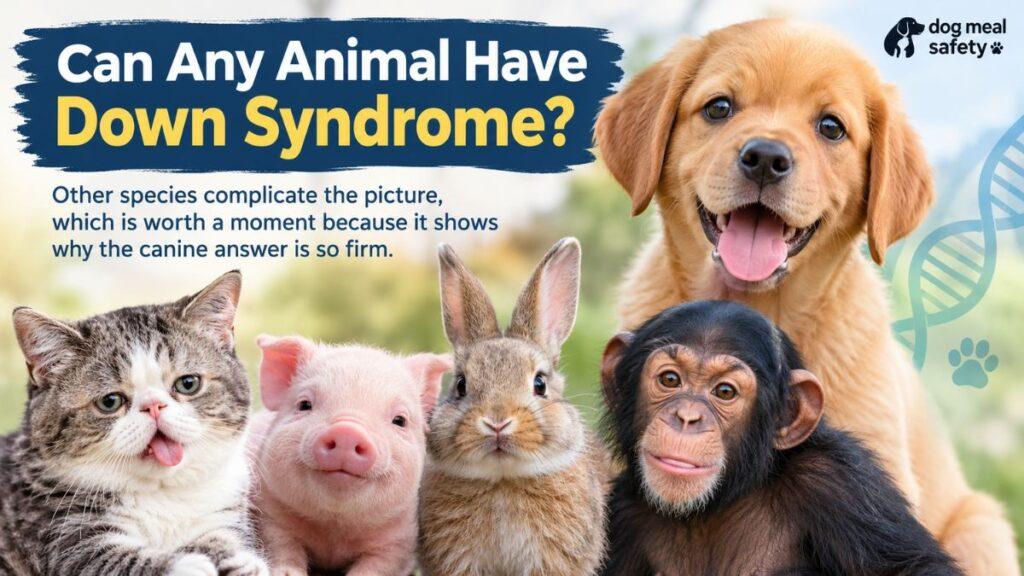
Chimpanzees. Chimps have 48 chromosomes, and their chromosome 22 corresponds to human chromosome 21. In 2017, a team at Kyoto University’s Kumamoto Sanctuary published a case study in Primates on a female chimpanzee called Kanako, born in 1992 with trisomy 22. Her symptoms tracked human Down syndrome closely: stunted growth, cataracts that eventually blinded her, an atrial septal defect, underdeveloped teeth. Only one other chimpanzee case has ever been confirmed.
Laboratory mice. Research on Down syndrome runs largely on the Ts65Dn mouse, which carries an extra segment of mouse chromosome 16 corresponding to part of human chromosome 21. That mouse was engineered. It did not occur on its own.
Dogs have no counterpart to either, because no single dog chromosome maps onto human chromosome 21.
Why Your Dog Might Look Like It Has Down Syndrome
The features that prompt this question tend to be:
A broad, flat, or domed skull
Wide-set or bulging eyes, sometimes drifting downward
A tongue that hangs out or looks too big for the mouth
Short legs relative to body length
Growth that stalls while the littermates keep going
Slow learning, poor house training, repeated circling
Weak muscle tone, low energy, a thin coat
These read as Down syndrome because they overlap with what people recognise in humans. In dogs they belong to a different group of conditions.
7 Conditions Commonly Mistaken for “Dog Down Syndrome”
1. Congenital hypothyroidism
Of everything on this list, this is the one that looks most like what owners expect. The thyroid gland fails from birth to produce enough hormone, and the puppy develops disproportionate dwarfism: a broad head, an oversized tongue, teeth that come through late, and obvious mental dullness. Growth slows inside the first few weeks.
Your vet confirms it with a thyroid panel covering total T4, free T4, and TSH together. The MSD Veterinary Manual is blunt about this. A low T4 on its own is not a diagnosis, because plenty of other illnesses push that number down.
Then it comes down to timing. Daily levothyroxine started early often lets a puppy develop close to normally. Started late, after the growth window has shut, the skeletal and cognitive effects stay for life.
2. Pituitary dwarfism
German Shepherds are the breed everyone associates with this one, and the genetics are unusually well mapped. Voorbij and colleagues published a study in PLOS ONE in 2011 tracing the cause to a deletion in the LHX3 gene on chromosome 9. Because it is recessive, two healthy carrier parents can produce affected pups without warning.
The pituitary gland fails to release growth hormone. Affected dogs stay puppy sized and keep a soft woolly coat that later falls out, though their body proportions usually stay normal, which separates them from hypothyroid dwarfs. Vets confirm it with IGF-1 testing plus a genetic test for the LHX3 mutation, then treat with progestins and thyroid supplementation. Left untreated, most of these dogs live three to five years.
3. Congenital hydrocephalus
Fluid collects inside the skull and presses on the brain. Toy and brachycephalic breeds carry most of the risk, particularly Chihuahuas, Yorkshire Terriers, Pugs, and English Bulldogs.
There are two physical giveaways. The skull domes outward, and the soft spot that should have closed stays open. A third sign is easy to spot once you know it: the eyes point down and out, which vets call the setting sun sign. Behaviourally, expect circling, head pressing against walls or furniture, seizures, and slow learning.
In a young puppy, a vet can image through the open fontanelle with ultrasound. Otherwise it takes an MRI. Treatment runs from corticosteroids and diuretics to a ventriculoperitoneal shunt, and VCA Hospitals puts shunt success rates as high as 80 percent when the surgery happens early.
4. Portosystemic shunt (liver shunt)
A blood vessel bypasses the liver, so toxins the liver should be filtering reach the brain instead. Yorkshire Terriers and Maltese usually get the extrahepatic type. Large breeds such as Labradors usually get the intrahepatic type, which matters enormously for prognosis.
Owners often notice the pattern before the symptoms. The puppy stays small, picks at food, and goes wobbly or disoriented after eating. Some drool heavily or press their head into furniture. Anything protein rich makes it worse.
Confirming it takes a paired bile acid test, drawn before and after a meal, then ultrasound or CT to find the vessel. Today’s Veterinary Practice reports that roughly 85 percent of dogs with a single extrahepatic shunt are clinically normal within four months of surgery. Intrahepatic repairs carry surgical mortality of up to 25 percent, which is a very different conversation to have with your vet.
5. Congenital heart defects
A patent ductus arteriosus, pulmonic stenosis, or a septal defect all restrict oxygen delivery. The puppy tires fast, coughs, breathes quickly at rest, and may show pale or bluish gums while growth lags behind. Most cases start with a murmur picked up on a routine exam and get confirmed by echocardiogram. Surgery or a catheter procedure fixes some defects outright; the rest are managed on medication.
6. Mucopolysaccharidosis and chondrodysplasia
Mucopolysaccharidosis covers a group of inherited enzyme deficiencies that let waste products accumulate inside cells. The face flattens and broadens, the neck shortens, the eyes cloud over, joints stiffen, and the skeleton deforms. A urine screen plus enzyme or DNA testing identifies it. There is no cure, so everything afterward is about keeping the dog comfortable.
Chondrodysplasia is abnormal cartilage development that shortens and sometimes bows the limbs. Breeders selected for it deliberately in Dachshunds, Corgis, and Bassets. Turning up in a breed where nobody selected for it is a different story, and points to a genetic defect.
7. Growth hormone deficiency and other causes
Isolated growth hormone deficiency, early malnutrition, a heavy parasite burden, and portal vein hypoplasia can each stunt growth and dull behaviour without any chromosome being involved at all.
Comparison table
| Condition | Key signs | Breeds at risk | Main test | Treatment | Prognosis |
| Congenital hypothyroidism | Broad head, large tongue, disproportionate dwarfism | Boxer, Giant Schnauzer | T4, free T4, TSH panel | Levothyroxine | Good if treated early |
| Pituitary dwarfism | Puppy size retained, woolly coat, normal proportions | German Shepherd | IGF-1 plus LHX3 test | Progestins, thyroid support | 3 to 5 years untreated |
| Congenital hydrocephalus | Dome skull, open fontanelle, setting sun eyes | Chihuahua, Yorkie, Pug | Fontanelle ultrasound, MRI | Medication or VP shunt | Up to 80% shunt success |
| Portosystemic shunt | Stunted growth, disorientation after meals | Yorkie, Maltese, Labrador | Paired bile acid test | Diet, medication, surgery | 85% normal after surgery |
| Congenital heart defect | Exercise intolerance, coughing, pale gums | Varies by defect | Echocardiogram | Surgery or medication | Varies widely |
| Mucopolysaccharidosis | Flat face, cloudy eyes, stiff joints | Plott Hound, Min Pinscher | Urine screen, DNA test | Supportive care | Guarded |
| Chondrodysplasia | Short, sometimes bowed limbs | Dachshund, Corgi, Basset | Radiographs, DNA test | Weight management | Usually normal |
How Vets Diagnose These Conditions
Most clinics work through the same sequence, and knowing it in advance makes the eventual bill less of a shock.
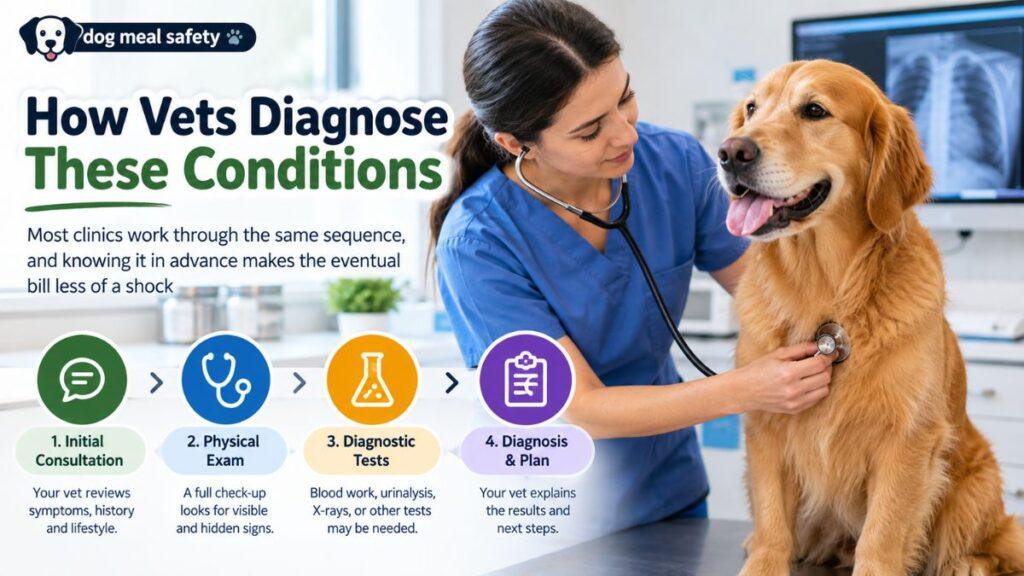
- Physical exam. Body proportions, skull shape, fontanelle, tongue size, plus a listen for a heart murmur.
- Blood work. CBC and chemistry panel to rule out organ problems and infection.
- Thyroid panel. Total T4, free T4, and TSH together. One low T4 proves nothing on its own.
- Paired bile acid test. Drawn before and after a meal. This is the liver shunt screen.
- Radiographs. Growth plates and bone shape tell hypothyroid dwarfism apart from pituitary dwarfism.
- Ultrasound, CT, or MRI. Imaging finds a shunt or confirms hydrocephalus.
- Genetic testing. Available for LHX3 pituitary dwarfism, several forms of mucopolysaccharidosis, and chondrodysplasia.
Counting a dog’s chromosomes through karyotyping is technically possible, but almost nobody offers it outside a university or research lab, and no vet is going to reach for it here. The conditions above are far more common, and the treatable ones all show up on the tests listed.
What Diagnosis and Treatment Cost
Prices swing hard depending on your country and on whether you walk into a general practice, a specialty hospital, or a university teaching hospital. Treat the figures below as a rough US guide rather than a quote.
| Item | Typical range |
| Consultation and physical exam | $50 to $120 |
| CBC and chemistry panel | $100 to $200 |
| Full thyroid panel | $80 to $200 |
| Paired bile acid test | $150 to $250 |
| Radiographs | $150 to $300 |
| Abdominal ultrasound | $250 to $400 |
| CT or MRI | $700 to $2,500 |
| Levothyroxine, monthly | $15 to $40 |
| Extrahepatic shunt surgery | $2,000 to $6,000 |
| Intrahepatic shunt repair | $6,000 to $12,000 |
| Ventriculoperitoneal shunt | $4,000 to $10,000 |
One thing worth checking before you commit to a full workup: most insurers exclude congenital conditions that existed before the policy started.
Feeding a Dog With One of These Conditions
With a liver shunt, food is not a supporting detail. It is part of the treatment.
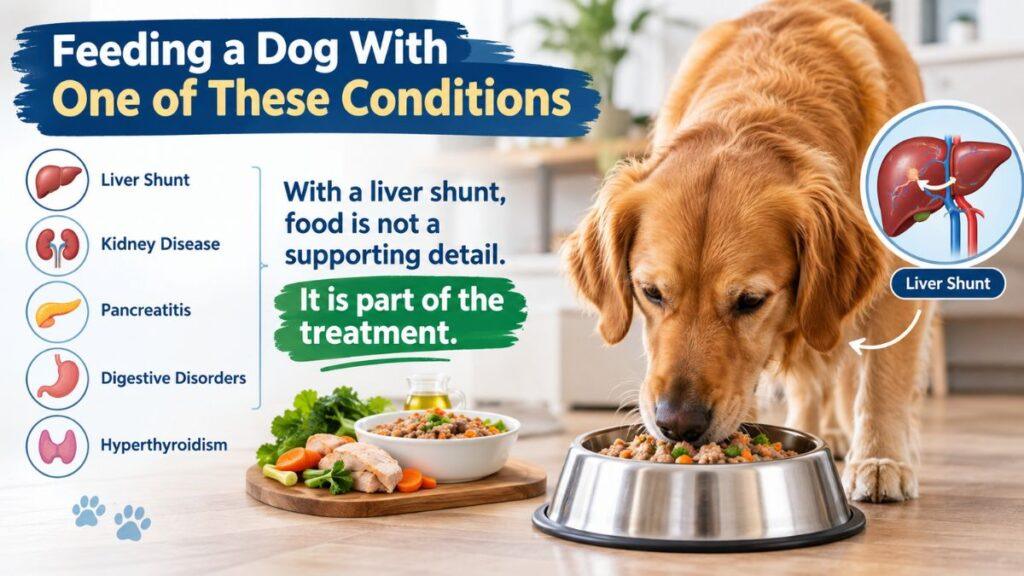
Liver shunt. The aim is to cut the ammonia load reaching the brain. Veterinary nutritionists at Tufts and the Purina Institute point toward protein from dairy, soy, and egg instead of red meat and organ meat, because those sources generate less ammonia. Protein gets restricted, never removed, with something around 2.1 to 2.5 grams per kilogram of body weight as a starting point. Keep copper low. Several small meals beat one or two big ones. Ask your vet for a prescription hepatic diet instead of assembling this at home.
Congenital hypothyroidism. Weight creeps up easily on levothyroxine, so portions need watching. Keep the medication on a steady schedule relative to meals, since food affects how much gets absorbed, and calcium rich foods and soy can block uptake outright.
Hydrocephalus. Nothing special is required, though a dog with poor coordination often manages better with softened food and a raised bowl.
Pituitary dwarfism and mucopolysaccharidosis. Keep the dog lean. Every extra kilo lands on joints and bone that are already compromised.
All cases. Xylitol, grapes and raisins, onions, garlic, chocolate, and macadamia nuts stay off the menu. A dog with liver or thyroid disease has far less reserve for handling a toxic exposure.
Caring for a Special Needs Dog
Most of these dogs live comfortably once the house adapts to them. Block off stairs and pool access if balance is poor, and put ramps where they need them. Hold the daily routine steady, because cognitive impairment and change do not mix well. Supervise around other dogs, since one that misreads social signals can find trouble in seconds. Keep a written log of seizures, confused episodes, or appetite changes, and bring it to appointments.
About those viral videos
Clips labelled “dog with Down syndrome” do the rounds on TikTok and Instagram constantly. The dogs are real and usually unwell. The label is the part that is made up.
That distinction has practical weight. A dog presented online as an internet curiosity may be sitting on untreated hypothyroidism or an undiagnosed shunt, both of which respond to treatment. If one of those videos reminds you of your own dog, book the appointment.
What to Do If You Suspect Something
Write down what you are seeing, when it started, and whether it gets worse after meals.
Film it. Dogs have a habit of looking perfectly normal in the exam room.
Book an appointment and ask specifically about thyroid testing and a bile acid test.
Bring whatever littermate history you have, since several of these conditions run in families.
If your vet finds nothing and the symptoms continue, ask for a referral to a veterinary internal medicine specialist.
Age is the variable that matters most here. Congenital hypothyroidism and liver shunts both respond far better when they are caught in the first few months.
Frequently Asked Questions
Can a dog actually be born with Down syndrome?
No. Down syndrome is trisomy 21, defined by an extra copy of human chromosome 21. Dogs have 39 chromosome pairs and no equivalent chromosome. No dog has ever been documented with a constitutional extra autosome.
Why does my dog look like it has Down syndrome?
Usually congenital hypothyroidism, pituitary dwarfism, hydrocephalus, or a portosystemic liver shunt. Each produces some mix of altered facial structure, stunted growth, and slowed behaviour.
What does a dog with “Down syndrome” look like?
Owners describe a broad or domed head, wide-set eyes, a protruding tongue, short limbs, and slower learning. Those features belong to the conditions above, not to a chromosomal trisomy.
Can puppies have Down syndrome?
No. Puppies can be born with congenital conditions that produce similar features, and most become obvious within the first eight to twelve weeks as the puppy falls behind its littermates.
How long do dogs with these conditions live?
That depends entirely on which condition. Treated congenital hypothyroidism carries a near normal lifespan. Untreated pituitary dwarfism usually means three to five years. A successfully repaired extrahepatic shunt often means a normal life.
Can dogs have autism instead?
Dogs are not diagnosed with autism. Vets describe a comparable pattern as canine dysfunctional behaviour, which involves repetitive actions and poor social response, and they diagnose it by behaviour rather than genetics.
Can cats have Down syndrome?
No. Cats have 19 chromosome pairs. Cats described this way usually have feline cerebellar hypoplasia or an injury affecting coordination.
Is there a genetic test for this?
Not for Down syndrome, since it cannot occur in dogs. DNA tests do exist for LHX3 pituitary dwarfism, several forms of mucopolysaccharidosis, and chondrodysplasia.
Sources
Szczerbal I, Switonski M. Clinical Cytogenetics of the Dog: A Review. Animals, 2021;11(4):947.
Hirata S, et al. Chimpanzee Down syndrome: trisomy 22 in a captive chimpanzee. Primates, 2017;58(2):267-273.
Voorbij AMWY, et al. LHX3 and pituitary dwarfism in German shepherd dogs. PLOS ONE, 2011;6(11):e27940.
MSD Veterinary Manual. Hypothyroidism in Animals; Juvenile-Onset Panhypopituitarism in Dogs.
VCA Hospitals. Hydrocephalus in Dogs; Portosystemic Shunt in Dogs.
Today’s Veterinary Practice. Diagnosis and Management of Canine Portosystemic Shunts.
Tufts Petfoodology. Feeding Pets with Liver Shunts.
This article is for information only and does not replace an exam by your veterinarian.