

Dogs can eat eggshells, but only after the shells have been cleaned, heat treated, and ground to a fine powder. Prepared that way, eggshell is a concentrated source of calcium carbonate. It is more concentrated than most owners expect: a single shell from a commercial laying hen carries roughly 2.2 grams of calcium, which is more than a medium sized dog needs in a whole day. For a dog already eating a complete and balanced food, that addition is not a benefit. It is an overshoot.
Can dogs eat eggshells?
Yes, dogs can eat eggshells when the shells have been washed, heat treated, and ground into a fine powder. A shell picked off the counter is a different item. It is raw, and the edges left after cracking are stiff enough to scrape the mouth or throat on the way down. PetMD draws the same line, saying eggshells suit dogs only when they have been prepared properly first.
Eggshell is not toxic. The problems are physical and microbiological, not chemical. Ground finely, the sharp edges stop being an issue and what remains is calcium carbonate, the same compound sold in many calcium supplements.

That still does not make eggshell a sensible daily addition. The American Kennel Club is blunter about it than most pet blogs: eggshells have sharp edges that can injure a dog’s throat or internal organs, there are easier ways to give a dog calcium, and shells belong in the bowl only with veterinary guidance.
| Form of eggshell | Main problem | Where it fits |
| Whole or coarsely broken | Choking, mouth or throat injury | Not recommended |
| Raw and unwashed | Bacterial contamination | Not recommended |
| Cleaned, heated, finely ground | Calcium excess if overdosed | A calcium source for diets a vet has confirmed are short |
Are eggshells safe for dogs?
Eggshells are reasonably safe for dogs in powdered form and unsafe in every other form. Safety here rests on two things: how the shell was prepared, and whether that particular dog needs more calcium at all. Neither question has a single answer that covers every dog.
A shell that has been washed, cooked, dried, and ground carries little physical risk and can be measured into food. A shell out of the kitchen bin carries both a contamination risk and a sharp fragment risk, and the dog gains nothing from it. Beyond that, a healthy adult on a complete diet, a growing Great Dane puppy, and a nursing bitch on a home cooked recipe are three different nutritional situations. “Is eggshell safe” really means “is eggshell safe for this dog, prepared this way, on top of this diet.”
How much calcium is actually in an eggshell?
More than most feeding advice suggests. According to the University of Florida IFAS Extension, a good quality eggshell from a commercial layer weighs about 5.5 grams dry, is roughly 95 percent calcium carbonate, and holds approximately 2.2 grams of calcium. The rest is around 0.3 percent phosphorus, 0.3 percent magnesium, and traces of sodium, potassium, zinc, manganese, iron, and copper. Published figures for calcium carbonate content vary by source and by measurement method, with some values reported as low as 78 percent, so treat 95 percent as a good central estimate rather than a fixed number.
To put 2.2 grams in context, here is a worked illustration rather than a feeding instruction. AAFCO’s adult maintenance profile sets a calcium minimum of 0.5 percent on a dry matter basis, which works out to about 1.25 grams of calcium per 1,000 calories of food. A 30 pound dog eating roughly 750 calories a day is therefore taking in somewhere around 0.9 grams of calcium at that floor, and considerably more in most real diets. One eggshell holds more than twice that floor amount.
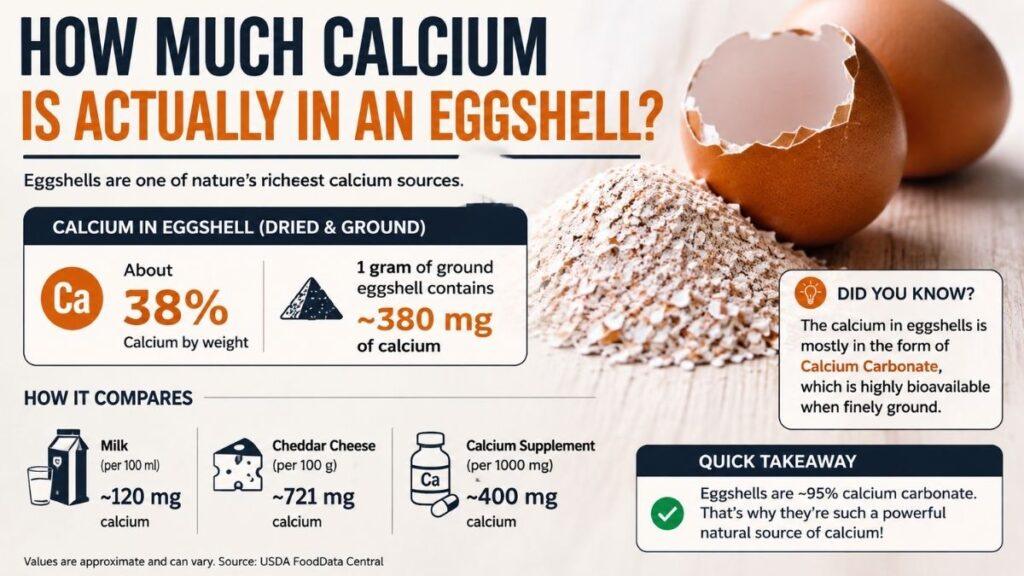
| Component | Approximate share of a dry eggshell |
| Calcium carbonate | About 95 percent |
| Phosphorus | About 0.3 percent |
| Magnesium | About 0.3 percent |
| Protein, fat, fiber | Negligible |
That is the whole nutritional case for eggshell. It is a mineral, not a multivitamin, and calcium does not act alone. AAFCO’s profiles require a calcium to phosphorus ratio between 1:1 and 2:1 in dog food, so adding calcium to a diet that is already balanced does not just add calcium. It shifts that ratio.
Do dogs actually need extra calcium?
Most dogs on commercial food do not. If a bag or can carries a nutritional adequacy statement saying the food is complete and balanced, calcium is already accounted for. The FDA explains that a pet food can only make that claim if it meets one of AAFCO’s nutrient profiles or passes an AAFCO feeding trial, and that those profiles set minimums for every listed nutrient plus maximums for some, with separate profiles for growth and reproduction and for adult maintenance.
The nutritional adequacy statement is the line worth reading on the label. If it is there, adding eggshell is not filling a gap.
Home prepared diets are the real exception, and the gap there is well documented. In a 2013 study published in the Journal of the American Veterinary Medical Association, researchers at UC Davis analyzed 200 home prepared dog food recipes from 34 sources, including veterinary textbooks, pet care books, and websites. Ninety five percent produced food lacking adequate levels of at least one essential nutrient, and more than 83 percent had multiple deficiencies. Only nine recipes met AAFCO minimums for adult dogs, and only five met the National Research Council’s minimum requirements. All five were written by veterinarians. Calcium was among the nutrients most often short.
So the honest version is narrow. A dog on kibble almost certainly needs no eggshell. A dog on a recipe someone found online may well need calcium, but the amount is a formulation question, not a sprinkle.
What are the risks of feeding eggshells to dogs?
Three risks, and none of them come from calcium being harmful in itself. They come from the wrong form or the wrong amount: sharp fragments, bacteria on raw shell, and too much calcium landing on a diet that was already adequate.
Whole and coarsely crushed shells are the version to avoid outright. The edges left after an egg is cracked can scrape the inside of the mouth or throat and can lodge on the way down. A dog that grabs one shell off the counter is usually fine, but deliberately feeding shells in that state is not.
Raw shell brings a separate issue. The FDA notes that fresh eggs, even ones with clean and uncracked shells, may carry Salmonella, which is why cartons of untreated shell eggs are required to carry safe handling instructions. Baking or boiling shells before grinding lowers that risk, and PetMD recommends exactly that step for eggs that have not been pasteurized. It is worth being clear about the limits, though: home baking is not a validated kill step the way commercial pasteurization is, and no oven temperature guide for eggshells has been through that kind of testing. Clean hands, clean grinder, and prompt storage still matter afterward.
Can too much calcium harm a dog?
Yes, and growing large and giant breed puppies are the group at real risk. The Merck Veterinary Manual states that excess calcium is more problematic for large and giant breed dogs during growth, from weaning to one year, and that supplementation above 3 percent calcium on a dry matter basis produces more severe signs of osteochondrosis and reduced skeletal remodeling than diets in the 1 to 3 percent range. Merck also notes that lameness, pain, and reduced mobility from high calcium intake have not been reported in small breed or slower growing dogs.
Regulators took the same concern seriously. AAFCO’s expert panel lowered the maximum calcium concentration for foods that may be fed to large size puppies, those expected to reach 70 pounds or more as lean adults, to 1.8 percent on a dry matter basis, while other life stages kept the 2.5 percent maximum. Excess calcium also interferes with other minerals: Merck notes that heavy calcium or phosphorus supplementation forms insoluble complexes in the intestine that can reduce magnesium absorption.
Adult dogs and smaller breeds have a wider margin. Wider is not unlimited, and there is no upside to pushing against it when the diet is already adequate.
How to prepare eggshells for dogs safely
If a veterinarian has confirmed a dog needs supplemental calcium and eggshell is the chosen source, the preparation is straightforward. Skipping any step brings back either the fragment risk or the contamination risk.
- Rinse the shells thoroughly to remove leftover white and any surface soil.
- Heat treat them by baking or boiling before grinding, as PetMD advises for eggs that were not pasteurized.
- Dry them completely, since damp shell clumps in the grinder instead of powdering.
- Grind to a genuinely fine powder in a spice or coffee grinder. If you can see or feel shell fragments, keep going.
- Store the powder in an airtight container somewhere cool and dry, and make small batches rather than large ones.
- Introduce it gradually at the amount your vet specified, and watch for digestive upset in the first few days.
How much eggshell powder can a dog have?
There is no safe amount that applies to every dog, and any article giving you a teaspoons per pound figure is guessing. The right amount depends entirely on how much calcium is already in the diet, the dog’s size, and its life stage. Since a whole shell is around 2.2 grams of calcium and a level teaspoon of powder is a meaningful fraction of that, small errors in measurement are not small errors in dose.
For a dog on a complete commercial food, the usable answer is almost always zero. For a home prepared diet that is genuinely short on calcium, the amount should come from a veterinarian or a board certified veterinary nutritionist working from the full recipe, because the calcium figure only means something alongside the phosphorus figure and the calorie content of the food.
Which dogs should avoid eggshells?
Four groups, and between them they cover most dogs:
- Dogs on a complete and balanced commercial food, who are already at or above their calcium requirement.
- Growing puppies, especially large and giant breeds, for the skeletal reasons above. Large breed puppy foods are formulated for controlled growth, and adding calcium works against that formulation rather than with it.
- Pregnant and nursing dogs, whose calcium and phosphorus needs shift and are covered by growth and reproduction profiles.
- Dogs on therapeutic or prescription diets, where the mineral content was chosen deliberately for a medical reason.
Dogs with a known egg allergy should skip eggshell too, though egg allergy in dogs is uncommon.
What about eggshell membrane supplements?
Eggshell membrane is the thin layer between the shell and the egg white, and it is a separate product from ground shell with a separate evidence base. It is sold for joint support rather than calcium, and it should not be confused with the calcium carbonate discussed above.
The most cited canine trial is a six week, randomized, double blind, placebo controlled study of a branded eggshell membrane product in 51 dogs with reduced joint function, published in Veterinary Medicine: Research and Reports in 2016. The results are more mixed than the headline suggests. Owner rated joint function and pain improved significantly against placebo at one week but not at six weeks, quality of life improved significantly at six weeks, and veterinarian rated pain improved significantly at six weeks while mobility and lameness scores did not reach significance. Two authors were employed by the supplement’s manufacturer and a third was a paid consultant.
That is worth knowing before treating membrane supplements as settled. It is a promising single trial with an industry sponsor, not a reason to start grinding shells for a dog with arthritis. Home ground eggshell is also not the same material as a processed membrane extract dosed by body weight.
Eggshell powder compared with other calcium sources
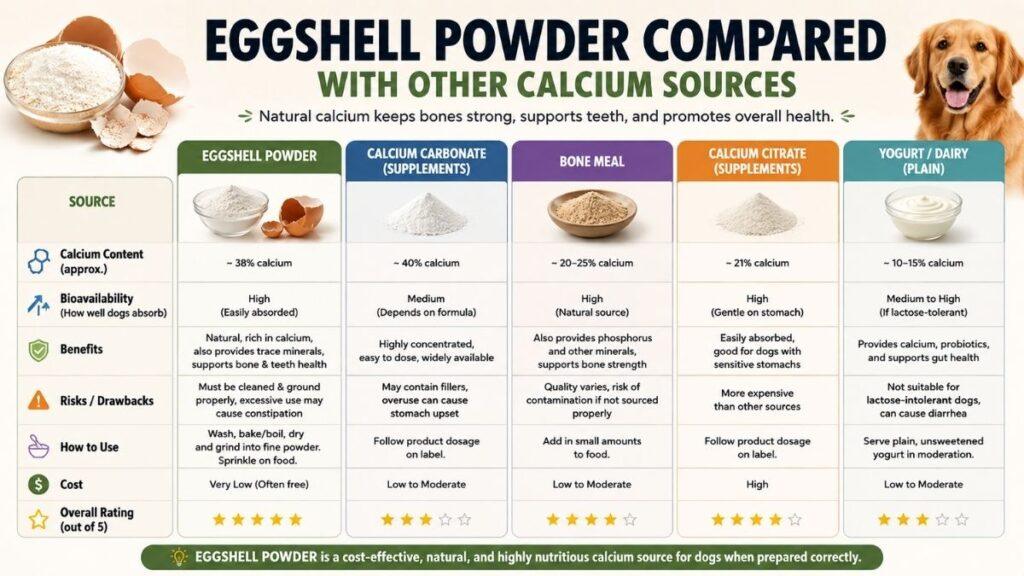
| Option | Main advantage | Main limitation |
| Complete and balanced commercial food | Calcium already formulated to AAFCO profiles | Must match the dog’s life stage |
| Veterinary recommended calcium supplement | Measured, predictable dosing | Requires a vet consultation |
| Home prepared eggshell powder | Cheap and readily available | Easy to over or under dose without a formulation |
| Whole or crushed shell | None | Sharp fragments and contamination risk |
What to do if your dog ate an eggshell
A dog that swallows one shell by accident usually needs monitoring rather than intervention. A dog that got into a carton is a different situation.
- Note roughly how much was eaten and whether it was raw or cooked.
- Watch for vomiting, lethargy, reduced appetite, or straining over the next 24 hours.
- Do not offer more shell afterward.
- Call your veterinarian if anything looks wrong or the amount was significant.
Call a vet promptly for persistent vomiting, straining or apparent pain when passing stool, trouble swallowing or breathing, blood in vomit or stool, or unusual lethargy. Any of those can point to an obstruction or an injury that needs looking at rather than watching. The same applies to a dog that swallowed large jagged pieces or already has a digestive condition.
Can dogs eat eggs themselves?
Yes, when the eggs are fully cooked and served plain. Scrambled, boiled, or poached with no oil, butter, salt, or seasoning is the standard advice, and the AKC’s position is that eggs work as an occasional snack rather than a daily staple, since they are calorie dense enough to unbalance a diet that was already complete.
Raw eggs are a different matter. Beyond the Salmonella risk, raw egg white contains avidin, which binds biotin and can interfere with its absorption. Biotin deficiency from eggs is rare in dogs, but it is one more reason cooking is the default recommendation.
Frequently asked questions
Can dogs eat eggshells safely?
Only when the shells have been washed, heat treated, and ground to a fine powder. In that form the sharp edge risk is largely gone and the bacterial risk is reduced. Whole and raw shells carry both risks and offer nothing a properly formulated diet does not already provide.
Can dogs eat raw eggshells?
No. The FDA notes that even clean, uncracked eggs can carry Salmonella, and raw shell has not been reduced to the safer powdered form. If your dog swallows a piece of raw shell, monitor for vomiting or lethargy and call your vet if anything seems off.
How much calcium is in one eggshell?
About 2.2 grams, according to University of Florida IFAS Extension figures for shells from commercial laying hens. That is more calcium than a 30 pound dog needs in a day, which is why eggshell is measured rather than sprinkled.
Can puppies eat eggshell powder?
Not without veterinary direction, particularly for large and giant breeds. The Merck Veterinary Manual links excess calcium during the weaning to one year window in these breeds to osteochondrosis and reduced skeletal remodeling, and large breed puppy foods are already formulated to keep calcium inside a narrow range.
Is there a safe daily amount of eggshell powder?
Not one that applies universally. The right figure depends on the dog’s existing diet, size, and life stage, and it has to be calculated alongside phosphorus and calorie intake. A veterinarian or veterinary nutritionist can work it out from the full recipe.
Is eggshell powder better than a commercial calcium supplement?
Not necessarily. A veterinary supplement gives predictable dosing and a stated calcium content per unit. Eggshell powder is cheaper and easy to make at home, but the calcium content of any given batch varies with shell size and how finely you ground it.
The bottom line
Eggshells are not dangerous to dogs by nature. The way most people encounter them, whole and raw and straight from the counter, is simply the wrong way to feed them, and the sharp edges are a real injury risk rather than a theoretical one. Cleaned, cooked, and finely ground, eggshell becomes a legitimate calcium source and a surprisingly concentrated one at roughly 2.2 grams of calcium per shell.
The problem is that concentration cuts against most of the reasons owners reach for it. A dog eating a food labelled complete and balanced is already covered, and adding calcium on top shifts the calcium to phosphorus ratio the formulation was built around. The genuine use case is narrow: a home prepared diet that a veterinarian has confirmed is short on calcium, with a dose calculated from the actual recipe. If that is not your dog, the shells belong in the compost. Check the nutritional adequacy statement on the bag first, then ask your vet before adding anything.