

Can dogs have Greek yogurt? Quick answer: Yes, provided it is plain and unsweetened. A teaspoon suits a small dog, two tablespoons a large one, three or four times a week. The label must read milk and live cultures and nothing else. Dogs with pancreatitis, dairy allergies, diabetes, or a prescription diet should skip it.
Ask ten pet blogs whether dogs can have Greek yogurt and you get either a superfood pitch or a xylitol panic. Neither helps much when you are standing in the kitchen with a tub in one hand and a dog staring at you.
So here are the numbers instead. Lactose per spoonful, the xylitol threshold for your dog’s weight, which labels pass, and which health claims fall apart on inspection.
Can dogs have Greek yogurt safely?
Short answer: Dogs can have Greek yogurt safely when it is plain and the portion is small. It stops being safe once it is sweetened, flavored, high in fat, or fed to a dog with a dairy or pancreatic problem.
Three things have to be true at once. The product is plain. The portion fits your dog’s treat calorie budget. And your dog’s gut tolerates dairy, which is not a given.
Worth saying up front: no dog needs this. A complete commercial food already covers protein and calcium. Greek yogurt is a delivery vehicle for pills, a bribe for picky eaters, and something to smear on a lick mat when you need ten quiet minutes.
Why Greek yogurt suits dogs better than regular yogurt
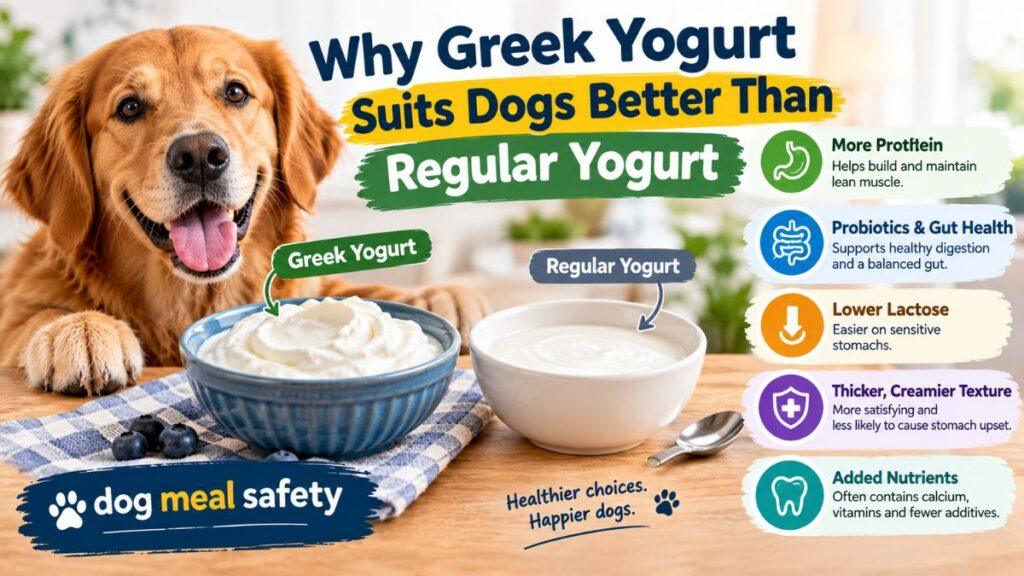
Short answer: Straining pulls out the whey, and the whey carries most of the lactose. Greek yogurt holds roughly 3 to 4 grams of lactose per 100 grams against 4 to 6 grams in regular yogurt, with about double the protein.
Dogs mostly stop making lactase once they are weaned. That is why a bowl of milk ends badly while a spoon of Greek yogurt usually does not.
Two steps strip the lactose out first. The starter bacteria eat some of it during fermentation and turn it into lactic acid, then straining removes a big share of what is left, around 71 percent by one measure of strained yogurt production.
The number that matters: one tablespoon of plain Greek yogurt carries roughly half a gram of lactose. Most dogs will not notice it.
How much Greek yogurt can dogs have?
Short answer: Start at 1 teaspoon for dogs under 10 lb, 1 tablespoon for a 40 lb dog, and 2 tablespoons for a large dog, three or four times a week. All treats together should stay under 10 percent of daily calories.
Plain nonfat Greek yogurt runs about 9 calories per tablespoon. Whole milk is closer to 15.
| Dog weight | Daily calories (approx) | 10% treat budget | Serving |
| Under 10 lb | 200 to 275 | 20 to 27 cal | 1 teaspoon |
| 10 to 25 lb | 300 to 450 | 30 to 45 cal | 1 to 2 teaspoons |
| 25 to 50 lb | 500 to 750 | 50 to 75 cal | 1 tablespoon |
| 50 to 90 lb | 800 to 1,100 | 80 to 110 cal | 1 to 2 tablespoons |
| Over 90 lb | 1,100 plus | 110 plus | 2 to 3 tablespoons |
Two worked examples, because percentages are easy to misjudge with a spoon in your hand.
A 22 lb Beagle needs roughly 400 calories a day, so the treat allowance is about 40. One tablespoon of nonfat Greek yogurt costs 9 of those and leaves 31 for the dental chew and training rewards. Switch to whole milk yogurt and the same spoonful costs 15, which on a Beagle adds up faster than most owners expect.
A 70 lb Labrador gets closer to 1,000 calories and a 100 calorie budget. Two tablespoons is 18 calories, no problem. The error with big dogs is eyeballing it and tipping out a quarter cup, which is four tablespoons and 36 calories before anything else goes in the bowl.
Can dogs have Greek yogurt every day?
Short answer: Better not. Three or four days a week keeps it a treat rather than a habit that displaces balanced food.
Daily feeding creates two quiet problems. Calories stack up, especially in small breeds where 20 calories is a real share of dinner. And dogs get expectant fast, so the spoonful that began as a pill trick ends with a dog refusing plain kibble.
The probiotic argument is the usual reason owners go daily, and it does not hold up. More on that below.
Which Greek yogurt brands pass the label test
Short answer: Any plain Greek yogurt whose ingredients are milk and live active cultures. Fage Total Plain, Chobani Plain, Stonyfield Organic Plain, and most supermarket own brands all qualify.
Shop by label, not brand name. Formulas change, and last year’s safe tub gets a sweetened sibling in near identical packaging.
Here is what passing looks like. Fage Total Nonfat lists Grade A pasteurized skimmed milk plus live active cultures, printed on the tub as L. Bulgaricus, S. Thermophilus, L. Acidophilus, Bifidus, and L. Casei. Milk and bacteria. Nothing else. Chobani Plain Non-Fat is built the same way, with 14 grams of protein in a 5.3 oz cup and no added sugar. Feeding a big dog regularly, a store brand like Great Value Plain Nonfat Greek in the 32 oz tub does the identical job at roughly a third of the price per ounce.
Failing looks like this. A standard strawberry fruit yogurt cup carries around 18 grams of added sugar plus natural flavors and potassium sorbate. None of it toxic. Just dessert, and no framing turns dessert into a health treat.
Leave these on the shelf:
- Light, diet, zero sugar, or no sugar added tubs
- Any flavored variety, vanilla and honey included
- High protein or keto yogurt drinks and pouches
- Anything with fruit pieces, granola, or chocolate
- Any sweetener you do not recognise
If your dog wants strawberry yogurt, mash a real strawberry into the plain stuff. Same flavour, none of the sugar.
Xylitol in yogurt: the risk in real numbers
Short answer: Xylitol is the one genuinely life threatening ingredient. Around 0.1 grams per kilogram of body weight can cause dangerous hypoglycemia, and around 0.5 grams per kilogram risks liver failure. Plain mainstream Greek yogurt does not contain it, but check the label anyway.
Xylitol triggers a rapid insulin release in dogs that does not happen in people. Blood sugar can crash inside 30 to 60 minutes, and at higher doses liver damage appears 12 to 48 hours later.
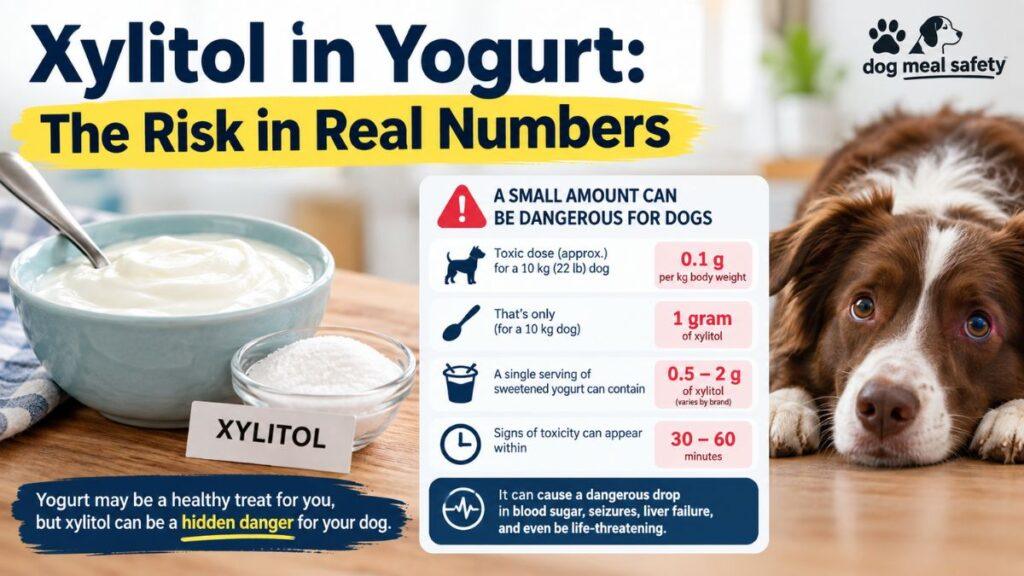
Put that in objects you can picture. A 10 kilogram dog, that 22 lb Beagle again, hits the hypoglycemia threshold at roughly 1 gram of xylitol. A single stick of sugar free gum holds between 0.3 and 1 gram. One piece off the coffee table is a genuine emergency. A tub of plain Fage contains zero. The danger is real and it is not in the plain yogurt aisle.
On labels it also goes by birch sugar, wood sugar, and E967. It appears in sugar free and keto products far more than anywhere else, which is the practical reason to skip light and diet yogurt lines even when one happens to be clean.
One thing most articles leave out: the big US yogurt makers do not use xylitol in their standard ranges, and Yoplait states publicly that none of its yogurt contains any. Some light products use sucralose or aspartame instead. Not toxic the way xylitol is, though still capable of causing gas and diarrhea. A no, not an emergency.
Act on vomiting, sudden weakness, a wobbly walk, tremors, collapse, or seizures. In the US, call the ASPCA Animal Poison Control Center on 888-426-4435 or the Pet Poison Helpline on 855-764-7661, and call before symptoms start rather than after.
Full fat or nonfat Greek yogurt for dogs?
Short answer: Buy nonfat or low fat plain. Whole milk versions carry nearly double the calories and add fat that matters for pancreatitis prone dogs.
This risk gets almost no coverage and it puts far more dogs in the clinic than xylitol does. A sudden hit of fatty food can set off pancreatitis, and Miniature Schnauzers, Yorkshire Terriers, and Cocker Spaniels start from a higher baseline. One previous episode is reason enough to leave dairy fat alone.
For an overweight dog the calorie gap settles it. Two tablespoons of whole milk Greek yogurt is 30 calories, a meaningful slice of a small dog’s day.
Do the probiotics in Greek yogurt actually help dogs?
Short answer: Not reliably. The live cultures are human origin strains in modest numbers, and a spoonful falls well short of a therapeutic dose for a dog.
This is the weakest claim in the category and it props up most of the marketing. Cornell’s canine health center puts the general recommendation for dogs at 1 to 10 billion colony forming units a day, and names FortiFlora and Proviable as products with published efficacy studies behind them. Supermarket yogurt is not a substitute for either. The American Kennel Club lands in the same place: dogs can get some probiotic benefit from yogurt, but better sources exist.
Then there is colonisation. Yogurt strains are largely transient in the canine gut, meaning they pass through rather than settle. So if your dog has chronic soft stool, is coming off antibiotics, or has a diagnosed gut condition, ask your vet about a canine formulated probiotic instead. Feed the yogurt because your dog likes it. That reason is good enough on its own.
Greek yogurt will not fix diarrhea, itching, or yeast
Short answer: No evidence supports feeding yogurt to clear a yeast infection or itchy skin, and during active diarrhea dairy usually makes things worse.
The yogurt for yeast idea migrated over from human home remedy forums and nobody checked it. Ear and skin yeast in dogs is normally Malassezia overgrowth, which needs a diagnosis and a topical or systemic treatment. Never put yogurt in a dog’s ear, which people genuinely do.
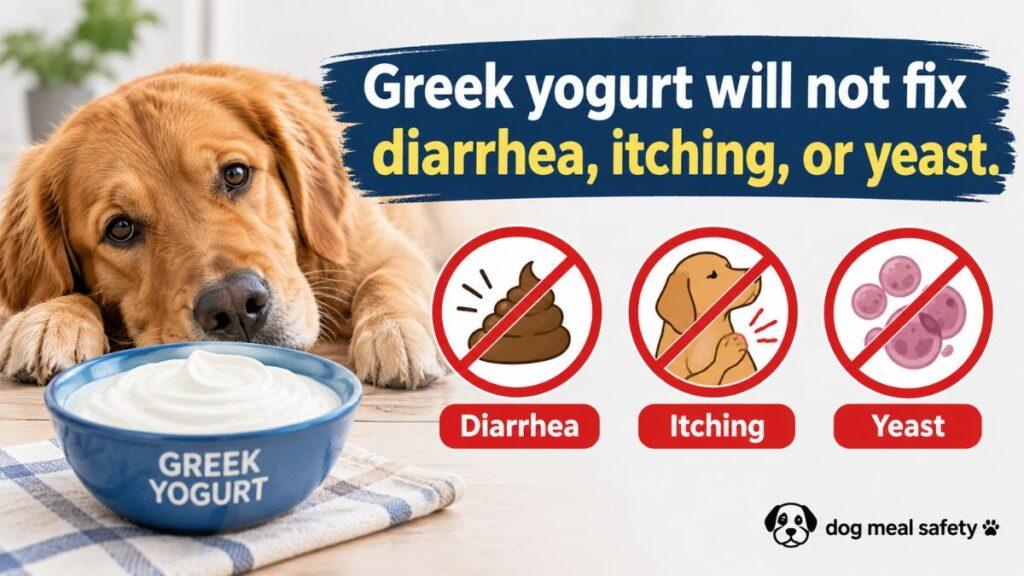
With acute diarrhea, adding dairy to an irritated gut is the wrong instinct. A bland diet and a call to the vet is the right one, particularly past 24 hours or if there is blood.
Where yogurt earns its keep is smaller. It hides tablets from dogs who spit them out, gets picky eaters started on kibble, slows down a dog who inhales food, and freezes into something that occupies a bored one.
Which dogs cannot have Greek yogurt at all
Short answer: Dogs with pancreatitis history, dairy allergy, IBD, diabetes, or any veterinary prescription diet should not have it at all.
Run through this before the first spoonful:
- Pancreatitis history. Avoid dairy fat unless your vet clears it.
- Confirmed dairy allergy. An allergy is an immune reaction, not lactose intolerance. A teaspoon can set off itching or GI signs.
- IBD or chronic GI disease. New foods muddy an already managed gut.
- Diabetic dogs. Even plain yogurt contains milk sugars that disturb a balanced plan.
- Prescription diets. Kidney, liver, and hypoallergenic diets only work when nothing else enters the bowl.
- Overweight dogs. A green bean does the same job for free.
- Puppies under 8 weeks. Milk replacer or puppy food only.
Older puppies can have a lick of plain Greek yogurt once they are eating solid food comfortably. Keep it to a quarter teaspoon, since a growth diet is easy to unbalance.
How to introduce Greek yogurt and spot a bad reaction
Short answer: Give a quarter of the normal portion on day one, then wait 24 hours. Gas, bloating, loose stool, or vomiting within 2 to 12 hours means stop.
Run the trial on a day when nothing else is new in the diet, otherwise you will not know what caused what. Most lactose related upset shows within a few hours and clears by the next day.
Mild reaction, drop it and let the gut settle. If it repeats on a second try, your dog is one of the many that does not do dairy. Vomiting that will not stop, lethargy, or a tender abdomen is a vet visit, not a wait and see.
Greek yogurt compared with the alternatives
Short answer: Kefir carries more varied cultures, plain cottage cheese has more protein but much more sodium, and a canine probiotic beats all of them if gut health is the real goal.
| Option | Lactose | Best use | Watch for |
| Plain Greek yogurt | Low, 3 to 4 g per 100 g | Lick mats, pills, kibble topper | Fat in whole milk versions |
| Plain regular yogurt | 4 to 6 g per 100 g | Same, thinner texture | More lactose per spoon |
| Plain kefir | Low | Wider range of cultures | Many dogs refuse the taste |
| Plain cottage cheese | Low | High protein topper | Sodium |
| Canine probiotic | None | Actual gut support | Cost, needs vet input |
Three ways to serve it
Short answer: Thin on a lick mat, frozen into cubes with dog safe fruit, or a quarter teaspoon wrapped around a tablet.
The lick mat is the one owners underuse. One tablespoon across a standard silicone mat takes a medium dog eight to ten minutes, long enough to cover a nail trim. The same tablespoon off a spoon lasts four seconds and costs the identical 9 calories.
For frozen cubes, stir two tablespoons of plain nonfat Greek yogurt with four or five blueberries, spoon into a silicone ice cube tray, and freeze for three hours. One cube suits a medium dog.
For pills, check the medication can go with dairy. Some antibiotics bind to calcium and lose potency, so ask your vet first.
Frequently asked questions
Can dogs have Greek yogurt every day?
Three or four days a week is better, so it does not crowd out balanced food.
Can dogs eat vanilla Greek yogurt?
No, vanilla varieties carry added sugar and flavourings your dog has no use for.
Is Chobani plain Greek yogurt safe for dogs?
Yes, the plain version lists only milk and live cultures. Check the label each time you buy.
Can puppies have Greek yogurt?
A quarter teaspoon is fine once a puppy is eating solid food well.
My dog ate a whole tub of plain Greek yogurt?
Expect gas and loose stool, hold back other treats, keep water available, and call your vet if vomiting continues past a few hours.
Can dogs have Greek yogurt with honey?
No, honey adds sugar with no benefit for a dog.
Can dogs have Greek yogurt when they have diarrhea?
No, dairy tends to worsen an already irritated gut.
Does Greek yogurt help a dog’s bad breath?
No, dental disease causes most bad breath and that needs an exam.
Can dogs have frozen yogurt from a shop?
No, it is sweetened and sometimes contains sugar substitutes.
The bottom line
So, can dogs have Greek yogurt? Yes, and it is handy to keep in the fridge if your dog fights tablets or eats too fast. Less lactose than regular yogurt, decent protein and calcium, and most dogs would trade a limb for it.
What it is not is a probiotic supplement, a diarrhea remedy, or a fix for itchy skin. Buy it for those reasons and you pay for a benefit that never arrives.
The rules stay simple. Milk and live cultures on the label, nonfat or low fat, a teaspoon up to two tablespoons by size, three or four days a week. Nothing for dogs with pancreatitis history, dairy allergies, diabetes, or a prescription diet. Start at a quarter portion and watch for a day.
2 thoughts on “Can Dogs Have Greek Yogurt? 7 Proven Rules for Safe Treats”