

Can dogs eat pizza? No. Dogs should not eat pizza, and the reason is not one dramatic poison. It is that pizza stacks four things a dog’s body handles badly into one small package: a heavy fat load, a heavy salt load, dairy, and allium seasoning hidden in the sauce and the crust.
Pizza is not acutely poisonous the way chocolate or xylitol is, and one stolen slice will not kill a healthy medium sized dog. But two situations need a phone call now rather than reading: raw, uncooked pizza dough, and blue cheese. Both are genuine emergencies and both are explained below. If your dog ate an ordinary cooked slice and seems well, skip to the first 48 hours section.
Quick answer: Can dogs eat pizza safely? No. A single cooked slice is unlikely to seriously harm a healthy adult dog, but it carries no nutritional benefit, and raw dough, blue cheese and concentrated garlic all make it genuinely dangerous. The honest version is not a flat yes or no. It is how much, on what size dog, and what was actually on the slice.
What one slice actually does to your dog’s day
People usually ask whether dogs can eat pizza before asking what is in it. Most articles say pizza is high in fat and salt and stop there. Here is what that means in numbers.
A standard slice of 14 inch cheese pizza, one eighth of the pie, carries roughly 272 calories, 9.8 g of fat and 551 mg of sodium. A pepperoni slice pushes sodium closer to 728 mg.
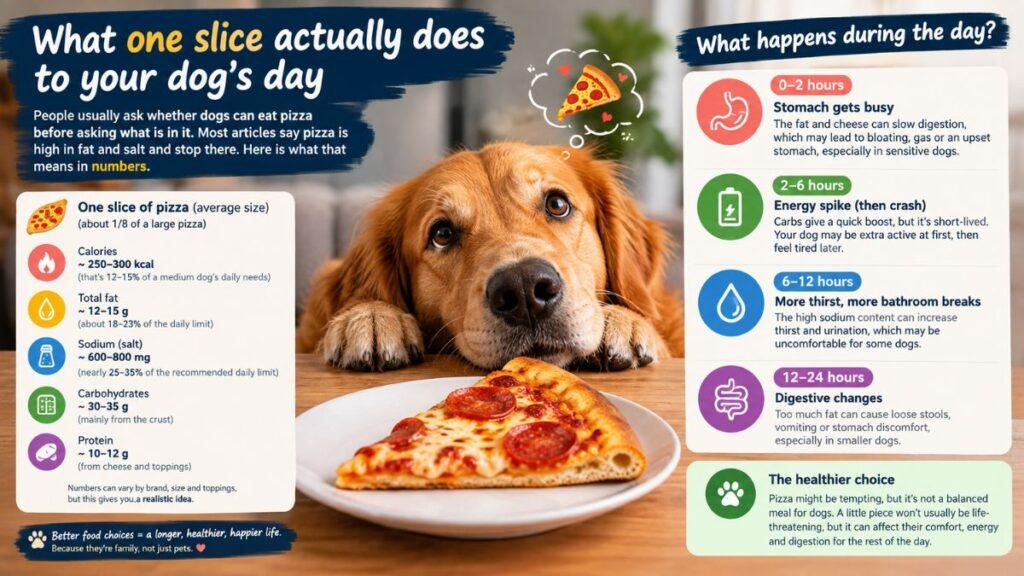
Now put that against your dog. Vets estimate daily calories from the resting energy requirement, 70 multiplied by body weight in kilograms to the power of 0.75, then multiplied by about 1.6 for a neutered adult. Treats should stay under 10 percent of that total.
| Dog weight | Estimated daily calories | 10% treat budget | One cheese slice as share of daily calories |
| 5 kg (11 lb) | about 375 kcal | about 37 kcal | about 73% |
| 10 kg (22 lb) | about 630 kcal | about 63 kcal | about 43% |
| 20 kg (44 lb) | about 1,060 kcal | about 106 kcal | about 26% |
| 30 kg (66 lb) | about 1,435 kcal | about 144 kcal | about 19% |
This table is the clearest reason dogs cannot eat pizza as a regular treat. A slice is most of a small dog’s daily food delivered in twenty seconds, with almost none of the nutritional balance a complete diet is built around. That is the real everyday harm, and it will hurt more dogs over a year than any single toxic ingredient.
The salt question, answered honestly
When people ask can dogs eat pizza, salt is usually the first worry raised. It gets the most dramatic coverage and deserves the least panic.
Sodium poisoning is real, but it takes a genuinely large dose. General veterinary guidance does not expect poisoning until roughly 4,000 mg of salt per kilogram of body weight, and the classic cases involve play dough, rock salt or a bag of pretzels eaten without water. A 10 kg dog would need twenty five to thirty slices to get near that.
So one slice will not cause salt toxicity in a healthy dog with a water bowl nearby. Expect thirst and extra urination, keep water available, and do not restrict it.
Salt does matter in dogs on a sodium restricted diet for heart or kidney disease, because a single 551 mg hit can outstrip a whole day’s allowance several times over. If your dog is on a prescription cardiac or renal food, that is worth telling your vet about.
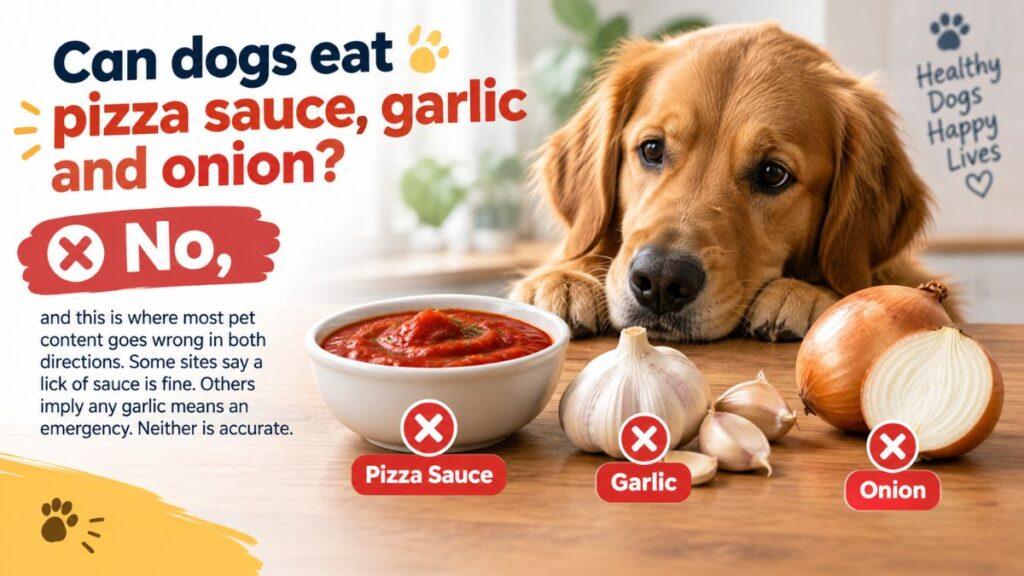
Can dogs eat pizza sauce, garlic and onion?
No, and this is where most pet content goes wrong in both directions. Some sites say a lick of sauce is fine. Others imply any garlic means an emergency. Neither is accurate.
Onions, garlic, chives, leeks and shallots all belong to the Allium family and contain sulfur compounds that oxidise haemoglobin, damaging red blood cells and potentially causing haemolytic anaemia. The Merck Veterinary Manual reports clinical signs in dogs after 15 to 30 g/kg of raw onion. Many toxicologists use a more conservative alarm point of about 0.5 percent of body weight, roughly 5 g/kg. Garlic runs three to five times more potent by weight, so its threshold sits far lower. If you want the full breakdown, see our guides on onions and dogs and garlic and dogs.
Run the numbers on an actual pizza. A whole large pie might carry ten to twenty grams of onion spread across eight slices, so a single slice holds maybe two grams. For a 20 kg dog, the conservative concern point is around 100 grams. A slice is nowhere near that.
Three things change the picture, and this is what deserves your attention.
Concentrated forms are the danger. Onion and garlic powder are dehydrated, so a teaspoon carries the equivalent of a great deal of fresh bulb. Commercial sauce, seasoned crust, garlic butter on the edge and garlic dipping sauce are all concentrated allium sources you cannot see. A dog that licks out a tub of garlic dip has taken a very different dose from one that ate a plain cheese slice.
Body weight changes everything. The thresholds are per kilogram, so what is trivial for a Labrador is not trivial for a 3 kg Chihuahua.
Repeated exposure accumulates. Red cell damage from several small doses over a few days stacks, so a dog that gets crusts every Friday night is a different case from a one time raid. Akitas and Shiba Inus also carry an inherited red cell trait that makes them more vulnerable, so any known allium exposure in these breeds is worth a vet call regardless of the arithmetic.
The tomato base is the least of your worries. Ripe tomato is fine for dogs. It is everything mixed into it that is not.
Can dogs eat pizza with cheese on it?
Plain mozzarella is one of the least alarming things on a pizza. It is relatively low in fat and sodium compared with aged cheeses, and it is not toxic.
The problems are volume and lactose. Adult dogs produce very little lactase, so dairy tends to cause gas, loose stool or vomiting. The melted cheese on a full slice is far more than most dogs handle, which is why the usual outcome of a stolen slice is a bad night rather than a hospital visit. Our guide to how much cheese a dog can safely have covers the safer options.
Blue cheese is a separate category and the one real ingredient emergency on a pizza menu. Gorgonzola, Roquefort and Stilton are ripened with Penicillium moulds that can produce tremorgenic mycotoxins, including roquefortine C and penitrem A. These hit the nervous system, and signs can appear within about fifteen minutes: vomiting, restlessness, raised temperature, muscle tremors, incoordination and in serious cases seizures.
If your dog ate a blue cheese pizza, call your vet or a poison line immediately. Do not wait to see what happens.
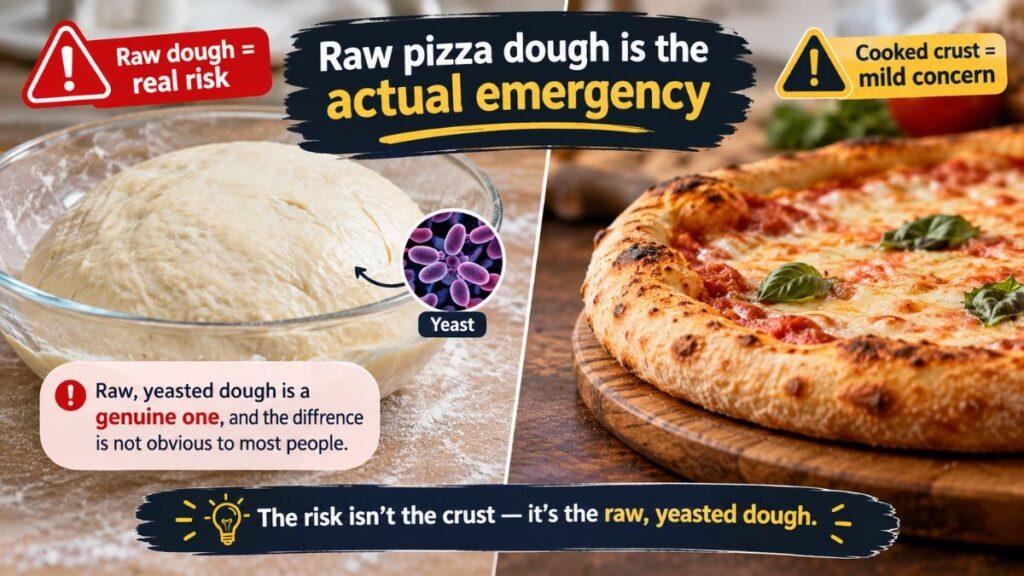
Raw pizza dough is the actual emergency
Cooked crust is a mild concern. Raw, yeasted dough is a genuine one, and the difference is not obvious to most people.
A dog’s stomach is a warm, moist, low oxygen environment, which makes an excellent incubator. Yeast keeps fermenting after the dough is swallowed, producing carbon dioxide and ethanol. The dough expands, distending the stomach and compressing blood vessels, and in deep chested breeds this can trigger gastric dilatation and volvulus. The ethanol meanwhile is absorbed rapidly into the blood.
The Merck Veterinary Manual describes the early picture as unproductive retching, abdominal distension and lethargy, progressing to ataxia and disorientation, then to profound CNS depression, weakness, hypoglycaemia, coma or seizures. Death in these cases is usually driven by the ethanol rather than the distension. The ASPCA lists yeast dough among the people foods to keep away from pets for this reason.
Ethanol effects can begin within thirty to sixty minutes but are often delayed two hours or more, which is exactly why owners misjudge it. Your dog looking fine at ninety minutes means nothing.
Go to a clinic. Do not induce vomiting at home in a dog that is already wobbly or drowsy, because the aspiration risk is high. Activated charcoal does not help here, since it does not bind ethanol.
Fully baked plain bread is a different question entirely and far less concerning.
Can dogs eat pizza crust?
The crust is the part most people hand over, so it deserves a direct answer: a small piece of plain, fully baked crust is unlikely to harm a healthy adult dog, but it is not a good treat and should not become a habit.
Three reasons. Crust is refined flour with no real nutritional value for a dog, so every bite spends calorie budget on nothing. Most crust is also not plain: takeaway crusts are often brushed with garlic butter, dusted with onion and garlic powder blends, or built with a sauce ring that reaches the edge. The garlic parmesan upgrades chains advertise are exactly the ones you should not share. And dogs learn fast, so a dog that gets crust on pizza night becomes a dog that counter surfs on pizza night.
If the habit already exists, substitution beats refusal. Keep plain cooked sweet potato or carrot next to the couch and hand that over at the same moment.
The hazard nobody writes about: the box
Can dogs eat pizza packaging? Obviously not, and yet when a dog steals pizza off a table it rarely eats only pizza.
The little white plastic tripod in the middle of the pie, called a pizza saver, is roughly the right size to lodge in a small dog’s gut. Toothpicks are worse, because they are sharp and can perforate. Cardboard, greaseproof paper, foil and plastic wrap pass through most dogs uneventfully but can obstruct a small one.
If your dog got into a whole box unsupervised, take two minutes to account for what is missing. Count toothpicks, look for the plastic saver, check whether cardboard has been chewed. Tell your vet what you cannot find, because a foreign body is a different conversation from a fatty meal and the signs overlap.
My dog ate pizza. What to do in the first 48 hours
For a healthy adult dog that ate a cooked slice or two with ordinary toppings, the standard veterinary approach is observation rather than intervention.
In the first two hours, remove any remaining food, leave fresh water down and do not induce vomiting unless a vet tells you to. Note the time, your dog’s weight, and as precisely as you can what was on the pizza and how much went in.
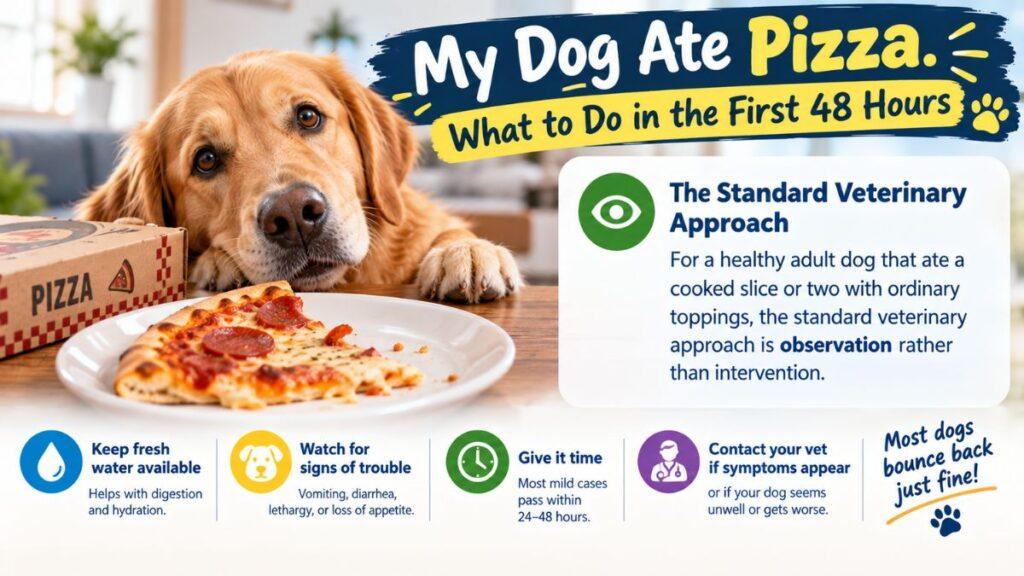
Vets answering this exact question commonly advise withholding the next meal, roughly twelve to sixteen hours of no food while water stays available, then resuming normal feeding if there is no vomiting. If the stomach stays unsettled, a short bland diet of boiled skinless chicken and plain white rice for a couple of days helps.
Through the first day, watch for vomiting, diarrhoea, drooling, restlessness and appetite loss. A mild single episode in an otherwise bright dog is usually just the digestive system complaining.
Call a vet immediately if you see repeated vomiting, a hunched or praying stretch position, a swollen or hard abdomen, unproductive retching, tremors, wobbliness, pale gums, laboured breathing, or a dog that has gone flat and unresponsive. The praying position and abdominal pain after a fatty meal point toward pancreatitis, which is painful, sometimes fatal, and needs treatment rather than monitoring.
Between days one and five, keep watching even if your dog seemed fine. This is when allium damage surfaces. Red cell destruction is delayed, so the tells arrive late: pale or yellow gums, weakness, exercise intolerance, rapid breathing, or urine that looks orange, red or brown. Discoloured urine after a suspected onion or garlic exposure is an emergency.
In the United States, the ASPCA Animal Poison Control Center is on 888-426-4435 and Pet Poison Helpline is on 855-764-7661. Both are staffed around the clock and both charge a consultation fee. Have your dog’s weight ready.
Dogs that should never get any pizza
For some dogs the question of whether can dogs eat pizza has no grey area at all. They sit outside the “probably fine” category entirely, and that matters more than the quantity.
Dogs with a history of pancreatitis, and breeds predisposed to it such as Miniature Schnauzers, should not have a fatty meal at all, because recurrence is common. Dogs on sodium restricted diets for heart or kidney disease lose the benefit of that diet with one slice. Diabetic dogs get a sudden uncontrolled carbohydrate and fat load. Overweight dogs cannot afford the calories. Puppies and seniors dehydrate faster when they get sick. And any dog with a dairy intolerance will have a miserable night.
If your dog is in one of these groups, treat pizza the way you treat chocolate: out of reach, not negotiated over.
Better things to give instead
If your dog cannot eat pizza, the next question is what they can have instead. A dog mostly wants to be included in whatever is happening, and almost anything works for that if it arrives at the right moment.
Plain cooked chicken, cubes of cooked sweet potato, carrot sticks, cucumber slices, a spoon of plain pumpkin puree or a few blueberries all do the job at a fraction of the calories. Whatever you use comes out of the 10 percent treat allowance rather than on top of it, so reduce dinner accordingly.
If you want the ritual, make a dog pizza instead of sharing yours. Press plain cooked mashed sweet potato into a thin round on parchment, top with shredded plain cooked chicken and finely chopped carrot, add a light scatter of plain mozzarella if your dog tolerates dairy, and bake at 180 C (350 F) until set. No salt, no sauce, no garlic, no onion, no seasoning at all.
Frequently asked questions
Can dogs eat pizza crust?
A small piece of plain baked crust is unlikely to harm a healthy adult dog, but seasoned or garlic buttered crust should be avoided entirely.
Can dogs eat pizza sauce?
Ripe tomato itself is fine, but commercial pizza sauce usually carries garlic, onion and added sugar, so it is best avoided.
Can dogs eat pizza cheese?
Plain mozzarella in tiny amounts is not toxic, but the quantity on a slice is far more dairy than most adult dogs can digest comfortably.
Can dogs eat pizza with pepperoni?
No, pepperoni adds roughly 40 to 50 calories plus a substantial amount of extra salt and fat per slice.
Can dogs eat pizza rolls or frozen pizza?
No, these are usually higher in sodium and processed fat than fresh pizza and offer nothing nutritionally.
Can dogs eat pizza once a week as a treat?
No, repeated small allium doses accumulate and the calories alone will push most dogs into weight gain.
Can puppies eat pizza?
No, puppies have less digestive reserve and dehydrate faster, so even small amounts are a poor idea.
Can dogs eat pizza bones, meaning the leftover crust ends?
They are the same refined flour and seasoning as the rest of the crust, so treat them the same way and keep portions tiny or skip them.
Can dogs eat pizza if it is homemade with no garlic or onion?
A plain homemade slice removes the allium risk but keeps the fat, salt and dairy, so it is still not a treat worth giving.
Is pizza toxic to dogs?
Pizza itself is not acutely toxic, but raw dough, blue cheese and concentrated garlic or onion within it can be.
My dog ate one slice and seems fine. Should I worry?
Usually not, but withhold the next meal, keep water available, and keep watching for five days if the pizza had onion or garlic.
How long after eating pizza would a dog get sick?
Digestive upset usually appears within 2 to 12 hours, pancreatitis within 12 to 48 hours, and allium related anaemia between 1 and 5 days.
So, can dogs eat pizza? The bottom line
Pizza is not a poison, and treating it as one helps nobody. It is an ordinary human food badly matched to canine physiology in four ways at once, and the risk scales almost entirely with your dog’s size and what was on top.
For most healthy adult dogs, one cooked slice means a rough night and nothing more. For a small dog, a dog with a pancreatitis history, or a dog on a prescription diet, the same slice is a real problem. For any dog that got into raw dough or blue cheese, it is an emergency and the clock matters.
So when someone asks whether dogs can eat pizza, the practical answer is no, and the habit is simple. Keep the box off the low table, skip the crust habit, and if something does get stolen, note the time and the toppings first. That is what your vet will ask for, and it is the difference between a useful phone call and a guess. For the wider picture, see our full list of human foods dogs should avoid.
This article is for general information and is not a substitute for veterinary advice. If you are worried about your dog, contact your veterinarian or a pet poison control line.