
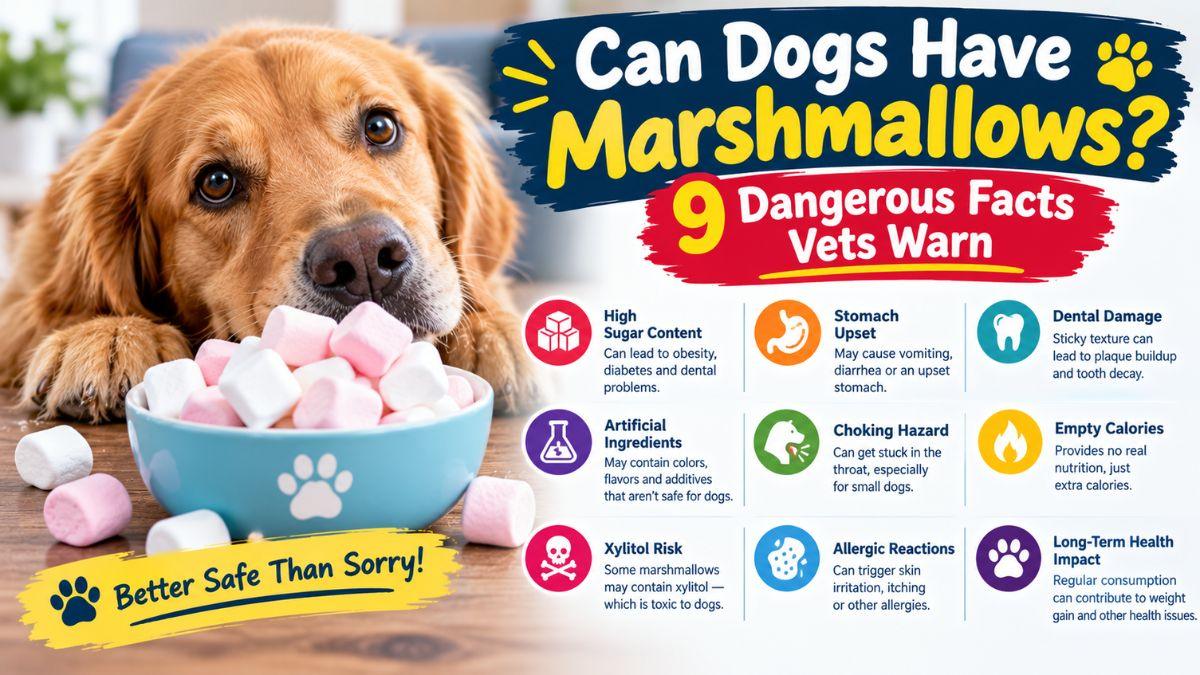
Can dogs have marshmallows? No. Dogs should not have marshmallows. A plain, xylitol free marshmallow or two will not usually poison a healthy dog, but marshmallows sweetened with xylitol are a genuine emergency that needs a vet the same hour. Before you do anything else, find the bag and read the ingredient list.
That single step decides everything that follows. Most articles asking whether dogs can have marshmallows tell you to check the label and then move on, without telling you what you are looking for, how much is dangerous, or how long you have. This one does.
What to do in the next ten minutes if your dog ate marshmallows
Pick up the packet and look for the words xylitol or birch sugar in the ingredients. Birch sugar is the same thing under a friendlier name, and plenty of owners scan a label, miss it, and assume they are in the clear.
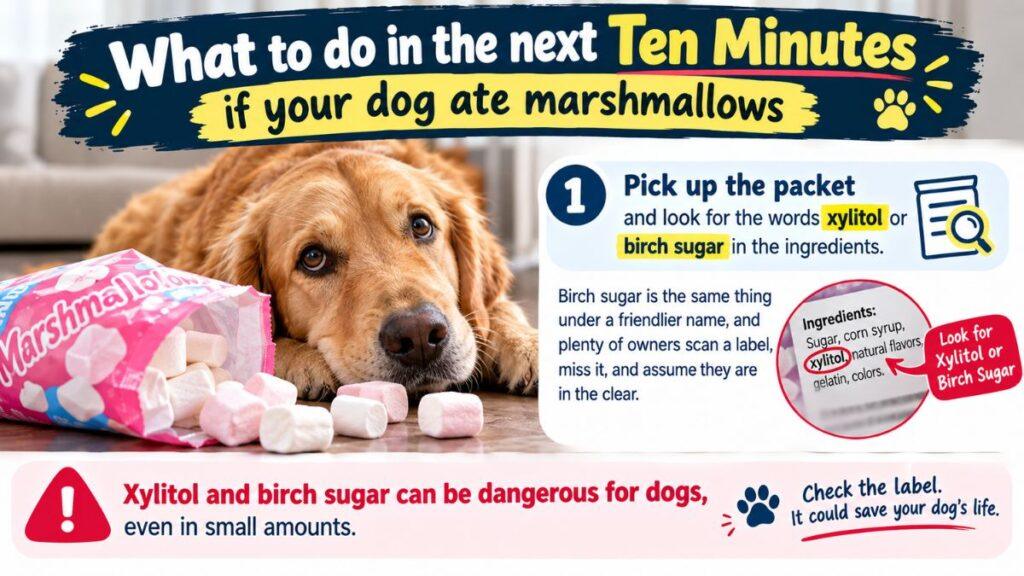
If xylitol or birch sugar appears anywhere on the list, call a vet or an animal poison line now, even if your dog looks completely normal. In the United States you can reach the ASPCA Animal Poison Control Center at (888) 426-4435 or the Pet Poison Helpline at (855) 764-7661. Both run 24 hours a day and both charge a consultation fee, roughly 85 to 95 dollars depending on the service. That fee is small next to an overnight hospital stay.
Do not try to make your dog vomit on your own. VCA Animal Hospitals warns that a dog who has already absorbed xylitol may be hypoglycaemic, and vomiting can make a low blood sugar crisis worse. Hydrogen peroxide also carries its own risks, including stomach ulceration and aspiration, so the current veterinary position is to ring first and act on instruction rather than guessing at home.
If the label shows only sugar, corn syrup, dextrose, cornstarch, water and gelatin, you are dealing with a sugar problem rather than a poisoning. Keep reading, but you can breathe.
Why xylitol decides whether dogs can have marshmallows
In humans, xylitol barely moves insulin at all. In dogs it does the opposite. Cornell University’s Riney Canine Health Center explains that xylitol triggers an insulin release three to seven times larger than the same amount of ordinary sugar would, and that this crashes blood glucose within about 30 to 60 minutes.
The Merck Veterinary Manual puts numbers on it. Doses above roughly 100 mg per kilogram of body weight are associated with hypoglycaemia. Doses above roughly 500 mg per kilogram can cause severe liver injury, sometimes without any low blood sugar episode first. A 2010 review in the Journal of Veterinary Emergency and Critical Care reports the same two thresholds.
Dogs are the only domestic species this happens to. Cats do not develop hypoglycaemia or liver damage from xylitol, which is why a cat eating the same marshmallow is a much smaller story.
How much xylitol is too much, by dog weight
Here is what those thresholds look like in real dogs. The figures are the total amount of xylitol, not the weight of the marshmallow.
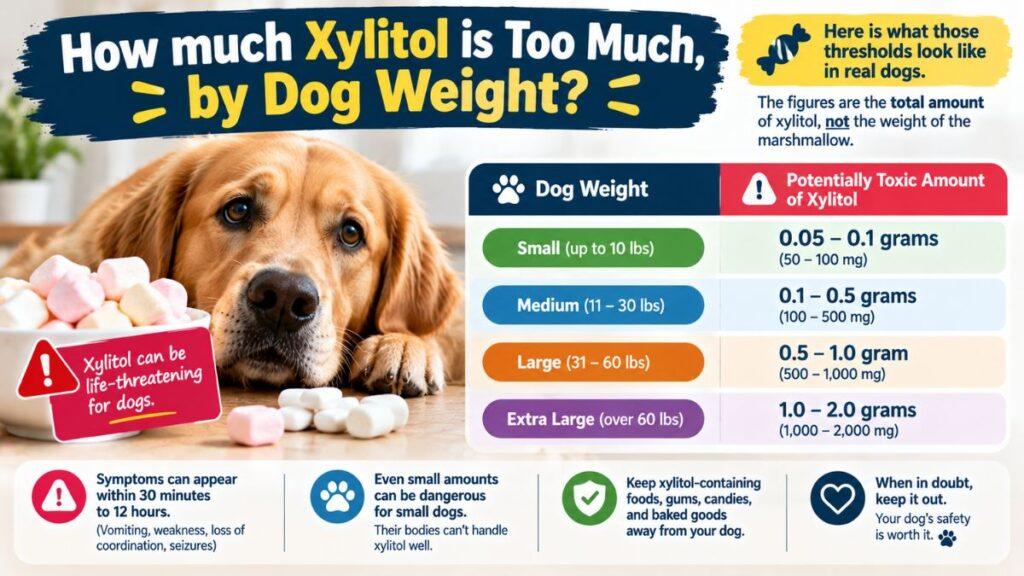
| Dog weight | Hypoglycaemia risk starts around | Liver injury risk starts around |
| 2.5 kg (5 lb) | 0.25 g | 1.25 g |
| 5 kg (11 lb) | 0.5 g | 2.5 g |
| 10 kg (22 lb) | 1 g | 5 g |
| 20 kg (44 lb) | 2 g | 10 g |
| 30 kg (66 lb) | 3 g | 15 g |
| 40 kg (88 lb) | 4 g | 20 g |
The frustrating part is that packets almost never print how many grams of xylitol sit in each piece. Sugar free sweets can run anywhere from a fraction of a gram to well over a gram per item. So a 5 kg terrier that eats three or four keto marshmallows may already be past the first threshold, and you have no way to prove otherwise from the wrapper.
This is exactly why poison control staff ask for your dog’s weight, the brand, and the number of pieces missing from the bag. Have all three ready when you call.
Can dogs have marshmallows that are sugar free?
This is the one version where the answer changes from unhealthy to dangerous. Standard supermarket marshmallows in the United States do not use xylitol. The Kraft Jet-Puffed label lists corn syrup, sugar, dextrose, modified cornstarch, water, gelatin, tetrasodium pyrophosphate, natural and artificial flavour, and Blue 1. No sugar alcohol anywhere on it.
The risk sits in a different aisle. Sugar free, keto, low carb and diabetic marshmallows are sweetened with sugar alcohols, and xylitol is one of the common choices alongside maltitol, isomalt, erythritol and lactitol. Some brands use monk fruit blended with xylitol. Mint flavoured products are worth extra suspicion, because xylitol turns up in mint items more often than in plain vanilla ones.
Two practical rules follow. Treat any packet that advertises sugar free, keto friendly or no added sugar as a possible emergency until you have read it. And remember that manufacturers reformulate, so a brand that was safe last Christmas is not automatically safe this one.
Can dogs have marshmallows made with plain sugar?
They can survive them, which is not the same as being allowed them. Ordinary marshmallows are not toxic. They are simply useless food that a dog’s gut is poorly built to handle in quantity.
A dog swallowing a slug of pure sugar pulls water into the intestine, which is why the usual result is a loose, watery stool a few hours later. Vomiting, gas and a skipped meal are common alongside it. Most cases settle on their own within a day or two.

Worth correcting a claim you will see repeated online: plain marshmallows are a fat free food, so they are not a classic pancreatitis trigger the way bacon grease or turkey skin is. Dietary indiscretion in general is a recognised risk factor, and a dog that raids a whole bag has certainly committed dietary indiscretion, but the fat driven mechanism does not apply to a plain marshmallow. It does apply to the variants covered further down, which is a distinction most articles skip entirely.
The longer term problem is quieter. Regular sugary snacks add calories with no protein, no fibre and no useful micronutrients, and that pushes a dog toward obesity, dental disease and eventually diabetes.
How many marshmallows is too many
Veterinary nutrition guidance from VCA and the American Kennel Club puts treats at no more than 10 percent of a dog’s daily calories, with the other 90 percent coming from complete, balanced food.
One large Jet-Puffed style marshmallow carries about 25 calories and a little over 4 grams of sugar, based on the package figure of 100 calories per four pieces. Minis run far lower per piece, which is precisely why dogs end up eating twenty of them.
Run the arithmetic and it gets uncomfortable fast. A 5 kg dog eating roughly 380 calories a day has about 38 calories of treat allowance, so a single large marshmallow uses up most of it and delivers nothing back. A 10 kg dog with around 600 calories a day has about 60 to spend, which two marshmallows nearly exhaust. Compare that to a few blueberries, which cost almost nothing and actually contain something.
So the honest answer to how many is too many: one is already a poor trade, and a handful is a wasted day of nutrition even when nothing goes wrong.
The timeline to watch after your dog eats marshmallows
Knowing when symptoms should appear is more useful than a list of symptoms on its own.
| Time after eating | Xylitol marshmallows | Plain sugar marshmallows |
| 10 to 60 minutes | Vomiting, weakness, wobbliness, collapse from falling blood sugar | Usually nothing |
| 1 to 6 hours | Tremors or seizures possible if untreated | Gas, restlessness, sometimes vomiting |
| 6 to 12 hours | Blood sugar may still be unstable | Loose or watery stool typical |
| 12 to 24 hours | Delayed signs possible with slowly absorbed products | Most dogs improving |
| 24 to 72 hours | Liver injury can surface: lethargy, appetite loss, yellow gums, bruising | Back to normal |
Two details in that table are easy to miss. The FDA notes xylitol effects can begin in as little as 10 minutes, and some products absorb slowly enough that signs are delayed 12 to 18 hours. And liver damage can appear days later without any earlier warning, which is why vets keep monitoring even when a dog seems fine at hour six.
Small dogs generally show signs sooner than large ones, because the same dose is far heavier relative to body weight.
The sticky texture problem
Every article mentions choking. Almost none explains why a marshmallow is different from a biscuit.
A marshmallow is a soft foam that compresses and then re-expands, and it clings. A dog that inhales one whole rather than chewing can end up with a soft plug that is hard to dislodge, and unlike a bone shard it will not break up. Flat faced breeds such as pugs, bulldogs and shih tzus already have crowded airways and are the ones most likely to run into trouble. Small dogs and fast, gulping eaters are next in line.
Roasted marshmallows deserve their own warning. Molten sugar holds heat well above the temperature the outside suggests, and a dog snatching one off a stick at a campfire can burn its lips, tongue or the roof of its mouth before anyone reacts. If you are toasting marshmallows outdoors, the dog should be somewhere else.
Marshmallow versions that are worse than plain
Plain marshmallows are the mild end of this category. These are not.
Chocolate coated marshmallows add theobromine, which is properly toxic to dogs, and dark chocolate carries several times the theobromine of milk chocolate. Treat these as a chocolate call, not a marshmallow one.
S’mores combine chocolate, sugar and a biscuit base, so you get the theobromine issue plus a large sugar and fat load in one bite.
Crisped rice marshmallow squares are usually bound with butter, which reintroduces the fat that plain marshmallows lack, and that does raise pancreatitis risk in susceptible dogs.
Marshmallow fluff and creme are semi liquid, so a dog can swallow a startling amount in seconds without any chewing to slow it down.
Hot chocolate with marshmallows floating on top stacks chocolate, dairy and sugar together, and sugar free cocoa mixes are another place xylitol shows up.
Peeps and coloured novelty marshmallows are ordinary marshmallows with more sugar coating and more dye. On dyes, the honest position is that Blue 1 in the United States and colours such as E102 and E129 in Europe have no established toxicity in dogs at these quantities and no benefit either. Strong canine research does not exist in either direction, and anyone claiming otherwise is filling a gap with unearned confidence.
Dogs that should never have even one marshmallow
Some dogs sit outside the general reassurance. A diabetic dog on a fixed insulin schedule can have its glucose control disrupted by an unplanned sugar hit. A dog with a history of pancreatitis, or on a prescription low fat diet, should not be getting stray human sweets at all. Overweight dogs have no calories to spare. Puppies have small, sensitive digestive systems and a smaller body to dilute any dose. Senior dogs with existing kidney, liver or dental disease have less margin for error.
If your dog is in any of these groups, the answer is not moderation. It is no.
Marshmallow root is a different thing entirely
Search results tangle these together, so it is worth separating them clearly.
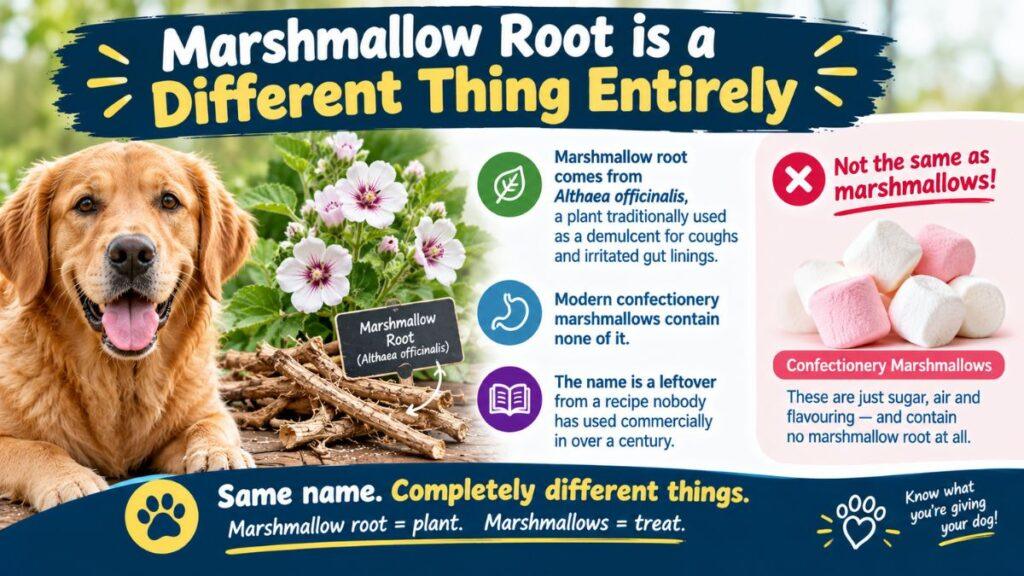
Marshmallow root comes from Althaea officinalis, a plant traditionally used as a demulcent for coughs and irritated gut linings. Modern confectionery marshmallows contain none of it. The name is a leftover from a recipe nobody has used commercially in over a century.
Giving your dog a bag of sweets in the hope of soothing a cough achieves nothing except a sugar load. If you want to try marshmallow root as a supplement, that is a conversation with your vet about a specific product and dose, and it has nothing to do with the packet in your kitchen cupboard.
What treatment actually looks like
If you end up at a clinic for xylitol ingestion, here is roughly what happens. The vet will want your dog’s weight, the product, and an estimate of the amount eaten. If the ingestion was recent and your dog is stable, they may induce vomiting in the clinic where they can control it. Activated charcoal is often skipped for xylitol because it binds the compound poorly.
From there the work is monitoring. Blood glucose is checked repeatedly and intravenous dextrose is given if it drops. Liver enzymes are measured at intake and rechecked over the following days, because hepatic injury can appear late. Dogs with liver involvement may receive protectants such as N-acetylcysteine or SAMe.
Mild cases often mean a day of observation. Serious ones mean several days in hospital. Merck notes that the outlook for uncomplicated hypoglycaemia caught early is good, while severe liver enzyme elevation with jaundice and clotting problems carries a guarded to poor prognosis.
What to give instead of marshmallows
Dogs that beg for marshmallows are chasing sweetness and your attention, not the texture. Blueberries, seedless watermelon without the rind, a slice of banana, a thin apple wedge without seeds, or a strip of carrot all deliver sweetness with something useful attached. Strawberries work too, in small amounts. Whatever you pick still counts against the 10 percent allowance.
Keeping marshmallows out of reach
Marshmallow bags are light, resealable and usually left on a counter, which is the storage habit behind most of these calls. Move them to a closed cupboard or a sealed container, and pay extra attention around camping trips and holiday baking, when bags sit open for hours. If there are children in the house, make the rule explicit rather than assumed. A child handing the dog a marshmallow under the table is the most common route to a bag going missing.
Frequently asked questions about dogs and marshmallows
Can dogs have marshmallows in small amounts?
A plain, xylitol free one will not usually harm a healthy adult dog, but it offers nothing worth the calories.
Are marshmallows toxic to dogs?
Only if they contain xylitol or birch sugar. Plain sugar versions are unhealthy rather than poisonous.
Can dogs have marshmallows that are mini sized?
No. Size changes the sugar per piece, not the xylitol risk, and dogs eat far more minis at once.
Can dogs have marshmallows from the Jet-Puffed range?
They contain no xylitol, so they are not an emergency, but they are still pure sugar.
My dog ate a whole bag, what now?
Call your vet or a poison line, especially if you cannot confirm the product was xylitol free.
Can puppies have marshmallows?
No. Smaller bodies, more sensitive digestion, and a higher choking risk.
Are marshmallows bad for a dog’s teeth?
Yes. Sticky sugar clings to the gum line and feeds plaque.
Can dogs have marshmallows for a cough?
No. Marshmallow root is a separate herbal product, not a sweet, and should be discussed with your vet.
Can dogs have marshmallows that have been roasted?
No. Hot melted sugar can burn the mouth on top of everything else.
The bottom line
So, can dogs have marshmallows? Only in the narrow sense that a plain one will not usually hurt them. Plain marshmallows are empty calories that will cost your dog an upset stomach and nothing more. Sugar free ones can put a small dog in hospital by evening.
The habit worth building is not avoiding marshmallows specifically. It is reading the ingredient list of any sweet before it reaches a dog, and knowing that xylitol and birch sugar are the two words that turn a shrug into a phone call. Save a poison control number in your phone now rather than hunting for one at midnight, and keep the bag so you can read the label to whoever answers.
For everything else, a handful of blueberries does the same job and costs you nothing to worry about afterwards.
This article is general information and is not a substitute for veterinary advice. If you are worried about your dog right now, contact your vet or an animal poison control service.