

Can dogs eat pecans? No. Dogs should not eat pecans, and there is no serving size that counts as a treat. That said, most dogs who swallow one plain pecan kernel off the kitchen floor will be fine. The dangerous versions are moldy pecans picked up under a tree, whole nuts still in the shell, pecans eaten by the handful, and anything baked into a pie.
There are seven separate risks behind that answer: juglone, tremorgenic mold toxins, aflatoxin, the fat load that causes pancreatitis, choking, intestinal blockage, and the extra ingredients baked in alongside the nuts. Each one is covered below.
The gap between “one nut, probably fine” and “this is an emergency” is where most owners get stuck, so this guide covers both: what to do in the next ten minutes, how much is too much for your dog’s size, and why vets openly disagree about whether pecans are toxic at all.
What to do right now if your dog ate a pecan
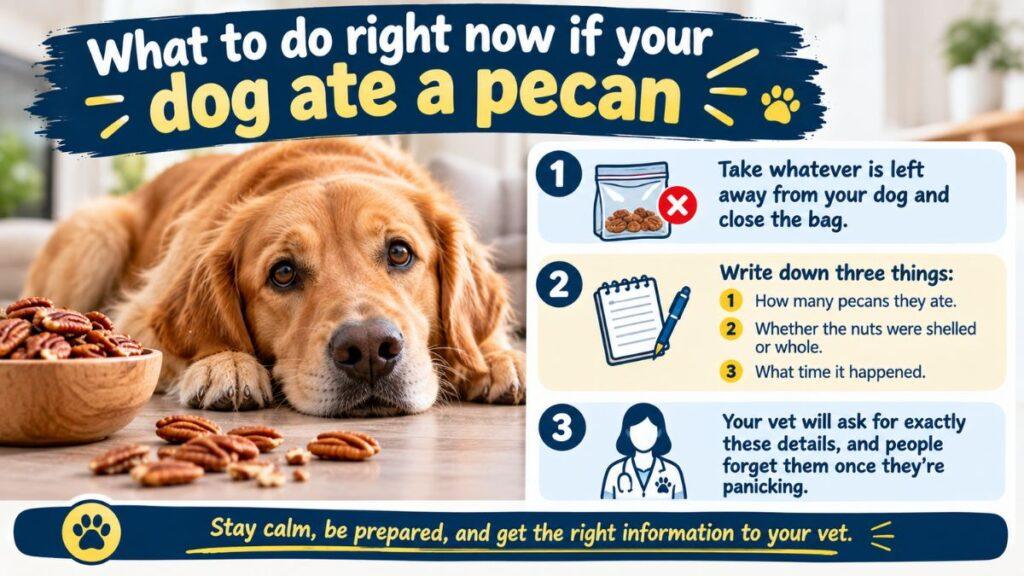
Start by taking whatever is left away from your dog and closing the bag. Then write down three things: how many pecans they ate, whether the nuts were shelled or whole, and what time it happened. Your vet will ask for exactly these details, and people forget them once they are panicking.
Do not make your dog vomit at home. Hydrogen peroxide dosing goes wrong often, it can burn the stomach lining, and vomiting is the wrong move if the dog is already unsteady or has swallowed a sharp shell. Pet Poison Helpline gives the same warning on its emergency page.
Call someone if the amount was more than a nut or two, if the pecans came from the ground or from an old bag, if your dog weighs under 20 pounds, or if any symptom has already started. Your regular vet is the cheapest first call because they know your dog’s history. Outside office hours, Pet Poison Helpline is 855-764-7661 and charges $89 per incident with follow-ups included. ASPCA Animal Poison Control is 888-426-4435 and charges $95. Both are staffed by veterinary toxicologists around the clock, and both will tell you plainly whether you can watch at home.
Skip the phone call entirely and drive to an emergency clinic if your dog is shaking, wobbling on their feet, drooling heavily, retching without producing anything, or has a hard and painful belly.
Can dogs eat pecans in small amounts?
No, but size changes what happens next. There is no officially established toxic dose of pecans in dogs. What vets actually work from is body weight against fat load and obstruction risk, which is why a Great Dane and a Chihuahua get very different advice for the same nut.
A rough working threshold used across pet safety guidance is one plain, fresh, shelled pecan half per 10 pounds of body weight as the upper limit for watching at home. Use it as a phone-call trigger, not permission.
| Dog weight | Roughly fine to monitor at home | Call a vet |
| Under 10 lb (Chihuahua, Yorkie) | A single small piece | 1 whole pecan or more |
| 10 to 25 lb (Beagle, Frenchie) | 1 to 2 shelled halves | 3 or more, or any shell |
| 25 to 50 lb (Border Collie) | 2 to 4 shelled halves | 5 or more, or any shell |
| Over 50 lb (Lab, Shepherd) | A small handful | 10 or more, or any shell |
Three things override this table completely. Any pecan that was moldy, fallen, or old goes straight to a phone call regardless of size. Any nut still in the shell is an obstruction question, not a toxicity question. Any dog with a history of pancreatitis needs a call after even a small amount.
Can dogs eat pecans safely, or are they toxic?
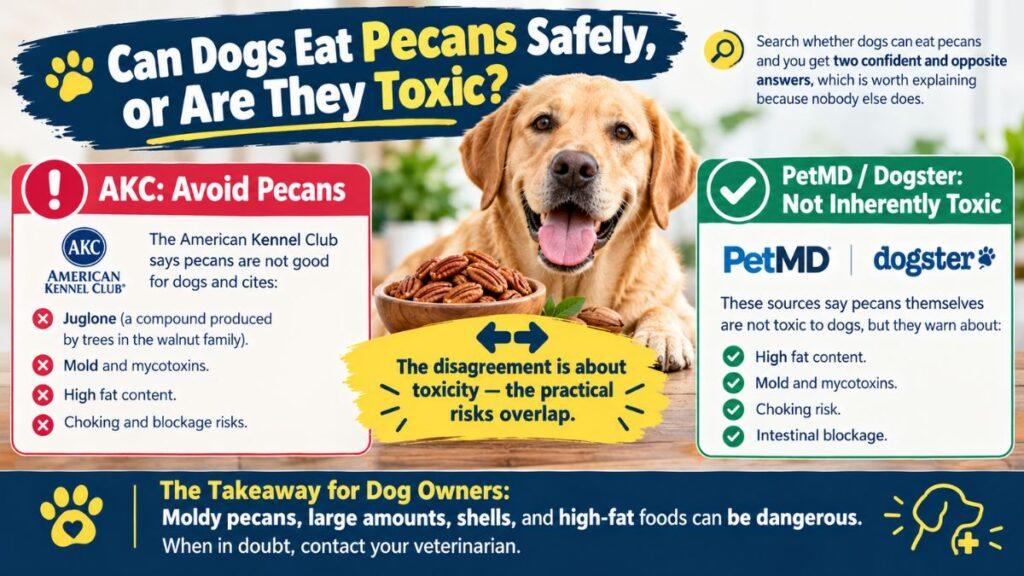
Search whether dogs can eat pecans and you get two confident and opposite answers, which is worth explaining because nobody else does.
One group of sources, including the American Kennel Club, says pecans are toxic because they contain juglone, a compound produced by trees in the walnut family. Another group, including PetMD and vet-reviewed articles at Dogster and Parade, says pecans are not toxic at all and that the real problems are mold, fat, and blockages.
Both are reading the same chemistry and emphasising different parts of it. Juglone is real and pecan trees produce it. The concentration is what matters: juglone sits in considerable amounts in the green parts of the tree and in the unripe hulls, while levels in the kernel itself are very low or absent. The black walnut, which carries far more of it, is the nut with a documented toxicity record in dogs. Our guide on whether dogs can eat walnuts covers that difference in detail.
The practical version is this. A pecan kernel from a sealed bag is not a poison in the way a macadamia nut or a grape is a poison. A pecan that fell off a tree, still wrapped in its hull, sitting in damp grass for two weeks, is a completely different object. Your dog does not know the difference, and neither does a label on a blog post.
Mold is the danger most owners never think about
Pecans grow mold easily, and the mold is the reason vets take fallen nuts seriously. Two separate toxins can come from it, and they behave nothing alike.
Tremorgenic mycotoxins, mainly penitrem A, come from Penicillium molds that grow readily on nuts, bread, cheese, and compost. The Merck Veterinary Manual lists the signs in dogs as vomiting, tremors, hypersensitivity to sound and touch, loss of coordination, rapid heart rate, and seizures. Onset is fast, often within 30 minutes and usually inside three hours. Most dogs recover within 24 to 48 hours with treatment, though severe cases can take far longer. Cases have been documented from something as small as a single slice of moldy bread, which tells you the quantity of nut needed is not large.
Aflatoxins are produced by Aspergillus molds and attack the liver instead of the nervous system. They are metabolised in the liver and cause cell death, so the signs look like appetite loss, vomiting, lethargy, dark stools, and jaundice, and they develop over days rather than minutes.
Mold is also why the answer to can dogs eat pecans from the yard is a firm no. The part that catches people out: aflatoxin can be present in pecans that look and smell perfectly normal. Visible fuzz or a musty, rancid smell means throw them out, but the absence of those signs is not a clearance. This is the single strongest argument for keeping your dog away from a pecan tree in autumn.
Fat, pancreatitis, and which dogs are most at risk
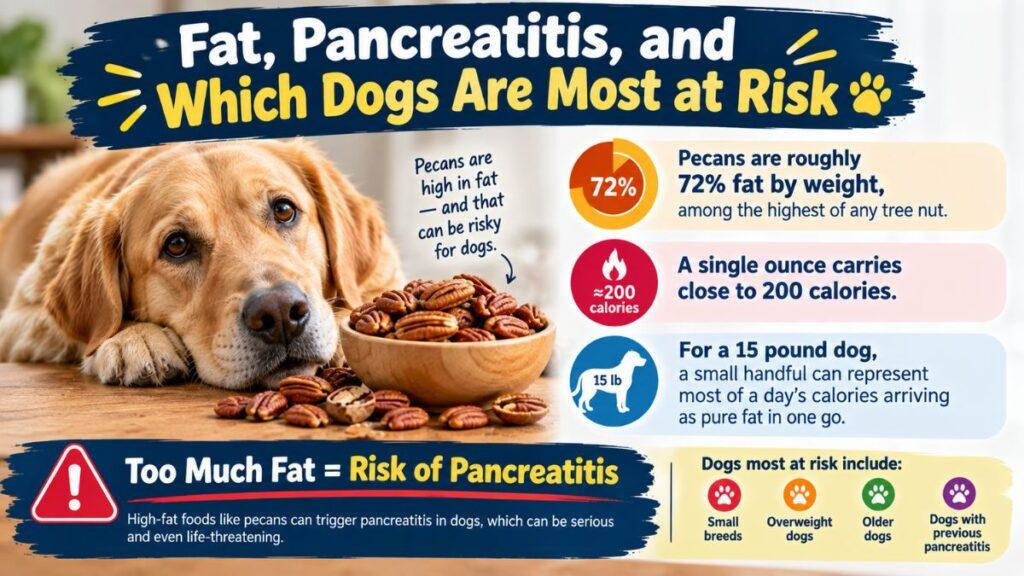
Pecans are roughly 72 percent fat by weight, among the highest of any tree nut, and a single ounce carries close to 200 calories. For a 15 pound dog, a small handful can represent most of a day’s calories arriving as pure fat in one go.
Fat is the reason most vets answer no when asked whether dogs can eat pecans as a regular treat. The immediate result is usually vomiting, loose stool, or gas. The one that lands dogs in hospital is pancreatitis, an inflammation of the pancreas triggered by a sudden high fat load. It looks like repeated vomiting, refusing food, lethargy, belly pain, and a hunched posture or the front end down with the rear up. Our article on pancreatitis symptoms in dogs walks through what that looks like hour by hour.
Pancreatitis does not arrive on the same clock as everything else. Signs commonly show up 12 to 72 hours after the meal, so a dog who seemed fine on the evening they raided the nut bowl can be genuinely unwell two days later. Keep watching past the first night.
Some dogs carry much more risk. Miniature Schnauzers, Yorkshire Terriers, and Cocker Spaniels are overrepresented in pancreatitis cases, and any dog who has had it once is more likely to have it again. Overweight dogs, seniors, and dogs on low fat prescription diets also belong in the call-the-vet column after even a modest amount.
Shells, choking, and blockage
The shell is a separate problem from anything the kernel contains, and small dogs are the ones at risk.
A whole pecan in the shell is hard, oval, and roughly the width of a small dog’s airway, so dogs who inhale food rather than chew it can lodge one in the throat. Shell fragments are sharp and can scratch the lining of the throat, stomach, or intestine on the way through. Several nuts eaten at once, shells included, can form a blockage. Watch for repeated vomiting especially after drinking, no stool at all, a painful or swollen abdomen, restlessness, and refusing food. Obstruction is surgical territory and does not resolve on its own, so any suspicion of it means the clinic rather than wait and see.
Can dogs eat pecan pie?
No, and pecan pie is genuinely more dangerous than the nuts by themselves. The nuts are only one of the problems in the dish.
The filling is corn syrup, sugar, butter, and eggs, so the fat and sugar load is far higher than the same weight of plain pecans, which pushes the pancreatitis risk up sharply.
Then there are the variants. Chocolate pecan pie adds theobromine, which dogs cannot clear the way people do. Pies with raisins add a fruit linked to acute kidney failure at unpredictable doses. Some recipes use nutmeg or a little bourbon.
The one that should worry you most is the sugar-free pie. Xylitol, used in sugar-free baking, causes a rapid crash in blood sugar in dogs and can cause liver failure. It is far more dangerous than anything in a pecan, and it is invisible in a baked pie. If your dog ate a pie and you cannot confirm what was in it, treat it as an emergency and call poison control straight away.
If your dog ate a whole pie, which happens more often than you would expect around the holidays, do not wait for symptoms. Call immediately, because treatment works best before signs appear.
Can dogs eat pecan butter, candied pecans, or other forms?
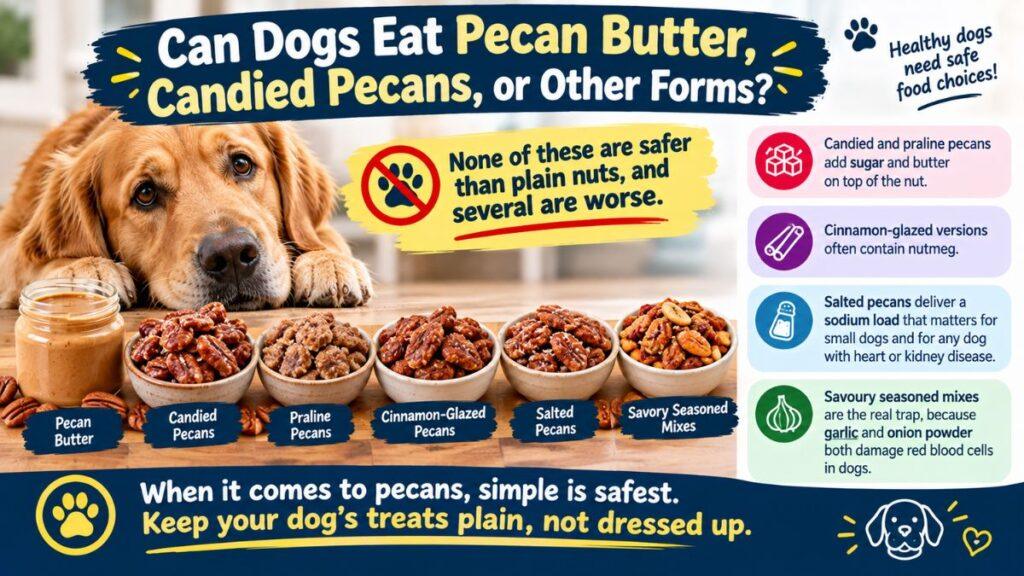
None of these are safer than plain nuts, and several are worse.
Candied and praline pecans add sugar and butter on top of the nut, and cinnamon-glazed versions often contain nutmeg. Salted pecans deliver a sodium load that matters for small dogs and for any dog with heart or kidney disease. Savoury seasoned mixes are the real trap, because garlic and onion powder both damage red blood cells in dogs.
Pecan butter and pecan milk remove the choking risk but concentrate the fat, so the pancreatitis problem is untouched. Trail mix combines pecans with raisins and chocolate, which is worse than any of its parts. If you want your dog to have a nut, plain unsalted peanuts or peanut butter without xylitol are the safer options, in small amounts.
Symptoms and when they appear
If your dog already ate some, the question shifts from can dogs eat pecans to what happens next. Timing tells you almost as much as the symptom itself, and knowing the pattern stops you relaxing too early.
In the first 30 minutes to 3 hours, tremors, drooling, wobbling, sensitivity to noise, or seizures point to mold toxins and mean an emergency clinic immediately.
Within 2 to 12 hours, vomiting, diarrhoea, gas, and a rumbling stomach are the common picture and usually mean simple digestive upset from the fat. Persistent vomiting or blood changes that assessment.
From 12 to 72 hours, repeated vomiting, refusing food, lethargy, belly pain, or a hunched posture suggest pancreatitis. Over a similar few days, yellowing of the gums or eyes and dark stools point at liver involvement from aflatoxin.
At any point, gagging, difficulty breathing, straining with no stool, or a hard abdomen suggests choking or obstruction.
What your vet will do
Knowing the likely plan makes the decision to go easier.
If the ingestion was recent, usually within about two hours, the vet may induce vomiting safely in the clinic and follow with activated charcoal. They will feel the abdomen and take x-rays if a shell or blockage is suspected. For a dog showing tremors, treatment is decontamination plus muscle relaxants or anticonvulsants, fluids, and monitoring. There is no antidote for penitrem A, so the care is supportive, and most dogs recover. Where pancreatitis is suspected, expect bloodwork including pancreatic lipase, fluids, anti-nausea medication, pain relief, and often a night or two in hospital.
Cost is part of the decision. An emergency exam typically starts around $150 to $400, and hospitalisation for a moderate poisoning case often runs $1,000 to $3,000, which is why a phone consultation under $100 is worth making early.
Safer treats to reach for instead
Plain baby carrots, apple slices without the seeds, green beans, blueberries, and cooked pumpkin give you the crunch or sweetness without the fat, and air-popped popcorn works for dogs who want something to chew. Keep all treats to roughly 10 percent or less of your dog’s daily calories.
Keeping pecans out of reach
Once you have decided that dogs cannot eat pecans, prevention is mostly about storage and the yard. If you have a pecan tree, the yard is the real risk, not the kitchen. Sweep fallen nuts before letting your dog out during the season, or supervise and teach a reliable leave it. Fallen nuts are both the moldiest and the highest in juglone.
Indoors, store pecans in a closed container above counter height rather than in a bowl on the table, and keep baking ingredients off low surfaces. Tell guests not to hand nuts to the dog, which is where most holiday incidents begin, and empty shells straight into an outside bin.
Can dogs eat pecans: common questions answered
My dog ate one pecan, will he be okay?
Most likely yes if it was a plain shelled kernel and your dog is medium or large, but watch for vomiting and diarrhoea over the next day.
Are pecans poisonous to dogs?
Not in the way grapes or macadamia nuts are, but moldy pecans genuinely are dangerous.
Can puppies eat pecans?
No, and puppies are at higher risk because of their size and their habit of swallowing things whole.
How long after eating a pecan will a dog get sick?
Mold-related signs start within 30 minutes to 3 hours, digestive upset within 2 to 12 hours, and pancreatitis at 12 to 72 hours.
Can dogs eat pecan shells?
No, shells are a choking and obstruction risk and can cut the digestive tract.
Is pecan pie safe for dogs?
No, the sugar, butter, and possible chocolate, raisins, or xylitol make it more dangerous than plain nuts.
Should I make my dog vomit at home?
No, call your vet or a poison helpline first.
Can dogs eat pecan butter?
No, it carries the same fat load as the nuts without the choking risk.
Can dogs eat pecans that fell from a tree?
No, fallen nuts carry the highest mold and juglone risk of any form.
Can dogs eat pecans in ice cream or cookies?
No, butter pecan ice cream and pecan cookies add dairy, sugar, and butter to an already high fat nut.
The short answer on whether dogs can eat pecans
Pecans sit in an awkward middle ground, which is why the advice online looks so contradictory. They are not an emergency poison, and a large dog who steals one kernel off the floor is almost always fine. They are also not a treat, because what makes them appealing to people works against dogs: the fat that causes pancreatitis, the shell that blocks intestines, and the mold that grows long before anything looks wrong.
The practical rule is simple enough to remember at Thanksgiving. Fresh, shelled, one or two nuts, medium or large dog, no symptoms means watch at home. Fallen or moldy nuts, shells, small dogs, large amounts, or anything baked into a pie means make the call. Note the time and the amount while you still remember them.
When you are unsure, a phone call to a vet or to poison control costs less than $100 and settles it in ten minutes, which beats guessing at two in the morning.