

Can dogs eat sardines? Yes, and plain ones packed in water are one of the few human foods that are actually good for them. The fish is small, low in mercury, and loaded with omega-3s. The part that trips people up is the tin, not the fish. Sardines in oil, brine, tomato sauce, mustard, or hot sauce bring problems the fish itself does not have.
Here are the seven rules, before the detail:
Buy sardines packed in water, ideally with no salt added, and drain them.
Feed about one small sardine per 20 pounds of body weight.
Keep it to one to three times a week, not daily.
The soft bones in canned sardines are safe. Bones in fresh or raw sardines are not.
Swap out a spoonful of kibble instead of adding the fish on top.
Skip sardines if your dog has had pancreatitis, is overweight, or is on a prescription kidney or low fat diet.
If your dog ate the wrong tin, the ingredient to worry about is onion or garlic powder, not the fish.
Are sardines good for dogs
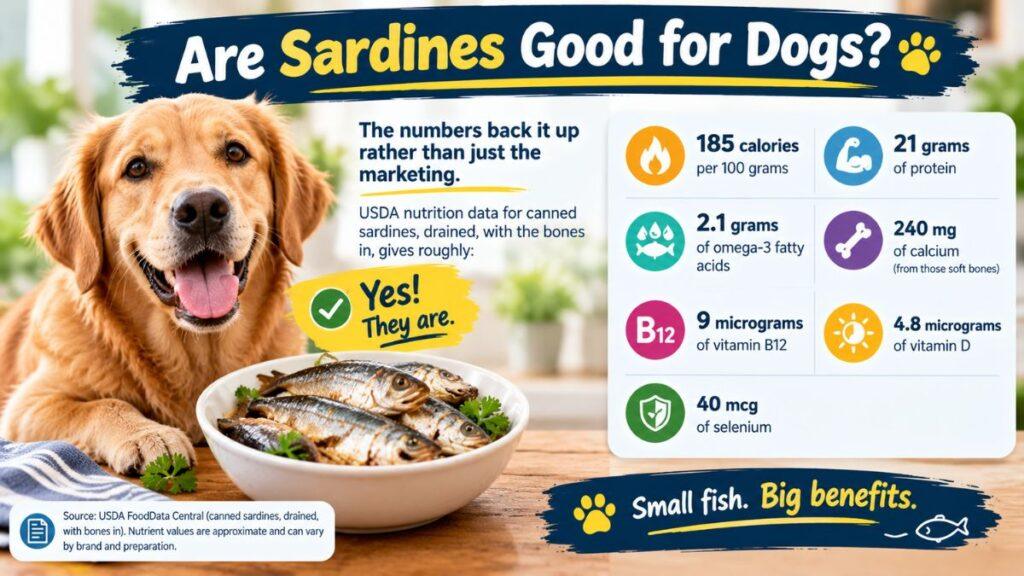
They are, and the numbers back it up rather than just the marketing. USDA nutrition data for canned sardines, drained, with the bones in, gives roughly 185 calories per 100 grams, about 21 grams of protein, and 2.1 grams of omega-3 fatty acids. The same 100 grams carries 240 mg of calcium from those soft bones, 9 micrograms of vitamin B12, 4.8 micrograms of vitamin D, and 40 mcg of selenium.
The omega-3s are the real reason vets keep recommending them. EPA and DHA are anti-inflammatory, and dogs cannot make them efficiently on their own. That is why omega-3s show up in joint supplements, skin and coat formulas, and therapeutic diets for itchy dogs. A sardine is just a cheaper delivery system for the same fatty acids.
Mercury is the other reason sardines get singled out. Mercury builds up as it moves up the food chain, so a long lived predator like swordfish or albacore tuna carries far more of it than a small plankton eating fish that lives two or three years. Sardines sit near the bottom of that chain, which is why a dog can eat them weekly and tuna only rarely.
One honest caveat that most articles skip: if your dog already eats a complete and balanced commercial food, they are not deficient in anything sardines provide. You are adding a topper your dog enjoys, not correcting a nutritional gap.
Can dogs eat canned sardines
Canned is the format most owners mean when they ask can dogs eat sardines, and it is the easiest one to get right. The fish comes already cooked, the bones are soft, and there is no prep beyond opening the tin.
The brand tells you almost nothing. King Oscar, Season, Wild Planet, and Bumble Bee all sell several versions of the same fish, and some of those versions are fine while others are not. The line you need to read is the packing liquid, usually printed under the brand name on the front.
| Type of tin | Safe for dogs? | Why |
| In water, no salt added | Best choice | Nothing added but fish |
| In water, with sea salt | Fine occasionally | Drain well, watch sodium |
| In olive or sunflower oil | Not ideal | Doubles the fat and calories |
| In brine | Avoid | Very high sodium |
| In tomato sauce | Avoid | Often has onion or garlic powder |
| In mustard, chilli, or hot sauce | Avoid | Spices and seasonings |
| Smoked or kippered | Avoid | Heavy salt and smoke curing |
After the packing liquid, read the ingredient list itself. You are looking for two words: onion and garlic. Both appear as powders in sauced and flavoured varieties, and both damage red blood cells in dogs. Everything else on a plain tin is usually just fish, water, and salt.
How many sardines can dogs eat
This is where most sites hand you a vague answer, so here is the actual arithmetic. Treats and toppers should stay under 10 percent of your dog’s daily calories. One average canned sardine weighs around 25 grams, which works out to roughly 45 calories.
| Dog’s weight | Approx daily calories | 10% treat budget | Sardines per serving |
| 10 lb | 350 | 35 cal | Half a sardine |
| 20 lb | 590 | 59 cal | 1 sardine |
| 30 lb | 790 | 79 cal | 1 to 2 sardines |
| 50 lb | 1,165 | 117 cal | 2 sardines |
| 70 lb | 1,500 | 150 cal | 3 sardines |
| 90 lb | 1,810 | 181 cal | 3 to 4 sardines |
Those daily calorie figures are estimates for a typical neutered adult dog at normal activity. A working border collie needs far more, a senior pug lying on the sofa needs less, so treat the table as a starting point rather than a prescription.
Two practical notes. First, the treat budget covers everything, not just fish. If your dog already gets two dental chews a day, the sardines have to fit into what is left. Second, if you are adding sardines as a topper on a full bowl of kibble, take a spoonful of kibble out. Otherwise you are adding calories rather than swapping them.
How often can dogs eat sardines
One to three times a week suits most healthy adult dogs. Daily is possible for a large dog on a small portion, but there is no benefit to it and two real drawbacks.
The first is fat. Sardines are roughly 10 percent fat by weight, and a steady daily hit of rich, oily food is exactly the pattern that precedes pancreatitis in susceptible dogs. The second is variety. A diet leaning heavily on fish can, over months, contribute to thiamine issues and pushes up phosphorus intake, which matters more than people realise for older dogs.
Weekly is the sweet spot. Many owners feed sardines every Sunday and treat it as a fixed routine, which also makes the calorie maths easier to remember.
Can dogs eat sardine bones
Canned sardine bones are safe. The canning process cooks the fish under high pressure long enough that the spine turns soft and crumbly, and those bones are a genuine calcium source. You do not need to pick them out.
Fresh and raw sardine bones are a different situation. They stay firm, they can splinter, and in a small dog they are a choking risk. If you buy fresh sardines, either fillet them or cook them thoroughly until the bones soften before serving.
Can dogs eat sardines in olive oil
They can, but it is not the tin to buy. Olive oil is not toxic to dogs, so a sardine that arrived in it will not poison anyone. The problem is arithmetic again. A fish that has 45 calories in water can land closer to 90 once it has been sitting in oil, and the fat content roughly doubles. Our guide to whether dogs can have olive oil covers the fat question in more detail.
If the oil packed tin is the only one in the cupboard, drain it properly and then rinse the fish under warm water for a few seconds. That removes most of the surface oil. Do not pour the leftover oil over the kibble, which is advice that circulates on raw feeding forums and is a reliable way to give a small dog diarrhoea.
Can dogs eat sardines in tomato sauce
Better not. This is the most searched version of the question, usually by someone who has already opened the tin and is now reading the label with a slightly sinking feeling.
The tomato itself is not the issue, and plain tomato is safe for dogs in small amounts. The issue is what commercial tomato sauce contains besides tomatoes. Most recipes include onion powder, garlic powder, salt, sugar, and assorted spices. Onions and garlic both contain thiosulfates, which damage canine red blood cells and can cause haemolytic anaemia.
That said, proportion matters. A 3.75 oz tin holds a small amount of sauce, and the amount of onion powder in it is usually tiny. A 60 pound labrador who licked out one tin is very unlikely to be in danger. A 6 pound chihuahua who ate the same tin deserves a phone call to the vet. Scroll down to the emergency section for what to actually watch for.
Can dogs eat sardines in brine, mustard, or hot sauce
No to all three. Brine is salt water, and a brined tin pushes the sodium load well past what a small dog needs in a day. Mustard contains seeds that irritate the canine stomach, and hot sauce adds capsaicin, which causes drooling, mouth pain, and vomiting.
None of these will usually harm a healthy dog who stole one tin, but none of them belong in a bowl on purpose. If the only tins in your cupboard are flavoured, wait until you can buy plain ones rather than rinsing and hoping.
Can dogs eat raw or fresh sardines
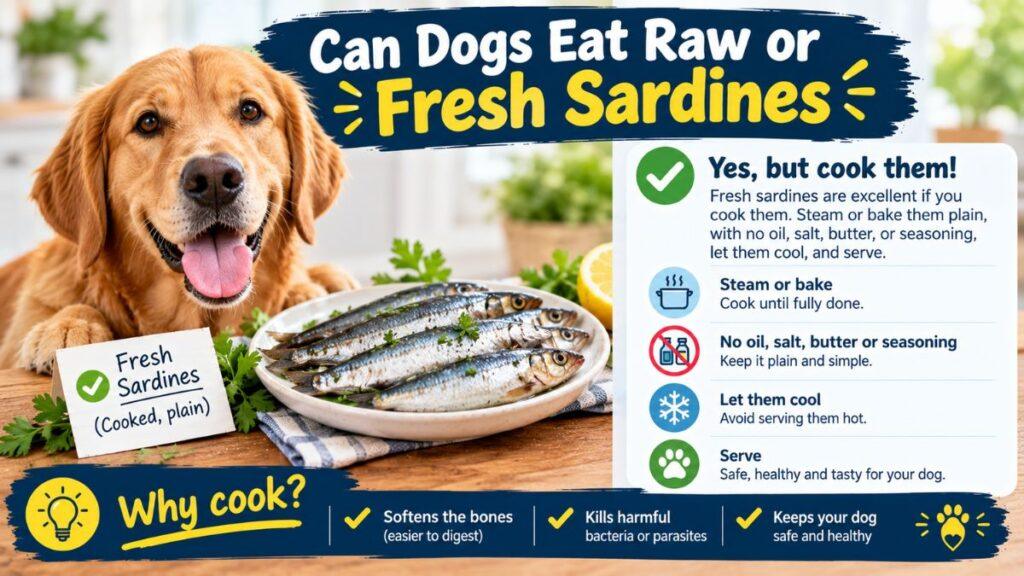
Fresh sardines are excellent if you cook them. Steam or bake them plain, with no oil, salt, butter, or seasoning, let them cool, and serve. Cooking softens the bones and kills anything unwelcome.
Raw sardines carry two risks that canned ones do not. Raw fish can host parasites, which is why raw feeders freeze fish at around minus 20 degrees Celsius for several weeks before serving. Raw fish also contains thiaminase, an enzyme that breaks down vitamin B1. A dog eating raw fish occasionally will be fine, but a dog eating a lot of raw fish over months can develop thiamine deficiency, which shows up as neurological signs including a blank upward stare and, in bad cases, seizures. Canning and cooking both destroy the enzyme, which is why this is a raw feeding concern rather than a canned sardine one.
Can puppies eat sardines
Yes, in very small amounts, and the DHA in sardines genuinely supports brain and eye development in growing puppies. Mash a small piece of a water packed sardine into their food and keep it well under that 10 percent rule, which for an 8 pound puppy means a quarter of a fish at most.
Introduce it once and then wait two days before offering it again. Puppy digestive systems are easily upset, and if something disagrees with them you want to know which food caused it.
Dogs that should not eat sardines
Can dogs eat sardines if they already have a health condition? Some can, and some should skip the fish entirely. This list is longer than most articles admit.
Dogs with a history of pancreatitis should not have them. Sardines are a high fat food, and a single fatty meal is a recognised trigger for a repeat episode. Overweight dogs on a weight loss plan are in a similar position, since 45 calories matters a great deal when the daily budget has already been cut.
Dogs with kidney disease need care too. Canned sardines carry around 366 mg of phosphorus per 100 grams, and restricting phosphorus is a central part of managing chronic kidney disease. This point is missing from nearly every sardine article online, and it is the one worth raising with your vet.
Dogs with heart disease on a sodium restricted diet should avoid salted or brined versions. Canned sardines run about 414 mg of sodium per 100 grams, so roughly 100 mg per fish.
Finally, if your dog is already taking a fish oil or omega-3 supplement, count the sardines as part of that dose rather than on top of it. Very high omega-3 intake over time can affect platelet function and deplete vitamin E.
How to serve sardines to your dog
The simplest method is also the best. Drain the tin, mash one fish with a fork, stir it through the usual meal, and take out an equivalent spoonful of kibble.
Two other approaches worth knowing. Mash a sardine with a little plain water, spoon it into a silicone mould, and freeze it for a hot weather treat that takes a dog ten minutes to work through. Or smear a small amount inside a rubber toy and freeze that instead, which is a useful trick for dogs who need distracting during nail trims.
Leftovers do not belong in the open tin. Move them into a sealed container in the fridge and use them within two days. The smell will announce itself either way.
What to do if your dog ate too many sardines
Start with what type. If your dog ate plain water packed sardines, even a whole tin, you are most likely looking at a rich meal rather than a poison. Expect loose stools, possibly vomiting, and a dog who smells like a harbour for a day. Withhold the next meal, keep water available, and see how they are in the morning.
If the tin had tomato sauce, brine, mustard, or spices, check the ingredient list for onion or garlic and note your dog’s weight and roughly how much they ate. Then watch the clock. In the first six hours the likely signs are vomiting, diarrhoea, drooling, and abdominal discomfort from the salt and the fat. Between twelve and twenty four hours is when onion or garlic toxicity would begin to show, and the signs there are lethargy, weakness, pale gums, and dark or reddish urine.
Call your vet straight away if you see pale gums, ongoing vomiting, a hunched posture with a painful belly, or a dog who will not get up. A painful, hunched abdomen after a fatty meal can mean pancreatitis, which needs treatment rather than waiting.
In the US you can also call the ASPCA Animal Poison Control Center on (888) 426-4435, which operates 24 hours a day. A consultation fee applies, and it is worth it if you cannot reach your own vet.
Sardines compared with other omega-3 options
Sardines are the best value option, but they are not the only one. Anchovies are nutritionally similar and just as low in mercury, though the canned ones are usually salt cured and far too salty. Mackerel works well if you buy the small Atlantic variety in water. Salmon is excellent cooked but must never be fed raw in the Pacific Northwest, where it can carry a fluke that causes salmon poisoning disease. Tuna is the one to limit, for the mercury reasons covered in our guide to whether dogs can eat tuna.
Freeze dried whole sardine treats are the convenient version. They cost more per gram than a tin, but they do not smell, they store easily, and the portions are consistent. For dogs who need a strictly controlled fat intake, a measured fish oil supplement gives you the omega-3s without the calories of the whole fish.
Can dogs eat sardines: frequently asked questions
Can dogs eat sardines every day?
Not recommended, since the fat and phosphorus add up. One to three times a week is safer.
Can dogs eat sardines in spring water?
Yes, spring water is just water, so these are the tins to buy.
Can dogs eat sardines with the bones in them?
Yes, canned sardine bones are soft enough to eat and provide calcium.
Can dogs eat sardines in sunflower oil?
Drain and rinse them first, since the oil roughly doubles the fat content.
Can dogs eat sardines if they have skin allergies?
Often yes, and the omega-3s can reduce inflammation, though results take several weeks and severe itching needs a vet.
Can dogs eat sardines from a pouch instead of a tin?
Yes, as long as the pouch is water packed with no sauce or seasoning.
Can dogs eat sardines alongside their normal kibble?
Yes, that is the usual way to serve them, but remove a spoonful of kibble to keep the calories level.
Can dogs eat sardine heads and tails?
Yes, in canned sardines the whole fish is soft and edible.
Can diabetic dogs eat sardines?
Usually yes in small portions, since sardines contain almost no carbohydrate, but confirm with your vet first.
Will sardines make my dog smell?
A little. Fishy breath for a few hours is normal and harmless.
The bottom line
So, can dogs eat sardines? Yes, and it is one of the easiest yes answers in dog nutrition, provided you buy the right tin. Water packed, no added salt, drained, and portioned to your dog’s weight. That is the whole system, and it takes ten seconds in the supermarket aisle to get right.
The mistakes people make are predictable. They buy whatever tin was on offer without reading the packing liquid, they pour the oil over the food, or they add sardines on top of a full bowl and wonder why the dog gained weight. None of those are hard to avoid once you know to look.
If your dog has pancreatitis in their history, carries extra weight, or has kidney or heart disease, ask your vet before starting rather than after. For everyone else, one small fish per 20 pounds of body weight, once or twice a week, is a genuinely good addition to the bowl and one that most dogs will hear you opening from three rooms away.
1 thought on “Can dogs eat sardines? 7 proven safety rules, exact portions, and the tins to avoid”